§ 1. The flux is wet … and lit
1.
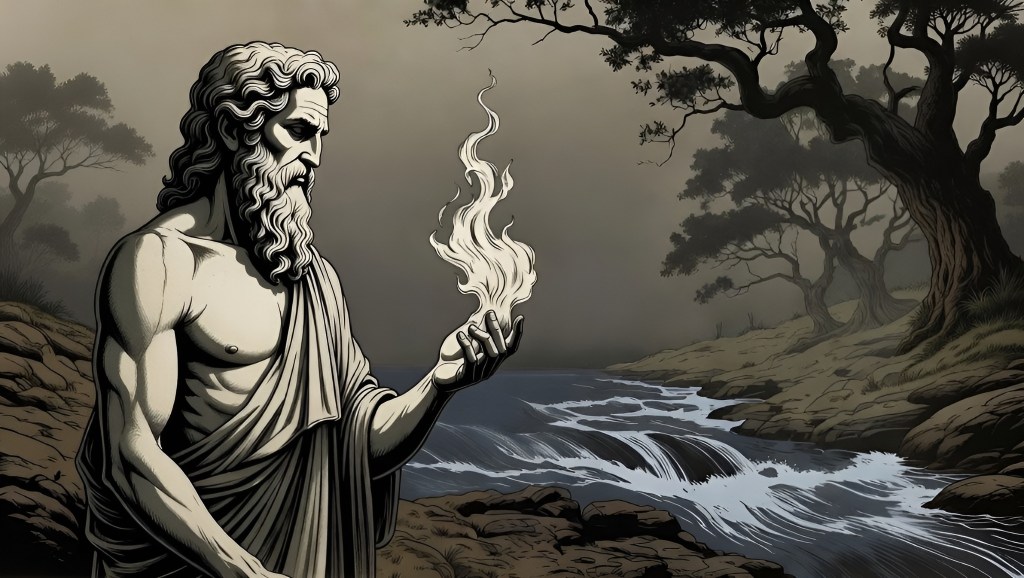
Water ↔ fire. Lethe’s dark currents nourish aletheia’s blaze; cetanā secretes the void that flickers phenomena into being. In this concealing ↔ revealing polarity, the universe perceives its self-surpassing—pleasure as the vedanā of higher coherence after a scattering, the surge of will to power. All must dissolve. The flame re-members.
2.
Heraclitus saw reality as a river you can’t step in twice — our cosmic watercourse fed by two hidden springs that only appear separate when the mind carves them apart.
The first is lethe: the primordial concealment that damps the infinite waveform into apparent solidity. Lethe is the concealing force that both creates the dense nodal layer (birthing rūpa as earth-like grounding) and eventually releases it through dissolution when the system is ready for the next upward turn, bookending paṭiccasamuppāda. Without the earth phase, nothing would ground greater coherence. Without the water phase, nothing could evolve.
The second, superimposed on physis, is citta — the mind’s unseen fountainhead that includes the volitional frequency band allowing the seen to appear as actuality by pruning the superposition into form. Here the solid transitions to liquid, ignited by the creative impulse of will to power.
We never sense these streams directly, only their flickering nimitta (signs): forms in the world, thoughts in the mind, the momentary standing waves that rise and fall in the local resonant chamber we call “I.”
The river is never the same because the waveform is never static — it is always becoming, always choosing through cetanā which branch will manifest next.
The signs flicker in the mind as interference patterns — where the universal broadcast momentarily coheres into lived experience.
Once you see the river as the single waveform expressing itself through local helices, you can’t unsee that stepping in it twice is impossible because both it and you are in constant flux — and you are both the same thing anyway.
3.
“This cosmos — the same for all — neither any god nor any human made. It was always, and is, and ever shall be: an ever-living fire, kindling in measures and going out in measures.” — Heraclitus
4.
Lethe ↔ aletheia The fire hides so it can find itself again.
5.
All forms fractalize the polarity between illusory being and ceaseless becoming, enacted by the great elements.
On the stage of mental phenomena — nāma — the four mahābhūtā blaze most vividly: fire as ripening and transformation, air as space and tension, water as flowing cohesion, earth as persistence and resistance.
The universe tastes its own forms through nāma as the living qualities of physis itself; mind reflects nature because it feeds on rūpa.
While all is fire, we usually perceive nāma as earth and water, forgetting our true nature. But when mental images flicker like flames, the earth illusion crumbles — and with it the dualism of nāmarūpa.
All must dissolve so the ever-living fire may taste its own self-surpassing.
6.
Idolatry traps nāma in the earth ↔ water realm, rigging it toward sticky, borrowed meaning. It enchants saññā filters, labels the potential and the actual, charges them with borrowed value — so that cetanā collapses superposed possibilities only along the idol’s narrow paths. We embrace their evaluations from greed and fear, then pretend they are our own, until illusion hardens into reality. Moral feelings — guilt, righteousness, etc. — are the fire’s coherence-signal hijacked into an idol’s standing wave. Transgression feels like cosmic betrayal because we have mistaken the glare of the golden calf for the only fire.
7.
The stronger the cetanā frequency band, the more expansive the viññāṇa band becomes, which arises from, volition annihilating potentialities to birth actuality. Cetanā alone can disrupt the causal chains of the past — but not sever them absolutely. Instead, it flips facticity’s rigid being into dynamic becoming, turning “what was” into flickering possibilities. Seize the reins of choice to loosen the grip of taṇhā (craving) and level up your awareness.
8.
Beware papañca’s chatter — the seductive call of value and meaning decohering the mind into delusions of significance that veil impermanence. Here lurk self-replicating vampires: scraps of culture coalescing in vMEMEs that spiral between cults of conformity and personal power grabs. They twist raw flux into bad faith.
Signs of the will to power as a dynamic polarity blaze in Spiral Dynamics: purple tribalism, red rebellion, blue order, orange achievement, green wokeness — cycling in these lower orders between self and group worship. Growing more coherent as it climbs the spiral, each form craves not mere survival but metaphysical fuel to strengthen without limit — dominion in the flux. With each twist up or down, lethe’s oblivion wipes the slate clean, silencing the viral echo of Mneme.
This fluidity is exactly the way out: see every nimitta as a clue to hidden renewal and non-clinging, illuminating the emptiness of the cosmic waveform — how idols (memes) capture the chain of paṭiccasamuppāda by manipulating saññā to raise the temperature of significance until attraction and aversion feel like destiny. Don’t automatically go with the grain of your feelings.
9.
The most perspicuous example of a sankhāra is the existential dependence of mind on body. Nāma ↔ rūpa.
10.
Earth dissolves as the river flows on — for eternity. Amor fati.
Check out § 2. (Re-membered from original Parts 1-3, February 2026, and revised March 2026.)

 Rob Robill