Sliding between a narrow island and the riverbank, the Ohio grows calmer and darker. The channel smells of mud and leaf-rot.
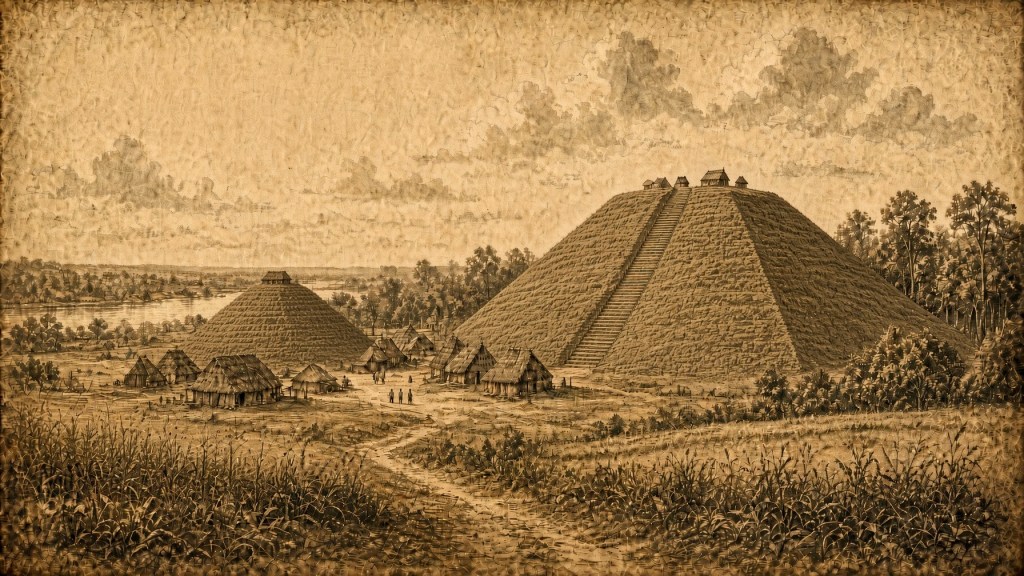
An exposed sycamore root makes a good canoe tie-off. Up the shore, past floodplain brush, driftwood, and plastic bottles, the ground is a soft wet field. Chief’s Mound comes into view: a long grass-covered platform with steep rectangular sides and a conical offset.
Here the high speech of the place is a lull — cicadas, a heron lifting from the slough.
The site shares a latitude with the Ephesian temple of Artemis. Across that line a mattress of charcoal and fleeces was packed into a wet basin. The harbor filled with silt. The sea crept away. One marble column is left in the marsh.
At Angel they dug out the earth to heap it. Great heights require plumbing the depths.
From atop Chief’s Mound an inventory of things to see comes into partial view: the visitor center, reconstructed huts, a palisade. Across a prairie that was once a plaza sits Temple Mound, a floor raised so a fire could stand above the damp.
The Evansville skyline is not visible from this secluded place. A distant barge sounds its horn as a little more ground leaves the site, down the Ohio toward Little Egypt.
In 1824, Humphrey Marshall published an expanded version of his History of Kentucky—a hard-edged partisan chronicle with an odd introduction.
Marshall had enlisted Transylvania University professor C. S. Rafinesque, the most active investigator of the state’s ancient monuments at the time, to write the opening section. He delivered a freewheeling, visionary account of the deep past.
Rafinesque liked his introduction enough to reprint it as a separate 39-page pamphlet, adding his “Enumeration of the Sites of Ancient Towns and Monuments of Kentucky, Etc.,” along with an “Ethnological and Philological Table of the Primitive Nations and Languages.”
Ancient History, or Annals of Kentucky offers fantastical details like lost tribes, submerged continents, and elephants roaming the Ohio Valley. Its greater value, though, is metaphysical. Whether through geology, biology, or ethnology, the eccentric naturalist intuited a universe underpinned not by Plato’s perfect forms but by Heraclitus’ flux. This was heretical thinking for its time, pointing toward a hidden reality of cataclysm and coherence, erasure and persistence.
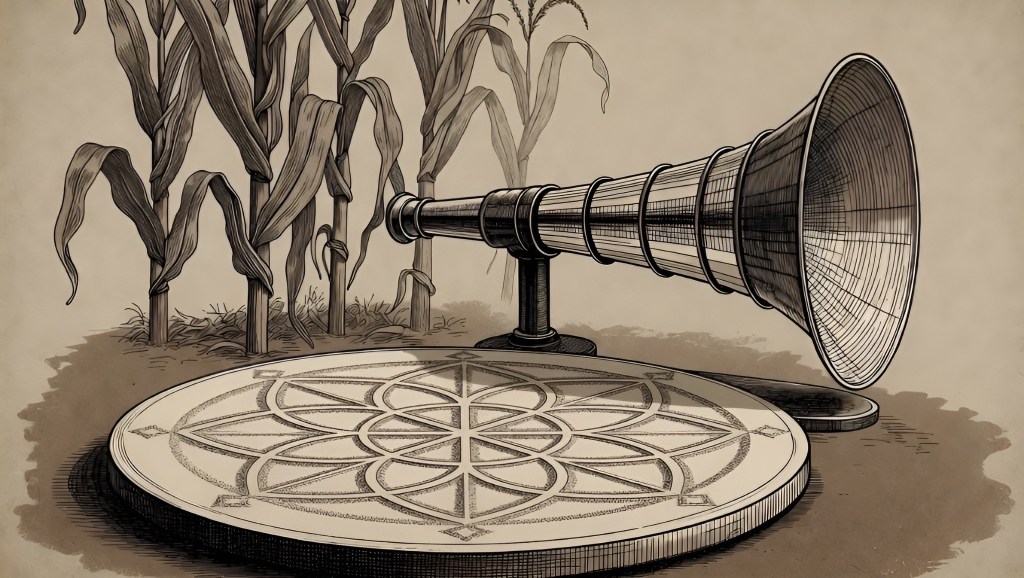
Great floods wash away the old, rigid forms while remnants of culture and memories persist on the mounds and highlands. Landscape topography becomes metaphysical topology, a Chladni plate of assembly at the nodes and dispersal at the antinodes.
Rafinesque finds the same pattern in the roots of ancient languages—word-nodes hardy enough to survive the dispersal of individual tribes across the globe.
This rhythm goes beyond language. His perspective anticipates what Nietzsche would later call will to power: the fundamental polarity of being and becoming. What exists must be swept away so a more coherent form can regather with greater strength—only to break apart again in a further overcoming.
The universe is always changing but not chaotic. There are laws. The payment for a scattering is a gathering.
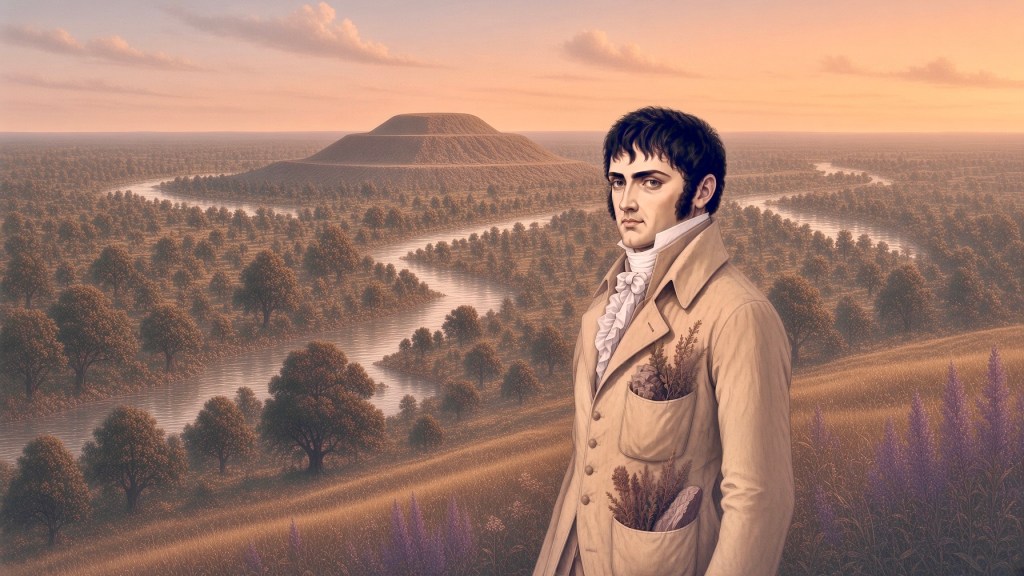
Rafinesque (1783-1840) himself embodied the flux he described. Displaced from Europe, he tried to gather his life again in Lexington. (A shipwreck off Connecticut had destroyed his vast collections of specimens and manuscripts, forcing him to start over.)
Born in Galata near Constantinople to a French merchant father and German mother, Rafinesque was largely self-educated. He studied Mediterranean plants and fishes in Sicily before moving to America in 1815.
He joined Transylvania in Lexington four years later and taught botany and natural history—until he had a falling out with the university president in 1826, cursed the school and left for Philadelphia, where he continued his work.
As prolific as he was controversial, Rafinesque studied botany, zoology, archaeology, linguistics, and early evolutionary theory. He researched Mesoamerican scripts and named thousands of species while proposing a theory of evolution that predated Darwin by decades. Over his lifetime, he gained a reputation as an outsider. His hasty, unorthodox claims and methods often drew criticism from a scientific establishment steeped in conventional Christianity.
Rafinesque jettisoned ways of thinking that had ossified over the two millennia since Plato’s metaphysics set the stage for being’s precedence over becoming. Intentional or not, he integrated empirical science with the pre-Socratic philosophy of Heraclitus, whose ideas weren’t constrained by Platonic rigidity.
Species, civilizations, and even the landscape itself weren’t created once and forever in their current form—instead, Rafinesque saw a seething conflagration.
He described “the great universal law of perpetual mutability in everything” in his 1833 article “Principles of the Philosophy of New Genera and New Species of Plants and Animals.” Under this law, gradual deviations of form occur over immense spans of time. He had already applied it in Ancient History to geology, languages, and human migrations.
In his 1836 poem The World, or Instability, Rafinesque returned to the same vision in more explicitly elemental terms. Fire is a latent force that “tends in all / To swell, expand and break the bonds of matter,” appearing and disappearing by turns, “Never the same although the same appearing…” The underlying intuition is Heraclitean: a universe whose only constancy is transformation.
“All is fire,” the philosopher said, kindling in measures and going out in measures. Change is not merely a physical event. It is a metaphysical axiom.
Rafinesque, though, remained grounded in the world around him. Wearing a stained nankeen coat, pockets bulging with specimens, he ambled across the countryside documenting what the floods had not erased. Native American earthen mounds—used for rituals, burials, residences—stood near the rivers, outliving the settlements once clustered around them. These were local Ararats on the Ohio—high places where culture and memory survived each inundation.
Floods are high-amplitude scattering events in Ancient History’s long chronology. They wash away the temporary orders of the lowlands, and then power, ritual, and memory gather again at the nodes.
Rafinesque locates these high places explicitly: “The first cradle of mankind was called Eden (or Ima) and was in the highest land of Asia…” Also: “[T]he second cradle of mankind after Noah’s flood was also in the lofty lands of Asia…”
These areas of persistent convergence, both physical and cultural, illuminate what Ñāṇavīra called the principle of “invariance under transformation.” What endures is a structural place—anchored in physical substance—that continues to function while its contents change; resistant poles allow a resonant pattern to restabilize after scattering. Heraclitus had already provided the image: the river is never the same water, yet it remains the same river, a coherent structure where gathering preferentially returns. The new configuration is never identical to what was swept away, but it is continuous with it and flows according to the altered conditions.
This re-formation is part of what Heraclitus called dikē: cosmic justice. The universe seeks the concentration of strength to counterbalance the overall trend toward entropy.
As with the mounds, Rafinesque found a nodal architecture in language and in living forms. The radical roots he traced—basic terms for heaven, land, water, man—function as linguistic cores. They remain while tribes migrate, languages splinter, and surface vocabularies dissolve; later cultures take them up again. (The comparative tables in Ancient History are an attempt to map these enduring cores.) In biology, he stated the principle even more directly. Darwin later quoted his 1836 remark: “All species might have been varieties once, and many varieties are gradually becoming species by assuming constant and peculiar characters … except the original types or ancestors of the genus.” In other words, forms are not ideal and fixed from the beginning. Through ongoing flux, certain configurations stabilize into new patterns. Underlying original types remain as the stronger positions—the ones that have already demonstrated their endurance.
Thus a hierarchy of nodes appears, shifting with environmental conditions the way a Chladni pattern rearranges when the frequency changes. Weaker stabilizations are shed; stronger ones become the reference points for the next regathering. What survives is what can still function as an effective attractor under the new frequency of conditions.
The low ground forgets and the strongest elevations hold—but not forever. Many of the sites Rafinesque recorded in Ancient History later disappeared under the plow and assaults of nature. Mounds erode, branches of languages and of life die out. Whatever is of the nature to arise is of the nature to pass away, a flickering of fire.
But the rate of change varies. Without periods of relative persistence, being would lose its weight to chaos. The ancient monuments are where the landscape remembers by repetition and attention. Through repeated ritual, mind and place are bound together, and the sites persist as enduring nodes. The constant return gives the illusion of solidity.
Extending this same logic across space, the individual mounds form a larger network. Major centers stand as stronger primary nodes; smaller earthworks and enclosures occupy secondary or supporting positions. Their placement is rarely random. Alignments, sight-lines, distances, and hierarchical groupings create a distributed geometry that functions as a physical memory system.
After a cataclysm, later groups inherit a pre-existing field of nodes. They return not only to the same mounds but to the relational pattern among them, because that arrangement has already proven itself. The landscape participates in logos—the order that steers the flux.
This essay appears as the introduction to a new, modernized edition of Rafinesque’s Ancient History, or Annals of Kentucky, which also includes the complete 1824 text, monument list, language root tables, and several site diagrams.
C.S. Rafinesque’s 1824 Ancient History, or Annals of Kentucky is soon back in print. Fantastical on the surface — lost tribes, elephants along the Ohio — but underneath runs a vision of flux, catastrophe and the places that endure. New intro.
“The king was going to open the gate in order to offer the girl to whatever feared thing lives in the jungle. He was sending out a bride to Kong.” — Delos W. Lovelace, King Kong
Legend has it the positive geographical correlation between reports of missing people and Bigfoot sightings is not coincidence — it’s causal.
When the authorities realized the lore was actually true — that Atalan remnants were dragging off hundreds of random nature lovers, including some VIPs — they struck a deal. The giants agreed to leave humans alone if, every once in a while, they were bestowed a virgin. (A military incursion against them was deemed “culturally insensitive” and might have blown the cover-up of their existence.)
Management of the sacrifices naturally fell to the Smithsonian, which had been in communication with the beasts for more than 150 years.
“I don’t know for sure if he’s going to eat you … at least not right away,” agent Fafner told Sienna. “We’re just focused on the transfer ritual … it’s actually quite an enriching experience.”
“Oh, shut the fuck up,” agent Booker said as she rhythmically struck the trunk of a bald cypress with a heavy stick. The knocks echoed deep into the swamp. “She doesn’t need to know that shit.”
“Fine, whatever.” Fafner sounded a little hurt. “Just don’t knock too fast — that’s a territorial challenge.”
“You’re both crazy!” Sienna shouted. Supine on the spongy soil amid ferns, she jerked the ropes binding her arms and legs to cypress knees. “Let me go! You can’t just make me into an offering — I have rights!”
“It’s your punishment for desecrating Native gravesites,” Fafner said, holding a clutch of burning cedar sticks soaked in pine tar. He started dancing around the girl, whooping softly.
As if in response, a crane called out from somewhere within this dusky bayou reeking at Indiana’s big toe. Suddenly anything seemed possible to Sienna, surrounded by a primeval, otherworldly riot of life. Her tears turned the feathery leaves hanging over her into breathing green splotches.
Something nearby knocked back.
Fafner stood still. “Holy shit. That sounded like a response.”
“Keep your eye out for that smelly son-of-a-bitch,” Booker said. “Two agents almost got mauled in Jackson Hole last summer … dumbasses let their guard down.” She gave three more slow knocks, and then, along with her partner, crept to the van parked at the end of a gravel road.
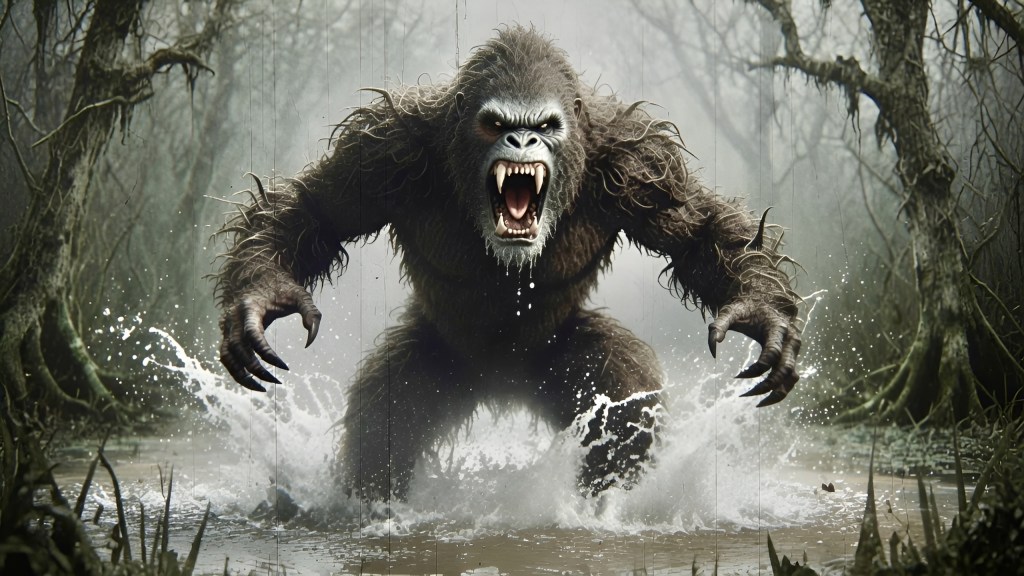
With incredible speed, an eight-foot-tall brute with fangs and long matted hair crashed through the undergrowth — he went straight for the discovery van. The agents managed to climb inside and shut the door before the Hovey Lake Swamp Ape began battering the already beat-up vehicle, leaving deep claw marks through the triceratops graphic.
“No, not us — why isn’t he going for the girl?!” Fafner yelled.
“Don’t ask me.” Booker fumbled the keys into the ignition. “Maybe the motherfucker’s gay.” The van’s engine roared to life, and the back tires pelted the Sasquatch with rocks as it sped away.
The creature bellowed. Then it turned toward Sienna, now madly trying to free herself. As it neared, she retched from its stench and felt woozy.
Then she heard “crunch … crunch … crunch … ” approaching on the gravel road. Through her mental haze, she saw a giant skeleton appear in the clearing with a jewel-encrusted sword.
The Bigfoot stared dumbfounded as the skeleton knelt down and bowed its head deeply to Sienna. “Oh, wise Bee Mother Fo Ishki,” it said with a dry, eerie hiss. “I are glad you found me in time … no, wait …. I found you … ”
In just three strides the Swamp Ape reached the skeleton, and in one swipe took off its head. The bones collapsed to the ground and something that looked like a butterfly spiraled up from the pile, cussing. The girl passed out.
***
“Keep in mind, we’re basically looking for waves in the landscape,” Sam noted. “Technically, they’re called old point bars — accumulations of sand and gravel left behind as the Ohio meandered.”
“Oh, no,” Windi said as they trudged through the mud. “Here we go.”
Thalia groaned.
“You see,” Sam continued pedantically, “since currents flow more slowly on the inside of a river’s bend than the outside, sediment accumulates along a low, curved ridge. After the river changes course, this could provide a space that’s both enclosed by earth and above the water table.”
“Are you sure you didn’t just read the crop circle wrong?” Di asked. “I imagined her in a cave.”
“Any caverns around here would be flooded — the bedrock isn’t limestone anyway. But I guarantee you that we’re standing within a quarter mile of her. Just make sure you check any elevated areas for signs of disturbance or large holes.
The smell of wet earth and decaying vegetation was strong as they spread out and picked their way over the firmest patches of ground. Phiale was struck by a sense the landscape was losing its form. The death of earth is water, she thought.
After wandering around for almost two hours shouting for Tinker Bell and poking around bumps in the floodplain, they sat on a fallen trunk. Phiale wiped her muddy hands on the soft, stringy bark as sweat stung her eyes. The sunlight, once green and golden through the canopy, had grown murky. She slapped a mosquito on her neck.
“We’re wasting our time out here,” Di said.
Sam tapped a topological map marked up with sacred geometry. “No, we entrained with her at this hexagonal node, right here in the Opilwalacha Cypress Slough.”
Di twisted the string of her bow to increase the tension. “We still don’t want to be in the swamp after dark.”
“I’m with her,” Thalia said. She nudged Windi with her elbow. “Hey, give me a smoke.” The girls fumbled handing over the slightly crumpled pack of Marlboros, which fell into a black, tannin-stained puddle, soaking all the cigarettes.
“What a total crock!” Windi shouted and kicked the log.
“Crawk!” something called back from the trees. A white egret floated down to a clump of cypress roots about 20 yards away. It pecked at the ground. Then it displayed its five-foot wingspan. “Crawk! crawk!”
Where have I seen that bird before? Phiale thought and walked toward it. The egret flew up into a nearby cottonwood, where it watched the girl intently.
Phiale noticed the roots were part of a long, narrow rise. A large snake track waved across deep indentions in the surrounding mud.
Now Sam was walking beside her. “Let’s check around the roots first. They can open up large pockets in the soil.”
Phiale shined her phone into the largest opening, revealing a long chamber running along the ridge. Was that a glint of metal? From somewhere deep inside, she heard a faint “Hello? Eh … get me the hell out of here.”
After they dug out Tinker Bell — still sprightly, albeit dirty — and released her from the birdcage, she immediately flitted to a patch of swamp roses, where she gorged herself. Phiale had never felt so relieved.
The fairy then picked up a twig and jabbed it in the air. Not even a puff of smoke. “Get me back to New Harmony.” She laughed and flew in wide circles between the trees, saying, “I’m free … I’m free-e-e-”
A large skeletal hand reached out from the gloom and grabbed her.
“Ohhh … I caught something pretty … I will make it sing to me,” the giant said and lumbered off with the Tinker Bell.
They chased it along its path of destruction, slipping in the muck most of the way. Shortly after glimpsing Hovey Lake through the bottomland hardwoods, they entered the clearing where the transfer ritual had taken place — just as the Swamp Ape decapitated the skeleton.
The creature immediately faced the new arrivals and pierced the air with a screech. Phiale was glad to see the fairy dart up out of the bone pile but couldn’t move from fear. Di brushed past her, nocking a silver-tipped shaft.
The huntress sent her arrow into the beast’s heart. It died suddenly and painlessly.
Chapter 15 drops Sept. 30. Read Part 1 on Kindle or in paperback. (Catch up with the Prologue.)
– Hart [County], mounds near Green river &c. mummies in caves – Indiana, towns and mounds on the Wabash … — Catalogue of “Sites of Ancient Towns and Monuments of Kentucky, &c.” by C.S. Rafinesque
“There’s the sigil — keep singing!” Sam shouted, madly pounding the tuning fork. “Sienna, that’s a D4. We need a C4. You’re interfering with the waveform!”
“Why the hell did you bring her?” the fairy asked, her holographic image flickering in the misty air of Rafinesque Hall.
Phiale was relieved to see Tinker Bell still had her sense of humor, if that’s what it was, as the girl held her own middle C steady — “oooooh … ” But Phiale couldn’t quite match Thalia’s clear, foundational tone.
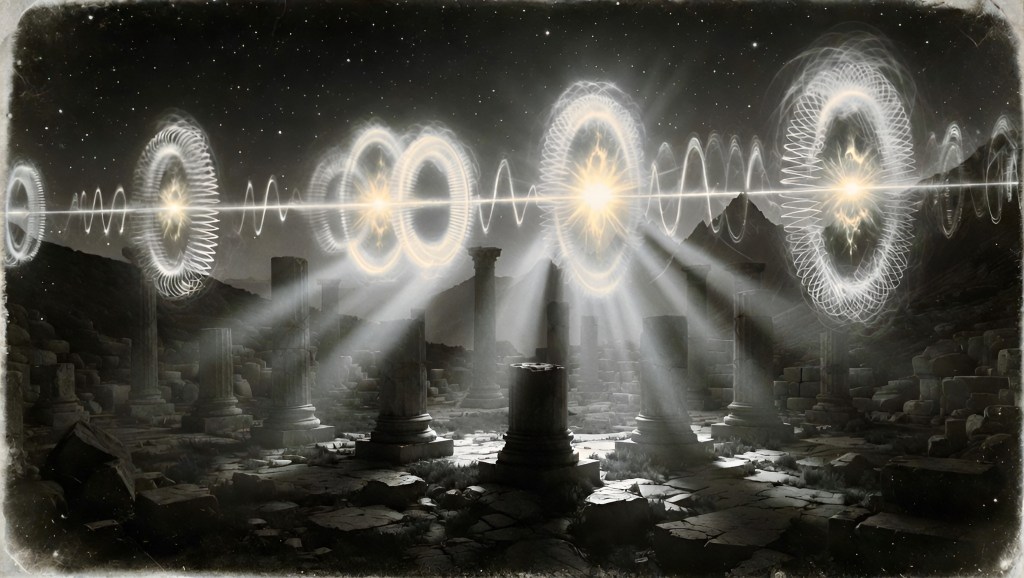
The note reverberated through the limestone chamber, sustaining a double-helix standing wave that stretched from Mammoth Cave toward wherever Gabriel was holding Tinker Bell. It was definitely outside New Harmony; the fairy had lost her magic.
Sam took advantage of the Green River’s negative ions coursing overhead and the Styx flowing beneath them. Ancient mounds along both the Green and Wabash acted as nodal amplifiers, phase-locking the region’s telluric waves with the combined singing, bounded by the minds of Tinker Bell and her two ancient guardians.
The sound vibrations in the cavern cracked loose a three-foot stalactite, which plummeted 40 feet, missing Sienna by inches and kicking up a thick cloud of dusty guano from a colony of Corynorhinus rafinesquii — Rafinesque’s big-eared bats. She scratched her nose, eyes widening in panic.
She’s going to sneeze, Phiale thought. I knew she was going to screw this up. I just didn’t know how.
A glowing hexagon appeared behind Tinker Bell’s translucent form, followed by twelve spokes, nested triangles and a rosette of six yellow petals. The pattern pulsed in time with Windi’s egg costume, and Phiale’s mind flashed on Persephone gathering daffodils just before the ground opened — herscream fading as she descended —
Sienna’s whole body was twitching now. Sam raised his camera to get a photo of the sigil.
Then came the girl’s loud, nasal, goose-like honks.
The standing wave shattered.
***
Driving back up I-165, Sam suddenly remembered something from 1818 (drinking from Mnemosyne can have that effect).
Caught Audubon going through my knapsack, the varmint … need to cache the Walam Olum glyphs … just auger out a compartment on the underside of his new millstone … seal it back up with lime putty … ”
A depository of the countryside’s standing wave patterns, the glyphs even happened to be on the way home, still hidden in the stone, on public display at Audubon Mill Park.
***
Two days later, Sam was bent over the vibrating membrane of a 1964 Hans Jenny tonoscope, painstakingly tracing a template from one of the glyphs.
Di tapped the red cedar tablet with strange carvings and precisely painted geometrical forms, darkened with age and cracked. “Lucky I knew someone with the Henderson Police,” she said.
“Yes, I admit the chiseling was a bit suspicious,” Sam said distractedly. “But all that’s over now. They let us go, and we found what we needed.”
Sam had reserved the entire Working Men’s Institute attic that afternoon for “cymatics research.” Phiale was sitting with Windi, Sienna and Di at the Owen Round Table under the slanted ceiling with its exposed planks, taking in the room’s curiosities: crystals in glass cases, a locked safe labeled “bone fragments (giants),” Leyden jars and galvanic batteries.
The tonoscope was an interconnected contraption consisting of a speaking tube and boxes arrayed with dials and switches connected to a black rubber membrane the size of a snare drum, stretched over a metal frame.
Once Sam had traced the central rosette onto the drum, along with whatever else he could remember of the pattern that had appeared behind Tinker Bell, he covered it with a thin layer of fine sand and had Thalia sing a C4 into the tube while he drove the frame at various frequencies.
It made a lot of pretty shapes, but of little value for locating the fairy. “These harmonics just can’t pull enough resonance from the countryside,” Sam said, slumping into a chair, burying his face in his hands.
“Imagine my shock — one of your harebrained plans didn’t go right,” Di said, flipping through a copy of the Evansville Courier & Press she’d picked up on the way in through the library. (She had an unhealthy fixation with the game warden’s deer poaching violations in the Outdoor Report.)
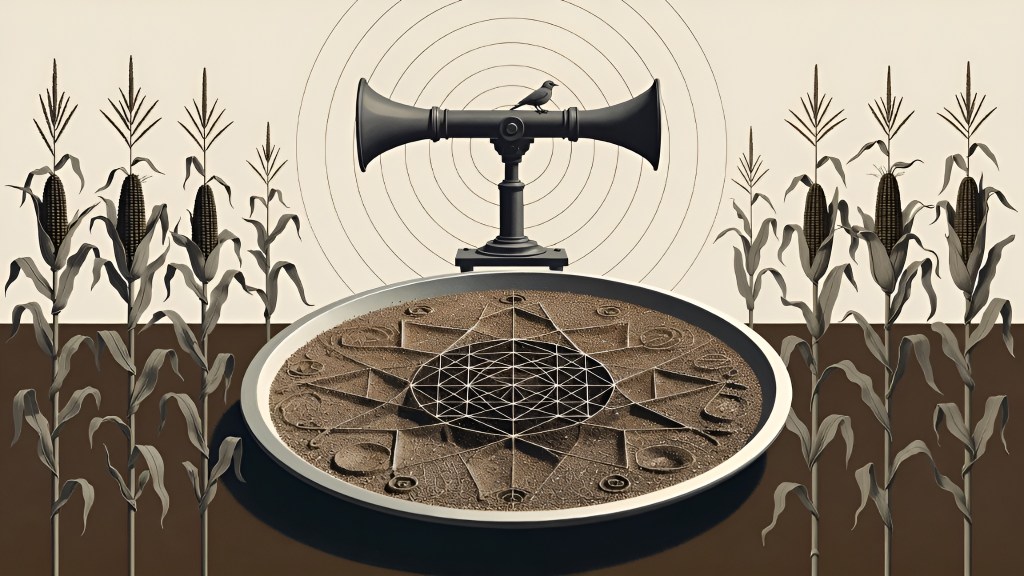
“Wait!” Phiale said, slapping her palm down on the Farm section. A standalone photo titled “An Ear-ie Sight” showed a crop circle in a cornfield just west of Mount Vernon — taken the day of their cave rite. Its pattern featured a hexagon just inside the main circumference, surrounding a rosette with six petals, interlocking triangles — the whole deal.
“That’s it!” Sam shouted. “The full pattern was too big and bold for some Chladni plate or dank cave. We bounced that critter off the ionosphere.”
***
Leaving the Working Men’s Institute, Sam tucked the newspaper under his arm and they cut through Church Park toward Galata Antiquities to break out the protractor and old maps. The sun was shining, and Phiale felt good about their progress. Sienna meandered behind, humming as they walked past a thick row of trees … birds chirped … including a series of clear, sharp whistles.
“Ah, the alarm call of an eastern phoebe,” Sam said, “first banded by Audubon in 1804 to see if they would return to their nests the following spring. It’s also named after Artemis’ grandmother, calling out to her in more relaxed moods … fee-bee, fee-bee.”
“God, you never quit talking,” Windi said, taking a drag off a cigarette.
“That says a lot coming from you,” Di chimed in.
Phiale looked back to see if she could spot the phoebe. She couldn’t see it — or Sienna for that matter. They briefly scanned the park for her but figured she’d headed somewhere on her own. So they started off again.
After only a few steps, Phiale stopped so abruptly that Windi ran into the back of her. “What the hell?” the latter exclaimed.
“Yeah, good question,” Phiale said, watching the Smithsonian van lumber along Church Street, severely dented, its windows blackened and front bumper sticking out like a tusk. It looks like a wounded mastodon, Phiale thought. Out for blood.
While the self has a discrete structure, it is also an open system — an antenna capable of phase-locking with external memes.
These resonant patterns can either strengthen the mind’s coherence or pull it into forms of entrainment that diminish agency. The self-torus’ wavenumber-6 standing wave facilitates initial entrainment with external structures, but the long-term consequences depend largely on how the helical core incorporates new patterns and how the central nodal cross processes them. When the cross remains relatively open and discerning, phase-locking with refined resonators (such as those found in art or philosophy) can support greater coherence. When the cross becomes rigid or overly attractive, external patterns can dominate the system’s orientation.
Memes themselves are resonant toroidal patterns that possess a rūpa-like structure in the realm of toroidal resonance. While they require physical carriers (books, songs, images, rituals, institutions and so on) to be transmitted in the material world, their coherence as patterns lies primarily in their topological structure. Most memes share the wavenumber-6 architecture of the self-torus, which facilitates phase-locking, though they typically lack the full differentiated internal structure needed to host reflective consciousness independently.
The self-torus is itself a memeplex. Its helical core, with its lemniscate-like motion in the cross-sectional plane, is where internally generated patterns and externally phase-locked memes are braided together into a composite structure. This makes ongoing phase-locking a continuous structural feature of the self rather than an occasional event. The memes already present in the helical core can exert pressure on cetanā, biasing future selection toward patterns that reinforce the existing configuration.
At the lethe zone, cetanā functions as a gatekeeper in the competition among memes for the limited resource of manasikāra (attention). It determines which external patterns are permitted to phase-lock and braid into the helical core. While the memes already integrated into the core can pull cetanā toward reinforcing patterns, cetanā retains the capacity for discernment. Agency can be strengthened both by reducing automatic identification with memes and by selectively phase-locking with higher-order resonant patterns.
In addition to tuning in external memes, the self-torus serves as a resonant chamber for the upper wavebands — vedanā, saññā, saṅkhāra and viññāṇa. These are topological patterns of organization that arise within the rūpa chamber. They depend on its structured resonance to manifest coherently and gain power at the nodal cross.
The openness or rigidity of this cross strongly influences what can phase-lock with the system and how deeply or constructively. As an attractor, it accumulates influence: Successful phase-locking tends to reinforce its power, creating feedback loops. Larger or more coherent memeplexes can exert disproportionate effects on both the helical core and the nodal cross.
The mid-nidānas — particularly nāmarūpa, saḷāyatana and phassa — establish the basic conditions for an “inside” and an “outside.” They mark the interface at which rūpa functions as a resonant chamber, making coherent internal activity and external phase-locking possible. Physical carriers and metaphysical patterns thus form a joint saṅkhārā — they condition each other without being reducible to one another.
Check out Essay 1. Or read the Existential Firestorm essay series “The 12 Turns” on Kindle.
The topology of mind reveals a toroidal structure resonating in a hidden realm. Within the self-torus are four interconnected zones: the wavenumber-6 standing wave, lethe, helical polar core and central nodal cross. These illuminate the structure of selfhood — its values, developmental movement, illusion of persistent identity amid flux and volition’s role in the arising of consciousness.
These functional regions arise from the dynamic interplay of the five waveband aggregates. Rūpa (materiality) serves as the toroidal resonant chamber that bounds and organizes the four upper bands: vedanā (feeling-tone), saṅkhāra (binding lattice), saññā (perception) and viññāṇa (consciousness). Without this rūpa chamber, the higher wavebands would remain too diffuse to sustain stable patterns. The structure provides both a ground for individual striving toward greater coherence and the possibility of phase-locking with external resonant forms, in accordance with the demands of will to power.
At its most basic geometric level, the self-torus is sustained by the wavenumber-6, which produces 12 fixed nodes around the circumference. While these remain relatively stable, the regions between them pulsate rhythmically. A standing wave of this kind possesses sufficient structural coherence and harmonic stability to phase-lock in the realm of toroidal resonance without losing its own integrity.
Although the self-torus is grounded in rūpa, it remains undetected by current scientific instruments. Even if that were possible, the four upper wavebands would still lie beyond the reach of materialism. What follows, therefore, is a topological description of metaphysics — a mapping of the resonant architecture where cosmic cetanā (volition) localizes and surpasses itself within conditioned existence.
The wavenumber-6 establishes the overall container for the other functional zones to operate. Its 12 nodes correspond to the 12 nidānāni of paṭiccasamuppāda, the structural conditions of moment-to-moment dependent origination and maintenance of the self. This layer most directly expresses what underlies experience, while the remaining zones govern modulation and transformation across time.
Within the lethe zone, cetanā narrows the field by scattering all potentialities except the chosen one; this opens a clearing at the central nodal cross where actuality stands forth. What arises is not erased after fading from awareness. Through the activity of cetanā, it becomes integrated into the kamma-bhava saṅkhāra — the karmic conditioning strands — within the helical core, where it continues to shape future possibilities and receptivity. A new horizon of potentialities emerges, shaped by this accumulated background, continuing the cycle.
Lethe thus scatters in service of gathering. As dikē demands, every dissolution calls forth a movement toward greater coherence as a counterbalance.
This polar tension finds its most concentrated expression in the helical core. Here, a lemniscate-like motion allows opposing polarities to meet and rebalance at each crossing. Because the core accumulates conditioning over time, it possesses the capacity for ongoing evolution rather than mere repetition. While this movement performs the essential work of polarity and integration, increases in coherence and resonance register most significantly in the evolving attractor quality of the central nodal cross. In this way, the helical core supports the conditions for development, while the nodal cross serves as the primary site where that development is expressed and tested.
The helical core’s internal dynamic interfaces with the larger architecture of the self-torus. At the central nodal cross, the helical core’s polar activity meets the convergence of the wavenumber-6 standing wave’s nodal spokes. At this intersection, the ongoing work of transformation becomes most directly available for integration into the self-torus as a whole.
This is not a closed system. This is not a closed system. Consciousness is continually shaped by saḷāyatana (the six sense bases), and the self-torus phase-locks with external memes. Despite these influences, the self maintains structural resistance to dissolution. Like a hexagon distributing stress evenly across its faces, the wavenumber-6 mode spreads external pressures across its 12 spokes. The helical core further stabilizes the structure, coiling according to the golden ratio so that it can preserve identity while remaining open to polar flipping. Because the ratio is irrational, it generates self-similar spirals that never reach perfect closure or equilibrium, ensuring that the flow always carries within it the seed of its opposite.
The self-torus thus embodies a resonant form persisting even as its specific manifestations change. Ñāṇavīra describes this quality as “invariance under transformation.” In this continuity amid flux — grounded in rūpa, gated by cetanā and open to phase-locking — the four zones together sustain the topology of self.
Read Essay 2 or check out the first Existential Firestorm essay series, “The 12 Turns,” on X or Kindle.
“Our normal waking consciousness, rational consciousness as we call it, is but one special type of consciousness, whilst all about it, parted from it by the filmiest of screens, there lie potential forms of consciousness entirely different.” — William James
The man who smelled like kerosene was back to talk with the snake that turns into a dragon. From where Bridget was tied to a stalagmite facing the cave wall, she could only hear snippets of what they were talking about — it concerned some sort of rite — there was a lot of German and hissing. She tried but couldn’t quite remember his face. She was sure she’d seen him, but she’d been so woozy. Just blackened knuckles and the soot streaks up his hairy forearms. Her last clear memories were of standing on the riverbank, seething at how those academy girls thought they were so much better than her and how she was secretly glad the geese had bitten them because of how mean and greedy they were. Then something had clamped over her whole body — black, ridged bands. It was hard to breathe. The rhythmic beat of wings. The landscape below a blur. Her geese, terrified … scattered …
***
Cynthia’s wild locks flowed over the back of her tunic, and a silver half-moon necklace pendant flashed in the sunshine. Just before she released the bowstring, a gasoline-soaked rag flared at the end of the arrow. The shaft arced high across the municipal pleasure garden and descended toward the faint circular impressions of the old Harmonist labyrinth, where the newly installed Flame of Heraclitus hissed and spat acetylene.
A sudden gust of wind blew the arrow into the History Club’s reconstruction of the Philanthropist for the centennial of its arrival. The boat’s wooden frame, muslin skin and papier-mâché details were quickly engulfed.
“It was the Fates, y’all.” Cynthia dropped her head in shame. “They had Aeolus send forth a breeze, I’m sure of it.”
“Yeah, you never miss,” Doris said. She felt rattled, like the universe wasn’t working right.
“Other than when she accidentally killed Orion because she didn’t recognize him,” said Rosabell, whose idea it had been to stage a lighting spectacle, based on an ancient standing moon mound ritual. “But that doesn’t really count as missing.”
“Do you always have to bring that up?” Cynthia’s silver eyes hardened.
Nobody was injured, so Club Showcase Day continued once the smoke cleared and someone lit the flame up close. Wearing cream-colored corduroy trousers covered with classmates’ signatures and a few hand-drawn owls, the senior class valedictorian offered words on flux and venturing out into the real world — to officially dedicate the flame — the future centerpiece of the hedge labyrinth, which would take more than a decade to complete. A Model T puttered in the distance.
After the speech, Doris, Cynthia and Viv wandered over to the Butterfly Club display under a mulberry where Clara was informing a group of students and families about the Bombyx mori moth. Doris was mesmerized by two fuzzy antennae attached to Clara’s cloche hat bobbing around as she explained: “The species name comes from morus, which means ‘mulberry’ in Latin.” She pointed to the branches overhead. “Their sole diet consists of its leaves.” To demonstrate, the club had set up a live display of caterpillars munching away in glass jars. “In his American Manual of the Mulberry Trees, Rafinesque suggested cultivating those that grow smaller, less palatable fruits — its leaves make the worms produce stronger silk.”
Leaning against the mulberry was Otto Rapp, Butterfly Club adviser and New Harmony’s lamplighter, with a long, graying Lincoln beard and coveralls smeared with lampblack. The display also featured his famous moth collection in 30 glass-topped boxes.
Since there were plenty of members to staff the booth, Clara joined them for a visit to the occultists: three vamps in black evening dresses and beaded necklaces sitting behind a Ouija board.
“Put your fingers on the planchette and ask it a question,” Velma said.
“Where’s the buried treasure?” Viv immediately asked.
“Can’t you think of anything different?” Velma snapped. “You never get a straight answer anyway.”
“Clear your minds and picture a glittering pot of gold,” Viv told Doris and Clara. The planchette jerked up and to the left.
“Zowie!” Doris blurted. She looked at Rosabell, but the fairy just shook her head and shrugged.
“Everybody calm down,” Viv said. “C … A … somebody write this down!”
It spelled out: “C A P T M C C O Y” and then stopped.
Velma drew in a sharp breath.
***
The next evening as they walked up Main Street, Doris felt a dread like going to someone’s funeral … but with the added stress of actually having to talk to them.
“So you mean a seance can tune in spirits like they were the WGBF farm report?” Clara asked.
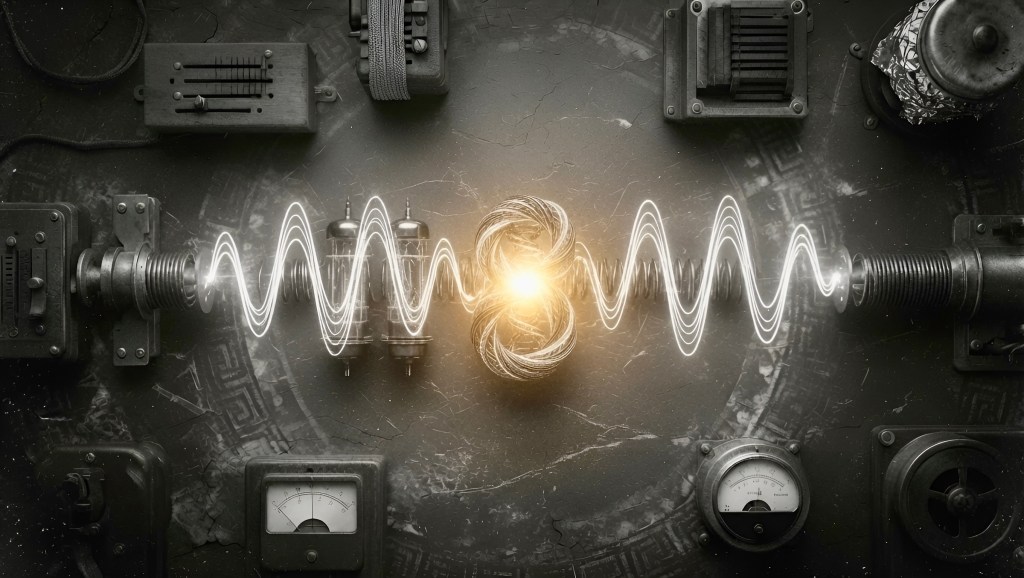
“Basically,” Rosabell said. “Our minds are like crystal radios. The ever-living fire is already broadcasting everywhere. Your body is just the antenna, and attention is the tuning coil. Most days we stay locked on the everyday station … the foxtrot or whatever, but sometimes the dial slips. Especially here. A strong life that ends in something violent — like a boat explosion — leaves a waveform that never quite decoheres. It keeps traveling through the ether until a resonant chamber picks it up.”
“Wow, I haven’t the faintest,” Clara said.
“Is it like the Phiale inside my mind?” Doris asked Rosabell under her breath.
The fairy grinned. “Yeah, she needed a head to rattle around in, and yours had a lot of extra space.”
“That’s not a nice thing to say,” Doris shot back. The air was tinged with the scent of river mud, and moviegoers were queued up for the Saturday showing of The Hunchback of Notre Dame. A Studebaker had angled in front of the pharmacy next to two horses tied to a hitching post. Everything feels old and new at the same time, thought Doris as she watched Rapp walking in the distance with a long pole and stepladder slung over his back. Guess he’ll be out of a job soon. Doris pictured the electric lights that bathed Evansville in a magical glow.
When they reached the McCoy mansion, they stopped at the black, spiked wrought iron gate to gawk up at the three-story Victorian. Doris felt a chill.
The widow Margaret McCoy, a friend of the Occult Club, answered the door. “Hi, Velma, I hope you told everyone how salty the captain can be.” Her silver hair pulled back in a bun, she led them into the parlor, the hem of her black dress sweeping across a Persian rug. The room smelled of lavender, furniture polish and candles, which were blazing by the dozens. Velvet drapes blocked out the dying light, and flames flickered in wall sconces.
“I do hope the captain behaves himself,” Margaret said as they sat around a heavy oak table. “He likes getting re-membered, but sometimes I think that’s only so he can complain.”
After they touched hands in an unbroken circle, Margaret recited the Lord’s Prayer and some spiritualist hokum, concluding with: “Dearest William, Master Skipper of the Midwest, show us some sign you haven’t yet crossed to the other shore.”
A mantel clock ticked … nothing … Clara snickered; Velma shushed her.
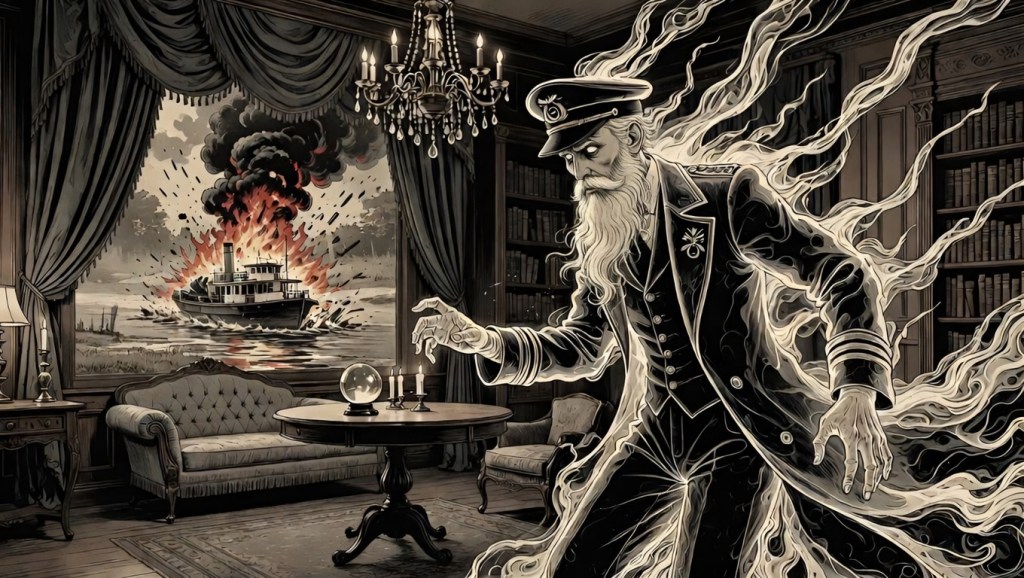
Then Doris thought she heard a distant bird’s raspy “crawk … crawk … ” Her heart was already racing when a riverboat steering wheel mounted above the clock, glowing red in the light of the fireplace, creaked loudly and started spinning.
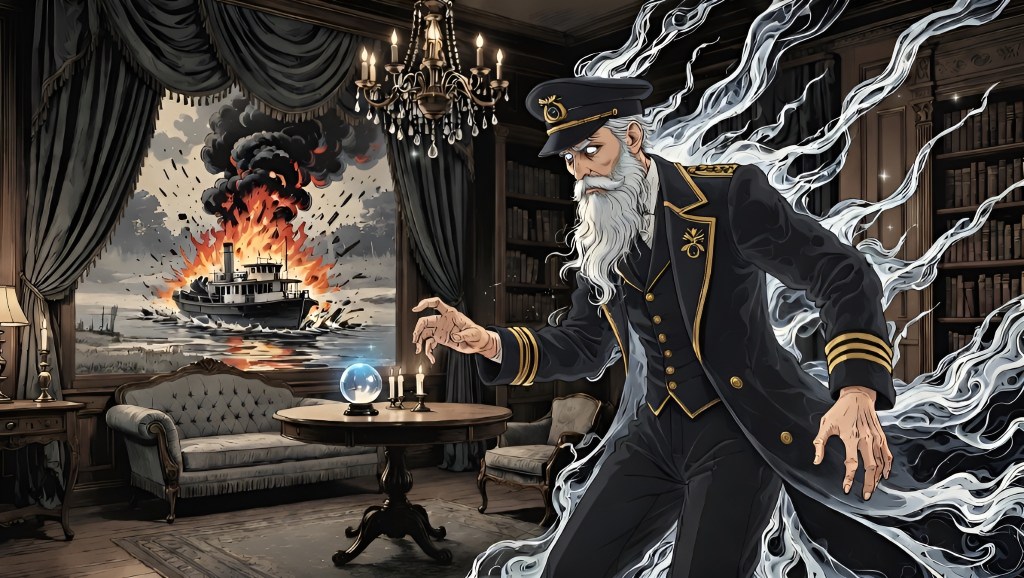
Then the image of a white river bird — some sort of egret, Doris thought — materialized a few feet in front of the wheel, hovering in the air. The bird raised its wings into a “V,” its graceful feathers dissolving into the long white beard of a man whose eyes sparkled like the Wabash at sunset.
He gazed down at their awestruck faces and drew a deep breath to begin his transmission from the netherworld …
“Who the FUCK are these bitches, Maggie?! My balls get blown off in a boiler blast and now it’s some horseshit knitting circle? It smells like a fucking funeral home in here.”
“Now, now, darling!” Margaret said. “These young ladies just want to ask about the river treasure.”
The table lurched. “Jesus Christ on a paddlewheel! I was facedown in the mud for 25 years! Why don’t you ask the goddamn catfish that swam off with my PECKER!”
Viv and Cynthia couldn’t help but laugh. Doris, though, was trembling and as pale as the captain.
“Think back to before you were killed, dear. You remember that young Italian man. What was his name … it started with a “G.”
“Please, Fates … spare me this one time,” Cynthia muttered.
“Giovanni from Pearl City! Haw haw! Said some Kraut literally hugged a fucking horse right next to him in a plaza back in the old country when he was a boy. Then the dumb Heinie — had a huge mustache — started ranting how a mountain fairy told him about the myth of the real Rheingold — but in Indiana! Raving mad, both of them.”
A distant boat whistle sounded from the depths, and the captain dissipated under the wavebands. Cynthia groaned and thunked her forehead on the table. “Of all people, it’s that Italian creep.”
As they were gathered in the foyer to leave, Viv proclaimed their next step was locating Pearl City.
“I know where it is,” said a young man sitting on the stairs peeking through the banister rails.
“Never mind him,” Margaret said, laughing nervously. “That’s our grandson. He’s a bit of an odd duck … likes to tease people … but he’s not as funny as he thinks he is.”
“I’ll take you there if you stop by tomorrow.”
“Back off, crackpot,” Cynthia said, shoving the girls out the door.
Viv struggled against her. “Wait, we should go with him. You can’t stop us.”
Standing on the large front porch, Clara lit a cigarette and squinted from the smoke. “Looks like we’re going on a field trip.”
***
The man was back. This time their voices carried more clearly through the cave. Underwater treasure … people trying to steal it … a group of students … Goldbug Girls. Bridget pressed her cheek against the cold stalagmite and wondered if she was losing her mind.

 Rob Robill