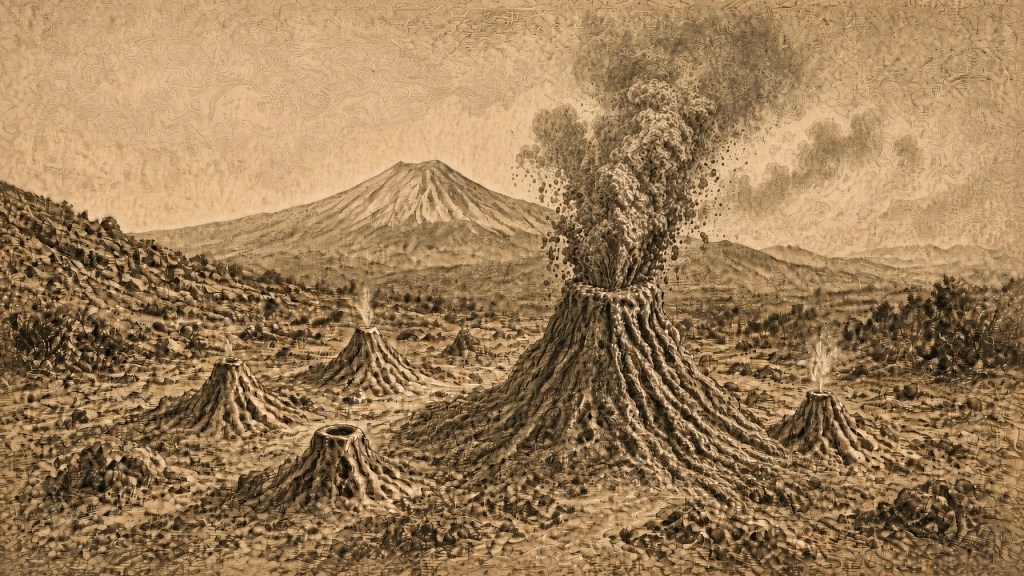
On a seaward approach to Sicily, Etna emerges from the mist: a cratered heap sitting on a powder keg of pressure.
Distance hides less spectacular mouths along its southwestern flank, belching sludge. Constantine Samuel Rafinesque, an eccentric 19th-century naturalist who walked that mountain, had these mud volcanoes in mind when he explained Kentucky’s sinkholes.
After he moved to the Bluegrass and roved its landscape, Rafinesque became convinced the area’s karst sinks were craters from undersea salses — formed when trapped brine and gas pressurize wet clay until a weak seal fails. In “The Caves of Kentucky,” he wrote: “The sinks are, according to my eruptive theory of the limestone and clay formations, the springs, craters, or spouts from whence issued in the sea, that limy mud which spread horizontally, imbedding the fossils.”
There were no cones around them, he thought, because the discharge had flattened into bedrock. Sea creatures were trapped in the sheet — back when a tropical sea covered the country hundreds of millions of years ago.
Rafinesque was wrong about the earth bursting and laying a new crust. Instead, water opens the sinks by dissolving limestone from underneath. Nothing is added. Something is taken away.
The first reading is Jünger’s cult: metaphysical ground driven until it explodes into another ground — an explosive passage over the Zero Meridian of completed nihilism that promises a spiritual dawn but only delivers a different set of tyrants. The second is a water passage. Idols are not replaced. They are removed.
Jünger and Heidegger eventually both accepted flow over control. The Anarch. Releasement.
Cult and papañca cannot bear a void. They need earth to arrive: a result, a slogan, an event, a self that is a thing. Particulars swell and fill the whole field so there is no farness left.
An underground stream works under a different weather. Lethe disintegrates idols, clearing space for new values.
This weather runs under a dry limestone plateau. On the surface is a stand of leaning trees. Closer in, roots hang over a crater of soil and weathered stone. Down a nearby ridge, a stream that had been hidden underfoot briefly emerges from the rock, gathers for a moment in the sun and air, and goes back into the ground.


