Geographical Sketches

The Cartography of Nihilism II: Where the Earth Fails Open

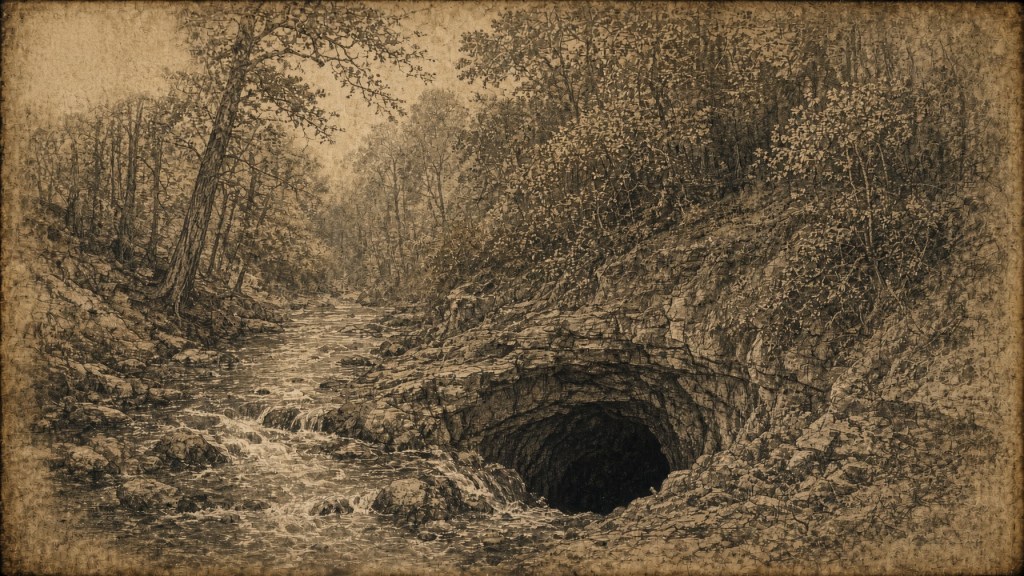
The sheet is a void. No entrance is evident. While the earth weather dominates, it is not total. A crack has opened in the cover. Collapse, not removal. Depth.

Legend

  • Phreatic: tube. Cut full of water. Will at full pressure.
  • Vadose: cut. Air in the void. A stream on the floor.

Water is will, lethe. An individual tunneling, entrained with artistic or philosophical hollows already opened. Earth — cult, idol, the They, the solid on call — has failed open. Water or air occupies the width. The surrounding is no longer entire.

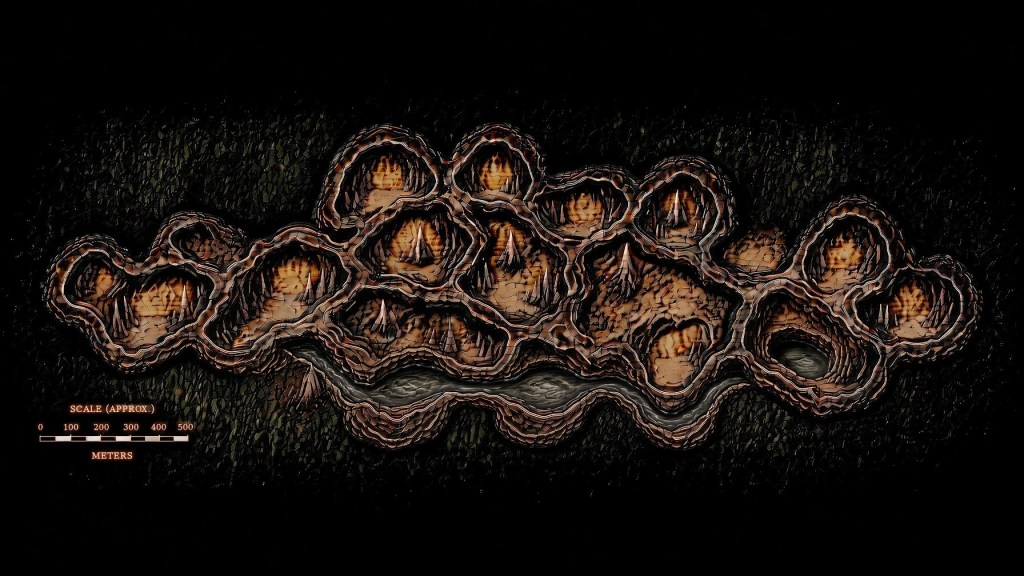
Stations

Crawl

Space opened to a body-width. The minimum void. Chest on the mud, ceiling on the back. Earth failed, but not much. What remains looks like a lead. It is a crack you can occupy and not pass.

Canyon

Vadose. High, narrow, vertical walls. A stream still cutting the floor. Will has not left this reach. Downward, not out.

Borehole

After the phreatic subsides, now air. Round in cross-section, cut by a will that does not wander. The solid is removed entirely.

Maze

Passages intersect — a network of junctions standing ready. Horizontal proliferation. A trap.

Silt Banks

Mud. Fine sediment left by a flood that still visits. Layers of concealment settle here. The sheet begins to call the deposit ground again.

Breakdown

The ceiling yielded. Stones on the floor. Earth no longer entire, but nearly impassable.

Dome

Height. No path up. Space opened overhead, still surrounded. The failure went vertical and remained a room.

Pit

Horizontal stations fail here. A vertical view of the present moment. A break in the labyrinth.

Siphon

Water with the death of earth. The passage descends, fills. Air stops. The void is still being carved.
Read “The Cartography of Nihilism: Two Weathers of Lethe.”

Geographical Sketches

The Cartography of Nihilism: Two Weathers of Lethe

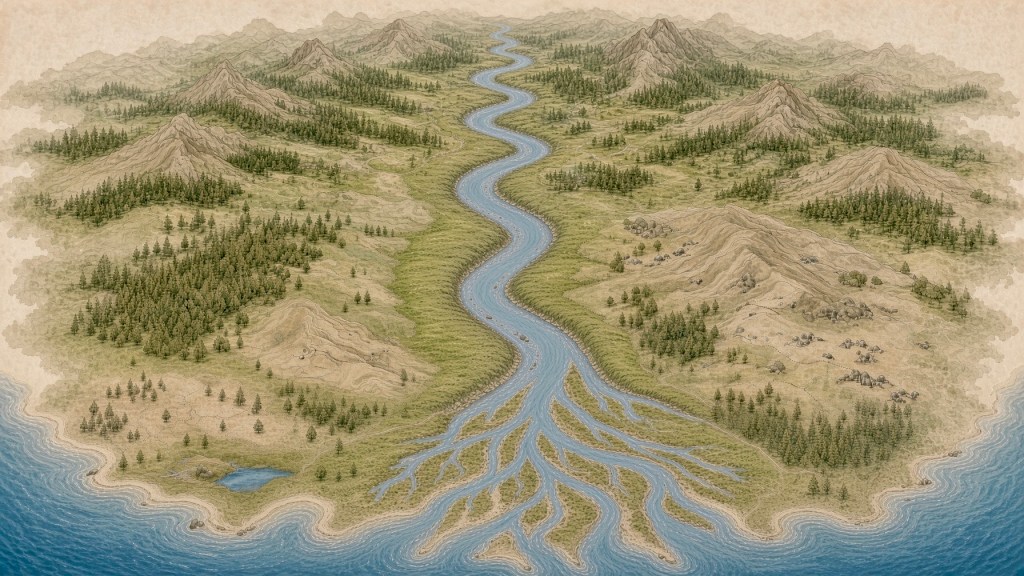
The sheet is a river and its overbank. The grid puts everything on call, drawn at a scale that deceives, compressed to a plane. It must be sounded.

Legend

  • Silt weather: cover. Nodal.
  • Flood weather: the current. Antinodal.
  • What thins in the wash: the idol, the self, the slogan.

Water and earth are one entity. The shores and overbank are what the wash laid — and will remove.

Stations

Bluff

Upland. Contour lines crowd. Bedrock. This is the last reach where the ground is not alluvium — the sheet’s east and west horizons.

Banks

Low, natural levees along the water — the river stood up. Silt as resistance. Flow and deposit condition each other but stay distinct. The formation is the polarity held.

Floodplain

Towns, inventory, idle talk. A floor that has become a field. A harbor, filled with mud, now a pasture. Silt does not announce a cover. It settles, conceals, and one day the sheet calls the cover “ground.” The unity of river and overbank is forgotten.

The world here is facticity full of the wrong nearness. Depth, anything not on call, remains hidden. What remains looks complete but is not. Particulars fill the weather until there is no distance left. Values and meaning deposit as stock.

Oxbow

The overbank as a mosaic. Abandoned channels still holding water. Meander scars, old point bars, loops that no longer flow. Past courses keep a skin of water. Kamma printed as topography. The past that cannot rejoin the river, blocked by the levee the water itself laid down.

Narrows

Alluvial walls — a terrace, a clay plug, not bedrock. Contours stack. The current is forced through dams it laid and now must breach. Rapids: broken water, no navigable thread. Being and becoming fail to pass cleanly here. The missing pole returns as a violent explosion. Debris spins downstream only to catch again in the tight passage.

Flood weather is justice here. The river will sweep the narrows themselves from the sheet. Potentialities scatter. Farness becomes possible again, because the field is no longer full. Earth is taken downstream.

Mouth

The widening space of a delta. Sandbars. A lighthouse. No single channel to the open sea.


Check out “The Cartography of Nihilism II: Where the Earth Fails Open.”

Geographical Sketches

Crossing the Zero Meridian

A Short Periplus of Mud Volcanoes

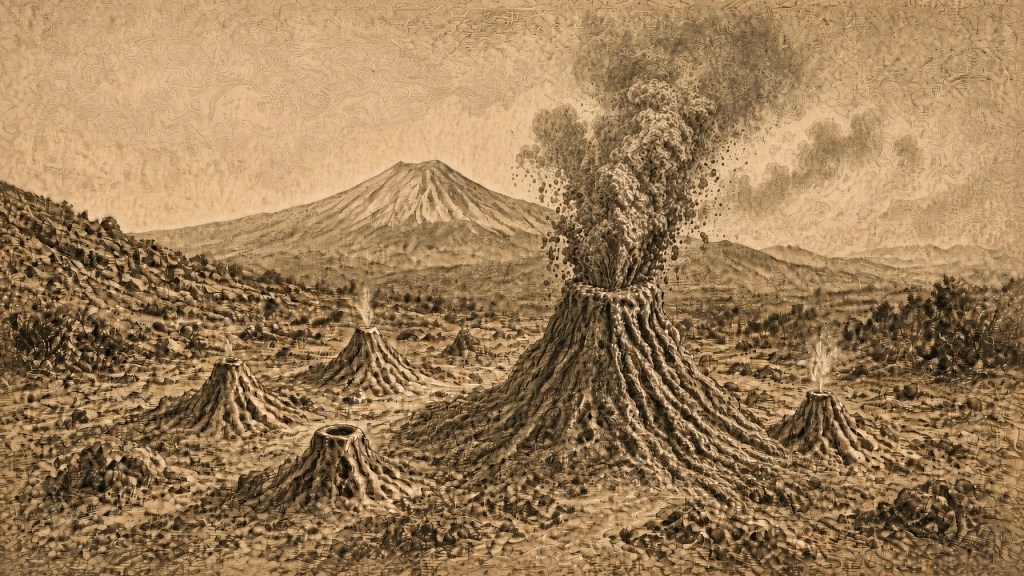
On a seaward approach to Sicily, Etna emerges from the mist: a cratered heap sitting on a powder keg of pressure.

Distance hides less spectacular mouths along its southwestern flank, belching sludge. Constantine Samuel Rafinesque, an eccentric 19th-century naturalist who walked that mountain, had these mud volcanoes in mind when he explained Kentucky’s sinkholes.

After he moved to the Bluegrass and roved its landscape, Rafinesque became convinced the area’s karst sinks were craters from undersea salses — formed when trapped brine and gas pressurize wet clay until a weak seal fails. In “The Caves of Kentucky,” he wrote: “The sinks are, according to my eruptive theory of the limestone and clay formations, the springs, craters, or spouts from whence issued in the sea, that limy mud which spread horizontally, imbedding the fossils.”

There were no cones around them, he thought, because the discharge had flattened into bedrock. Sea creatures were trapped in the sheet — back when a tropical sea covered the country hundreds of millions of years ago.

Rafinesque was wrong about the earth bursting and laying a new crust. Instead, water opens the sinks by dissolving limestone from underneath. Nothing is added. Something is taken away.

The first reading is Jünger’s cult: metaphysical ground driven until it explodes into another ground — an explosive passage over the Zero Meridian of completed nihilism that promises a spiritual dawn but only delivers a different set of tyrants. The second is a water passage. Idols are not replaced. They are removed.

Jünger and Heidegger eventually both accepted flow over control. The Anarch. Releasement.

Cult and papañca cannot bear a void. They need earth to arrive: a result, a slogan, an event, a self that is a thing. Particulars swell and fill the whole field so there is no farness left.

An underground stream works under a different weather. Lethe disintegrates idols, clearing space for new values.

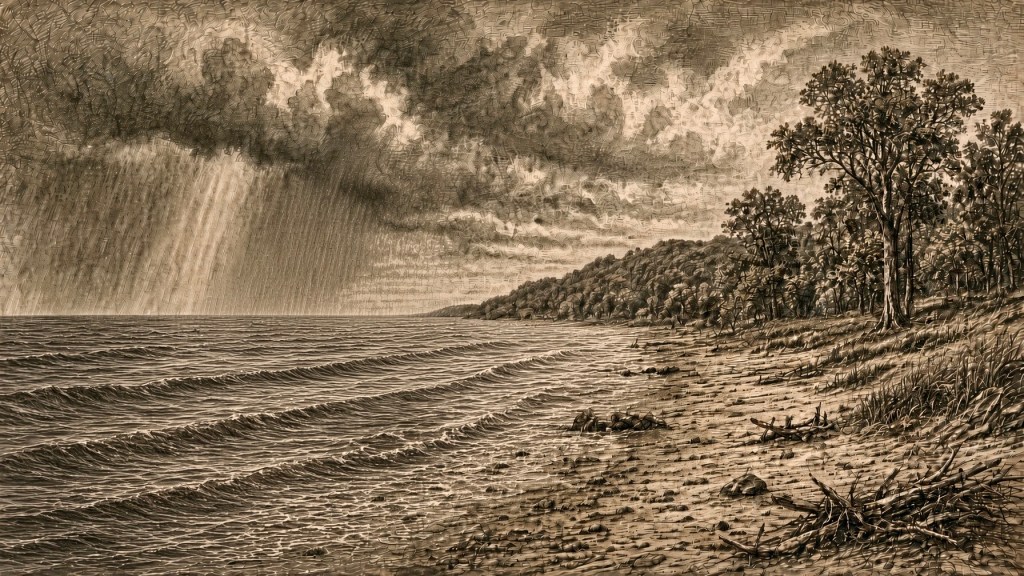
This weather runs under a dry limestone plateau. On the surface is a stand of leaning trees. Closer in, roots hang over a crater of soil and weathered stone. Down a nearby ridge, a stream that had been hidden underfoot briefly emerges from the rock, gathers for a moment in the sun and air, and goes back into the ground.


Read “The Cartography of Nihilism: Two Weathers of Lethe.”

Geographical Sketches

Hidden weathers

A short periplus of place

A written sketch of a shoreline contains the unseen — from submerged sandbars to microbursts rushing down the side of a mountain, invisible until they hit the sails. This is true of any metaphysical periplus as well.

From a song to a person to a massive earthen mound, some things are more than what you can perceive. These saṅkhārā gather visible and hidden weathers into a jointure that lasts only as long as its polar tension holds.

Visible weather tends toward the earth element. Hidden weather is the rest of the jointure: water, air, and fire coalescing without becoming a separate pile. Hidden does not mean elsewhere — because a thing has the nature of a place and not a site. Its revealed aspect alone carries the “where” that can be pinpointed on a grid, and that is what we typically mistake for its totality.

Metaphysically, a human is a toroidal standing wave. Rūpa, including the body, belongs to a structural wavenumber-6 ring as a node in paṭiccasamuppāda. The other 11 nidānāni along the wave are the rest of the gathering as look — e.g., feeling, perception, and consciousness. At the antinodes, cetanā scatters possibilities so one actuality can stand forth.

These hidden weathers form a farness that lets something appear as a “this” containing a “that” in its structure as background.

Earth is just a lump without water, air, or fire: no cohesion, no spacing, no pulse. The gathering collapses into the depthless, distanceless inventory of standing reserve. But without rūpa, the other weathers scatter into formless chaos. Dikē regulates these extremes of the being-becoming polarity.

A human jointure includes the mortal look as air opening in the space between birth and death, which are also nidānāni on the ring. The 12 spokes meet with the appearance of mind at the central nodal cross, shaped by the meme patterns and kamma-bhava braided into the helical core.

An ancient earthen mound follows the same grammar, but without a look of its own. Earth is the visible carrier; the meme’s attractor and interconnections are hidden fire and water. Air blows in vicariously from its mortal hosts.

After the memetic phase-lock fades and the mound is abandoned, grown over with trees or grass, what remains is more tourist site than place — GPS coordinates and plaques, a thinner gathering.

The mound as meme was chamber and gathering at once. Its hidden weather was not another world alongside the piled silt. It was the dirt’s way of refusing to be only dirt, as a mind is a way of being more than a point in the skull.

Beyond the visible shoreline, the land continues.


Also read “Crossing the Zero Meridian: A Short Periplus of Mud Volcanoes.”

Geographical Sketches

What a Parallel is Not

A Short Periplus of Angel Mounds

Sliding between a narrow island and the riverbank, the Ohio grows calmer and darker. The channel smells of mud and leaf-rot.

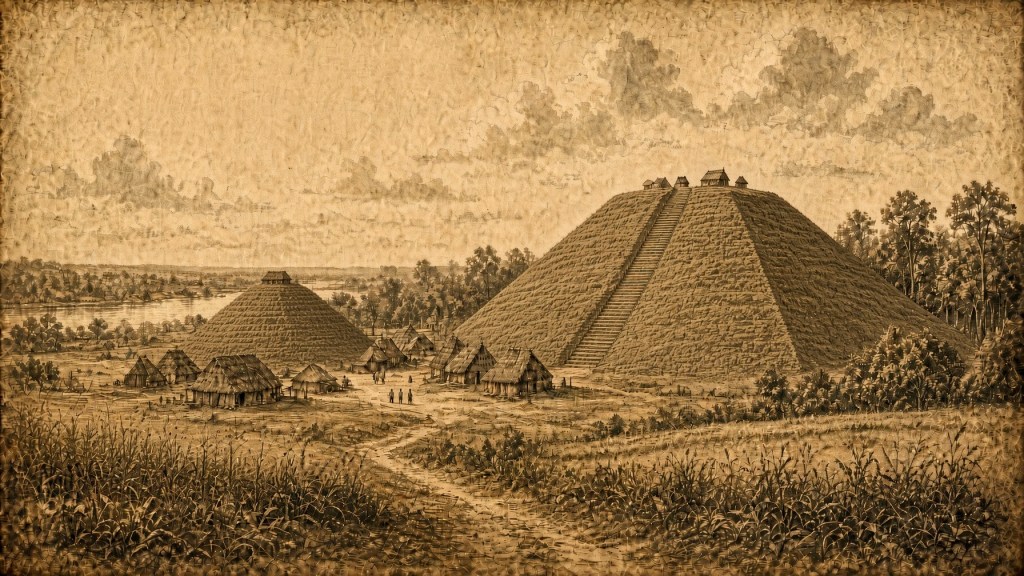
An exposed sycamore root makes a good canoe tie-off. Up the shore, past floodplain brush, driftwood, and plastic bottles, the ground is a soft wet field. Chief’s Mound comes into view: a long grass-covered platform with steep rectangular sides and a conical offset.

Here the high speech of the place is a lull — cicadas, a heron lifting from the slough.

The site shares a latitude with the Ephesian temple of Artemis. Across that line a mattress of charcoal and fleeces was packed into a wet basin. The harbor filled with silt. The sea crept away. One marble column is left in the marsh.

At Angel they dug out the earth to heap it. Great heights require plumbing the depths.

From atop Chief’s Mound an inventory of things to see comes into partial view: the visitor center, reconstructed huts, a palisade. Across a prairie that was once a plaza sits Temple Mound, a floor raised so a fire could stand above the damp.

The Evansville skyline is not visible from this secluded place. A distant barge sounds its horn as a little more ground leaves the site, down the Ohio toward Little Egypt.


Check out “Hidden Weathers: A Short Periplus of Place.”

Geographical Sketches

What the Floor is Not

sepia drawing of a karst landscape

A Short Periplus of Central Kentucky

A brook glints in the sunlight before vanishing into the dark earth.

Beyond the city, the conical hills are unseen. They mark what the limestone plain is not.

Places sit inside places, far or near, sometimes hidden. The weather of a region can change while the coordinates stay the same.

From the inhabited floor of the Bluegrass to the rim of the Knobs to the hollow ground of the Pennyroyal to the wash of the Ohio Valley, the countryside presences differently.

On the floor, a village called Athens shares the same parallel as the Ephesian temple of Artemis. It is a lull inside Lexington’s city limits: brick and farms just east of the interstate.

Different weathers gather on this rolling ground. Rivers cut palisades in the limestone, revealing remains of ancient marine life. Ice sheets never scoured this floor.

West and south, the woods thicken. Steep knobs horseshoe the Bluegrass. They were not heaped up like the earthen mounds. Everything around them was taken. The caps mark how high the plateau once stood. Hard to farm, thinly lived. On one wooded hill, Merton’s hermitage still stands.

The Knobs do not ease into the Pennyroyal. Muldraugh Hill is a true scarp, a plateau you do not have to infer. The ground under it does not stay solid: black rivers and empty chambers. On the same upland, a vault was built and filled with gold, charged with significance.

Fort Knox holds a hill above the Ohio, where cannons once looked down from a few hundred feet. To drop into the valley is to lose that perch — no field of fire, no cave, no vault. Only flood is guaranteed.

The ancients piled platforms the water did not take. Glaciers, stopping short of this line, carved the Ohio and buried the north side with a jumble of rocks and soil.

Now the river gathers the missing land and streams, seen or not, and carries them off.


Read “What a Parallel is Not: A Short Periplus of Angel Mounds.”