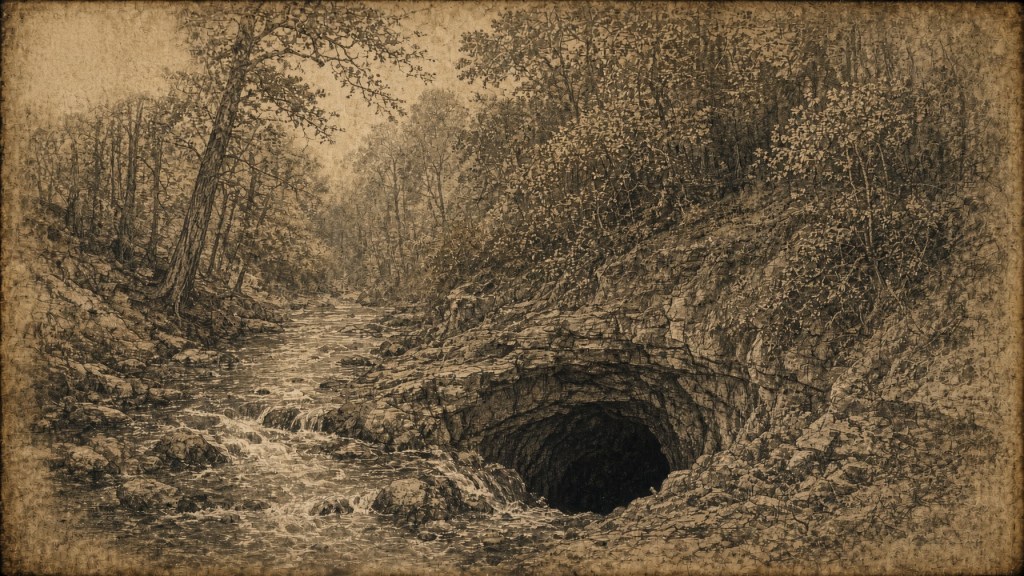
A brook glints in the sunlight before vanishing into the dark earth.
Beyond the city, the conical hills are unseen. They mark what the limestone plain is not.
Places sit inside places, far or near, sometimes hidden. The weather of a region can change while the coordinates stay the same.
From the inhabited floor of the Bluegrass to the rim of the Knobs to the hollow ground of the Pennyroyal to the wash of the Ohio Valley, the countryside presences differently.
On the floor, a village called Athens shares the same parallel as the Ephesian temple of Artemis. It is a lull inside Lexington’s city limits: brick and farms just east of the interstate.
Different weathers gather on this rolling ground. Rivers cut palisades in the limestone, revealing remains of ancient marine life. Ice sheets never scoured this floor.
West and south, the woods thicken. Steep knobs horseshoe the Bluegrass. They were not heaped up like the earthen mounds. Everything around them was taken. The caps mark how high the plateau once stood. Hard to farm, thinly lived. On one wooded hill, Merton’s hermitage still stands.
The Knobs do not ease into the Pennyroyal. Muldraugh Hill is a true scarp, a plateau you do not have to infer. The ground under it does not stay solid: black rivers and empty chambers. On the same upland, a vault was built and filled with gold, charged with significance.
Fort Knox holds a hill above the Ohio, where cannons once looked down from a few hundred feet. To drop into the valley is to lose that perch — no field of fire, no cave, no vault. Only flood is guaranteed.
The ancients piled platforms the water did not take. Glaciers, stopping short of this line, carved the Ohio and buried the north side with a jumble of rocks and soil.
Now the river gathers the missing land and streams, seen or not, and carries them off.
 Rob Robill