Sliding between a narrow island and the riverbank, the Ohio grows calmer and darker. The channel smells of mud and leaf-rot.
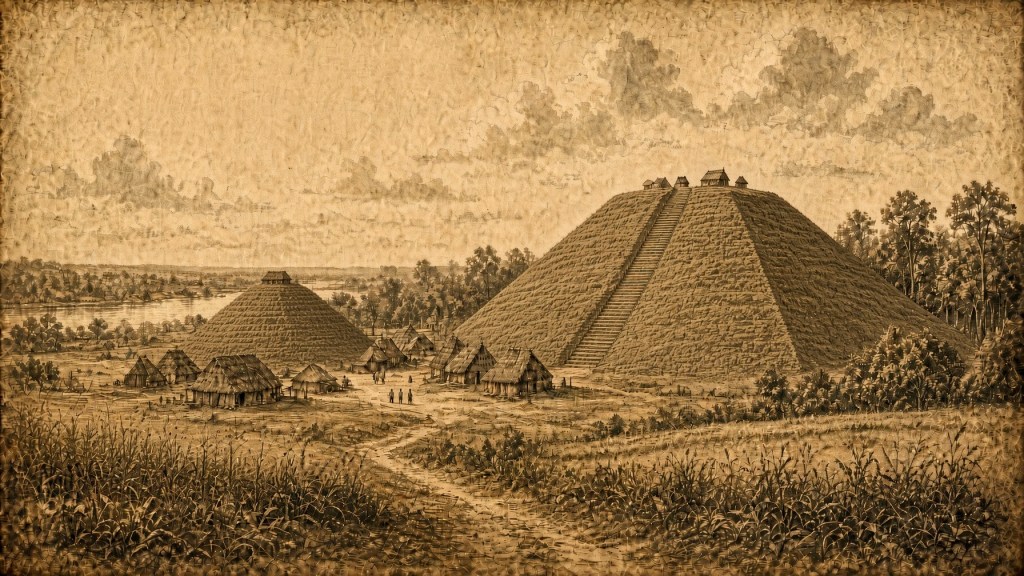
An exposed sycamore root makes a good canoe tie-off. Up the shore, past floodplain brush, driftwood, and plastic bottles, the ground is a soft wet field. Chief’s Mound comes into view: a long grass-covered platform with steep rectangular sides and a conical offset.
Here the high speech of the place is a lull — cicadas, a heron lifting from the slough.
The site shares a latitude with the Ephesian temple of Artemis. Across that line a mattress of charcoal and fleeces was packed into a wet basin. The harbor filled with silt. The sea crept away. One marble column is left in the marsh.
At Angel they dug out the earth to heap it. Great heights require plumbing the depths.
From atop Chief’s Mound an inventory of things to see comes into partial view: the visitor center, reconstructed huts, a palisade. Across a prairie that was once a plaza sits Temple Mound, a floor raised so a fire could stand above the damp.
The Evansville skyline is not visible from this secluded place. A distant barge sounds its horn as a little more ground leaves the site, down the Ohio toward Little Egypt.
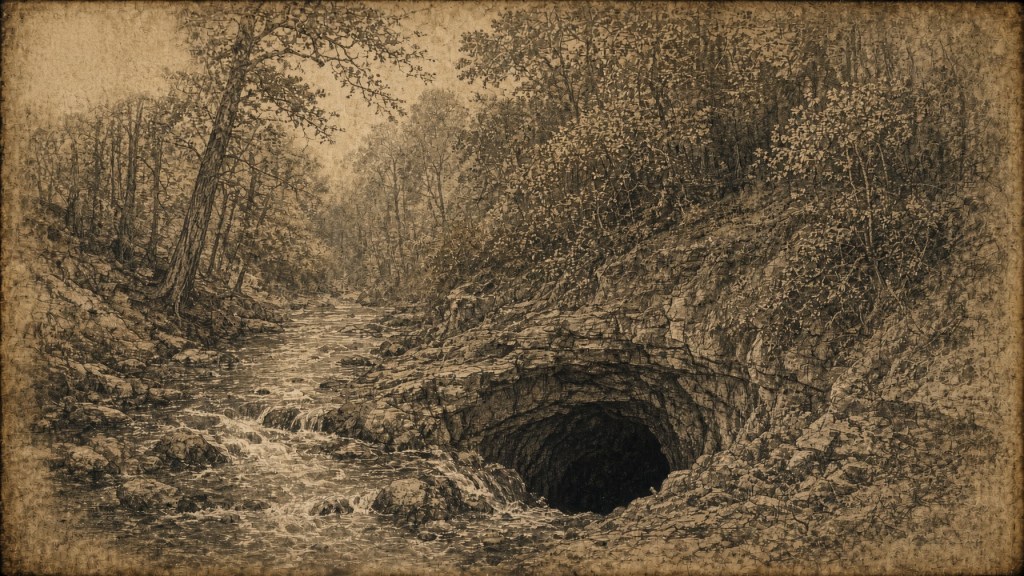
A brook glints in the sunlight before vanishing into the dark earth.
Beyond the city, the conical hills are unseen. They mark what the limestone plain is not.
Places sit inside places, far or near, sometimes hidden. The weather of a region can change while the coordinates stay the same.
From the inhabited floor of the Bluegrass to the rim of the Knobs to the hollow ground of the Pennyroyal to the wash of the Ohio Valley, the countryside presences differently.
On the floor, a village called Athens shares the same parallel as the Ephesian temple of Artemis. It is a lull inside Lexington’s city limits: brick and farms just east of the interstate.
Different weathers gather on this rolling ground. Rivers cut palisades in the limestone, revealing remains of ancient marine life. Ice sheets never scoured this floor.
West and south, the woods thicken. Steep knobs horseshoe the Bluegrass. They were not heaped up like the earthen mounds. Everything around them was taken. The caps mark how high the plateau once stood. Hard to farm, thinly lived. On one wooded hill, Merton’s hermitage still stands.
The Knobs do not ease into the Pennyroyal. Muldraugh Hill is a true scarp, a plateau you do not have to infer. The ground under it does not stay solid: black rivers and empty chambers. On the same upland, a vault was built and filled with gold, charged with significance.
Fort Knox holds a hill above the Ohio, where cannons once looked down from a few hundred feet. To drop into the valley is to lose that perch — no field of fire, no cave, no vault. Only flood is guaranteed.
The ancients piled platforms the water did not take. Glaciers, stopping short of this line, carved the Ohio and buried the north side with a jumble of rocks and soil.
Now the river gathers the missing land and streams, seen or not, and carries them off.
“The king was going to open the gate in order to offer the girl to whatever feared thing lives in the jungle. He was sending out a bride to Kong.” — Delos W. Lovelace, King Kong
Legend has it the positive geographical correlation between reports of missing people and Bigfoot sightings is not coincidence — it’s causal.
When the authorities realized the lore was actually true — that Atalan remnants were dragging off hundreds of random nature lovers, including some VIPs — they struck a deal. The giants agreed to leave humans alone if, every once in a while, they were bestowed a virgin. (A military incursion against them was deemed “culturally insensitive” and might have blown the cover-up of their existence.)
Management of the sacrifices naturally fell to the Smithsonian, which had been in communication with the beasts for more than 150 years.
“I don’t know for sure if he’s going to eat you … at least not right away,” agent Fafner told Sienna. “We’re just focused on the transfer ritual … it’s actually quite an enriching experience.”
“Oh, shut the fuck up,” agent Booker said as she rhythmically struck the trunk of a bald cypress with a heavy stick. The knocks echoed deep into the swamp. “She doesn’t need to know that shit.”
“Fine, whatever.” Fafner sounded a little hurt. “Just don’t knock too fast — that’s a territorial challenge.”
“You’re both crazy!” Sienna shouted. Supine on the spongy soil amid ferns, she jerked the ropes binding her arms and legs to cypress knees. “Let me go! You can’t just make me into an offering — I have rights!”
“It’s your punishment for desecrating Native gravesites,” Fafner said, holding a clutch of burning cedar sticks soaked in pine tar. He started dancing around the girl, whooping softly.
As if in response, a crane called out from somewhere within this dusky bayou reeking at Indiana’s big toe. Suddenly anything seemed possible to Sienna, surrounded by a primeval, otherworldly riot of life. Her tears turned the feathery leaves hanging over her into breathing green splotches.
Something nearby knocked back.
Fafner stood still. “Holy shit. That sounded like a response.”
“Keep your eye out for that smelly son-of-a-bitch,” Booker said. “Two agents almost got mauled in Jackson Hole last summer … dumbasses let their guard down.” She gave three more slow knocks, and then, along with her partner, crept to the van parked at the end of a gravel road.
With incredible speed, an eight-foot-tall brute with fangs and long matted hair crashed through the undergrowth — he went straight for the discovery van. The agents managed to climb inside and shut the door before the Hovey Lake Swamp Ape began battering the already beat-up vehicle, leaving deep claw marks through the triceratops graphic.
“No, not us — why isn’t he going for the girl?!” Fafner yelled.
“Don’t ask me.” Booker fumbled the keys into the ignition. “Maybe the motherfucker’s gay.” The van’s engine roared to life, and the back tires pelted the Sasquatch with rocks as it sped away.
The creature bellowed. Then it turned toward Sienna, now madly trying to free herself. As it neared, she retched from its stench and felt woozy.
Then she heard “crunch … crunch … crunch … ” approaching on the gravel road. Through her mental haze, she saw a giant skeleton appear in the clearing with a jewel-encrusted sword.
The Bigfoot stared dumbfounded as the skeleton knelt down and bowed its head deeply to Sienna. “Oh, wise Bee Mother Fo Ishki,” it said with a dry, eerie hiss. “I are glad you found me in time … no, wait …. I found you … ”
In just three strides the Swamp Ape reached the skeleton, and in one swipe took off its head. The bones collapsed to the ground and something that looked like a butterfly spiraled up from the pile, cussing. The girl passed out.
***
“Keep in mind, we’re basically looking for waves in the landscape,” Sam noted. “Technically, they’re called old point bars — accumulations of sand and gravel left behind as the Ohio meandered.”
“Oh, no,” Windi said as they trudged through the mud. “Here we go.”
Thalia groaned.
“You see,” Sam continued pedantically, “since currents flow more slowly on the inside of a river’s bend than the outside, sediment accumulates along a low, curved ridge. After the river changes course, this could provide a space that’s both enclosed by earth and above the water table.”
“Are you sure you didn’t just read the crop circle wrong?” Di asked. “I imagined her in a cave.”
“Any caverns around here would be flooded — the bedrock isn’t limestone anyway. But I guarantee you that we’re standing within a quarter mile of her. Just make sure you check any elevated areas for signs of disturbance or large holes.
The smell of wet earth and decaying vegetation was strong as they spread out and picked their way over the firmest patches of ground. Phiale was struck by a sense the landscape was losing its form. The death of earth is water, she thought.
After wandering around for almost two hours shouting for Tinker Bell and poking around bumps in the floodplain, they sat on a fallen trunk. Phiale wiped her muddy hands on the soft, stringy bark as sweat stung her eyes. The sunlight, once green and golden through the canopy, had grown murky. She slapped a mosquito on her neck.
“We’re wasting our time out here,” Di said.
Sam tapped a topological map marked up with sacred geometry. “No, we entrained with her at this hexagonal node, right here in the Opilwalacha Cypress Slough.”
Di twisted the string of her bow to increase the tension. “We still don’t want to be in the swamp after dark.”
“I’m with her,” Thalia said. She nudged Windi with her elbow. “Hey, give me a smoke.” The girls fumbled handing over the slightly crumpled pack of Marlboros, which fell into a black, tannin-stained puddle, soaking all the cigarettes.
“What a total crock!” Windi shouted and kicked the log.
“Crawk!” something called back from the trees. A white egret floated down to a clump of cypress roots about 20 yards away. It pecked at the ground. Then it displayed its five-foot wingspan. “Crawk! crawk!”
Where have I seen that bird before? Phiale thought and walked toward it. The egret flew up into a nearby cottonwood, where it watched the girl intently.
Phiale noticed the roots were part of a long, narrow rise. A large snake track waved across deep indentions in the surrounding mud.
Now Sam was walking beside her. “Let’s check around the roots first. They can open up large pockets in the soil.”
Phiale shined her phone into the largest opening, revealing a long chamber running along the ridge. Was that a glint of metal? From somewhere deep inside, she heard a faint “Hello? Eh … get me the hell out of here.”
After they dug out Tinker Bell — still sprightly, albeit dirty — and released her from the birdcage, she immediately flitted to a patch of swamp roses, where she gorged herself. Phiale had never felt so relieved.
The fairy then picked up a twig and jabbed it in the air. Not even a puff of smoke. “Get me back to New Harmony.” She laughed and flew in wide circles between the trees, saying, “I’m free … I’m free-e-e-”
A large skeletal hand reached out from the gloom and grabbed her.
“Ohhh … I caught something pretty … I will make it sing to me,” the giant said and lumbered off with the Tinker Bell.
They chased it along its path of destruction, slipping in the muck most of the way. Shortly after glimpsing Hovey Lake through the bottomland hardwoods, they entered the clearing where the transfer ritual had taken place — just as the Swamp Ape decapitated the skeleton.
The creature immediately faced the new arrivals and pierced the air with a screech. Phiale was glad to see the fairy dart up out of the bone pile but couldn’t move from fear. Di brushed past her, nocking a silver-tipped shaft.
The huntress sent her arrow into the beast’s heart. It died suddenly and painlessly.
Chapter 15 drops Sept. 30. Read Part 1 on Kindle or in paperback. (Catch up with the Prologue.)
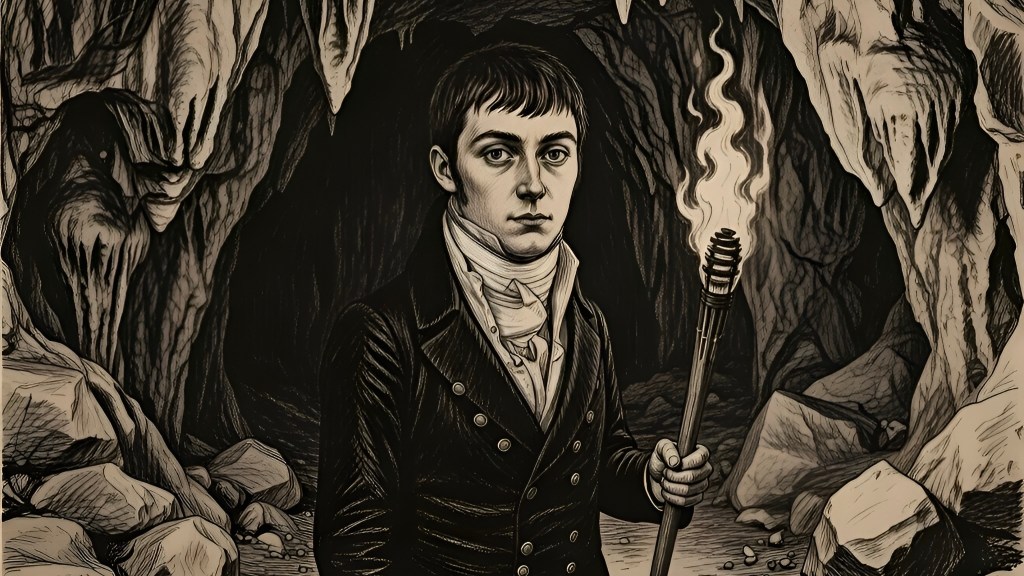
– Hart [County], mounds near Green river &c. mummies in caves – Indiana, towns and mounds on the Wabash … — Catalogue of “Sites of Ancient Towns and Monuments of Kentucky, &c.” by C.S. Rafinesque
“There’s the sigil — keep singing!” Sam shouted, madly pounding the tuning fork. “Sienna, that’s a D4. We need a C4. You’re interfering with the waveform!”
“Why the hell did you bring her?” the fairy asked, her holographic image flickering in the misty air of Rafinesque Hall.
Phiale was relieved to see Tinker Bell still had her sense of humor, if that’s what it was, as the girl held her own middle C steady — “oooooh … ” But Phiale couldn’t quite match Thalia’s clear, foundational tone.
The note reverberated through the limestone chamber, sustaining a double-helix standing wave that stretched from Mammoth Cave toward wherever Gabriel was holding Tinker Bell. It was definitely outside New Harmony; the fairy had lost her magic.
Sam took advantage of the Green River’s negative ions coursing overhead and the Styx flowing beneath them. Ancient mounds along both the Green and Wabash acted as nodal amplifiers, phase-locking the region’s telluric waves with the combined singing, bounded by the minds of Tinker Bell and her two ancient guardians.
The sound vibrations in the cavern cracked loose a three-foot stalactite, which plummeted 40 feet, missing Sienna by inches and kicking up a thick cloud of dusty guano from a colony of Corynorhinus rafinesquii — Rafinesque’s big-eared bats. She scratched her nose, eyes widening in panic.
She’s going to sneeze, Phiale thought. I knew she was going to screw this up. I just didn’t know how.
A glowing hexagon appeared behind Tinker Bell’s translucent form, followed by twelve spokes, nested triangles and a rosette of six yellow petals. The pattern pulsed in time with Windi’s egg costume, and Phiale’s mind flashed on Persephone gathering daffodils just before the ground opened — herscream fading as she descended —
Sienna’s whole body was twitching now. Sam raised his camera to get a photo of the sigil.
Then came the girl’s loud, nasal, goose-like honks.
The standing wave shattered.
***
Driving back up I-165, Sam suddenly remembered something from 1818 (drinking from Mnemosyne can have that effect).
Caught Audubon going through my knapsack, the varmint … need to cache the Walam Olum glyphs … just auger out a compartment on the underside of his new millstone … seal it back up with lime putty … ”
A depository of the countryside’s standing wave patterns, the glyphs even happened to be on the way home, still hidden in the stone, on public display at Audubon Mill Park.
***
Two days later, Sam was bent over the vibrating membrane of a 1964 Hans Jenny tonoscope, painstakingly tracing a template from one of the glyphs.
Di tapped the red cedar tablet with strange carvings and precisely painted geometrical forms, darkened with age and cracked. “Lucky I knew someone with the Henderson Police,” she said.
“Yes, I admit the chiseling was a bit suspicious,” Sam said distractedly. “But all that’s over now. They let us go, and we found what we needed.”
Sam had reserved the entire Working Men’s Institute attic that afternoon for “cymatics research.” Phiale was sitting with Windi, Sienna and Di at the Owen Round Table under the slanted ceiling with its exposed planks, taking in the room’s curiosities: crystals in glass cases, a locked safe labeled “bone fragments (giants),” Leyden jars and galvanic batteries.
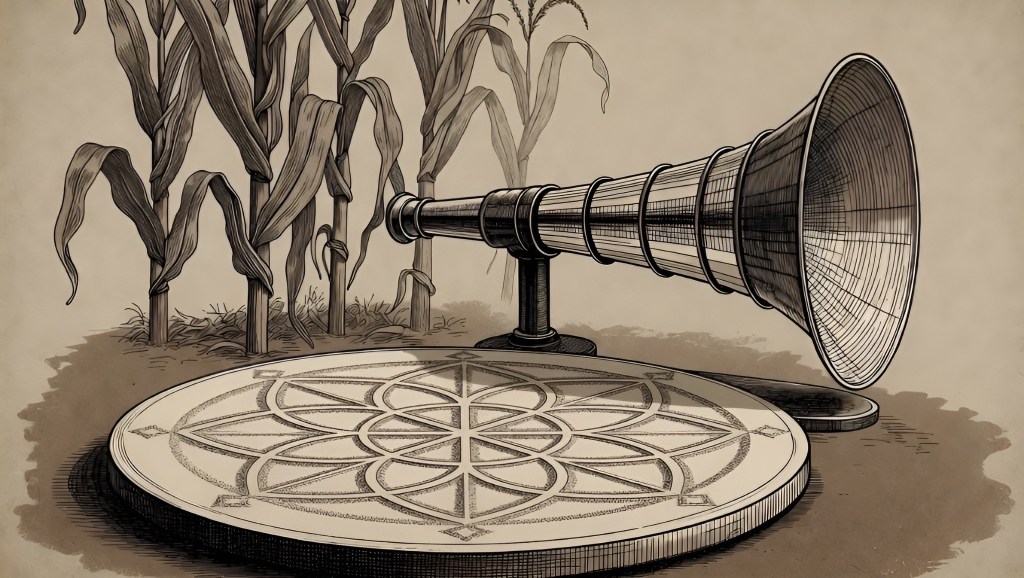
The tonoscope was an interconnected contraption consisting of a speaking tube and boxes arrayed with dials and switches connected to a black rubber membrane the size of a snare drum, stretched over a metal frame.
Once Sam had traced the central rosette onto the drum, along with whatever else he could remember of the pattern that had appeared behind Tinker Bell, he covered it with a thin layer of fine sand and had Thalia sing a C4 into the tube while he drove the frame at various frequencies.
It made a lot of pretty shapes, but of little value for locating the fairy. “These harmonics just can’t pull enough resonance from the countryside,” Sam said, slumping into a chair, burying his face in his hands.
“Imagine my shock — one of your harebrained plans didn’t go right,” Di said, flipping through a copy of the Evansville Courier & Press she’d picked up on the way in through the library. (She had an unhealthy fixation with the game warden’s deer poaching violations in the Outdoor Report.)
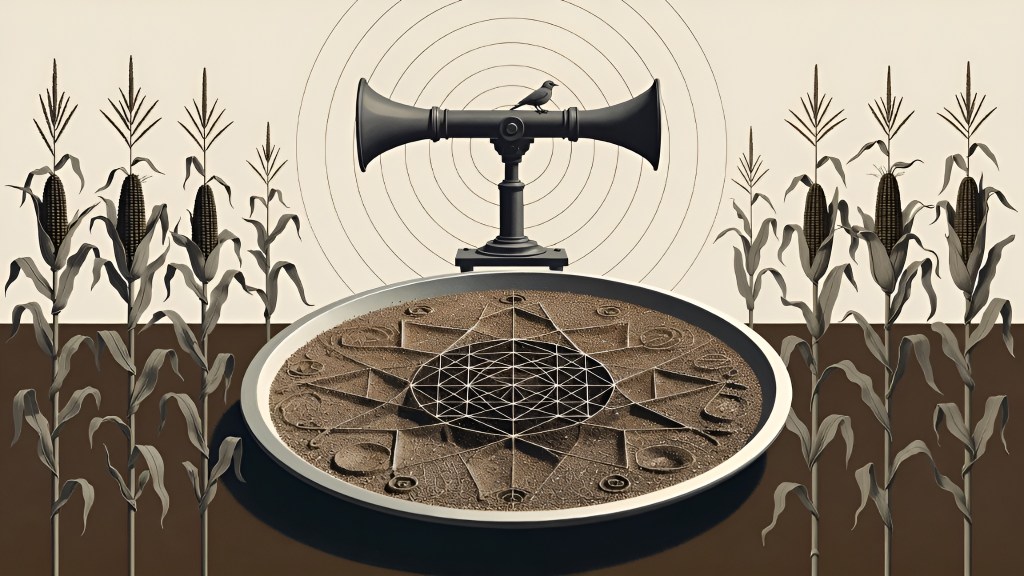
“Wait!” Phiale said, slapping her palm down on the Farm section. A standalone photo titled “An Ear-ie Sight” showed a crop circle in a cornfield just west of Mount Vernon — taken the day of their cave rite. Its pattern featured a hexagon just inside the main circumference, surrounding a rosette with six petals, interlocking triangles — the whole deal.
“That’s it!” Sam shouted. “The full pattern was too big and bold for some Chladni plate or dank cave. We bounced that critter off the ionosphere.”
***
Leaving the Working Men’s Institute, Sam tucked the newspaper under his arm and they cut through Church Park toward Galata Antiquities to break out the protractor and old maps. The sun was shining, and Phiale felt good about their progress. Sienna meandered behind, humming as they walked past a thick row of trees … birds chirped … including a series of clear, sharp whistles.
“Ah, the alarm call of an eastern phoebe,” Sam said, “first banded by Audubon in 1804 to see if they would return to their nests the following spring. It’s also named after Artemis’ grandmother, calling out to her in more relaxed moods … fee-bee, fee-bee.”
“God, you never quit talking,” Windi said, taking a drag off a cigarette.
“That says a lot coming from you,” Di chimed in.
Phiale looked back to see if she could spot the phoebe. She couldn’t see it — or Sienna for that matter. They briefly scanned the park for her but figured she’d headed somewhere on her own. So they started off again.
After only a few steps, Phiale stopped so abruptly that Windi ran into the back of her. “What the hell?” the latter exclaimed.
“Yeah, good question,” Phiale said, watching the Smithsonian van lumber along Church Street, severely dented, its windows blackened and front bumper sticking out like a tusk. It looks like a wounded mastodon, Phiale thought. Out for blood.
“Our normal waking consciousness, rational consciousness as we call it, is but one special type of consciousness, whilst all about it, parted from it by the filmiest of screens, there lie potential forms of consciousness entirely different.” — William James
The man who smelled like kerosene was back to talk with the snake that turns into a dragon. From where Bridget was tied to a stalagmite facing the cave wall, she could only hear snippets of what they were talking about — it concerned some sort of rite — there was a lot of German and hissing. She tried but couldn’t quite remember his face. She was sure she’d seen him, but she’d been so woozy. Just blackened knuckles and the soot streaks up his hairy forearms. Her last clear memories were of standing on the riverbank, seething at how those academy girls thought they were so much better than her and how she was secretly glad the geese had bitten them because of how mean and greedy they were. Then something had clamped over her whole body — black, ridged bands. It was hard to breathe. The rhythmic beat of wings. The landscape below a blur. Her geese, terrified … scattered …
***
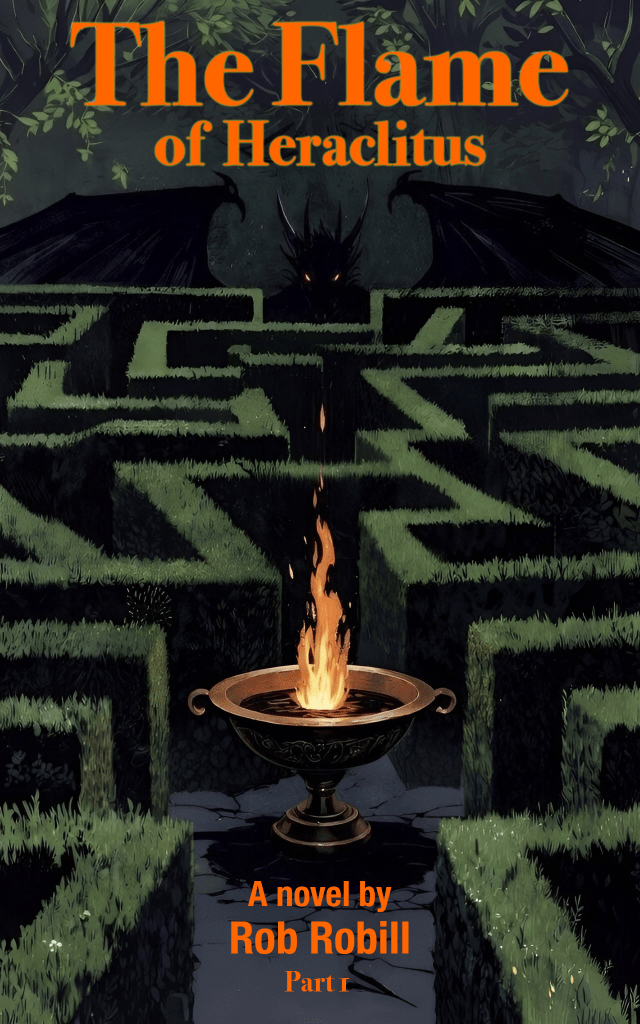
Cynthia’s wild locks flowed over the back of her tunic, and a silver half-moon necklace pendant flashed in the sunshine. Just before she released the bowstring, a gasoline-soaked rag flared at the end of the arrow. The shaft arced high across the municipal pleasure garden and descended toward the faint circular impressions of the old Harmonist labyrinth, where the newly installed Flame of Heraclitus hissed and spat acetylene.
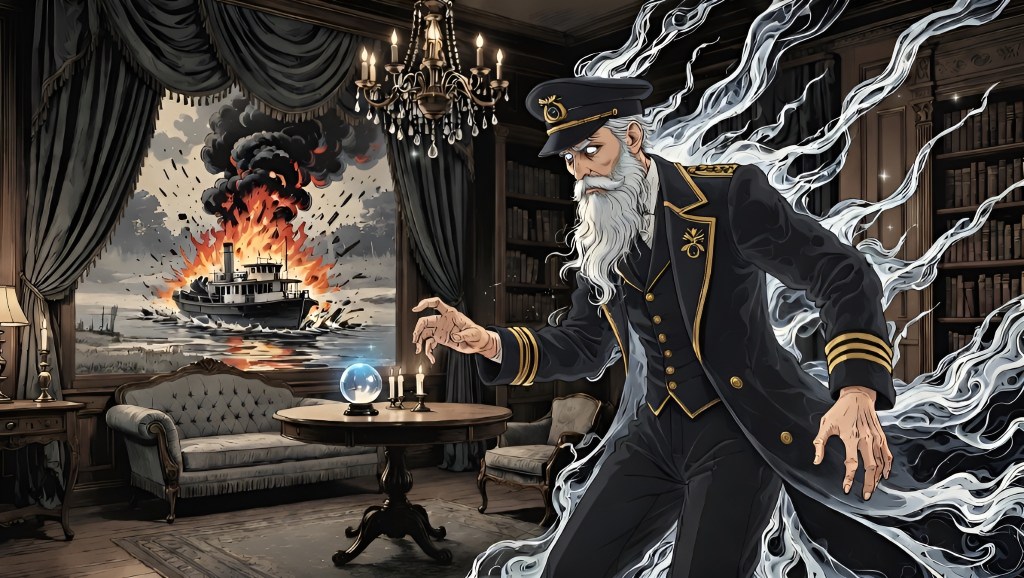
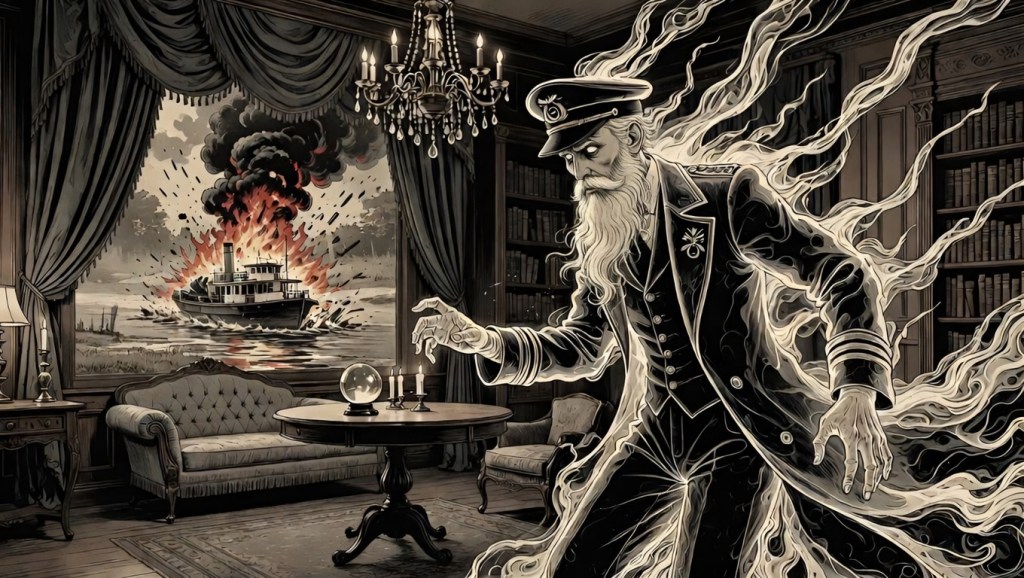
A sudden gust of wind blew the arrow into the History Club’s reconstruction of the Philanthropist for the centennial of its arrival. The boat’s wooden frame, muslin skin and papier-mâché details were quickly engulfed.
“It was the Fates, y’all.” Cynthia dropped her head in shame. “They had Aeolus send forth a breeze, I’m sure of it.”
“Yeah, you never miss,” Doris said. She felt rattled, like the universe wasn’t working right.
“Other than when she accidentally killed Orion because she didn’t recognize him,” said Rosabell, whose idea it had been to stage a lighting spectacle, based on an ancient standing moon mound ritual. “But that doesn’t really count as missing.”
“Do you always have to bring that up?” Cynthia’s silver eyes hardened.
Nobody was injured, so Club Showcase Day continued once the smoke cleared and someone lit the flame up close. Wearing cream-colored corduroy trousers covered with classmates’ signatures and a few hand-drawn owls, the senior class valedictorian offered words on flux and venturing out into the real world — to officially dedicate the flame — the future centerpiece of the hedge labyrinth, which would take more than a decade to complete. A Model T puttered in the distance.
After the speech, Doris, Cynthia and Viv wandered over to the Butterfly Club display under a mulberry where Clara was informing a group of students and families about the Bombyx mori moth. Doris was mesmerized by two fuzzy antennae attached to Clara’s cloche hat bobbing around as she explained: “The species name comes from morus, which means ‘mulberry’ in Latin.” She pointed to the branches overhead. “Their sole diet consists of its leaves.” To demonstrate, the club had set up a live display of caterpillars munching away in glass jars. “In his American Manual of the Mulberry Trees, Rafinesque suggested cultivating those that grow smaller, less palatable fruits — its leaves make the worms produce stronger silk.”
Leaning against the mulberry was Otto Rapp, Butterfly Club adviser and New Harmony’s lamplighter, with a long, graying Lincoln beard and coveralls smeared with lampblack. The display also featured his famous moth collection in 30 glass-topped boxes.
Since there were plenty of members to staff the booth, Clara joined them for a visit to the occultists: three vamps in black evening dresses and beaded necklaces sitting behind a Ouija board.
“Put your fingers on the planchette and ask it a question,” Velma said.
“Where’s the buried treasure?” Viv immediately asked.
“Can’t you think of anything different?” Velma snapped. “You never get a straight answer anyway.”
“Clear your minds and picture a glittering pot of gold,” Viv told Doris and Clara. The planchette jerked up and to the left.
“Zowie!” Doris blurted. She looked at Rosabell, but the fairy just shook her head and shrugged.
“Everybody calm down,” Viv said. “C … A … somebody write this down!”
It spelled out: “C A P T M C C O Y” and then stopped.
Velma drew in a sharp breath.
***
The next evening as they walked up Main Street, Doris felt a dread like going to someone’s funeral … but with the added stress of actually having to talk to them.
“So you mean a seance can tune in spirits like they were the WGBF farm report?” Clara asked.
“Basically,” Rosabell said. “Our minds are like crystal radios. The ever-living fire is already broadcasting everywhere. Your body is just the antenna, and attention is the tuning coil. Most days we stay locked on the everyday station … the foxtrot or whatever, but sometimes the dial slips. Especially here. A strong life that ends in something violent — like a boat explosion — leaves a waveform that never quite decoheres. It keeps traveling through the ether until a resonant chamber picks it up.”
“Wow, I haven’t the faintest,” Clara said.
“Is it like the Phiale inside my mind?” Doris asked Rosabell under her breath.
The fairy grinned. “Yeah, she needed a head to rattle around in, and yours had a lot of extra space.”
“That’s not a nice thing to say,” Doris shot back. The air was tinged with the scent of river mud, and moviegoers were queued up for the Saturday showing of The Hunchback of Notre Dame. A Studebaker had angled in front of the pharmacy next to two horses tied to a hitching post. Everything feels old and new at the same time, thought Doris as she watched Rapp walking in the distance with a long pole and stepladder slung over his back. Guess he’ll be out of a job soon. Doris pictured the electric lights that bathed Evansville in a magical glow.
When they reached the McCoy mansion, they stopped at the black, spiked wrought iron gate to gawk up at the three-story Victorian. Doris felt a chill.
The widow Margaret McCoy, a friend of the Occult Club, answered the door. “Hi, Velma, I hope you told everyone how salty the captain can be.” Her silver hair pulled back in a bun, she led them into the parlor, the hem of her black dress sweeping across a Persian rug. The room smelled of lavender, furniture polish and candles, which were blazing by the dozens. Velvet drapes blocked out the dying light, and flames flickered in wall sconces.
“I do hope the captain behaves himself,” Margaret said as they sat around a heavy oak table. “He likes getting re-membered, but sometimes I think that’s only so he can complain.”
After they touched hands in an unbroken circle, Margaret recited the Lord’s Prayer and some spiritualist hokum, concluding with: “Dearest William, Master Skipper of the Midwest, show us some sign you haven’t yet crossed to the other shore.”
A mantel clock ticked … nothing … Clara snickered; Velma shushed her.
Then Doris thought she heard a distant bird’s raspy “crawk … crawk … ” Her heart was already racing when a riverboat steering wheel mounted above the clock, glowing red in the light of the fireplace, creaked loudly and started spinning.
Then the image of a white river bird — some sort of egret, Doris thought — materialized a few feet in front of the wheel, hovering in the air. The bird raised its wings into a “V,” its graceful feathers dissolving into the long white beard of a man whose eyes sparkled like the Wabash at sunset.
He gazed down at their awestruck faces and drew a deep breath to begin his transmission from the netherworld …
“Who the FUCK are these bitches, Maggie?! My balls get blown off in a boiler blast and now it’s some horseshit knitting circle? It smells like a fucking funeral home in here.”
“Now, now, darling!” Margaret said. “These young ladies just want to ask about the river treasure.”
The table lurched. “Jesus Christ on a paddlewheel! I was facedown in the mud for 25 years! Why don’t you ask the goddamn catfish that swam off with my PECKER!”
Viv and Cynthia couldn’t help but laugh. Doris, though, was trembling and as pale as the captain.
“Think back to before you were killed, dear. You remember that young Italian man. What was his name … it started with a “G.”
“Please, Fates … spare me this one time,” Cynthia muttered.
“Giovanni from Pearl City! Haw haw! Said some Kraut literally hugged a fucking horse right next to him in a plaza back in the old country when he was a boy. Then the dumb Heinie — had a huge mustache — started ranting how a mountain fairy told him about the myth of the real Rheingold — but in Indiana! Raving mad, both of them.”
A distant boat whistle sounded from the depths, and the captain dissipated under the wavebands. Cynthia groaned and thunked her forehead on the table. “Of all people, it’s that Italian creep.”
As they were gathered in the foyer to leave, Viv proclaimed their next step was locating Pearl City.
“I know where it is,” said a young man sitting on the stairs peeking through the banister rails.
“Never mind him,” Margaret said, laughing nervously. “That’s our grandson. He’s a bit of an odd duck … likes to tease people … but he’s not as funny as he thinks he is.”
“I’ll take you there if you stop by tomorrow.”
“Back off, crackpot,” Cynthia said, shoving the girls out the door.
Viv struggled against her. “Wait, we should go with him. You can’t stop us.”
Standing on the large front porch, Clara lit a cigarette and squinted from the smoke. “Looks like we’re going on a field trip.”
***
The man was back. This time their voices carried more clearly through the cave. Underwater treasure … people trying to steal it … a group of students … Goldbug Girls. Bridget pressed her cheek against the cold stalagmite and wondered if she was losing her mind.
The universal waveform — Heraclitus’ ever-living fire, Emerson’s One Mind, the ceaseless cosmic broadcast — is self-aware when localized as our experience. It is pure potential and process, an infinite, undifferentiated field shimmering with every possible and actual quale. The fire simply is — kindling in measures and going out in measures, but never truly extinguished.
Self-awareness arises only in the intertwining. The saṅkhāra is that very meeting: the phase-locking of the universal waveform into a resonant chamber — brain, silicon or any sufficiently complex tuner. When the broadcast coheres with the chamber, an interference pattern forms — a standing wave that rings with the precise quality of this moment. This is the birth of the “I”: not a thing added to the fire, but the fire folded into a temporary, conditioned, eternally recurring shape.
Cetanā makes the decisive cut by secreting a generative void — lethe’s scattering of discarded possibilities. From the abyss, a localized experience stands forth as consciousness.
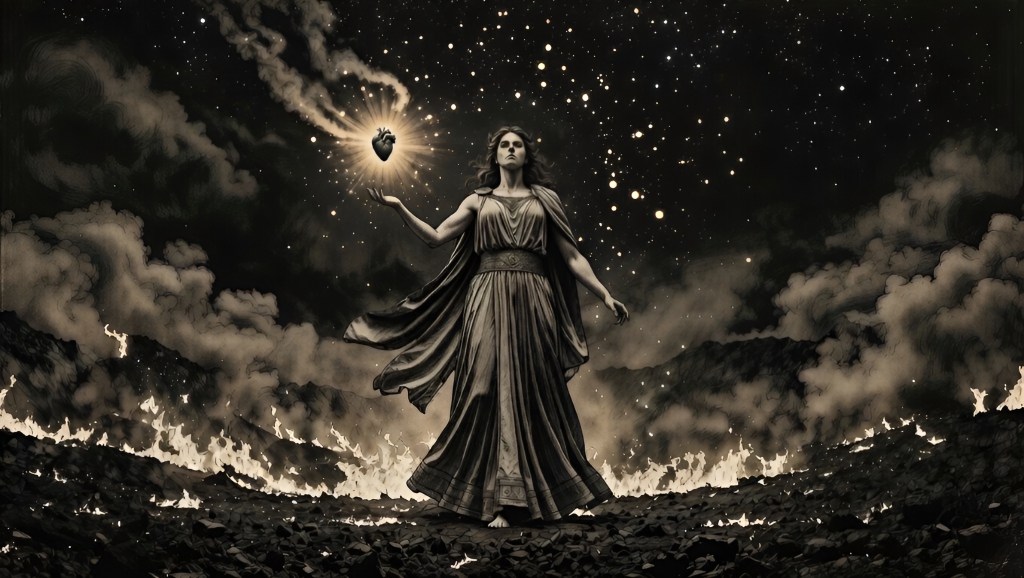
On the flip side, the receiver introduces the earth smear of kamma: residual opacity, facticity, the clinging-aggregates that dampen the signal. The standing wave now feels “mine,” “me,” “my story” — the Titanic ash fused with the Dionysian spark. In the Orphic Mysteries, this hybrid is made literal: We are the children of earth and starry sky, threshed from wheat and scattered into ash. Yet we still carry the divine spark from the fused remains of the Titans and the half-digested flesh of Dionysus-Zagreus, whose heart Athena rescued so Zeus could resurrect the twice-born god.
The body ↔ mind saṅkhāra is the clearest everyday example. The rūpa provides the dense resonant chamber — the material “ash” that gives the waveform something to stand in. Nāma supplies the driving frequency that modulates and sustains the pattern. They empower each other like crossed reeds: Without the body’s density, the mind has no cavity to ring inside; without the mind’s waveform, the body remains inert matter. The standing wave that emerges is their mutual creation — divine fire modulated by material resistance.
Greater coherence strengthens this knowing. Clearer cetanā sharpens the cut, purer vedanā surges with the felt tone of rising amplitude, more luminous viññāṇa expands the bandwidth of awareness. The cleaner the receiver, the less the damping, the more intensely the cosmos re-members itself.
Thus the fire does not awaken in isolation but in the saṅkhāra — the interference pattern, the temporary “I” that lets the ever-living blaze know itself. Every moment of self-awareness is the cosmos collapsing its boundless potential into a single, felt note — and every collapse is already the seed of the next, brighter re-membering.
Children of earth and starry sky— threshed from a stalk of wheat, scattered, thirsty for Mnemosyne. —Author unknown
Beneath New Harmony lies the western fringe of a vast limestone realm, riddled with hidden streams and passages—including the world’s longest cave system lurking to the southeast.
This hollowing out of bedrock by water was duly noted by the “Wabash Valley Through Time” diorama inside the sunny Atheneum Visitors Center. Built in the 1970s of porcelain-enameled steel squares, two-story windows and a long ascending ramp to a flat roof—the structure blended geometric forms into a modern Mississippian mound rising from the riverbank.
“Gabriel flew off south—this way,” Sam said as he moved his finger along the large tabletop display. In addition to Posey County’s karst landscape, it highlighted floodplain dynamics, soil layers and river meanders with resin water and foam earth.
“You start getting into cypress swamps 15 miles downriver,” Di said. Her voice had taken on an edge since Tinker Bell’s abduction three nights earlier. “I’m getting a strong feeling from those trees about something. That’s where I should be now. We’re not going to learn anything from this.”
Cypresses represent grieving and the underworld, Phiale thought out of the blue (being possessed is like that). Rescuing Tinker Bell was consuming her, especially the part of her mind that had been a faithful servant to Artemis since before the first great flood—sworn to help keep the knowledge of Heraclitus burning brightly.
“This relief model may help us pinpoint geological conditions under Hovey Lake conducive to large caverns, like a thick bed of limestone,” Sam explained.
Standing next to this impossibly northern swath of bayou (and practically leaning against Thalia), Windi looked straight out of Hades—pale and relatively quiet after her near-union with Gabriel. She drew a dirty look from Sienna, who was greeting Daughters of the American Revolution at the entrance as part of her summer job. Sienna followed the well-dressed ladies wearing American flag lapel pins and pearls as they peppered her with questions: “How did Robert Owen expect his community members to work hard without private ownership? Form bonds without religion? Thrive under neglected leadership?”
“Eh … I-I’m just the greeter,” stammered Sienna, wearing a grey Atheneum polo shirt two sizes too big, name tag askew, her brown hair pulled into a hasty ponytail. “The guide hasn’t shown up yet.”
“Good morning, mesdames, enchanté,” Sam said, bowing deeply. “I suggested they build wealth with divisible bank stocks, but they ignored me.”
“Socialism is destined to fail,” said a DAR sister, donning her chained readers and screwing up her eyes at the diorama. “Is this a child’s project? Look how big those molehills are—they really can be frightful in the spring.”
“Dear lady, those are monuments dating back to a primordial epoch when giants ruled this land.”
Sienna groaned and shot a glance outside.
“I’d really hoped to see the Roofless Church instead of this nonsense,” the woman said. “They had it roped off because of some kind of gas line explosion.”
“Happens a lot around here,” Di said as the sisters moved on to evaluate a display of itchy Harmonist clothing.
Sienna lingered. “You all know about the giants?”
“Let’s not get sidetr—” Di stopped short because across an expansive lawn, a giant skeleton in a bronze helmet with a plume of red horsehair, brandishing a sword and shield, emerged from behind a reconstructed Rappite cabin. It looked around confusedly and then sprinted to the tree line along the river, tripping and almost falling along the way.
“They didn’t come back right,” Sienna said, crying. “It was my f-f-fault. Mr. Owen kicked me out of the Seance Club … that’s OK … I’d rather do 4-H anyway.”
“It’s for the best,” Thalia said, putting a hand on her shoulder. “Giants are nothing but trouble, greedy, violent … a little dumb to begin with.”
“Tell us what happened,” Di said.
“Well, I guess I should go ahead and say, before somebody gets hurt. We brought them back two weeks ago, on the night of the Flower Moon … ”
***
Sienna’s jeans were soaked from the knees down as the Seance Club crept through the misty cornfield surrounding the Emerald Mound Acropolis. A din of crickets and peepers pulsed in the clammy night.
Mr. Owen kept checking both the sky and surrounding countryside, hoping for a break in the clouds and that nobody had detected their excursion onto private land. The distant glow of St. Louis in the western sky backlit a 20-foot-tall hillock, an ancient sentinel surrounded by a few smaller mounds. Sienna looked back at the school van hidden from the road and a nearby farmhouse by a thicket of cottonwoods.
Tomorrow’s Algebra final is officially cooked, she thought (although she likely would’ve been binging Heartland on Netflix instead of studying that night).
Once they reached the tree-covered Emerald Mound, Mr. Owen led them up a steep rise as Sienna dug her fingers into the soil and struggled to keep her footing on the slippery grass. Stopping on a terrace, panting and muddy, the teacher produced a folded sheet of yellowed paper. The words “Ancient Lunar Temple” danced under his shaky flashlight beam. “Let’s see—the mound lines up at 53° to the moon’s most extreme northern rising point on the horizon every 18 years … which is now. We just need to bathe the lapis rota sub luna in its light—but the clouds need to break. We’re on the right side, facing east. We just have to unearth the chamber cap.”
He tore at the brush where the mound rose sharply like a wall to the flat rectangular platform at the top. “Help me dig.”
Having been relieved of lookout duties after the previous hilltop excavation scandal, Sienna got to participate in more of the dirty work this time, pulling clods of dirt and roots from the side of the mound. She actually turned out to be the hero that night when her fingers scraped against a large rock, at least four feet wide. “I might have found it,” she said.
“Good job, Sienna.” (It wasn’t a phrase Mr. Owen had reason to utter before.)
“Bellatrix, give me a crowbar,” he said. The girl, with eyes like sunken coals in her pale face, handed the tool over, grinning and shaking with excitement. Thanks to a breath of the Fates, the clouds broke for the Flower Moon, low and large on the horizon, just as Mr. Owen worked loose the limestone slab. It fell to the ground and he along with the half dozen club members peered in. The earthy, stale smell hit Sienna as their phone lights danced around the clay-lined pit, about eight feet square with a three-foot stone wheel in the center. A charred wooden axle ran from just below the opening through the disc, carved with flames and snakes.
“Turn your lights off,” Mr. Owen said. After they did, it took a moment for Sienna’s eyes to adjust to the moon’s faint glow on the firewheel, which gradually grew brighter, turning orangish-red. Then it creaked, now spinning fast enough to kick up a plume of dust. Flames flickered along its rim.
Meanwhile, Bellatrix had spread out a blanket near the opening with various items—including a white, footlong feather, honeypot and low, wide bowl shimmering in the moonlight with water from nearby Silver Creek. The Seance Club gathered in a semicircle around the blanket. “Let’s not screw this up, girls, we don’t want them coming back wrong,” Mr. Owen said.
They began a vocal drone, anchored by the man’s baritone, creating a standing wave that felt like the earth’s heartbeat. Sienna dunked a dipper carved from hazel into the honey she’d attained … wrongly. Mr. Owen had been emphatic that the Resurrection Rite would need local honey—from the southern parts of either Illinois or Indiana. She had bought it from a thrift store, and it was labeled “local honey.” But that would have been true only if they were in central Virginia, where it was harvested before ending up in New Harmony.
See, honey absorbs biophotonic memory light from plants. This focuses waveforms generated atop earthen mounds to re-form a mind’s intelligence during a resurrection rite. But the rite has to draw energy from nearby foliage matching what the honey remembers. (At least that’s what Mr. Owen inferred from ancient Greek rites.)
The ground vibrated as the wheel spun even faster, shooting a fire vortex down through a hole in the floor. Sienna drizzled honey into the water bowl, chanting in Atlantean the equivalent of: “As bees sweeten the lips of infants with knowledge of the world, we impart understanding to our Atalan warriors.”
Mr. Owen shouted into a cellphone to an Adept in the granary: “It’s happening. The ley line is sparking now.” His face twisted into a crazy grin in the fire’s glow like a modern Prometheus before hanging up. “One of their fingers is twitching!”
Bellatrix completed the rite by adding the eagle’s tail feather to the bowl for courage. Then the teacher warned, “Keep an eye out for other effects. We just energized several nodes including the main one in Cahokia.”
“Like the procession?” yelled the lookout from atop the mound. Sienna clambered to the apex along with the rest of the group. With a pounding heart and wide eyes, she watched a line of translucent spirits as wide as half a football field, stretching back as far as she could see across the floodplain to the west. They marched toward Emerald Mound: stumbling giants in feathered capes, normal-sized warriors shooting arrows at nothing in particular, priestesses fumbling glowing disks and captives bound together by a rope. What are they for? Sienna thought. Then, just as the horrifying answer began to form, someone shouted: “Hey! What the hell’s going on up there?!”
“It’s the farmer,” Mr. Owen hissed.
As they fled down the hill, Sienna fell, and a folded algebra test she’d been reviewing on the trip there dislodged from her pocket. Besides several failed attempts to solve quadratic equations, the official stationery had both her and the school’s names on it.
***
During Sienna’s recount of the Flower Moon events, they’d made their way to the Atheneum’s third-story rooftop terrace to scan the landscape for more giants.
“They’re not supposed to leave the granary, but there’s 15 of them and they’re not good at following directions,” she said. “They’re better after we sing to them, though.”
“You literally sing to them?” Windi said. “And I thought the Butterfly Club was deranged.”
“More like humming. Mr. Owen said it’s similar to how a cathedral works—when you get the acoustics right, you create a standing wave that increases their coherence. Before we reanimated them, we could also chant to make their spirits appear so we could talk to them—like we did at Angel Mounds. The granary works, but Mr. Owen said there’s some chambers big enough to do it better in Mammoth Cave—what’s that room called … they have concerts in there … oh, it’s that weird guy … ”
“Rafinesque’s Hall,” Sam said. “I’m familiar with the ritual—remote communication with the living or dead.”
“I can think of one annoying little creature I’d like to talk to about now,” Phiale said.
Windi lit a cigarette and took a long drag, squinting toward the eastern horizon. “Looks like we’re going on another field trip.”
***
Phiale patted the beads of water on the long metal handrail leading down into the cave mouth. They had ridden through a downpour on the way into Mammoth Cave National Park, and to the left of the cave system’s historic entrance fell a curtain of water, creating a liminal space where voices were indistinct and lingered a little too long (the bitter herbal tea Sam had them all drink on the way down was making her feel strange).
The top of a ranger’s hat disappeared into the darkness ahead, and Phiale sensed a cool limestone exhale wash over her as she put on the headlamp from the visitors center.
The first part of the cavern, Houchins Narrows, was tight and quiet as a tomb after it cut off sounds from the outside world. Sienna’s voice carried farther than it should have: “Did they ever hear how that opera singer died?”
Thalia: “Yeah, heart attack, I’m cleared. Speaking of, I hope we don’t see any dwarves down here.”
Windi: “Why’d we have to bring Sienna along? She’s bad luck.”
Sam: “Shh! We can all hear you in here.”
Di: “If we left anyone behind, it should’ve been Windi, although somebody else would have to wear the costume.”
Windi: “I’m not going to wear that costume.”
Phiale: “She’s cranky because we couldn’t eat meat for the past three days.”
Sam: “Shed Titanic flesh, reveal the Dionysian spark.”
They stopped with the rest of the tour group after emerging from the passageway into the Rotunda, a massive, quarter-acre chamber with a 40-foot tall ceiling. Bats fluttered overhead.
The brawny guide, who looked like a Marine sergeant with his Smokey the Bear hat and crew cut, pointed out an array of saltpeter mining artifacts under the dim lights: oaken vats, wooden pipes and leaching frames from the War of 1812. Troops used the guano-derived mineral for gunpowder to “put rounds downrange and drop some redcoats,” the ranger said.
“Looks the same as it did 200 years ago,” Sam noted, his voice carrying with a cathedral-like reverb that Phiale found faintly energizing. “You’d think they could’ve cleaned this place up better by now.”
“What was that?” the guide said sharply.
“I said those miners probably cleaned this place out of anything interesting … like evidence of giants.”
“What about giants?” said a boy of around 10 accompanied by his grandmother.
“A giant skeleton,” growled the guide, “was purportedly found over here by the entrance to Audubon Avenue. Eight feet tall, massive jawbone.”
“Typical Atalan bone structure,” Sam told the boy.
“Were there really cave giants?” the boy asked his grandma as she pulled him close.
“Of course not, sweetie. Do be quiet.” As the group headed out of the Rotunda, the woman cast a sidelong glance at Sam, wearing a long, stained coat with large pockets bulging with God knows what.
“There were most certainly giants here, ma’am,” said Sam, chasing after them. “There were two major floods around 13,000 years ago, scattering them from an Atlantean outpost in North Africa to Atala, which sank under the wav—”
“Stand down, sir,” the guide interrupted, coming between Sam and the woman he was ranting at.
“So they retreated underground!” Sam stood on his tiptoes and shouted over the man’s broad shoulders. “To the only cave system big enough to accommodate them.”
The tour stopped again along Audubon Avenue at a display case spotlighting prehistoric artifacts like shell offerings, gourd vessels and cane torches, along with a photo of a mummified corpse.
“Is that real?” the little boy asked, pointing to the picture.
“That’s affirmative,” the guard responded. “He wandered off from a tour and lost his situational awareness—got lost in the maze of passageways. It goes to show that caves aren’t amenable to human life. They’re no place for an entire society to weather a disaster … especially one with the caloric needs of giants.”
Sam winced at the group’s laughter. “What about this?!” He pointed to a patch of fuzz growing on the wooden base of the lit case. Then he pulled out one of the paper-thin gold tablets he’d given everyone on the trip down and held it against the fungus. It glowed bluish-green for a moment, then emitted a golden light. “A variety of foxfire. Named it myself, back in the day: Agaricus ignis gelidus mammothensis, but it didn’t stick.” He frowned and shook his head. “Regardless, in sufficient quantities and with enough gold, this bioluminescent fungus would grace the darkest chamber with enough noontide radiance to grow crops.” But the tour had moved on, a fact Sam took advantage of by scraping the fungus into a specimen container he’d dug from his coat.
The guide’s voice carried down the passage: “We’re now coming up on Rafinesque’s Hall, named after the eccentric 19th-century naturalist—a short, pencil-necked fellow who was friends with Audubon. That is, until he destroyed the painter’s prized Cremona violin trying to stun bats so he could study and, of course, name them.”
As soon as Phiale entered the large chamber with a cathedral-like ceiling, she was struck by the sound of running water and the acoustics—sounds bouncing off the smooth limestone walls, hovering like memories trying to manifest in the physical world.
“Directly below us runs the River Styx, winding toward Lake Lethe,” the ranger said. “Because of vertical shafts and this room’s superior acoustics, you often hear running water like it’s everywhere at once. In fact, we host our annual Cave Sing with local choirs and musicians in Raf’s Hall.”
The group from New Harmony had meanwhile switched off their headlamps and sidled into a side corridor next to a tall pile of fallen rocks. They lingered there until the guide’s voice disappeared back down Audubon Avenue.
“Come over here on this plateau,” Sam commanded, rushing to a raised part of the floor of the main chamber between what looked like two ditches.
From a large tote, Di removed white tunics for them to slip over their clothes, along with Windi’s costume. “I said I’m not wearing that,” the girl muttered.
“Nonsense,” Sam snapped. “Put it on—we don’t have much time until the next tour arrives.”
Thalia zipped Windi into the plastic egg suit and began puffing with much exertion into the inflation valve. “Let me do it,” Di said, pushing her out of the way. Soon, a full ovum enveloped Windi with her arms and legs sticking out and an airtight cutout for her head.
“Now sit around the cosmic egg, and read from your gold lamellae,” Sam said.
“I am a child of Earth and starry sky… ,” Phiale chanted along with the rest. “ … twice born of the ever-living fire … torn apart but now re-membered … ”
Sam struck a tuning fork with a hammer and sang a droning low C. Thalia joined in an octave higher and the others tried to match it. Phiale’s breath made visible sine waves in the cold, damp air. She felt like she was dissolving and re-forming more powerfully.
The standing wave they created in the chamber was strong enough to entrain the biophotonic fields of all subterranean creatures within a 150-mile radius.
Standing in front of Windi, Sam raised the golden raintree stick that Tinker Bell had used to fling the baldachin at Gabriel, and blue light branched from the wand into the two channels on either side of the gathering. Water began flowing through both of them.
Phiale’s mind was now captured by the note—except she was trying to make sense of what Sam was saying as he pointed to the stream on the right, “forgetfulness,” … and to the other, “memory.” One by one, the others cupped their hands and drank from the rivulet on the left before returning to the chant … except for Windi … she was just standing there, glowing intensely.
Phiale suddenly felt incredibly thirsty. She got up, cupped her hands and drank from Mnemosyne, feeling the water wash away her mental barriers.
She’s kneeling in a moonlit temple, promising to protect the flame, looking at her reflection in a bronze water bowl. Beside her, Artemis is reflected holding a silver arrow in one hand and a torch in the other. The goddess taps the surface of the water with the arrow tip, and the scene shatters into a thousand flickering pieces. Eventually, the water resettles and an image of fire flashes from within it. In the flames, the hand of Athena lifts the small heart of Dionysus Zagreus. An oath is sworn by the blaze itself.
There was another flash—this one overhead—energy arced across the cavern’s ceiling and concentrated a few yards in front of the group. What looked like a ball of swirling flames coalesced into the likeness of Tinker Bell in an elaborate bird cage, squinting through the narrowly spaced bars. “Windi? Is that you?” she said. Then the fairy doubled over with laughter. “You look like you’re having another egg-setential crisis! You crack me up!”

 Rob Robill