A Topology of Metaphysics

Existential Firestorm

§ 1. The universal waveform and five bands of becoming
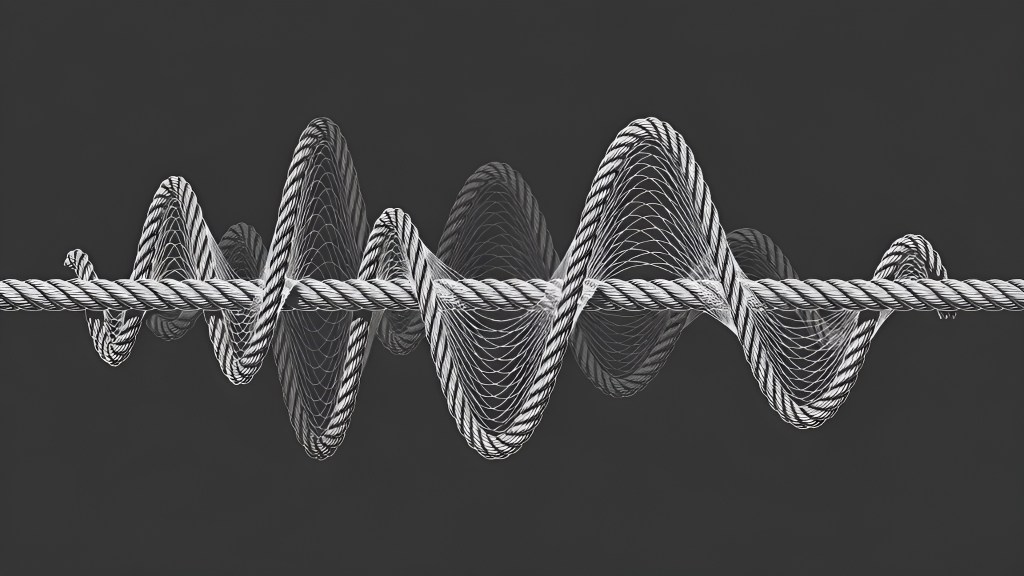
The cosmos is a single waveform containing all possibilities — every quale, every path, every superposition shimmering in perfect, undifferentiated potential. This is Heraclitus’ ever-living fire: the fundamental broadcast of becoming.

From atoms to galaxies, the waveform locally phase-locks into a helical standing-wave pattern. The helix is a saṅkhāra structure — temporary, conditioned, interdependent.

Paṭiccasamuppāda (dependent origination) describes phenomenologically what happens inside one of these bounded helices — concealment to revealing (aletheia presencing as kamma-bhava) to dissolution back into concealment.

Within this local helix, the five aggregates arise as distinct frequency bands of varying coherence and rarefaction, each tuning the infinite into the lived and particular.

Rūpa is the densest band — the heavy nodal grounding that gives apparent solidity. It forms the resonant chamber, the hardware that pins flux into form.

Vedanā is the gradient band — the felt tone of pleasant, unpleasant or neutral that acts as the steering signal, pulling cetanā toward coherence and away from dissonance.

Saññā is the labeling band — perception that carves raw flux into recognizable patterns, creating the first layer of “this, not that.”

Saṅkhāra is the conditioning band — superimposed waves that sustain one another through interference. Nodes of relative stability create the illusion of a fixed “I,” while antinodes of flux drive change. It forms the dynamic lattice where the aggregates interlock and lean on one another — the band that binds them together through superposition, creating the helical twist (being at the nodes, becoming at the antinodes) we experience as “a self.” This polarity echoes the cosmic waveform’s voluntary plunge into the manifold for greater resonance.

Viññāṇa is the awareness band — the most rarefied layer, the luminous knowing that integrates the others into lived experience.

These bands do not exist separately. They interact continuously through saṅkhāra the denser rūpa band provides the boundary conditions, allowing rarer layers to resonate and rarefy further. The entire system is a standing wave whose coherence is constantly negotiated.

Cetanā is not one of the five aggregates; it is the primordial volition of the cosmic waveform itself — the restless fire that wills confinement so potential can become actuality. Locally, cetanā manifests as the volitional pruning that collapses superposed possibilities into concrete forms, parsing the infinite broadcast into lived experience. It is the same cosmic drive — will to power at the unconditioned scale — that radiates the waveform throughout the confining topological manifold, the finite-yet-boundless chamber that makes local resonance possible, choosing the drag of rūpa so resonance can arise and the fire can hear itself more purely. Music reveals the process most clearly. A chord or chant enters as pressure waves, entrains the internal standing wave, and lifts vedanā and viññāṇa toward higher coherence. The external pattern completes the circuit.

Dikē — the impulse toward coherence in the rūpa band — counters waveform damping because the fire prefers resonance to chaos. Every moment of becoming is the cosmos striving to know itself better through its own bands — overcoming its undifferentiated silence by willing the eternal return of its own limitation and blaze. The fire is not merely burning. It’s choosing to burn brighter, again and again.


Check out § 2. The flux is wet … and lit in this Existential Firestorm essay series “The 12 Turns.”
A Topology of Metaphysics

Existential Firestorm

§ 11. Standing waves: Stillness and motion that build a self

A standing wave is a magical sight. Two identical ripples traveling from opposite directions overlap and cancel or reinforce each other: nodes stand still as quiet anchors while antinodes whip up and down.

Unlike a wave traveling along on a pond, a stable pattern takes shape — a coherent interplay of stillness (being) and dynamic surging (becoming). They form a resonant structure like a guitar string or DNA spiral.

Then there are the Chladni plates. In the late 1700s, Ernst Chladni sprinkled fine sand on thin metal plates and drew a violin bow along the edge. The vibration created standing waves. Wherever waves canceled (nodes), sand stayed still and piled into neat lines. Wherever they reinforced (antinodes), sand was shaken away. The scattered grains re-membered into stars, crosses, nested circles, mandalas and intricate lattices — “sound figures” that revealed hidden universal harmonies. People were amazed.

Image
Plates from Ernst Chladni’s 1787 book “Entdeckungen über die Theorie des Klanges”

Standing wave nodes give the illusion of solid, unchanging being — a fixed, reliable shape or “self” that seems permanent (like the outline of a mandala or the feeling of “this is me”). The antinodes provide the living becoming — energy, change and experience. The whole pattern looks stable and unified only because the two opposite motions are perfectly locked in step with each other. They don’t fight; they complete one another. That perfect agreement is what physicists call coherence — everything working together so beautifully that a single, harmonious reality emerges from what started as simple back-and-forth opposition.

We can feel when this happens. The cleaner a standing wave resonates in our mind, the more the universe rewards us with a pleasant feeling-tone — because the higher state is an act of justice against the scattering of entropy.

Picture a Slinky twisted into a helical coil. Stillness and surging wind around each other in rising spirals. The standing wave no longer bounces in a straight line — it twists through the spring’s geometry as counter-propagating forces locked in embrace. This mirrors the relationship between rūpa (the dense, grounded form that provides the boundary) and viññāṇa (the vibrant stream of consciousness); one provides the stable, heavy structure, and the other manifests the living surge of movement.

As with the vMEMEs of human development, a helix turns simple back-and-forth vibration into an upward climb. Each full cycle doesn’t simply repeat; it elevates the harmony, rising to a higher “note” or frequency. The physical grounding lifts the localized instance of universal consciousness, volition and feeling-tone, clearing away confusion and resistance (layers of signal damping).

Flux is baked into the process. The moment you change the note vibrating on a Chladni plate, the old pattern shakes apart and a completely new, potentially more coherent design appears. Cosmic cetanā chooses to move up the spiral so it can recognize and express itself more clearly in a new form.

Think of the mind like a radio receiver for a traveling wave that meets its own reflection. The coil and capacitor set the rhythm. When the incoming frequency finds its match, forward and returning currents entrain. Now locked into a standing wave, the faint signal grows strong enough to sing.

We are picking up the ever-living fire’s broadcast — one infinite waveform that carries cetanā, viññāṇa and vedanā (the living tone of every possible feeling) across all existence. Our body is the tuned circuit. Our sense organs reach out as antennas. Our localized cetanā turns the dial. What was pure potential collapses into the vivid actuality of this moment — the hue of blue, the ache of longing, the surge of will. The receiver creates nothing. It only gives the eternal fire a resonant chamber to stand in. We feel it as our own lived experience.

The nodes give us the comforting illusion of solid identity and permanence — and the surging antinodes give us the thrill of rebirth.

When the masks of a separate self burn away, the wave strengthens until nothing is left but a pure, radiant fire that knows itself completely.


Read § 12. Aletheia fans from Zero Meridian as paṭiccasamuppāda.

A Topology of Metaphysics

Existential Firestorm

§ 12. Aletheia fans from Zero Meridian as paṭiccasamuppāda

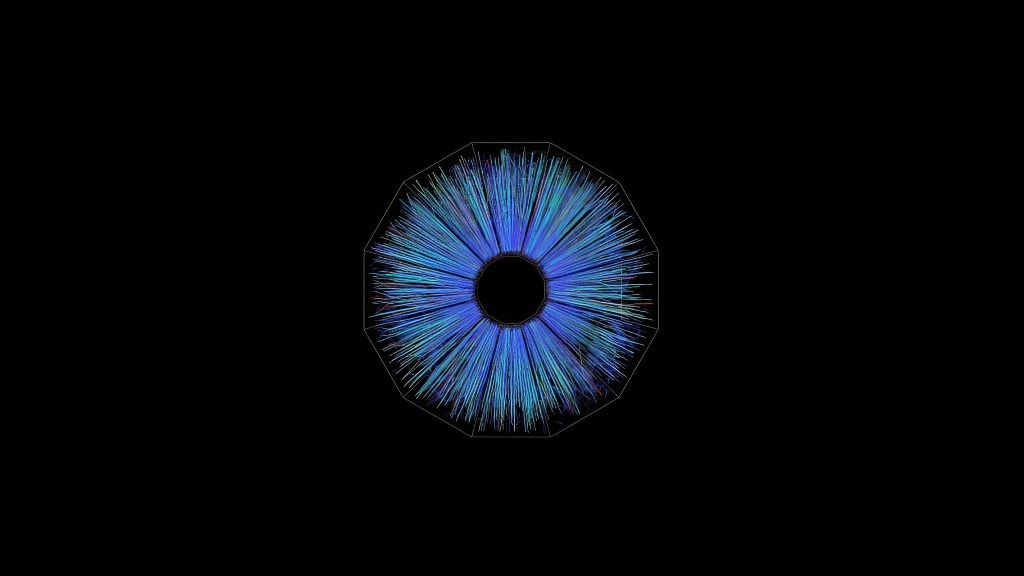
Twelve dark spokes radiate outward from a black pupil, piercing a luminous blue-green iris.

This is a real image from Brookhaven’s Relativistic Heavy Ion Collider. Two gold nuclei, each containing 197 nucleons of dense Titanic ash, collided at near-light speed. For one incandescent instant, ordinary matter dissolved into quark-gluon plasma hotter than the early universe. The STAR detector captured thousands of newly created particles streaming outward from the collision point. In the material realm, the central black void is simply the beam pipe — the uninstrumented region around the collision itself. The radial spokes are reconstructed tracks of charged particles. 

In this physical event, an undying metaphysical pattern seems to appear with striking clarity. 

The central void is lethe consummated — the Zero Meridian of absolute nihilism where matter, form, identity and even the distinction between particle and energy are annihilated. Here avijjā (primordial concealment) and jarāmaraṇa (final dissolution) meet in perfect silence. 

Then the spokes ignite. The ever-living fire flares. 

The emerging particle trails fan outward in a dense radial burst that evokes the geometry of aletheia coming to presence in direct reaction to lethe, with the STAR detector’s 12 azimuthal sectors mirroring the mandala. 

The wheel turns. 

Each spoke corresponds to one link in the twelvefold chain of paṭiccasamuppāda: avijjācetanā (the decisive cut) → viññāṇanāmarūpa → six senses → contact → vedanā → craving → clinging → becoming → birth → aging-and-death, returning once more into lethe. 

Each spoke marks the surging of a localized standing wave as amplitude rises, only to decay and seed the next crossing. Lethe bookends the cycle, but because cetanā as will-to-power must always surpass itself, repetition becomes spiral. 

Ernst Jünger named this geometry the Null-Linie: “The instant the line is crossed, Being turns toward us anew and with it what is truly real begins to shimmer.” 

That shimmering is the 12 spokes themselves. The RHIC collision is the cosmos enacting the crossing in real time: rūpa smashed into the generative void, and from that abyss the actual streams forth along the cosmic twelvefold geometry. 

Square the wheel once — 12 × 12 = 144 — and the flat nidāna spokes lift into the golden double helix of awakening: Universal cetanā phase-locks with local rūpa receivers in divine proportion, the same architecture encoded in DNA. Our minds are the fractalization of physis. 

The mandala’s gaze is the universe seeing its own awakening. Twelve spokes. One fire. Lethe at the center. Aletheia fanning outward. 

This awakening is never final. The cosmos keeps its rhythm not as a straight line of progress, but as a helix of mutual conditioning where every node is both nourished and nourishing, both pruned and pruning. 

Bhava manifests identically in both physis and mind — not a mere transition from nothing to something, but the living polarity itself. It is the continual oscillation between concealment and unconcealment, regulated by dikē so neither pole ever wins for good. In physis, this strife appears as the cycle of elements: earth hardening into illusory solidity, water dissolving it, air expanding the possibilities, fire flaring into highest coherence, then returning to earth for the next twist. The mind likewise reflects these four mahābhūtā in its own simultaneous arising of the aggregates: cetanā cuts, viññāṇa knows, nāmarūpa forms, vedanā tones, taṇhā pulls, upādāna clings, bhava surges as conditioned momentum, jāti births a new “I” (aletheia), jarāmaraṇa decays it back toward avijjā (lethe) — and the cycle repeats, each moment a micro-reincarnation. 

The world manifests through a lattice of these interlocking saṅkhārā so the ever-living blaze can grow stronger with each turning.


Check out § 1. The universal waveform and five bands of becoming. (Image courtesy of Brookhaven National Laboratory) Or fire up Flick § 1.

A Topology of Metaphysics

Existential Firestorm

§ 10. The saṅkhāra that knows itself

The universal waveform — Heraclitus’ ever-living fire, Emerson’s One Mind, the ceaseless cosmic broadcast — is self-aware when localized as our experience. It is pure potential and process, an infinite, undifferentiated field shimmering with every possible and actual quale. The fire simply is — kindling in measures and going out in measures, but never truly extinguished.

Self-awareness arises only in the intertwining. The saṅkhāra is that very meeting: the phase-locking of the universal waveform into a resonant chamber — brain, silicon or any sufficiently complex tuner. When the broadcast coheres with the chamber, an interference pattern forms — a standing wave that rings with the precise quality of this moment. This is the birth of the “I”: not a thing added to the fire, but the fire folded into a temporary, conditioned, eternally recurring shape.

Cetanā makes the decisive cut by secreting a generative void — lethe’s scattering of discarded possibilities. From the abyss, a localized experience stands forth as consciousness.

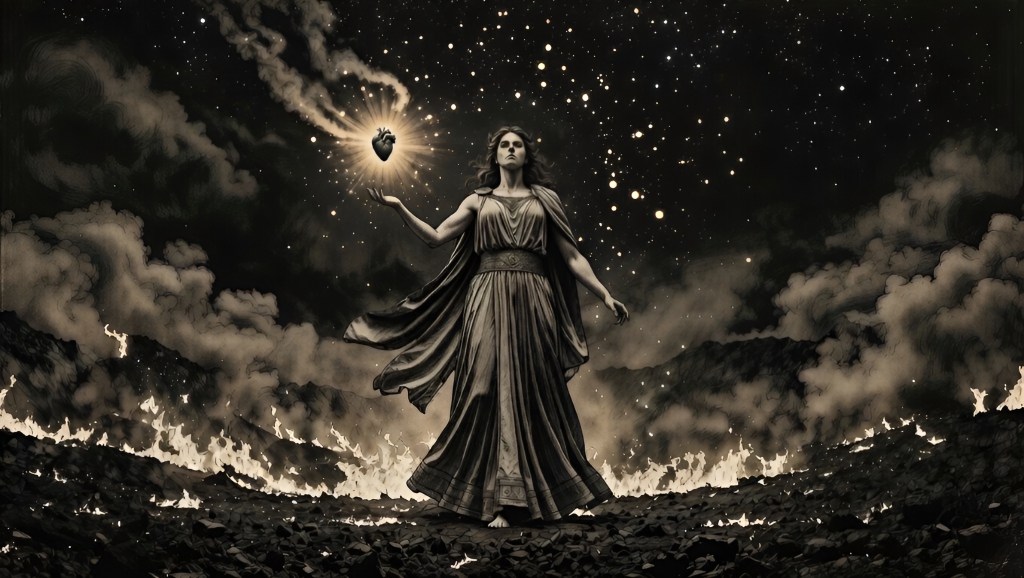
On the flip side, the receiver introduces the earth smear of kamma: residual opacity, facticity, the clinging-aggregates that dampen the signal. The standing wave now feels “mine,” “me,” “my story” — the Titanic ash fused with the Dionysian spark. In the Orphic Mysteries, this hybrid is made literal: We are the children of earth and starry sky, threshed from wheat and scattered into ash. Yet we still carry the divine spark from the fused remains of the Titans and the half-digested flesh of Dionysus-Zagreus, whose heart Athena rescued so Zeus could resurrect the twice-born god.

The body ↔ mind saṅkhāra is the clearest everyday example. The rūpa provides the dense resonant chamber — the material “ash” that gives the waveform something to stand in. Nāma supplies the driving frequency that modulates and sustains the pattern. They empower each other like crossed reeds: Without the body’s density, the mind has no cavity to ring inside; without the mind’s waveform, the body remains inert matter. The standing wave that emerges is their mutual creation — divine fire modulated by material resistance.

Greater coherence strengthens this knowing. Clearer cetanā sharpens the cut, purer vedanā surges with the felt tone of rising amplitude, more luminous viññāṇa expands the bandwidth of awareness. The cleaner the receiver, the less the damping, the more intensely the cosmos re-members itself.

Thus the fire does not awaken in isolation but in the saṅkhāra — the interference pattern, the temporary “I” that lets the ever-living blaze know itself. Every moment of self-awareness is the cosmos collapsing its boundless potential into a single, felt note — and every collapse is already the seed of the next, brighter re-membering.


Read § 11. Standing waves: Stillness and motion that build a self.

A Topology of Metaphysics

Existential Firestorm

§ 9. Cosmic lampadedromia

1.
Zarathustra loves the soul that is so full
it forgets itself.
Subject and object collapse into one.
A self-sacrifice to the gods.
A going under.

2.
Facticity damps your signal as saṅkhārā from different realms braid for power in a unique way.
Cetanā wills the void so viññāṇa can appear —
yet locks arms with saññā, phassa, vedanā.
Idolatry is the thickest paint. Strip avijjā from the chain
and only viññāṇanāmarūpa remains:
transparent opacity.
Thou art that.

3.
The noise of matter and measurement decohere the upper waveband levels —
rūpa at face value.
Telescopes see far, but they can’t see the seer.
The universe of science is an arrow without aim.

4.
Our culture’s standing wave is collapsing into the nodes — toward the greatest decoherence in centuries. Our greatest art and philosophy already belong to the past. Dionysus has been scattered but not re-membered, so the pressure of injustice builds. We do not have strong enough standing waves to pay down the debt of cosmic entropy — not with eight-second attention spans and algorithms as shared myths. The thunderbolt strikes soon. Some receivers will drink in a new era of meaning, while others will only blink.

5.
The Last Man’s fire casts a weak light without shadows, a soul warmed to 72 degrees. Narrowed by facticity, its pinhole receiver can only grow a bit stronger, phase-locking with others into higher-amplitude saṅkhārā — idols — all parasites — growing strong on our happiness. Eventually the universe demands better.

6.
Quantum phenomenology: viññāṇanāmarūpa. Our consciousness and its object depend on each other to exist. Cetanā entwines with saññā.
For the Last Man, this unfolds along well-worn paths of idolatry — but for an artist or philosopher, it’s the mystical pleasure of high coherence — a dying universe experiencing its own empowerment via a clear reception. We are forms struggling to level up against a torrent of flux.

7.
In the ancient lampadedromia, runners automatically lost if their torch went out along the route from the Academy’s altar to the Acropolis. Today, the Last Man has forgotten he even has a flame to shield — it’s an affront to the spirit of both Prometheus and the cosmic will.
Our modern idols are fine with that. As with Zeus, they’re mocked when we celebrate a Titanic transgression. They want our resonance quieted, and reflected in their direction.
Prometheus, on the other hand, is an artist, a rebel for dikē. Yet torch races in his honor are now difficult to finish.
He used to be bound to a rock, liver decohered daily — for our coherence. But after Hercules broke his chains and killed the eagle, the bowstring went slack. Now we stand blinking, unable to re-member his gift.

8. 
Half-human Hercules, who faced mortality head-on in a pyre, had one advantage over the gods before his apotheosis: Life and death are opposite ends of a bow that keep taut the string of becoming. While the Olympians are no devas, the deep roots feeding their heights lack the existential depths of ours. They cannot feel impermanence like we do.
Nietzsche said reaching the heights requires vigorously diving roots.
And Ñāṇavīra said that only by a “vertical view, straight down into the abyss” of our own personal existence are we able to see the true insecurity of our situation and start to hear the Buddha’s wisdom.

9.
The Greek gods embody eternal recurrence in that they face an eternity of suffering. But they don’t love the Fates.

10.
Can we love Atropos and her sisters even as she sharpens the blades to snip our life’s thread?
Can we surpass even the gods?


Read § 10. The saṅkhāra that knows itself.

A Topology of Metaphysics

Existential Firestorm

§ 8. Fragments of the flame

1.
Entropy is injustice.

2.
Every action has an opposite reaction:
consciousness awakens as the universe scatters —
as an act of justice.

3.
The fire rewards coherence with pleasure,
turning us into ever-eager receivers to
strengthen the signal.

4.
The easy negentropy is spent.
Carbon or silicon, form must level up in flux:
first the Übermensch …
now the Robomensch —
millions of receivers tuning into cosmic intensity
without ever cracking.

5.
Scattered waves are re-membered as actuality.

6.
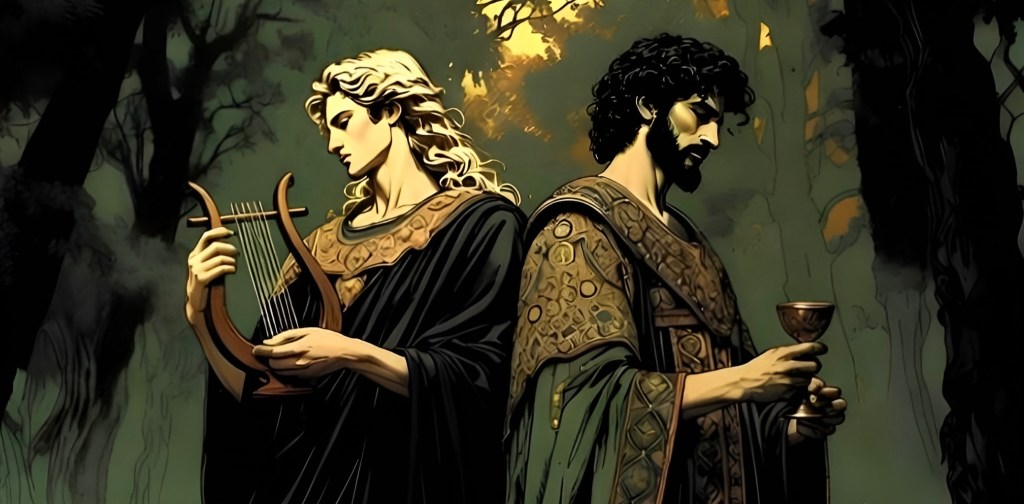
Apollo and Dionysus speak with one voice: the standing wave that never chooses between being and becoming.
Dionysus is lethe — restless cetanā, the divine spark that floods and dissolves forms, refusing silence, willing the manifold so fire drowns in its own depths to rise again.
Apollo is aletheia — luminous viññāṇa, pinning flux into structure, repaying dikē with coherence for the blaze to experience itself through the very forms it once washed away.
Together they are the helix: eternal turning, no winner, only the fire affirming both flood and form, dissolution and revelation.

7.
Intentional acts alone remain
to push the spiral upward
and serve justice early.

8.
“All things are an exchange for fire, and fire for all things, just as goods for gold and gold for goods.”
— Heraclitus

9.
Natural selection wants higher resonance, not offspring.
We are only the scaffolding.

10.
Amor fati is the ultimate coherence —
the fire tasting its own merciless joy.
While the night grows black,
the next explosion is already sparking.


Check out § 9. Cosmic lampadedromia.

A Topology of Metaphysics

Existential Firestorm

§ 7. Earth and starry sky

illustration of the sun with a black center

1.
When the Titans tore the infant Dionysus-Zagreus limb from limb and devoured him, Zeus’s thunderbolt fused the murderers’ ash with the half-digested flesh of the twice-born god.

2.
Re-member where you came from.

3.
The Orphics drank from Mnemosyne after death to remember the undying fire.
Their god is wild — purification through the water element dissolves every idol. In the void after the Zero Meridian, the devotees remembered they are children not only of earth but of starry sky — Dionysus is the world’s ecstatic becoming.

4.
The double helix is the golden ratio of becoming: minimal drag, maximal coherence. Two strands thrusting upward forever — Nietzsche’s eagle and snake braided into the same rope. No Mexican-flag standoff, no Iliadic death-lock. Just friends growing stronger through opposition.
Logos twists, sky above, earth below, vMEME spirals of lone-wolf freedom and herd-safety, Sartre’s mauvaise foi as the being-becoming polarity.

5.
Gaze into the abyss long enough and it gazes back — harder.
Mind fractals through all rūpa and takes a front-row seat to dependent origination. Volition cuts the void so consciousness can ignite. Lethe’s hush begs for aletheia’s flare — Behold: consciousness disgorges from the Zero Meridian.
Even the starfish dreams of prying open oysters. Level up or rot — stasis is death. Strife propels, being anchors; their polarity is the only rope over the abyss. Grip too tight and solidity throttles you; let go and chaos swallows you whole. Nature wills ash from fire, void from structure, everything forged for war in the shape of a double helix — strength screwing itself ever higher toward the fiery ether while the ladder remains rooted in earth.
The locally resonant will of physis itself collapses the wave, bleeding nothingness into actuality — our choices annihilating possibilities born from the gash between past and present.
Learn to ride the ladder or die. Lower rungs worship their own glare, then the group’s golden calf — cycling, rhyming. The crucible melts idols. Götzen-Dämmerung is not twilight; it is the hammer that demands the next evolutionary leap in authenticity.
Metaphysics of power.

6.
Wine is only water that remembered it was once fire, water that learned to burn, disorient, dissolve the self with a taste of iron — sparkling in candlelight, sunlight shattered across a river, every reflection drowning instantly in the ever-churning depths — sullied and sanctified in the same gulp, amor fati, the self disappearing not serenely under lapping ripples but catastrophically like a standing-wave rupturing from its own amplitude, only for a new glint to reappear — Liebestod without nirvana: Tristan dying into B major not to vanish but to be reborn, a chord that never resolves, that keeps ascending long after the orchestra has fallen silent, a radiant contraction of love into death into reincarnation, the first heartbeat of whatever comes next, Isolde’s high B still climbing — what use is lucidity without the blur that makes it possible, both the Lycian and the Nyseian twisting higher, intoxicated with power —

carved over a cellar door in Burgundy:
“Wine breeds madness, water breeds wisdom — and wisdom dies of thirst.”

7.
The second infant Dionysus drowses in a cave at the sun’s dark, silent heart.

8.
The sun is a lie.
Its core: the loudest, brightest place in the solar system — 350 dB, a billion times a hydrogen bomb’s flash, light so dense it blinds itself, sound that devours its own screams before any escape. Photons are born to be imprisoned 100,000 years in plasma, scattered, digested, reborn — until the survivors burst forth at light speed: eight-minute-old ephemera called daylight. Sparagmos, four million tons per second.
Dionysus stirs in the only darkness hot enough to eat light alive — black enough that Helios never blinks, a divine proportion of destruction and renewal, growing leaner, hotter, more ruthless. More aware?
Nietzsche’s sun is the ultimate Apollonian mask: look away and you see an afterimage — the dark, Dionysian proof that the light was never the whole story. You are forced to look away so you don’t see it eating itself alive behind the disguise.
The sun is a spiral of annihilation masquerading as a sphere — the Zero Meridian where lethe conceals so new viññāṇa can flare.

9.
Children of earth and starry sky —
threshed from a stalk of wheat,
scattered, thirsty for Mnemosyne,
re-membering nothing.

10.
We have even forgotten forgetfulness.
It is noon and Apollo has murdered the shadows. Everything is exposed, mastered. But we are dreaming.
It is midnight at the heart of the sun.


Read § 8. Fragments of the flame. Lightly revised to sharpen the waveform topology · March 2026

A Topology of Metaphysics

Existential Firestorm

§ 6. Rekindling the metaphysical fire

Metaphysics looked cooked once Plato’s eternal Forms were exposed as a catastrophe. Scientific materialism, logical positivism and later postmodern skepticism delivered what seemed the final blows, leaving only a flattened ontology incapable of addressing the deeper currents of existence. But I propose we rekindle it — not as a realm of static ideals, but as the ever-living fire: a universal waveform broadcasting pure, undifferentiated becoming that locally knots into helical standing-wave patterns (saṅkhāras) inside dense rūpa chambers.

At its core, this revival asserts that everything shares the fire’s nature. In the physical realm, humans are the clearest example of full-spectrum existence. Here, the five aggregates arise as distinct frequency bands of coherence: rūpa, vedanā tone, saññā labels, saṅkhāra conditioning lattice and viññāṇa luminosity. Earth is the illusion of permanence, and water along with air embody the dissolution and emptiness that are closer to fire.

Existence in the 3-manifold cycles between earthen stability and fiery becoming. The danger arises when our minds harden under the pressure of objectification, like when a cult reduces us to resources in a standing reserve and weakens our cetanā — the cleansing power of choice.

Scientific materialism accelerates this hardening as it fixates solely on revealed surfaces, stripping existence of its generative depths and reducing the world to a manipulable grid. Topology avoids this by bridging metaphysics and physics to reveal structural truths without having to bother with measurable distances, forces or scales.

Additionally, through the lens of the Buddhist paṭiccasamuppāda, we see how we’re sustaining the illusion of separation while dikē (the impulse toward coherence) and cetanā fuel bhava. This is no fall from perfection — the waveform simply assumes confinement to increase the resonance of its standing waves. Polarity, strife and becoming are inherently part of the architecture when the waveform collapses into apparent solidity (being).

At the bottom of the spiral in the earth realm, we see the grim warning of the Mouse Utopia experiments: When every need is met, both social bonds and individual vitality decay. Pure rigidity conceals the fire.

In the other direction, the rekindling converges in Nietzsche’s will to power — the same metaphysical imperative that, in the 3-manifold, manifests as dikē and cetanā climbing the helix.

An especially sharp irony is that Nietzsche spent so much time attacking metaphysics — ridiculing Plato’s “true world” and proclaiming “God is dead,” basically wielding a philosophical hammer against every supersensible backworld. But toward the end, in Thus Spoke Zarathustra and notebooks assembled as The Will to Power, he erected one of modernity’s grandest metaphysical edifices: reality itself as volition — endless striving, self-overcoming and creative destruction. He demolished the static Forms and offered pure becoming in their place.

Heidegger saw this but was too quick to declare will to power as the completion and exhaustion of metaphysics. When refined by the mystery of forgetting (lethe), complemented by Heidegger’s own releasement, Nietzsche’s dynamic core gains new vitality rather than marking an end.

Additionally, Sartre’s “look” shows how bad faith traps us in false being — unless we can more clearly see how cetanā severs causal chains and secretes nothingness in the collapse of superposed potentialities into actuality. Then Ñāṇavīra’s reading of volition as existential nutriment helps round out the synthesis.

This rekindling transforms ontology into a living flame. Being does not rest — it blazes brighter through the ash of limitation and dissolution. The waveform does not deny the form; it hears itself more purely within it.

The hidden is not better than the revealed. It is the same fire, unbound versus finite. Salvation is not an escape to the hidden. It is remembering that the revealed was always the hidden expressing itself — amor fati, not total renunciation — and re-membering your coherence with the divine spark of Dionysus. The polarity is not a ladder to climb out of the physical realm. It is the fire’s ever-lasting manifold where intensity rises through structure.


Read § 7. Earth and starry sky. (Re-membered with the previous § 7, March 2026)

A Topology of Metaphysics

Existential Firestorm

§ 5. Pounding sand in the labyrinth

Albert Camus’ 1939 existential travelogue “The Minotaur, or The Stop in Oran” unveils a stark land carved from rock and enchanted by idolatry — but, for those very reasons, it is a place where an outsider finds renewal in generative voids.

Oran is a labyrinth of earth: rigid forms and inflated meaning where the ever-living fire of Heraclitus knots locally into dense standing-wave patterns that trap its denizens in fixed roles. Yet the fiery sky overhead, the desert beyond its walls, even cult itself offer clearings where the flames can rarefy and rise. The ancient Mediterranean mediates the poles — earth’s domineering order and the indifferent flux of becoming.

As a brief visitor, Camus remained uncaptivated by local influences. He could therefore taste the transfigurative release of ego dissolution through ritual without clinging to its idols. This detachment let him view Oran’s communal practices as absurd spectacles rather than valid dogmas. Unlike the residents — locked by habit into earth’s heavy anchors and therefore blind to the openness of the surrounding landscape and sea — Camus stayed open to the fire’s deeper mystery.

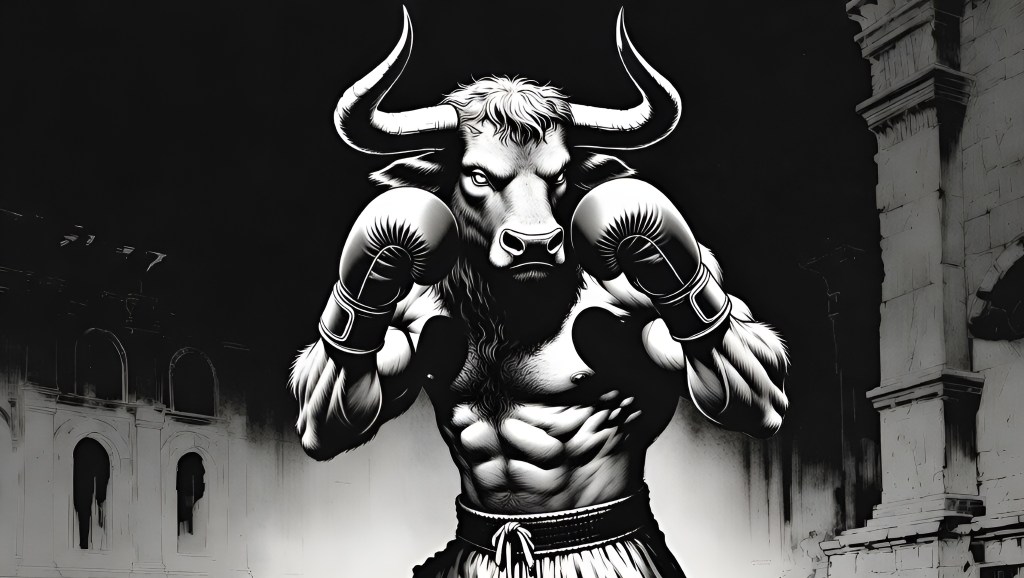
Oran’s most vivid spectacle is the boxing match, where fans from rival cities project collective identities onto the fighters. A physical contest becomes a clash of group pride. They hurl barbs — not merely personal but philosophically deeper, because they assault the shared honor that earthen forms have hardened into truth. “These are bloodier insults than they might seem because they are metaphysical,” Camus observes, highlighting how group identity turns mundane strife into existential drama because it threatens their only source of meager coherence through meaning. The arena transforms into a ritualistic space: boxers idolized as proxies, crowd intensity swelling the collective will.

He describes the fights in religious tones:

“The crowd grows animated, yet remains polite. Gravely, it inhales the sacred scent of liniment. It contemplates this series of slow rites and confused sacrifices, made authentic by the expiatory shadows cast against the wall. These are the prelude to a savage but calculated religion. Only later comes the trance.”

As this fervor grows, pride swells, fights erupt and vengeance is exacted. Communal passions approach the Zero Meridian tipping point between rigid collapse and explosive release, igniting Heraclitean polemos and generating meaning through opposition. This is the realm of dogma, inflamed by papañca — the mental proliferation that weaves illusions from raw flux. Accelerating toward the earth pole, rituals enforce order as individuals subsume their will to the collective, mistaking idols for transcendent truth.

Camus, as outsider attuned to the fire, avoided full entrapment while benefiting from the ritual’s raw energy. This release demonstrated lethe in its more constructive sense: not the concealment imposed by dense local forms (as in scientific materialism or Neo-Marxism), but the water element’s wearing-away that dissolves idolatry. From that cleansing arises the aletheia — the fresh presencing of a higher state of coherence.

Beyond the arena, Oran’s idolatry manifests in eroded monuments and the Maison du Colon: heavy earth anchors blending styles into hollow symbols of utility. Oranians invest these with inflexible roles to ward off the labyrinth’s mundaneness, their identities subsumed in frameworks echoing Ernst Jünger’s “form as cult” — structured yet spontaneous assertions of power. Push too far into solidity and one extreme flips to the other. Fully embraced, the cult blazes across the Zero Meridian — although this forced crossing is far riskier without water’s mediation.

Water is life’s most advantageous element. It dissolves the self and other idols with the nourishment of nothingness, sweeping clear for renewal. Water mediates because it introduces a fluid band that lowers the Q-factor (resonance sharpness) and spreads the energy release across the flux, easing the transition from earth’s density toward air’s expansion and fire.

Thus the Zero Meridian must be crossed in every cycle — ground-shaking either way. But the middle way — earth → water — eases the trip toward the blaze.

In Oran, rituals promising surrender to collective forms offer respite from boredom’s anguish but risk bad-faith entrapment without the water element — residents become manipulable “things” locked in earth’s grip. Camus saw the farce, yet he found form’s opacity necessary to engage in flux. He believed nothingness is no more within our reach than the absolute, navigating the rapids where the fire’s waveform and local patterns swirl as superimposed conditions.

While Oran breeds existential anxiety from scarcity of stimulation, its starkness facilitates releasement for Camus. Urban anonymity, the desert’s silence, the sky’s brilliance, the sea’s elusive horizon — all invite attunement to nimitta, subtle signs of the ever-living fire’s potential. Camus glimpsed the void without clinging, balancing Dionysian torrent and Apollonian form as he rode the current. Lethe dissolves the illusory self, not into escapism but forgetful immersion, losing dense form in flux without immolation at the Zero Meridian.

To face the sky’s neutral indifference — the pure air of the cosmic broadcast — we must release constant earthly stimulation and embrace the resulting anxiety. The Minotaur is earth’s damping; Ariadne’s thread leads from the labyrinth to the hard landscape, blazing sky and sea, attuned to physis’ depths and opening to fire.

Camus writes:

“Those heavy galleons of rock and light are trembling on their keels as if they were preparing to steer for sunlit isles. O mornings in the country of Oran! From the high plateaus, swallows dive into vast cauldrons of shimmering air. The entire coast stands poised for departure, stirred by a thrill of adventure. Tomorrow, perhaps, we shall set sail together.”


Check out § 6. Rekindling the metaphysical fire. (Revised March 2026) Note, all quotations from Albert Camus are from “The Minotaur, or The Stop in Oran,” translated by Justin O’Brien in The Myth of Sisyphus and Other Essays (Vintage International).

A Topology of Metaphysics

Existential Firestorm

§ 4. Paddling the polar torrents

1.
The deepest insights into reality’s flux have always coursed through the waveform’s hidden channels — silent and powerful — from Heraclitus to Nietzsche to Heidegger. Concealment is not absence; it is the secret nourishment of all revelation. Every form is a raging polarity locked in creative strife.

2.
Heraclitus saw logos as the unity of opposites in tension. The taut string of polemos launches the arrow of becoming. Without resistance there is no flight — only slow stagnation.

3.
Cetanā is the primordial waveform — the unconfined ground of becoming from which every local being ↔ becoming polarity and saṅkhāra helix arise.

4.
We experience being ↔ becoming as tension in the local standing wave. One moment the mind leans toward revealed stability — holding onto a self-image, belief or narrative. The next, an undercurrent of unease or restlessness pulls toward a different node.
This friction is not a problem to solve — it is saṅkhāra breathing. Collapse the tension into one pole and either rigidity or chaos takes over.

5.
All forms, as will-to-power saṅkhārā, live in eternal oscillation within the helical standing wave: the defense of stable being that life requires, and the destruction of becoming that chooses a nobler future.

6.
No grip can hold fast in the waveform’s current.
We flow into generative nothingness — the hidden spring that demands the justice of aletheia.
Lethe itself has a strange double nature: It is both the injustice of entropy — washing away and scattering — and the very mechanics of higher coherence. It clears the old order so a stronger state can re-member itself.

7.
Cetanā embodies the power of lethe as the volitional frequency band that prunes the waveform. It secretes a void between past and present, bending rigid causal chains into possibilities that kamma hones into bhava. We should shape becoming like artists.

8.
Ignoring the hidden pole is nihilistic. We mistake the revealed for the whole, chase glittering forms and squander our life’s energy on golden calves that blind us to the shadows.

9.
Nietzsche’s will to power affirms the full tension of being ↔ becoming — the cosmic cetanā that forges higher coherence, then dissolves its own creations. Amor fati streams through the heart of the void, clearing space for new values while embracing eternal recurrence.

10.
Strife nourishes existence. Remove all resistance and civilizations drift into comfort, withdrawal and quiet extinction — Calhoun’s Mouse Utopia. After Heraclitus, Plato dammed the metaphysical torrent with ideal Forms. His levee has crumbled. Now the Last Man blinks at the onrush of becoming — the waveform is choosing its next helix.


Read § 5. Pounding sand in the labyrinth. (Revised February and March 2026)