§ 5. Pounding sand in the labyrinth
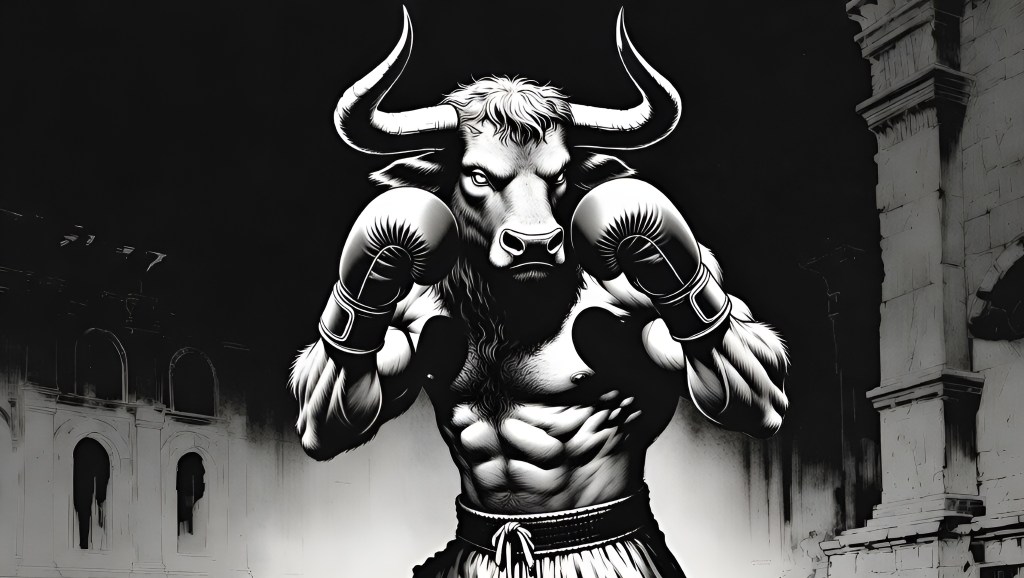
Albert Camus’ 1939 existential travelogue “The Minotaur, or The Stop in Oran” unveils a stark land carved from rock and enchanted by idolatry — but, for those very reasons, it is a place where an outsider finds renewal in generative voids.
Oran is a labyrinth of earth: rigid forms and inflated meaning where the ever-living fire of Heraclitus knots locally into dense standing-wave patterns that trap its denizens in fixed roles. Yet the fiery sky overhead, the desert beyond its walls, even cult itself offer clearings where the flames can rarefy and rise. The ancient Mediterranean mediates the poles — earth’s domineering order and the indifferent flux of becoming.
As a brief visitor, Camus remained uncaptivated by local influences. He could therefore taste the transfigurative release of ego dissolution through ritual without clinging to its idols. This detachment let him view Oran’s communal practices as absurd spectacles rather than valid dogmas. Unlike the residents — locked by habit into earth’s heavy anchors and therefore blind to the openness of the surrounding landscape and sea — Camus stayed open to the fire’s deeper mystery.
Oran’s most vivid spectacle is the boxing match, where fans from rival cities project collective identities onto the fighters. A physical contest becomes a clash of group pride. They hurl barbs — not merely personal but philosophically deeper, because they assault the shared honor that earthen forms have hardened into truth. “These are bloodier insults than they might seem because they are metaphysical,” Camus observes, highlighting how group identity turns mundane strife into existential drama because it threatens their only source of meager coherence through meaning. The arena transforms into a ritualistic space: boxers idolized as proxies, crowd intensity swelling the collective will.
He describes the fights in religious tones:
“The crowd grows animated, yet remains polite. Gravely, it inhales the sacred scent of liniment. It contemplates this series of slow rites and confused sacrifices, made authentic by the expiatory shadows cast against the wall. These are the prelude to a savage but calculated religion. Only later comes the trance.”
As this fervor grows, pride swells, fights erupt and vengeance is exacted. Communal passions approach the Zero Meridian tipping point between rigid collapse and explosive release, igniting Heraclitean polemos and generating meaning through opposition. This is the realm of dogma, inflamed by papañca — the mental proliferation that weaves illusions from raw flux. Accelerating toward the earth pole, rituals enforce order as individuals subsume their will to the collective, mistaking idols for transcendent truth.
Camus, as outsider attuned to the fire, avoided full entrapment while benefiting from the ritual’s raw energy. This release demonstrated lethe in its more constructive sense: not the concealment imposed by dense local forms (as in scientific materialism or Neo-Marxism), but the water element’s wearing-away that dissolves idolatry. From that cleansing arises the aletheia — the fresh presencing of a higher state of coherence.
Beyond the arena, Oran’s idolatry manifests in eroded monuments and the Maison du Colon: heavy earth anchors blending styles into hollow symbols of utility. Oranians invest these with inflexible roles to ward off the labyrinth’s mundaneness, their identities subsumed in frameworks echoing Ernst Jünger’s “form as cult” — structured yet spontaneous assertions of power. Push too far into solidity and one extreme flips to the other. Fully embraced, the cult blazes across the Zero Meridian — although this forced crossing is far riskier without water’s mediation.
Water is life’s most advantageous element. It dissolves the self and other idols with the nourishment of nothingness, sweeping clear for renewal. Water mediates because it introduces a fluid band that lowers the Q-factor (resonance sharpness) and spreads the energy release across the flux, easing the transition from earth’s density toward air’s expansion and fire.
Thus the Zero Meridian must be crossed in every cycle — ground-shaking either way. But the middle way — earth → water — eases the trip toward the blaze.
In Oran, rituals promising surrender to collective forms offer respite from boredom’s anguish but risk bad-faith entrapment without the water element — residents become manipulable “things” locked in earth’s grip. Camus saw the farce, yet he found form’s opacity necessary to engage in flux. He believed nothingness is no more within our reach than the absolute, navigating the rapids where the fire’s waveform and local patterns swirl as superimposed conditions.
While Oran breeds existential anxiety from scarcity of stimulation, its starkness facilitates releasement for Camus. Urban anonymity, the desert’s silence, the sky’s brilliance, the sea’s elusive horizon — all invite attunement to nimitta, subtle signs of the ever-living fire’s potential. Camus glimpsed the void without clinging, balancing Dionysian torrent and Apollonian form as he rode the current. Lethe dissolves the illusory self, not into escapism but forgetful immersion, losing dense form in flux without immolation at the Zero Meridian.
To face the sky’s neutral indifference — the pure air of the cosmic broadcast — we must release constant earthly stimulation and embrace the resulting anxiety. The Minotaur is earth’s damping; Ariadne’s thread leads from the labyrinth to the hard landscape, blazing sky and sea, attuned to physis’ depths and opening to fire.
Camus writes:
“Those heavy galleons of rock and light are trembling on their keels as if they were preparing to steer for sunlit isles. O mornings in the country of Oran! From the high plateaus, swallows dive into vast cauldrons of shimmering air. The entire coast stands poised for departure, stirred by a thrill of adventure. Tomorrow, perhaps, we shall set sail together.”
Check out § 6. Rekindling the metaphysical fire. (Revised March 2026) Note, all quotations from Albert Camus are from “The Minotaur, or The Stop in Oran,” translated by Justin O’Brien in The Myth of Sisyphus and Other Essays (Vintage International).
 Rob Robill