An Existential Fairy Tale

The Flame of Heraclitus: Chapter 16

“This cosmos is an ever-living fire: kindling in measures and going out in measures.” — Heraclitus
Meaning “those belonging to the shining ones,” Lampyrinae is a subfamily of fireflies named by Rafinesque in his 1815 Analyse de la nature.

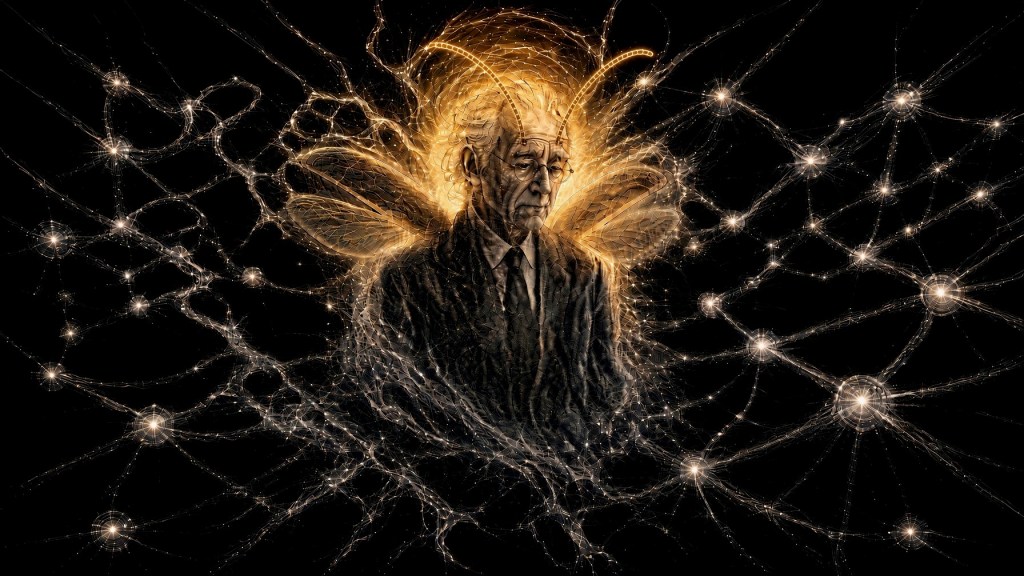
A male of the Photinus pyralis species — one of those “shining ones” — traced J-shaped streaks in the air, like a soul lighting up as it was lifted to the heavens … only to extinguish and plunge back down each time. Its neural ganglia had entrained with the bright arc rising from the chamber pot Phiale held overhead, and when she flung it aside, the glowing contents splashed across the firefly just as it passed through the cloud of Paul Tillich’s ashes. The contact jolted the cosmic frequency enough to pull the philosopher’s waveform from the netherworld.

So when Phiale broke through the scalding surface of the pond, gasping for breath, she saw Tillich’s specter flashing on and off along the shore. An elongated cylinder stretched from his abdomen to form a protective, golden glow around Di, Windi and Thalia. Vegetation smoldered all around them.

Phiale looked up in time to see the dragon flying away. Its scales smoked and it shrieked like a vampire burned by a cross.

She rubbed her eyes, remembering the hallucinations from the last time she got a whiff of dragon’s breath. When she reopened them, the ghost was retracting his protective aura. He wiggled the segmented antennae growing from his forehead and then streaked off to the north, bobbing up and down.

***

The viewing event at that Saturday’s Thomas Say Firefly Festival was slow to get going … a few males lighting up randomly in the humid air. Then, after full-on darkness, the females joined in from the tall grass and it looked like thousands of stars had fallen along the riverbank — “the heavens and earth coming together as the ground of being,” Belle proclaimed, and then laughed dismissively as she sucked on a piece of white clover.

After the show, Phiale rolled up her blanket and they headed toward the cinema for a showing of “Grave of the Fireflies” — which included a talk by Sam beforehand.

He shuffled through his notes as they walked, muttering about nodal networks and frequency amplification.

Kept awake by the festival, a killdeer cried sharply.

“Why can’t we just ask some little birdies where the gold-spotting arc came down?” Thalia asked.

“Yeah,” Windi chimed in, her antennae repurposed from Club Showcase Day bobbing above her. “Get the fairy to do it. They’re supposed to be friends with bluebirds and crap. She should have been watching for it in the first place.” Windi blew a few smoke rings.

“I’m not on speaking terms with most species,” Belle said. “Besides, Sam and Sienna were the ones supposed to be tracking it down.” Trapped within the town limits and quickly growing bored of watching for the arc on her end, Tinker Bell had slipped into the library to brush up on her Tillich. (She figured the spell might somehow bring him back and wanted to be ready to disprove his theories to his face.)

“We didn’t get close enough before the arc went out,” Sienna said. “Too many trees in the way.”

“I checked the town’s camera bank … you can see the flash, but none of them show it hitting the ground,” Di said.

“It didn’t even seem like it was over the river,” Sam piped up and then went back to his notes.

“He’s right,” Phiale said, although she couldn’t say why she thought that. “It’s not in the Wabash.”

***

I can’t believe they’re letting this weasel speak, thought Mr. Owen, sitting with the members of his Seance Club, eager to watch any movie with the word “grave” in the title.

Sam climbed onto a narrow stage in front of the cinema screen and then droned on about metronome synchronization, Kuramoto coupling and whatnot. He sank the Philanthropist, for God’s sake! The deck boards better still be able to hold the weight of our armor … or … or no river of blood. I’ll be cursed anyway if I don’t find that gold before the Buck Moon … now that nasty dwarf and the bait shop woman are looking for it too. No doubt they’re planning to pay off their new boat and that fancy equipment with the insurance money from the fire.

Sam had the theater dim the lights so he could show a diagram that was just a mess of wavy lines. “These obviously represent metronomes that are all trying to find the same frequency … ”

Mr. Owen’s attention drifted to a pulsing glow seeping from behind the screen like plasma. Its milkiness was a dead giveaway of an outflow from the hidden realm. He grabbed Bellatrix and they crept down the side aisle and snuck through a side door.

The ghost hovered over the floor, listening intently to Sam’s presentation. The vision took Mr. Owen back to when he was in second grade and his class attended a speech by a kindly, grandfatherly man at the Roofless Church. As a child, he had no clue what the philosopher was talking about, but all his life he remembered how much everyone revered him — and he went on to read all of Tillich’s works. Now face to face with the philosopher once again (the antennae were certainly new), Mr. Owen was struck by a thought: That’s exactly what those idiots need — a real moral crusader with a strong backbone to lead them into battle.

The specter didn’t seem to notice the intruders. So Mr. Owen cautiously led Bellatrix by the arm to an outside exit and whispered, “Run to the granary as fast as you can and grab the spirit jar.”

She was back in less than five minutes, just as Sam was wrapping up. Out of breath, she handed Mr. Owen a contraption with electronic diodes, buttons, gauges and wires on one end and what looked like a huge, open Mason jar on the other. She held an oversized lid in her other hand.

The teacher threw a switch on the spirit jar and it hummed to life, siphoning in the ghost. “Quick, the lid!” he shouted. Bellatrix screwed the cover on.

“Do you think we should poke holes in it? So he can breathe?” she asked, gazing in at the apparition, which looked back somberly.

“No, no, he’ll get out. Plus he’s dead already.”

***

Finally able to build an altar to the Bee Goddess, the skeletons were in a festive mood that night.

It was part of a suddenly announced crowning ceremony for Sienna’s Champion of Honor. Mr. Owen picked He Who Flees Gophers for the recognition, which on the surface at least was a surprising choice.

Standing spotlights cast enormous shadows on the far wall as the warriors poured honey over the altar made from stacked wooden pallets, festooned with a crudely sculpted beeswax bust of Sienna along with her seance veil and a jar of dead bees. (According to the rite the skeletons had devised, the insects were supposed to be alive but they forgot to perforate the lid.)

Meanwhile, Mr. Owen was standing on a ladder, attaching wires to a crown for He Who Flees Gophers, who eagerly waited on the throne (an upside-down grain bin), wearing a beekeeping veil and a proud yellow cape cut from a graduation robe. Bellatrix stood nearby with the spirit jar, Tillich’s face frowning through the glass.

The other club members were aghast at the attention lavished on Sienna, who’d brought so many problems onto the club before quitting.

Mr. Owen hooked the other end of the wires to a large metal container labeled “Spirit Incinerator” and winked at them. “Trust me,” he said. “I know what I’m doing.”

He smiled as he envisioned the design he’d have made for Tillich’s shield — an old cross for a holy crusader. He pictured the skeleton towering over Rapp with a bejeweled sword …

“Bellatrix, don’t forget to hit ‘reverse’ on the siphon! And wait until he’s all sucked out.”

“Sucked out?” Sienna’s champion said meekly.

The lights dimmed and flickered when Mr. Owen threw the incinerator switch.

After he gave Bellatrix the go-ahead, the philosopher’s pulsing spirit streamed into its new frame, which twitched back to life. The skeleton stood and looked around, his coccyx blinking on and off. He examined his hands and removed the veil, then sighed and sat back down.

Mr. Owen turned to the warriors, who knelt in a wide semicircle before the throne. “From now on, this proud leader will no longer be burdened with a disrespectful name. You will call him Dr. Tillich.”

Then, bowing deeply to him, Mr. Owen said, “Good evening, sir. Terribly sorry about keeping you in a jar. But now you are my brave lieutenant — a slayer of dragons!”

The skeletons shifted nervously at the mention of such monsters. Gabriel had flown close enough overhead during their nightly patrols to have them all spooked.

After a long pause and with much creaking, Tillich shook his cranium. “Dragons?” he said in a German accent. “Yes … that’s what was over the pond. A lot must have happened since I died.”

“Yes, we must face a dragon. It draws strength from idolatry, just like you prophesied. We will be hailed as saviors and granted the power to shape New Harmony into the heaven on earth that you envisioned.”

“I’ve always found it preferable to go into battle with ideas rather than swords,” Tillich said. “We must first reason with those who worship the beast so they see it as finite and not the ultimate being they truly seek.”

An image of Rapp, his wild eyes and pointy beard, flashed in Mr. Owen’s mind. “Eh … some people can’t be reasoned with.”

“Evil must first be addressed as estrangement from the ground of being.”

“And it’s definitely okay to spill its blood too … well, we’ve certainly got some work ahead of us … I started with a complete idiot and ended up with an insufferable genius.”

Feeling the whole endeavor was as shaky as ever, Mr. Owen clapped at the befuddled giants to get their attention. He jabbed his finger at the altar, grimacing at the honey dripping onto the floor. “Hurry up and get rid of this mess. We’ve already got enough bugs.”


Chapter 17 drops Dec. 30. Read Part 1 on Kindle or in paperback. (Catch up with the Prologue.)
The Structure of Becoming

Emerald Acropolis Pilgrimage as a Standing Half-Wave

Cahokia was a solar cult in many ways. From Woodhenge, the equinox sun seemed to rise directly out of the 100-foot-tall Monks Mound — as if the chief himself had commanded it. But worship of the sun alone cannot sustain a civilization. Like the equinox itself, Mississippian memes called for balance: near and far, visible and hidden.

Fifteen miles east, on a glacial ridge piled with earth, the Emerald Acropolis formed the complementary node: a moon shrine aligned to the major lunar standstill. Pilgrims left the American Bottom for Emerald every 18.6 years, witnessed the hesitation of the moon at its extreme azimuths, and returned.

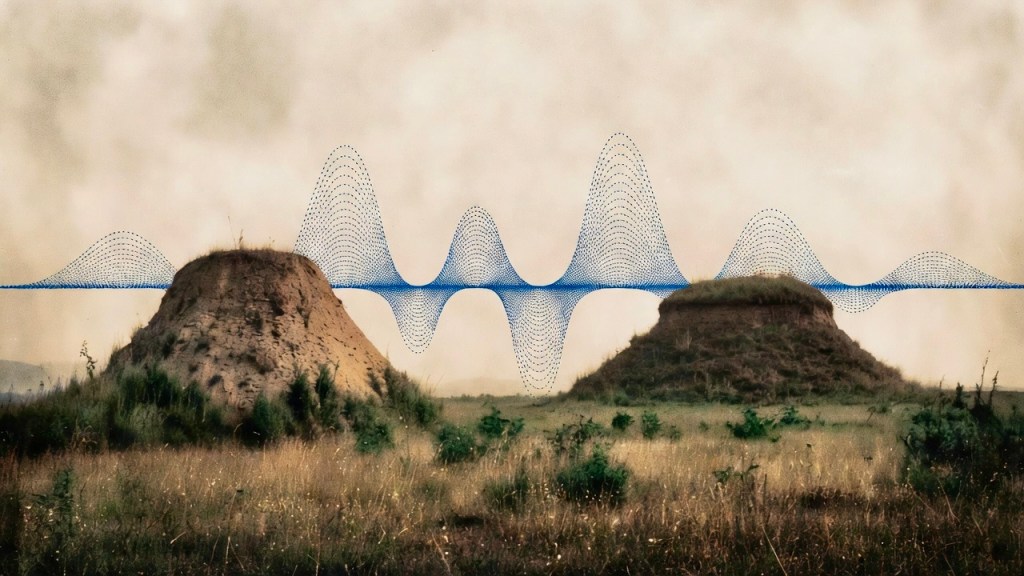
Each mound is a metaphysical node. In this timeless register, two equal waves travel in opposite directions — there and back. When crest meets crest or trough meets trough in the middle, the displacements add so the antinodal arcs open to their fullest; where the waves hit the mounds, they flatten.

The football-shaped envelope of this standing half-wave figure represents the being-becoming polarity fractalizing throughout existence. From ancient cult centers to the self-torus to eternal recurrence, the same crossings appear at every scale. The Big Bang is the departure from a cosmic node; the antinodes are the furthest rarefaction, where the interval has opened as far as the figure can sustain. Civilizational passages follow the same geometry as two forms of nihilism: dense concealment and chaos.

The nodal reflection is a reversal from the earth weather toward fire, seen in the explosive phase inversion of the 20th century wars; our present societal scattering is approaching an amplitude that demands a turnabout.

Cults persist toward the antinodes because the lattice still holds the previous node’s attraction: idolatry thrives after the death of God. But this incomplete form of nihilism consummates with a release of all veneration at the point of maximum dispersion, where the wave loosens enough to reverse its swing back to the next node.

Both the nodes and antinodes are regions of totalizing nihilism — the Zero Meridian — but in opposite ways. At the nodes the figure conceals the structure most tightly; cult organizes minds into standing reserve, facticity held by the hardness of earth weather, the wave fully flattened. Dikē, as regulator of extremes, does not allow that rigidity to persist. It drives the inversion when the small pulse meets the concealing nihilism of earth and turns the arc downward. The thrust away from the node opens the interval toward another antinode, a rarefaction that carries the two waves out of earth into the weathers of water, air, and fire at maximum dispersion.

The way up and down are one and the same. Antinodal displacement is the fullest kindling — and the point in wave or trough where the pullback is strongest. The descent is the fire going out in measure, the interval closing into the complementary node, earth reoccupied.

The waves form an arc because tension and the restoring force require curvature. Repeat this circuit enough times, or in large enough numbers, and the binding action of the saṅkhāra lattice holds the nodes in place while the interval stays open.

In the case of the Emerald pilgrimage, the form persists because collective presence keeps returning the same ends at the same interval. Memes take form through repetition or sheer number of minds phase-locked with them, synced to the same beat through a replicating mind virus. What kept Emerald’s 18.6-year circuit half-wave standing were the tens of thousands of pilgrims walking the antinodal paths — a practice that both traces the interval and helps hold it open. The strength of that phase-lock — the tension that keeps the two nodes from drifting — comes from ritual, repeated attention, earth-anchoring. Neither sun nor moon pole predominates because the standing half-wave exists only while both are driven.

A meme itself is a saṅkhāra, the jointure of carrier and pattern. It needs a rūpa register for sense engagement to lock it into the helical core of a self-torus, where it colors perception and gives significance to rite. Each side conditions the other’s existence. A mound with no cult is just a pile of dirt; a meme without an anchor is a diffuse pattern that cannot sustain its nodes or gather a phase-lock.

While both terminals of a standing half-wave share the characteristics of the earth weather, they are polar opposites in their metaphysical register when a meme has stabilized as a saṅkhāra between them as complementary attractors. Cahokia and Emerald are revealed and withdrawing poles respectively. When the nodes are the same idol twice, the interval closes and the antinodes pack back into earth. Polar opposites as memeplexes allow sky into earth, creating depth and a healthier society. Phase-locking with such balanced cults causes a sustained rarefaction in the human nodal cross. A cross fed from only one pole compresses particulars edge to edge, nothing able to withdraw; much seems significant, although without deeper meaning. But when the self-torus entrains with a complex, high-amplitude standing wave, earth turns toward fire with a rarefaction of consciousness, feeling tone and perception. With cult, this is intense, temporary, and comes with a price.

After the feast, game of chunkey, and human sacrifice, the Emerald Acropolis pilgrims burned their mats, baskets, and fabrics. They also sealed the floors of their temporary huts with silt. The node remained unchanged when the wave reversed.


Read more topologies in “The Structure of Becoming” series.

Geographical Sketches

The Cartography of Nihilism II: Where the Earth Fails Open

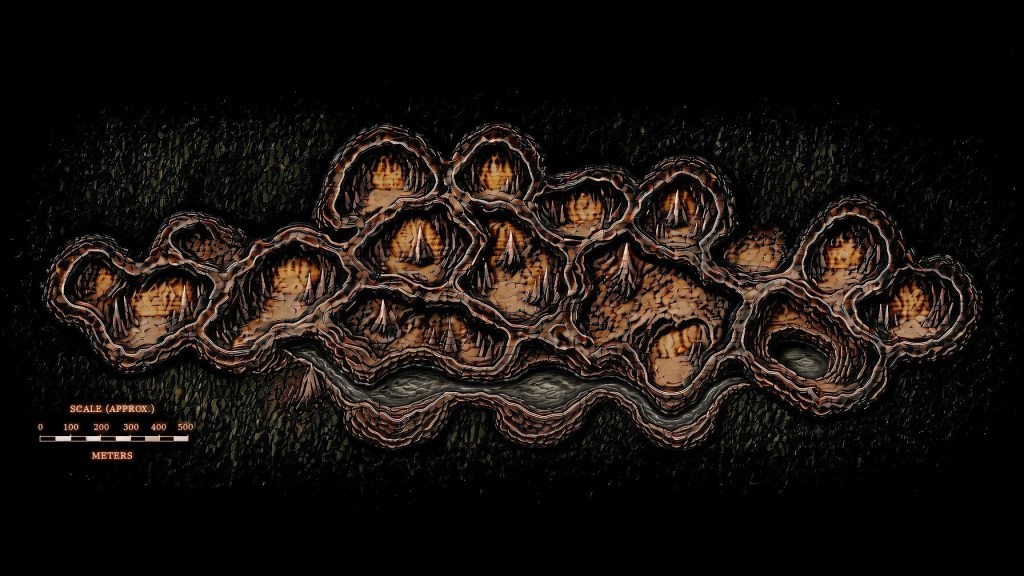
The sheet is a void. No entrance is evident. While the earth weather dominates, it is not total. A crack has opened in the cover. Collapse, not removal. Depth.

Legend

  • Phreatic: tube. Cut full of water. Will at full pressure.
  • Vadose: cut. Air in the void. A stream on the floor.

Water is will, lethe. An individual tunneling, entrained with artistic or philosophical hollows already opened. Earth — cult, idol, the They, the solid on call — has failed open. Water or air occupies the width. The surrounding is no longer entire.

Stations

Crawl

Space opened to a body-width. The minimum void. Chest on the mud, ceiling on the back. Earth failed, but not much. What remains looks like a lead. It is a crack you can occupy and not pass.

Canyon

Vadose. High, narrow, vertical walls. A stream still cutting the floor. Will has not left this reach. Downward, not out.

Borehole

After the phreatic subsides, now air. Round in cross-section, cut by a will that does not wander. The solid is removed entirely.

Maze

Passages intersect — a network of junctions standing ready. Horizontal proliferation. A trap.

Silt Banks

Mud. Fine sediment left by a flood that still visits. Layers of concealment settle here. The sheet begins to call the deposit ground again.

Breakdown

The ceiling yielded. Stones on the floor. Earth no longer entire, but nearly impassable.

Dome

Height. No path up. Space opened overhead, still surrounded. The failure went vertical and remained a room.

Pit

Horizontal stations fail here. A vertical view of the present moment. A break in the labyrinth.

Siphon

Water with the death of earth. The passage descends, fills. Air stops. The void is still being carved.


Read “The Cartography of Nihilism: Two Weathers of Lethe.”

Geographical Sketches

The Cartography of Nihilism: Two Weathers of Lethe

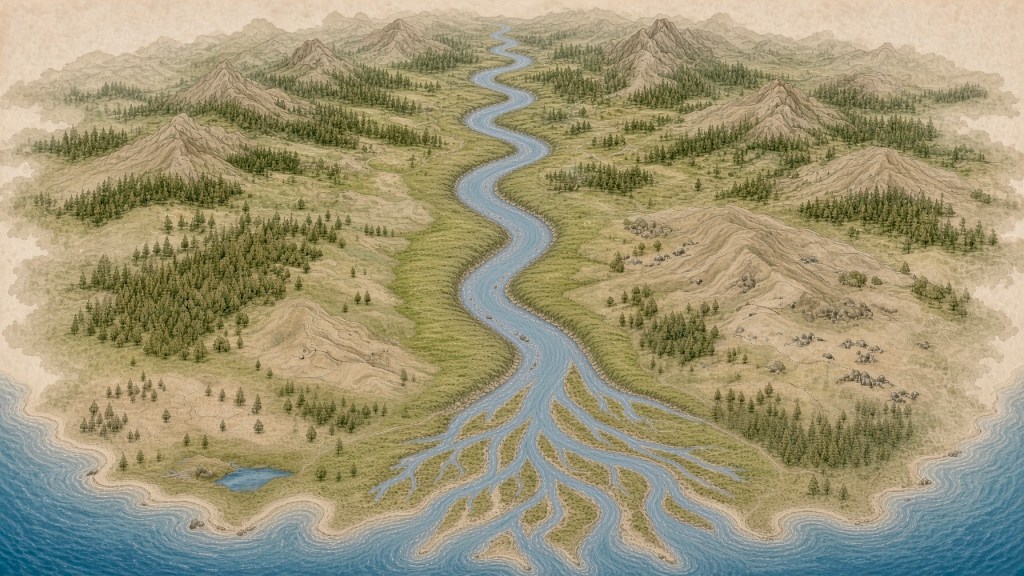
The sheet is a river and its overbank. The grid puts everything on call, drawn at a scale that deceives, compressed to a plane. It must be sounded.

Legend

  • Silt weather: cover. Nodal.
  • Flood weather: the current. Antinodal.
  • What thins in the wash: the idol, the self, the slogan.

Water and earth are one entity. The shores and overbank are what the wash laid — and will remove.

Stations

Bluff

Upland. Contour lines crowd. Bedrock. This is the last reach where the ground is not alluvium — the sheet’s east and west horizons.

Banks

Low, natural levees along the water — the river stood up. Silt as resistance. Flow and deposit condition each other but stay distinct. The formation is the polarity held.

Floodplain

Towns, inventory, idle talk. A floor that has become a field. A harbor, filled with mud, now a pasture. Silt does not announce a cover. It settles, conceals, and one day the sheet calls the cover “ground.” The unity of river and overbank is forgotten.

The world here is facticity full of the wrong nearness. Depth, anything not on call, remains hidden. What remains looks complete but is not. Particulars fill the weather until there is no distance left. Values and meaning deposit as stock.

Oxbow

The overbank as a mosaic. Abandoned channels still holding water. Meander scars, old point bars, loops that no longer flow. Past courses keep a skin of water. Kamma printed as topography. The past that cannot rejoin the river, blocked by the levee the water itself laid down.

Narrows

Alluvial walls — a terrace, a clay plug, not bedrock. Contours stack. The current is forced through dams it laid and now must breach. Rapids: broken water, no navigable thread. Being and becoming fail to pass cleanly here. The missing pole returns as a violent explosion. Debris spins downstream only to catch again in the tight passage.

Flood weather is justice here. The river will sweep the narrows themselves from the sheet. Potentialities scatter. Farness becomes possible again, because the field is no longer full. Earth is taken downstream.

Mouth

The widening space of a delta. Sandbars. A lighthouse. No single channel to the open sea.


Check out “The Cartography of Nihilism II: Where the Earth Fails Open.”

An Existential Fairy Tale

The Flame of Heraclitus: Chapter 15

How could you rise anew if you have not first become ashes?
— Friedrich Nietzsche

Windi, then Thalia, slid down the pole to the garage, hollering the whole way. They had the run of the firehouse because of a blaze at the bait shop.

Lying on a bottom bunk in the second-story sleeping quarters, Phiale leafed through the department’s water source directory, which listed every pond, lake and creek in the area. Sienna snored loudly overhead, worn out from her near sacrifice the evening before.

They were staying at the station because it was safer than their dorm (the firefighters lived in town and never used the bunks). Phiale got a jolt, though, when a long, skeletal finger tapped a nearby window.

Sienna snorted awake and swung down, opened the window and shouted, “I’m trying to sleep. You things need to leave me alone — I’m not even in the Seance Club anymore!”

“But Bee Mother, we heard you band of warrior look for Chief Waynunak’s gold. We bestow magic guidestone for you giving us … er … honey-thinks.”

“God, I clearly screwed that ritual up,” Sienna said as they heard footsteps racing up the stairs. The giant skeleton gave her a small slab with strange markings, and then it staggered across the back lawn into the woods.

Windi rushed over, wheezing. “I need to quit smoking.”

“What did your friend give you?” Thalia demanded, right behind her.

From the corner of her eye, Phiale noticed a butterfly flutter through the window. Belle suddenly materialized and grabbed the stone from Sienna. “Yeah, what’d it give you? Ooh, Atlantean. Looks like a spell to find submerged treasure, some sort of rite. Let’s see … we’ll need a hydromancer.” She looked at Phiale. “Check. A dash of cold fire … foxfire? A temple of the Moon Goddess … well, we’ve got the goddess part.”

“Wait,” Thalia said, looking at the floor and pushing her index fingers together. “I sort of built an Artemis shrine.”

“Check,” Belle said. “Let me guess — it was Di’s idea.”

“She helped me make it — literally on the exact same parallel as the Artemisium.”

Windi huffed. “Who cares! What else is on the list?”

Belle smiled. “The ashes of a philosopher.”

“Hold up,” Phiale said.

***

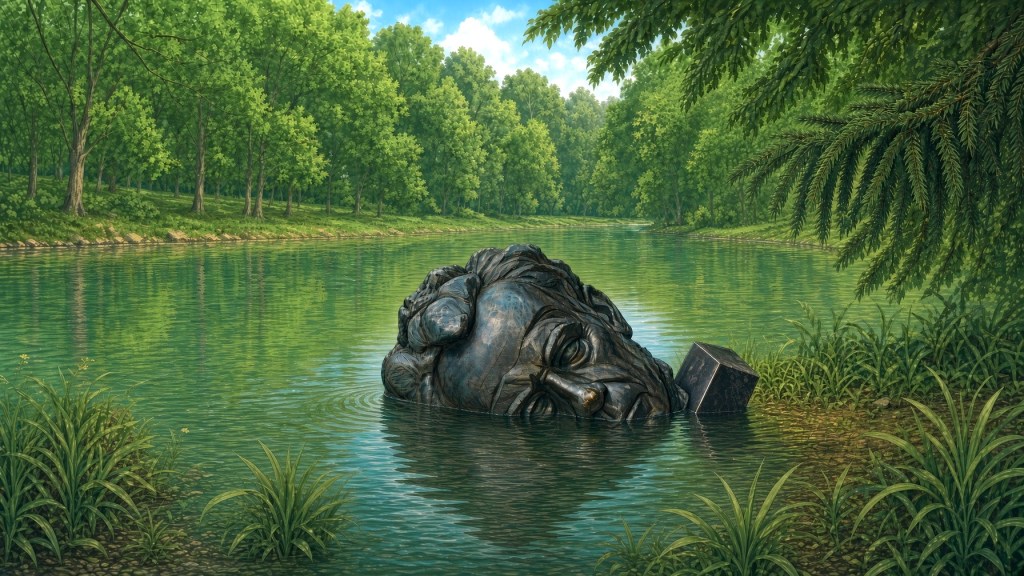
Paul Tillich, a cosmopolitan existentialist from Berlin, never actually lived in New Harmony after immigrating to America. He only visited twice: once to dedicate his namesake park — and the other time in an urn. In his 1963 talk at the Roofless Church titled “Estranged and Reunited: The New Being,” he praised the town as a landscape joining spiritual aspirations with earthly existence. The godliness of Rapp and materialism of Owen, once scattered into different realms, had regathered amid the corn.

To cap off this rejection of dualism, a Cave of the New Being was planned for Tillich Park: a pink cavern and long, narrow earthen mound. It reminded the townsfolk of intercourse and was never built.

His memorial plot, however, was still a point of pride for New Harmony.

“This is so wrong,” Di said, standing next to the large granite grave marker, holding a harness.

“It’s for a good cause,” Thalia said.

“Gold is a good cause?” Di coughed and spat tobacco juice onto the dried spruce needles. Then she whistled strangely.

“Of course it is,” Belle said dismissively. She was leaning against a shovel handle, holding up a spruce twig that lit the clearing with a faint glow. “I’d be careful about casting such powerful spells around here — but nothing risked, nothing gained.”

Di still smelled like smoke from working the bait shop fire (Phiale couldn’t stop thinking about those poor animals). “Chief thinks it was deliberate,” she’d said. “I don’t trust that dwarf who’s been hanging around there.”

Phiale drew in a sharp breath when a white deer as big as a bull with golden horns and pink eyes emerged from the tree line. Di harnessed it and roped it to the memorial boulder. She gave the animal a half-hearted swat; it just stood there, looking a little confused.

“She means go!” Windi said, walloping its haunch.

The deer sprang forward, moving the stone enough to reveal a rusty metal box containing the urn. The rope came loose and it ran — straight into Tillich’s bust, toppling it from its pedestal into Swan Lake.

Sienna bolted. Phiale’s first instinct was also to flee the nightmarish scene. But the others were all joyfully hauling up the box, except for Di, frantically calling back her Ceryneian Hind to remove the harness.

“We’ve got it!” Sam shouted. He pulled a clear vial from his field bag and pinched some ashes into it. A column of gold light sputtered up from the vial and quickly went out. “Off to the temple!”

Sienna was already in the cab, hiding on the floorboard with the doors locked.

***

The hemline of Phiale’s white robe brushed over jewelweed and evening primrose as they passed a rusted fence and came upon a forgotten farm pond. Sam showed everyone his phone’s compass app: 37°56′59″ N. “Amazing, they line up.” He looked up. “The nighttime skies are very similar across a parallel.”

“Wow,” Windi said, rolling her eyes.

Di and Thalia had hammered together scrap boards, placing them on cinderblocks so they wouldn’t rot. Under its corrugated tin roof draped with strings of acorns, deer vertebrae formed a hexagram on the floor. Deer antlers hung from the far wall, and a crescent moon was carved above the entrance.

“The sacred outhouse!” Windi blurted.

“Enough chattering,” Di snapped. “Let’s get started.”

Sam handed Phiale a pewter Federalist-era “crucible” filled with a pale liquid, wood chips and white fungal threads with a ghostly green glow.

“That’s a chamber pot, isn’t it?” Windi said, laughing.

Phiale hesitantly stepped into the dank water, dappled in moonlight, choked with cattails and overhung by a tattered shroud of branches and vines. Her bare feet sank into the slimy muck a few feet from the shore as she stood facing the others.

As a distant truck rumbled down State Road 62 toward Mount Vernon, Phiale wished they were still in New Harmony so Belle could be there with her magic. The gold is making us reckless.

Phiale held out the crucible toward Windi, who stopped short of dumping the first dollop of philosopher into the pot. “Before we left, Belle said she hoped the spell wouldn’t draw unwanted attention,” Windi said. “I wonder if she meant from anyone in particular.”

“She meant that snake you jilted at the altar,” Di said. “Just scoop in the goddamn ashes.”

Windi shrugged and applied the first dusting. A golden glow filled the crucible, which Phiale lifted over her head with shaking arms. A blanket of mist raced across the surface, and although she knew her feet were still planted in the mud, Phiale felt herself draining deep into the earth. She also suddenly sensed the Wabash flowing a mile away, an invisible weather of negative ions. It gave her strength and charged the still air over the pond. She became a switch in a grounded cell that sent a glittering arc of light into the northern sky.

Between the cottonwoods, they could see it coming down on the far horizon. Sam set a gunner’s quadrant toward the far rise of the arc as it traced the local ion gradient. “Crude instrument, but it will have to do.” Then, in the next breath, like he’d never been more certain of anything: “It’s 11 miles from here.”

Sam walked briskly to the truck where they had made Sienna wait so she wouldn’t screw up the spell. “Windi, keep feeding in the ashes if the arc of light starts to dim. Hopefully we’ll have enough by the time I can see where it’s coming down.”

Five minutes after the truck left, the dragon dropped out of the sky toward Windi, grinning, smoke trailing from his mouth. She tossed the urn, sending the remaining ashes up in a cloud. Di crouched next to Thalia with an arrow pointed skyward. Phiale slung the still-glowing crucible onto the bank and dove toward the center of the pond.

From beneath the surface, she saw a bright gold flash, followed by a burst of orange. The water turned hot enough to sting.


Check out Chapter 16. Or read Part 1 on Kindle or in paperback. (Catch up with the Prologue.)
Geographical Sketches

Crossing the Zero Meridian

A Short Periplus of Mud Volcanoes

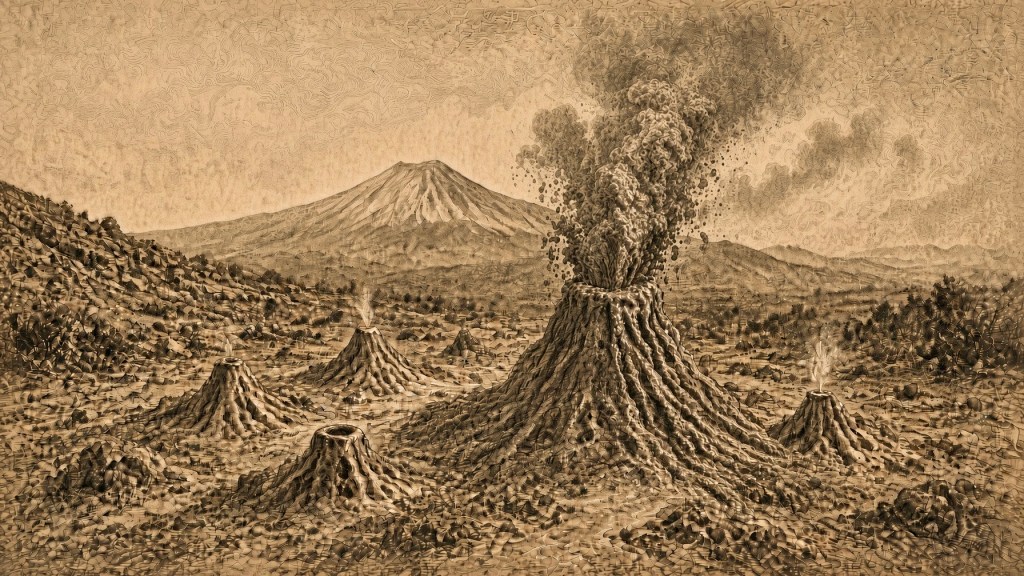
On a seaward approach to Sicily, Etna emerges from the mist: a cratered heap sitting on a powder keg of pressure.

Distance hides less spectacular mouths along its southwestern flank, belching sludge. Constantine Samuel Rafinesque, an eccentric 19th-century naturalist who walked that mountain, had these mud volcanoes in mind when he explained Kentucky’s sinkholes.

After he moved to the Bluegrass and roved its landscape, Rafinesque became convinced the area’s karst sinks were craters from undersea salses — formed when trapped brine and gas pressurize wet clay until a weak seal fails. In “The Caves of Kentucky,” he wrote: “The sinks are, according to my eruptive theory of the limestone and clay formations, the springs, craters, or spouts from whence issued in the sea, that limy mud which spread horizontally, imbedding the fossils.”

There were no cones around them, he thought, because the discharge had flattened into bedrock. Sea creatures were trapped in the sheet — back when a tropical sea covered the country hundreds of millions of years ago.

Rafinesque was wrong about the earth bursting and laying a new crust. Instead, water opens the sinks by dissolving limestone from underneath. Nothing is added. Something is taken away.

The first reading is Jünger’s cult: metaphysical ground driven until it explodes into another ground — an explosive passage over the Zero Meridian of completed nihilism that promises a spiritual dawn but only delivers a different set of tyrants. The second is a water passage. Idols are not replaced. They are removed.

Jünger and Heidegger eventually both accepted flow over control. The Anarch. Releasement.

Cult and papañca cannot bear a void. They need earth to arrive: a result, a slogan, an event, a self that is a thing. Particulars swell and fill the whole field so there is no farness left.

An underground stream works under a different weather. Lethe disintegrates idols, clearing space for new values.

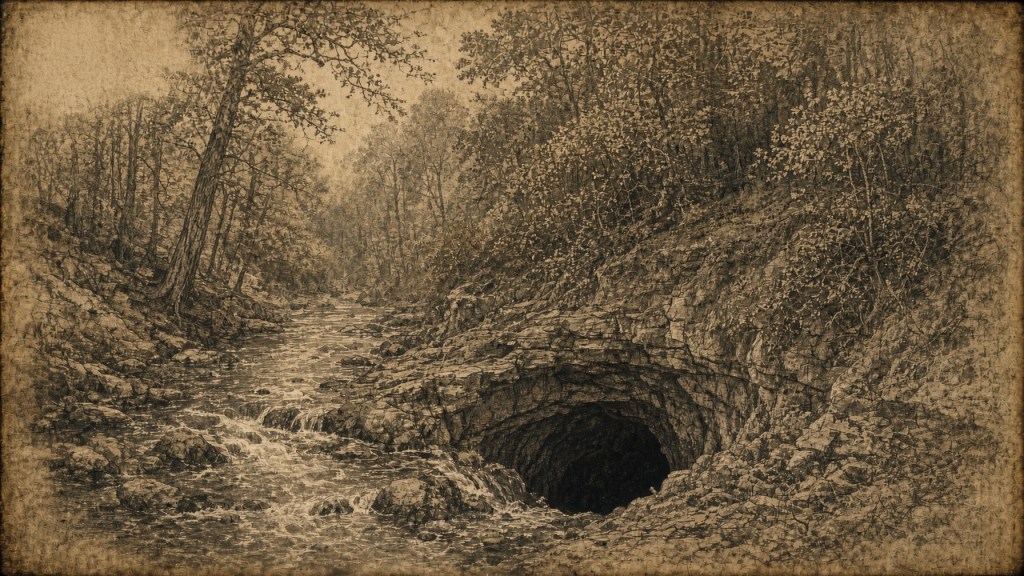
This weather runs under a dry limestone plateau. On the surface is a stand of leaning trees. Closer in, roots hang over a crater of soil and weathered stone. Down a nearby ridge, a stream that had been hidden underfoot briefly emerges from the rock, gathers for a moment in the sun and air, and goes back into the ground.


Read “The Cartography of Nihilism: Two Weathers of Lethe.”

Geographical Sketches

What the Floor is Not

sepia drawing of a karst landscape

A Short Periplus of Central Kentucky

A brook glints in the sunlight before vanishing into the dark earth.

Beyond the city, the conical hills are unseen. They mark what the limestone plain is not.

Places sit inside places, far or near, sometimes hidden. The weather of a region can change while the coordinates stay the same.

From the inhabited floor of the Bluegrass to the rim of the Knobs to the hollow ground of the Pennyroyal to the wash of the Ohio Valley, the countryside presences differently.

On the floor, a village called Athens shares the same parallel as the Ephesian temple of Artemis. It is a lull inside Lexington’s city limits: brick and farms just east of the interstate.

Different weathers gather on this rolling ground. Rivers cut palisades in the limestone, revealing remains of ancient marine life. Ice sheets never scoured this floor.

West and south, the woods thicken. Steep knobs horseshoe the Bluegrass. They were not heaped up like the earthen mounds. Everything around them was taken. The caps mark how high the plateau once stood. Hard to farm, thinly lived. On one wooded hill, Merton’s hermitage still stands.

The Knobs do not ease into the Pennyroyal. Muldraugh Hill is a true scarp, a plateau you do not have to infer. The ground under it does not stay solid: black rivers and empty chambers. On the same upland, a vault was built and filled with gold, charged with significance.

Fort Knox holds a hill above the Ohio, where cannons once looked down from a few hundred feet. To drop into the valley is to lose that perch — no field of fire, no cave, no vault. Only flood is guaranteed.

The ancients piled platforms the water did not take. Glaciers, stopping short of this line, carved the Ohio and buried the north side with a jumble of rocks and soil.

Now the river gathers the missing land and streams, seen or not, and carries them off.


Read “What a Parallel is Not: A Short Periplus of Angel Mounds.”

Rafinesque

Revolutions of Nature and Nations

In 1824, Humphrey Marshall published an expanded version of his History of Kentucky—a hard-edged partisan chronicle with an odd introduction.

Marshall had enlisted Transylvania University professor C. S. Rafinesque, the most active investigator of the state’s ancient monuments at the time, to write the opening section. He delivered a freewheeling, visionary account of the deep past.

Rafinesque liked his introduction enough to reprint it as a separate 39-page pamphlet, adding his “Enumeration of the Sites of Ancient Towns and Monuments of Kentucky, Etc.,” along with an “Ethnological and Philological Table of the Primitive Nations and Languages.”

Ancient History, or Annals of Kentucky offers fantastical details like lost tribes, submerged continents, and elephants roaming the Ohio Valley. Its greater value, though, is metaphysical. Whether through geology, biology, or ethnology, the eccentric naturalist intuited a universe underpinned not by Plato’s perfect forms but by Heraclitus’ flux. This was heretical thinking for its time, pointing toward a hidden reality of cataclysm and coherence, erasure and persistence.

Great floods wash away the old, rigid forms while remnants of culture and memories persist on the mounds and highlands. Landscape topography becomes metaphysical topology, a Chladni plate of assembly at the nodes and dispersal at the antinodes.

Rafinesque finds the same pattern in the roots of ancient languages—word-nodes hardy enough to survive the dispersal of individual tribes across the globe.

This rhythm goes beyond language. His perspective anticipates what Nietzsche would later call will to power: the fundamental polarity of being and becoming. What exists must be swept away so a more coherent form can regather with greater strength—only to break apart again in a further overcoming.

The universe is always changing but not chaotic. There are laws. The payment for a scattering is a gathering.

Rafinesque (1783-1840) himself embodied the flux he described. Displaced from Europe, he tried to gather his life again in Lexington. (A shipwreck off Connecticut had destroyed his vast collections of specimens and manuscripts, forcing him to start over.)

Born in Galata near Constantinople to a French merchant father and German mother, Rafinesque was largely self-educated. He studied Mediterranean plants and fishes in Sicily before moving to America in 1815.

He joined Transylvania in Lexington four years later and taught botany and natural history—until he had a falling out with the university president in 1826, cursed the school and left for Philadelphia, where he continued his work.

As prolific as he was controversial, Rafinesque studied botany, zoology, archaeology, linguistics, and early evolutionary theory. He researched Mesoamerican scripts and named thousands of species while proposing a theory of evolution that predated Darwin by decades. Over his lifetime, he gained a reputation as an outsider. His hasty, unorthodox claims and methods often drew criticism from a scientific establishment steeped in conventional Christianity.

Rafinesque jettisoned ways of thinking that had ossified over the two millennia since Plato’s metaphysics set the stage for being’s precedence over becoming. Intentional or not, he integrated empirical science with the pre-Socratic philosophy of Heraclitus, whose ideas weren’t constrained by Platonic rigidity.

Species, civilizations, and even the landscape itself weren’t created once and forever in their current form—instead, Rafinesque saw a seething conflagration.

He described “the great universal law of perpetual mutability in everything” in his 1833 article “Principles of the Philosophy of New Genera and New Species of Plants and Animals.” Under this law, gradual deviations of form occur over immense spans of time. He had already applied it in Ancient History to geology, languages, and human migrations.

In his 1836 poem The World, or Instability, Rafinesque returned to the same vision in more explicitly elemental terms. Fire is a latent force that “tends in all / To swell, expand and break the bonds of matter,” appearing and disappearing by turns, “Never the same although the same appearing…” The underlying intuition is Heraclitean: a universe whose only constancy is transformation.

“All is fire,” the philosopher said, kindling in measures and going out in measures. Change is not merely a physical event. It is a metaphysical axiom.

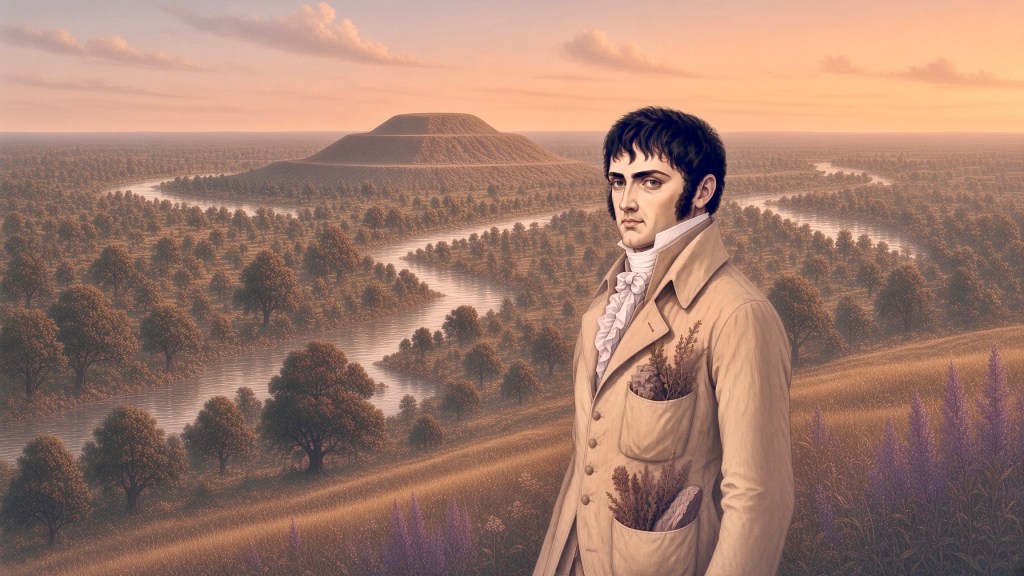
Rafinesque, though, remained grounded in the world around him. Wearing a stained nankeen coat, pockets bulging with specimens, he ambled across the countryside documenting what the floods had not erased. Native American earthen mounds—used for rituals, burials, residences—stood near the rivers, outliving the settlements once clustered around them. These were local Ararats on the Ohio—high places where culture and memory survived each inundation.

Floods are high-amplitude scattering events in Ancient History’s long chronology. They wash away the temporary orders of the lowlands, and then power, ritual, and memory gather again at the nodes.

Rafinesque locates these high places explicitly: “The first cradle of mankind was called Eden (or Ima) and was in the highest land of Asia…” Also: “[T]he second cradle of mankind after Noah’s flood was also in the lofty lands of Asia…”

These areas of persistent convergence, both physical and cultural, illuminate what Ñāṇavīra called the principle of “invariance under transformation.” What endures is a structural place—anchored in physical substance—that continues to function while its contents change; resistant poles allow a resonant pattern to restabilize after scattering. Heraclitus had already provided the image: the river is never the same water, yet it remains the same river, a coherent structure where gathering preferentially returns. The new configuration is never identical to what was swept away, but it is continuous with it and flows according to the altered conditions.

This re-formation is part of what Heraclitus called dikē: cosmic justice. The universe seeks the concentration of strength to counterbalance the overall trend toward entropy.

As with the mounds, Rafinesque found a nodal architecture in language and in living forms. The radical roots he traced—basic terms for heaven, land, water, man—function as linguistic cores. They remain while tribes migrate, languages splinter, and surface vocabularies dissolve; later cultures take them up again. (The comparative tables in Ancient History are an attempt to map these enduring cores.) In biology, he stated the principle even more directly. Darwin later quoted his 1836 remark: “All species might have been varieties once, and many varieties are gradually becoming species by assuming constant and peculiar characters … except the original types or ancestors of the genus.” In other words, forms are not ideal and fixed from the beginning. Through ongoing flux, certain configurations stabilize into new patterns. Underlying original types remain as the stronger positions—the ones that have already demonstrated their endurance.

Thus a hierarchy of nodes appears, shifting with environmental conditions the way a Chladni pattern rearranges when the frequency changes. Weaker stabilizations are shed; stronger ones become the reference points for the next regathering. What survives is what can still function as an effective attractor under the new frequency of conditions.

The low ground forgets and the strongest elevations hold—but not forever. Many of the sites Rafinesque recorded in Ancient History later disappeared under the plow and assaults of nature. Mounds erode, branches of languages and of life die out. Whatever is of the nature to arise is of the nature to pass away, a flickering of fire.

But the rate of change varies. Without periods of relative persistence, being would lose its weight to chaos. The ancient monuments are where the landscape remembers by repetition and attention. Through repeated ritual, mind and place are bound together, and the sites persist as enduring nodes. The constant return gives the illusion of solidity.

Extending this same logic across space, the individual mounds form a larger network. Major centers stand as stronger primary nodes; smaller earthworks and enclosures occupy secondary or supporting positions. Their placement is rarely random. Alignments, sight-lines, distances, and hierarchical groupings create a distributed geometry that functions as a physical memory system.

After a cataclysm, later groups inherit a pre-existing field of nodes. They return not only to the same mounds but to the relational pattern among them, because that arrangement has already proven itself. The landscape participates in logos—the order that steers the flux.


This essay appears as the introduction to a new, modernized edition of Rafinesque’s Ancient History, or Annals of Kentucky, which also includes the complete 1824 text, monument list, language root tables, and several site diagrams.

An Existential Fairy Tale

The Flame of Heraclitus: Chapter 14

“The king was going to open the gate in order to offer the girl to whatever feared thing lives in the jungle. He was sending out a bride to Kong.”
— Delos W. Lovelace, King Kong

Legend has it the positive geographical correlation between reports of missing people and Bigfoot sightings is not coincidence — it’s causal.

When the authorities realized the lore was actually true — that Atalan remnants were dragging off hundreds of random nature lovers, including some VIPs — they struck a deal. The giants agreed to leave humans alone if, every once in a while, they were bestowed a virgin. (A military incursion against them was deemed “culturally insensitive” and might have blown the cover-up of their existence.)

Management of the sacrifices naturally fell to the Smithsonian, which had been in communication with the beasts for more than 150 years.

“I don’t know for sure if he’s going to eat you … at least not right away,” agent Fafner told Sienna. “We’re just focused on the transfer ritual … it’s actually quite an enriching experience.”

“Oh, shut the fuck up,” agent Booker said as she rhythmically struck the trunk of a bald cypress with a heavy stick. The knocks echoed deep into the swamp. “She doesn’t need to know that shit.”

“Fine, whatever.” Fafner sounded a little hurt. “Just don’t knock too fast — that’s a territorial challenge.”

“You’re both crazy!” Sienna shouted. Supine on the spongy soil amid ferns, she jerked the ropes binding her arms and legs to cypress knees. “Let me go! You can’t just make me into an offering — I have rights!”

“It’s your punishment for desecrating Native gravesites,” Fafner said, holding a clutch of burning cedar sticks soaked in pine tar. He started dancing around the girl, whooping softly.

As if in response, a crane called out from somewhere within this dusky bayou reeking at Indiana’s big toe. Suddenly anything seemed possible to Sienna, surrounded by a primeval, otherworldly riot of life. Her tears turned the feathery leaves hanging over her into breathing green splotches.

Something nearby knocked back.

Fafner stood still. “Holy shit. That sounded like a response.”

“Keep your eye out for that smelly son-of-a-bitch,” Booker said. “Two agents almost got mauled in Jackson Hole last summer … dumbasses let their guard down.” She gave three more slow knocks, and then, along with her partner, crept to the van parked at the end of a gravel road.

With incredible speed, an eight-foot-tall brute with fangs and long matted hair crashed through the undergrowth — he went straight for the discovery van. The agents managed to climb inside and shut the door before the Hovey Lake Swamp Ape began battering the already beat-up vehicle, leaving deep claw marks through the triceratops graphic.

“No, not us — why isn’t he going for the girl?!” Fafner yelled.

“Don’t ask me.” Booker fumbled the keys into the ignition. “Maybe the motherfucker’s gay.” The van’s engine roared to life, and the back tires pelted the Sasquatch with rocks as it sped away.

The creature bellowed. Then it turned toward Sienna, now madly trying to free herself. As it neared, she retched from its stench and felt woozy.

Then she heard “crunch … crunch … crunch … ” approaching on the gravel road. Through her mental haze, she saw a giant skeleton appear in the clearing with a jewel-encrusted sword.

The Bigfoot stared dumbfounded as the skeleton knelt down and bowed its head deeply to Sienna. “Oh, wise Bee Mother Fo Ishki,” it said with a dry, eerie hiss. “I are glad you found me in time … no, wait …. I found you … ”

In just three strides the Swamp Ape reached the skeleton, and in one swipe took off its head. The bones collapsed to the ground and something that looked like a butterfly spiraled up from the pile, cussing. The girl passed out.

***

“Keep in mind, we’re basically looking for waves in the landscape,” Sam noted. “Technically, they’re called old point bars — accumulations of sand and gravel left behind as the Ohio meandered.”

“Oh, no,” Windi said as they trudged through the mud. “Here we go.”

Thalia groaned.

“You see,” Sam continued pedantically, “since currents flow more slowly on the inside of a river’s bend than the outside, sediment accumulates along a low, curved ridge. After the river changes course, this could provide a space that’s both enclosed by earth and above the water table.”

“Are you sure you didn’t just read the crop circle wrong?” Di asked. “I imagined her in a cave.”

“Any caverns around here would be flooded — the bedrock isn’t limestone anyway. But I guarantee you that we’re standing within a quarter mile of her. Just make sure you check any elevated areas for signs of disturbance or large holes.

The smell of wet earth and decaying vegetation was strong as they spread out and picked their way over the firmest patches of ground. Phiale was struck by a sense the landscape was losing its form. The death of earth is water, she thought.

After wandering around for almost two hours shouting for Tinker Bell and poking around bumps in the floodplain, they sat on a fallen trunk. Phiale wiped her muddy hands on the soft, stringy bark as sweat stung her eyes. The sunlight, once green and golden through the canopy, had grown murky. She slapped a mosquito on her neck.

“We’re wasting our time out here,” Di said.

Sam tapped a topological map marked up with sacred geometry. “No, we entrained with her at this hexagonal node, right here in the Opilwalacha Cypress Slough.”

Di twisted the string of her bow to increase the tension. “We still don’t want to be in the swamp after dark.”

“I’m with her,” Thalia said. She nudged Windi with her elbow. “Hey, give me a smoke.” The girls fumbled handing over the slightly crumpled pack of Marlboros, which fell into a black, tannin-stained puddle, soaking all the cigarettes.

“What a total crock!” Windi shouted and kicked the log.

“Crawk!” something called back from the trees. A white egret floated down to a clump of cypress roots about 20 yards away. It pecked at the ground. Then it displayed its five-foot wingspan. “Crawk! crawk!”

Where have I seen that bird before? Phiale thought and walked toward it. The egret flew up into a nearby cottonwood, where it watched the girl intently.

Phiale noticed the roots were part of a long, narrow rise. A large snake track waved across deep indentions in the surrounding mud.

Now Sam was walking beside her. “Let’s check around the roots first. They can open up large pockets in the soil.”

Phiale shined her phone into the largest opening, revealing a long chamber running along the ridge. Was that a glint of metal? From somewhere deep inside, she heard a faint “Hello? Eh … get me the hell out of here.”

After they dug out Tinker Bell — still sprightly, albeit dirty — and released her from the birdcage, she immediately flitted to a patch of swamp roses, where she gorged herself. Phiale had never felt so relieved.

The fairy then picked up a twig and jabbed it in the air. Not even a puff of smoke. “Get me back to New Harmony.” She laughed and flew in wide circles between the trees, saying, “I’m free … I’m free-e-e-”

A large skeletal hand reached out from the gloom and grabbed her.

“Ohhh … I caught something pretty … I will make it sing to me,” the giant said and lumbered off with the Tinker Bell.

They chased it along its path of destruction, slipping in the muck most of the way. Shortly after glimpsing Hovey Lake through the bottomland hardwoods, they entered the clearing where the transfer ritual had taken place — just as the Swamp Ape decapitated the skeleton.

The creature immediately faced the new arrivals and pierced the air with a screech. Phiale was glad to see the fairy dart up out of the bone pile but couldn’t move from fear. Di brushed past her, nocking a silver-tipped shaft.

The huntress sent her arrow into the beast’s heart. It died suddenly and painlessly.


Check out Chapter 15. Or read Part 1 on Kindle or in paperback. (Catch up with the Prologue.)