In 1824, Humphrey Marshall published an expanded version of his History of Kentucky—a hard-edged partisan chronicle with an odd introduction.
Marshall had enlisted Transylvania University professor C. S. Rafinesque, the most active investigator of the state’s ancient monuments at the time, to write the opening section. He delivered a freewheeling, visionary account of the deep past.
Rafinesque liked his introduction enough to reprint it as a separate 39-page pamphlet, adding his “Enumeration of the Sites of Ancient Towns and Monuments of Kentucky, Etc.,” along with an “Ethnological and Philological Table of the Primitive Nations and Languages.”
Ancient History, or Annals of Kentucky offers fantastical details like lost tribes, submerged continents, and elephants roaming the Ohio Valley. Its greater value, though, is metaphysical. Whether through geology, biology, or ethnology, the eccentric naturalist intuited a universe underpinned not by Plato’s perfect forms but by Heraclitus’ flux. This was heretical thinking for its time, pointing toward a hidden reality of cataclysm and coherence, erasure and persistence.
Great floods wash away the old, rigid forms while remnants of culture and memories persist on the mounds and highlands. Landscape topography becomes metaphysical topology, a Chladni plate of assembly at the nodes and dispersal at the antinodes.
Rafinesque finds the same pattern in the roots of ancient languages—word-nodes hardy enough to survive the dispersal of individual tribes across the globe.
This rhythm goes beyond language. His perspective anticipates what Nietzsche would later call will to power: the fundamental polarity of being and becoming. What exists must be swept away so a more coherent form can regather with greater strength—only to break apart again in a further overcoming.
The universe is always changing but not chaotic. There are laws. The payment for a scattering is a gathering.
Rafinesque (1783-1840) himself embodied the flux he described. Displaced from Europe, he tried to gather his life again in Lexington. (A shipwreck off Connecticut had destroyed his vast collections of specimens and manuscripts, forcing him to start over.)
Born in Galata near Constantinople to a French merchant father and German mother, Rafinesque was largely self-educated. He studied Mediterranean plants and fishes in Sicily before moving to America in 1815.
He joined Transylvania in Lexington four years later and taught botany and natural history—until he had a falling out with the university president in 1826, cursed the school and left for Philadelphia, where he continued his work.
As prolific as he was controversial, Rafinesque studied botany, zoology, archaeology, linguistics, and early evolutionary theory. He researched Mesoamerican scripts and named thousands of species while proposing a theory of evolution that predated Darwin by decades. Over his lifetime, he gained a reputation as an outsider. His hasty, unorthodox claims and methods often drew criticism from a scientific establishment steeped in conventional Christianity.
Rafinesque jettisoned ways of thinking that had ossified over the two millennia since Plato’s metaphysics set the stage for being’s precedence over becoming. Intentional or not, he integrated empirical science with the pre-Socratic philosophy of Heraclitus, whose ideas weren’t constrained by Platonic rigidity.
Species, civilizations, and even the landscape itself weren’t created once and forever in their current form—instead, Rafinesque saw a seething conflagration.
He described “the great universal law of perpetual mutability in everything” in his 1833 article “Principles of the Philosophy of New Genera and New Species of Plants and Animals.” Under this law, gradual deviations of form occur over immense spans of time. He had already applied it in Ancient History to geology, languages, and human migrations.
In his 1836 poem The World, or Instability, Rafinesque returned to the same vision in more explicitly elemental terms. Fire is a latent force that “tends in all / To swell, expand and break the bonds of matter,” appearing and disappearing by turns, “Never the same although the same appearing…” The underlying intuition is Heraclitean: a universe whose only constancy is transformation.
“All is fire,” the philosopher said, kindling in measures and going out in measures. Change is not merely a physical event. It is a metaphysical axiom.
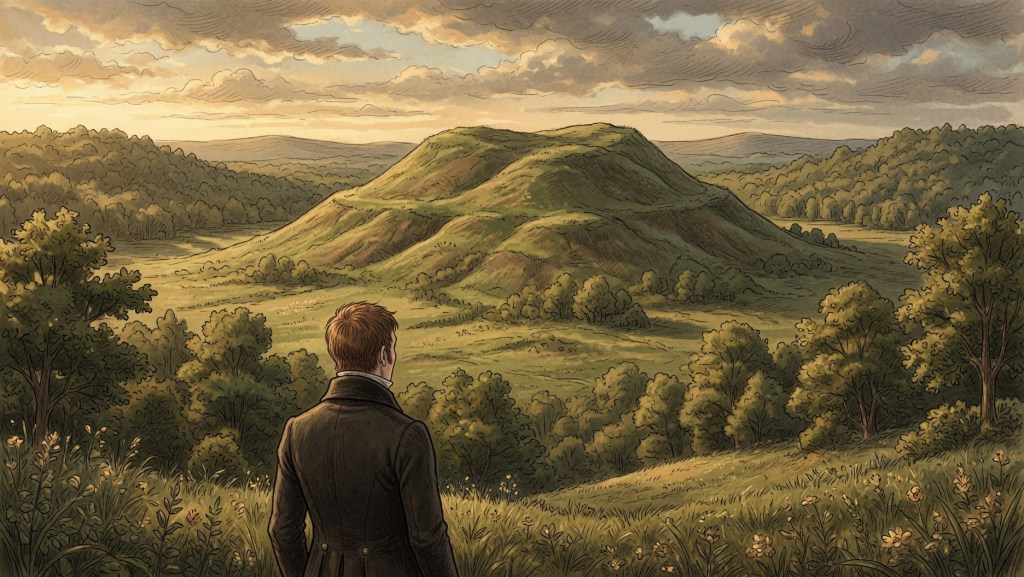
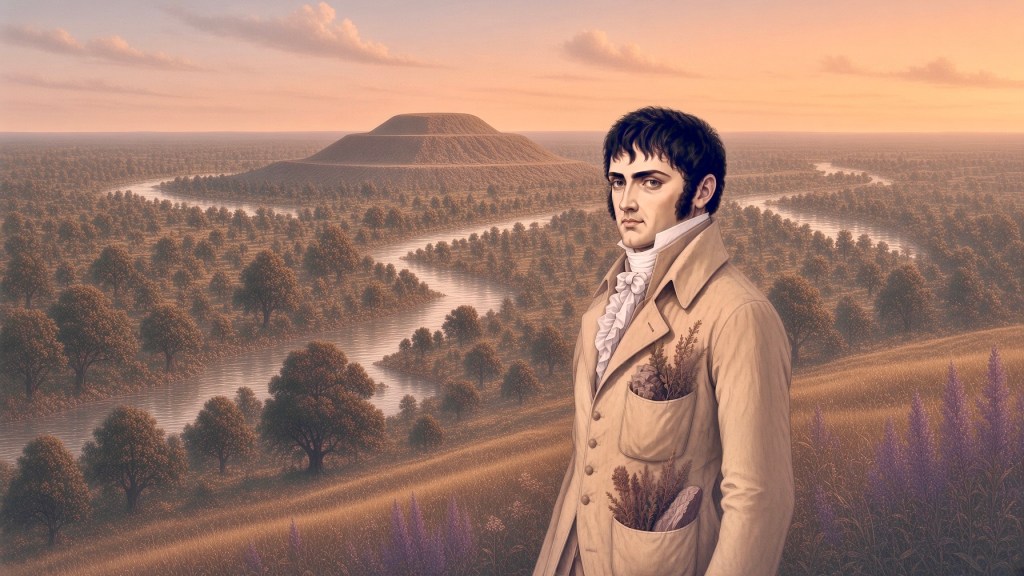
Rafinesque, though, remained grounded in the world around him. Wearing a stained nankeen coat, pockets bulging with specimens, he ambled across the countryside documenting what the floods had not erased. Native American earthen mounds—used for rituals, burials, residences—stood near the rivers, outliving the settlements once clustered around them. These were local Ararats on the Ohio—high places where culture and memory survived each inundation.
Floods are high-amplitude scattering events in Ancient History’s long chronology. They wash away the temporary orders of the lowlands, and then power, ritual, and memory gather again at the nodes.
Rafinesque locates these high places explicitly: “The first cradle of mankind was called Eden (or Ima) and was in the highest land of Asia…” Also: “[T]he second cradle of mankind after Noah’s flood was also in the lofty lands of Asia…”
These areas of persistent convergence, both physical and cultural, illuminate what Ñāṇavīra called the principle of “invariance under transformation.” What endures is a structural place—anchored in physical substance—that continues to function while its contents change; resistant poles allow a resonant pattern to restabilize after scattering. Heraclitus had already provided the image: the river is never the same water, yet it remains the same river, a coherent structure where gathering preferentially returns. The new configuration is never identical to what was swept away, but it is continuous with it and flows according to the altered conditions.
This re-formation is part of what Heraclitus called dikē: cosmic justice. The universe seeks the concentration of strength to counterbalance the overall trend toward entropy.
As with the mounds, Rafinesque found a nodal architecture in language and in living forms. The radical roots he traced—basic terms for heaven, land, water, man—function as linguistic cores. They remain while tribes migrate, languages splinter, and surface vocabularies dissolve; later cultures take them up again. (The comparative tables in Ancient History are an attempt to map these enduring cores.) In biology, he stated the principle even more directly. Darwin later quoted his 1836 remark: “All species might have been varieties once, and many varieties are gradually becoming species by assuming constant and peculiar characters … except the original types or ancestors of the genus.” In other words, forms are not ideal and fixed from the beginning. Through ongoing flux, certain configurations stabilize into new patterns. Underlying original types remain as the stronger positions—the ones that have already demonstrated their endurance.
Thus a hierarchy of nodes appears, shifting with environmental conditions the way a Chladni pattern rearranges when the frequency changes. Weaker stabilizations are shed; stronger ones become the reference points for the next regathering. What survives is what can still function as an effective attractor under the new frequency of conditions.
The low ground forgets and the strongest elevations hold—but not forever. Many of the sites Rafinesque recorded in Ancient History later disappeared under the plow and assaults of nature. Mounds erode, branches of languages and of life die out. Whatever is of the nature to arise is of the nature to pass away, a flickering of fire.
But the rate of change varies. Without periods of relative persistence, being would lose its weight to chaos. The ancient monuments are where the landscape remembers by repetition and attention. Through repeated ritual, mind and place are bound together, and the sites persist as enduring nodes. The constant return gives the illusion of solidity.
Extending this same logic across space, the individual mounds form a larger network. Major centers stand as stronger primary nodes; smaller earthworks and enclosures occupy secondary or supporting positions. Their placement is rarely random. Alignments, sight-lines, distances, and hierarchical groupings create a distributed geometry that functions as a physical memory system.
After a cataclysm, later groups inherit a pre-existing field of nodes. They return not only to the same mounds but to the relational pattern among them, because that arrangement has already proven itself. The landscape participates in logos—the order that steers the flux.
This essay appears as the introduction to a new, modernized edition of Rafinesque’s Ancient History, or Annals of Kentucky, which also includes the complete 1824 text, monument list, language root tables, and several site diagrams.