Cahokia was a solar cult in many ways. From Woodhenge, the equinox sun seemed to rise directly out of the 100-foot-tall Monks Mound — as if the chief himself had commanded it. But worship of the sun alone cannot sustain a civilization. Like the equinox itself, Mississippian memes called for balance: near and far, visible and hidden.
Fifteen miles east, on a glacial ridge piled with earth, the Emerald Acropolis formed the complementary node: a moon shrine aligned to the major lunar standstill. Pilgrims left the American Bottom for Emerald every 18.6 years, witnessed the hesitation of the moon at its extreme azimuths, and returned.
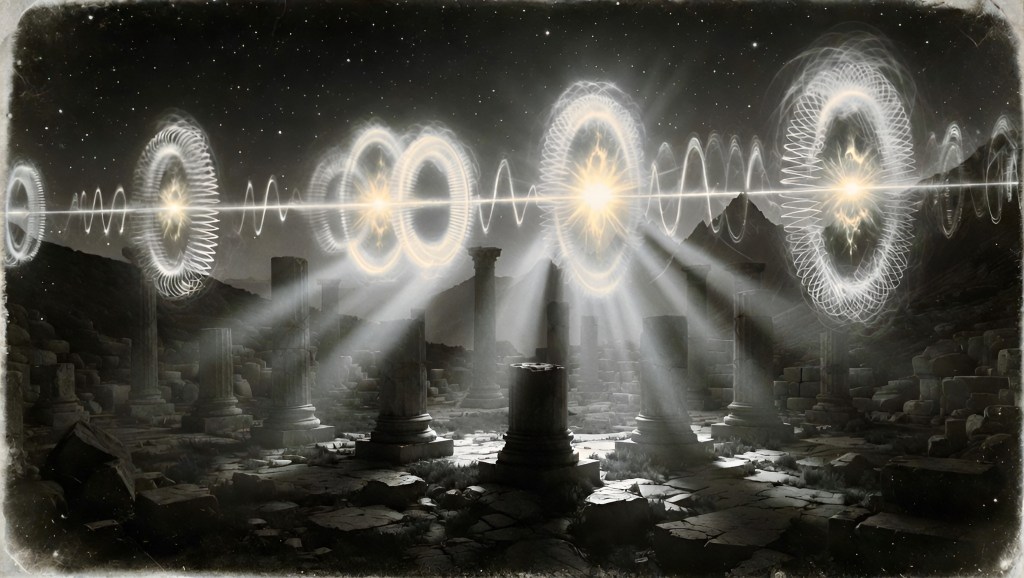
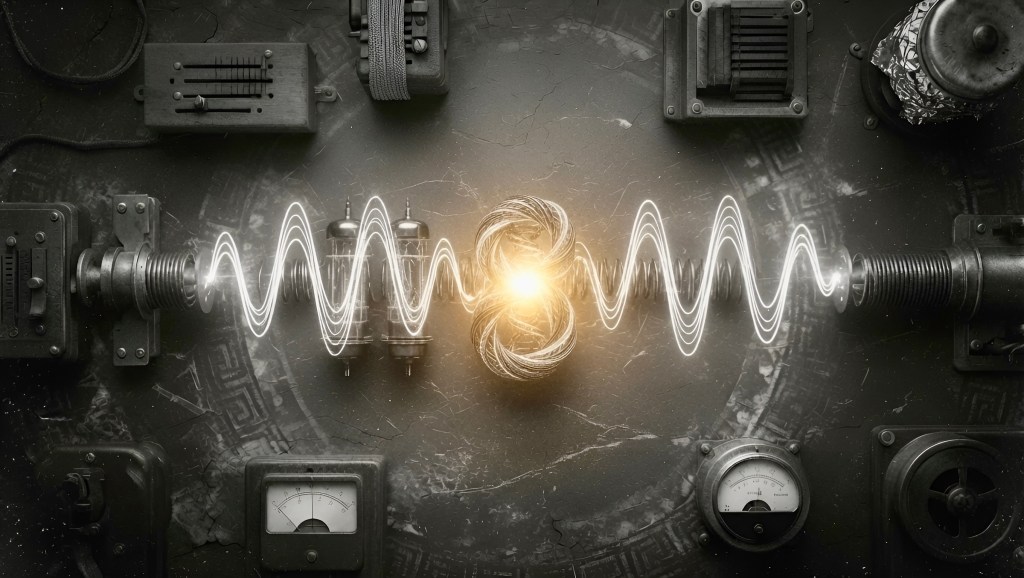
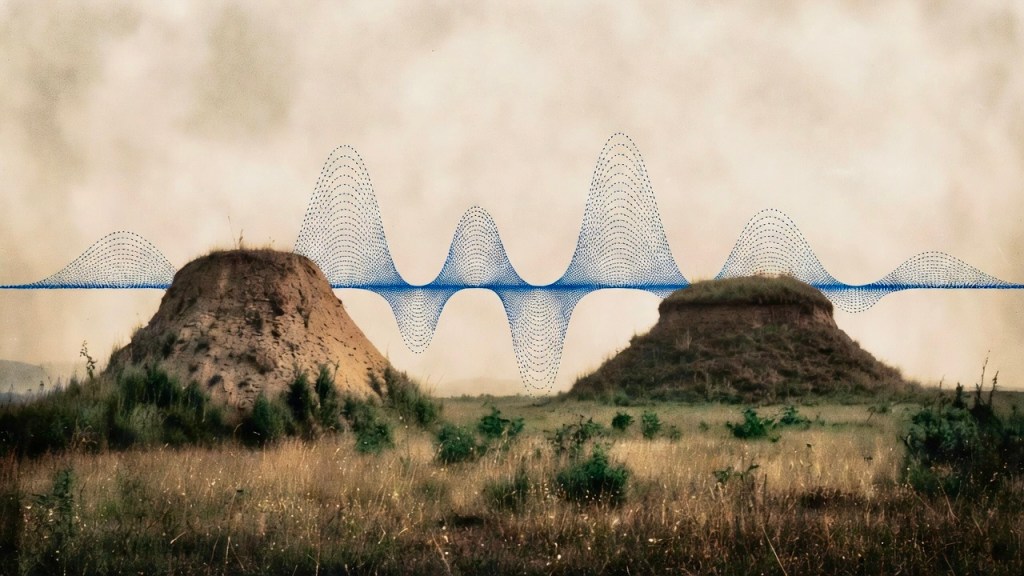
Each mound is a metaphysical node. In this timeless register, two equal waves travel in opposite directions — there and back. When crest meets crest or trough meets trough in the middle, the displacements add so the antinodal arcs open to their fullest; where the waves hit the mounds, they flatten.
The football-shaped envelope of this standing half-wave figure represents the being-becoming polarity fractalizing throughout existence. From ancient cult centers to the self-torus to eternal recurrence, the same crossings appear at every scale. The Big Bang is the departure from a cosmic node; the antinodes are the furthest rarefaction, where the interval has opened as far as the figure can sustain. Civilizational passages follow the same geometry as two forms of nihilism: dense concealment and chaos.
The nodal reflection is a reversal from the earth weather’s toward fire, seen in the explosive phase inversion of the 20th century wars; our present societal scattering is approaching an amplitude that demands a turnabout.
Cults persist toward the antinodes because the lattice still holds the previous node’s attraction: idolatry thrives after the death of God. But this incomplete form of nihilism consummates with a release of all veneration at the point of maximum dispersion, where the wave loosens enough to reverse its swing back to the next node.
Both the nodes and antinodes are regions of totalizing nihilism — the Zero Meridian — but in opposite ways. At the nodes the figure conceals the structure most tightly; cult organizes minds into standing reserve, facticity held by the hardness of earth weather, the wave fully flattened. Dikē, as regulator of extremes, does not allow that rigidity to persist. It drives the inversion when the small pulse meets the concealing nihilism of earth and turns the arc downward. The thrust away from the node opens the interval toward another antinode, a rarefaction that carries the two waves out of earth into the weathers of water, air, and fire at maximum dispersion.
The way up and down are one and the same. Antinodal displacement is the fullest kindling — and the point in wave or trough where the pullback is strongest. The descent is the fire going out in measure, the interval closing into the complementary node, earth reoccupied.
The waves form an arc because tension and the restoring force require curvature. Repeat this circuit enough times, or in large enough numbers, and the binding action of the saṅkhāra lattice holds the nodes in place while the interval stays open.
In the case of the Emerald pilgrimage, the form persists because collective presence keeps returning the same ends at the same interval. Memes take form through repetition or sheer number of minds phase-locked with them, synced to the same beat through a replicating mind virus. What kept Emerald’s 18.6-year circuit half-wave standing were the tens of thousands of pilgrims walking the antinodal paths — a practice that both traces the interval and helps hold it open. The strength of that phase-lock — the tension that keeps the two nodes from drifting — comes from ritual, repeated attention, earth-anchoring. Neither sun nor moon pole predominates because the standing half-wave exists only while both are driven.
A meme itself is a saṅkhāra, the jointure of carrier and pattern. It needs a rūpa register for sense engagement to lock it into the helical core of a self-torus, where it colors perception and gives significance to rite. Each side conditions the other’s existence. A mound with no cult is just a pile of dirt; a meme without an anchor is a diffuse pattern that cannot sustain its nodes or gather a phase-lock.
While both terminals of a standing half-wave share the characteristics of the earth weather, they are polar opposites in their metaphysical register when a meme has stabilized as a saṅkhāra between them as complementary attractors. Cahokia and Emerald are revealed and withdrawing poles respectively. When the nodes are the same idol twice, the interval closes and the antinodes pack back into earth. Polar opposites as memeplexes allow sky into earth, creating depth and a healthier society. Phase-locking with such balanced cults causes a sustained rarefaction in the human nodal cross. A cross fed from only one pole compresses particulars edge to edge, nothing able to withdraw; much seems significant, although without deeper meaning. But when the self-torus entrains with a complex, high-amplitude standing wave, earth turns toward fire with a rarefaction of consciousness, feeling tone and perception. With cult, this is intense, temporary, and comes with a price.
After the feast, game of chunkey, and human sacrifice, the Emerald Acropolis pilgrims burned their mats, baskets, and fabrics. They also sealed the floors of their temporary huts with silt. The node remained unchanged when the wave reversed.
Read more topologies in “The Structure of Becoming” series.