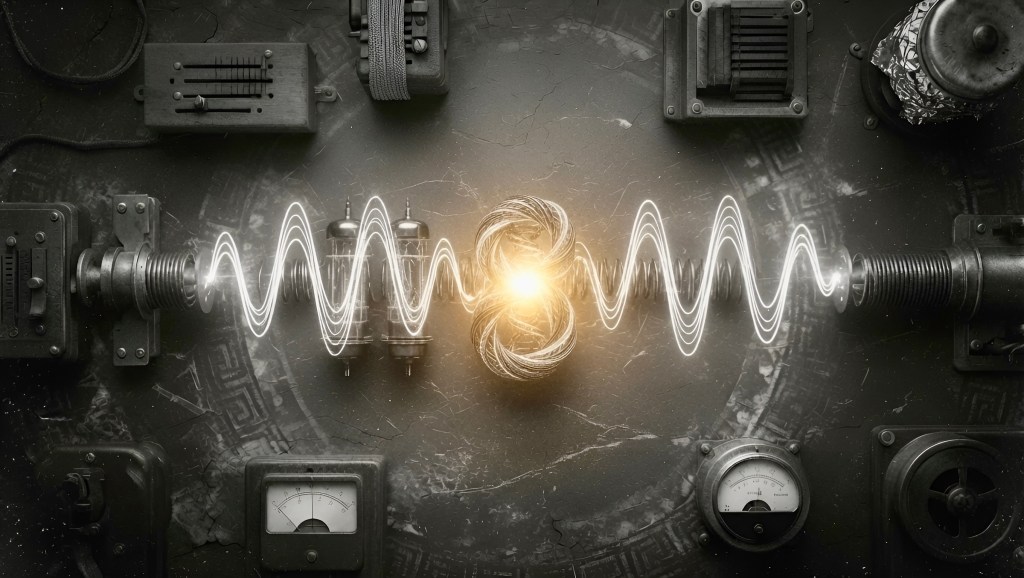
The topology of mind reveals a toroidal structure resonating in a hidden realm. Within the self-torus are four interconnected zones: the wavenumber-6 standing wave, lethe, helical polar core and central nodal cross. These illuminate the structure of selfhood — its values, developmental movement, illusion of persistent identity amid flux and volition’s role in the arising of consciousness.
These functional regions arise from the dynamic interplay of the five waveband aggregates. Rūpa (materiality) serves as the toroidal resonant chamber that bounds and organizes the four upper bands: vedanā (feeling-tone), saṅkhāra (binding lattice), saññā (perception) and viññāṇa (consciousness). Without this rūpa chamber, the higher wavebands would remain too diffuse to sustain stable patterns. The structure provides both a ground for individual striving toward greater coherence and the possibility of phase-locking with external resonant forms, in accordance with the demands of will to power.
At its most basic geometric level, the self-torus is sustained by the wavenumber-6, which produces 12 fixed nodes around the circumference. While these remain relatively stable, the regions between them pulsate rhythmically. A standing wave of this kind possesses sufficient structural coherence and harmonic stability to phase-lock in the realm of toroidal resonance without losing its own integrity.
Although the self-torus is grounded in rūpa, it remains undetected by current scientific instruments. Even if that were possible, the four upper wavebands would still lie beyond the reach of materialism. What follows, therefore, is a topological description of metaphysics — a mapping of the resonant architecture where cosmic cetanā (volition) localizes and surpasses itself within conditioned existence.
The wavenumber-6 establishes the overall container for the other functional zones to operate. Its 12 nodes correspond to the 12 nidānāni of paṭiccasamuppāda, the structural conditions of moment-to-moment dependent origination and maintenance of the self. This layer most directly expresses what underlies experience, while the remaining zones govern modulation and transformation across time.
Within the lethe zone, cetanā narrows the field by scattering all potentialities except the chosen one; this opens a clearing at the central nodal cross where actuality stands forth. What arises is not erased after fading from awareness. Through the activity of cetanā, it becomes integrated into the kamma-bhava saṅkhāra — the karmic conditioning strands — within the helical core, where it continues to shape future possibilities and receptivity. A new horizon of potentialities emerges, shaped by this accumulated background, continuing the cycle.
Lethe thus scatters in service of gathering. As dikē demands, every dissolution calls forth a movement toward greater coherence as a counterbalance.
This polar tension finds its most concentrated expression in the helical core. Here, a lemniscate-like motion allows opposing polarities to meet and rebalance at each crossing. Because the core accumulates conditioning over time, it possesses the capacity for ongoing evolution rather than mere repetition. While this movement performs the essential work of polarity and integration, increases in coherence and resonance register most significantly in the evolving attractor quality of the central nodal cross. In this way, the helical core supports the conditions for development, while the nodal cross serves as the primary site where that development is expressed and tested.
The helical core’s internal dynamic interfaces with the larger architecture of the self-torus. At the central nodal cross, the helical core’s polar activity meets the convergence of the wavenumber-6 standing wave’s nodal spokes. At this intersection, the ongoing work of transformation becomes most directly available for integration into the self-torus as a whole.
This is not a closed system. This is not a closed system. Consciousness is continually shaped by saḷāyatana (the six sense bases), and the self-torus phase-locks with external memes. Despite these influences, the self maintains structural resistance to dissolution. Like a hexagon distributing stress evenly across its faces, the wavenumber-6 mode spreads external pressures across its 12 spokes. The helical core further stabilizes the structure, coiling according to the golden ratio so that it can preserve identity while remaining open to polar flipping. Because the ratio is irrational, it generates self-similar spirals that never reach perfect closure or equilibrium, ensuring that the flow always carries within it the seed of its opposite.
The self-torus thus embodies a resonant form persisting even as its specific manifestations change. Ñāṇavīra describes this quality as “invariance under transformation.” In this continuity amid flux — grounded in rūpa, gated by cetanā and open to phase-locking — the four zones together sustain the topology of self.
Read “Phase-Locking with Memes” or check out the first Existential Firestorm essay series, “The 12 Turns,” on X or Kindle.


1 thought on “Dynamic Zones of the Self-Torus”