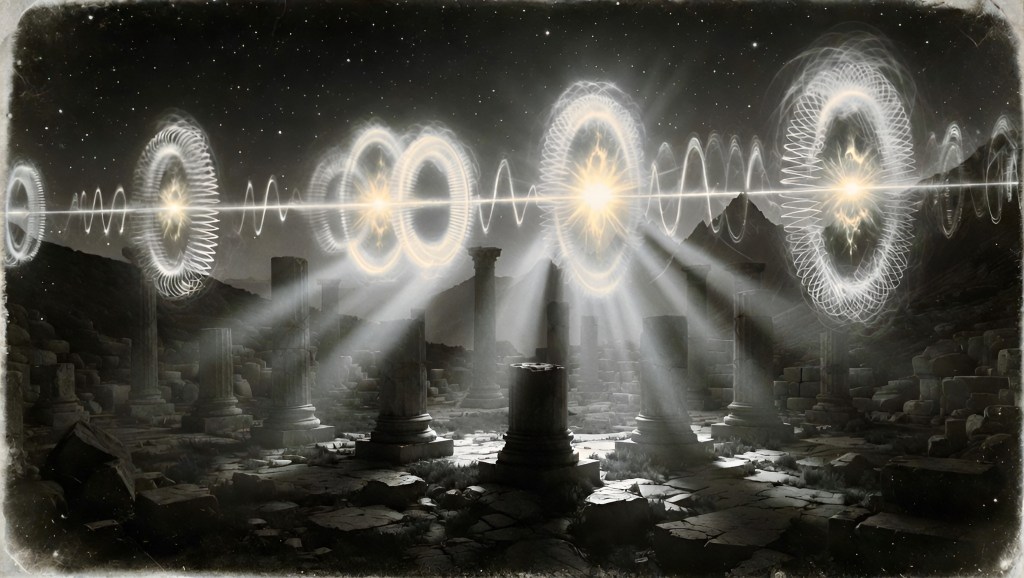
While the self has a discrete structure, it is also an open system — an antenna capable of phase-locking with external memes.
These resonant patterns can either strengthen the mind’s coherence or pull it into forms of entrainment that diminish agency. The self-torus’ wavenumber-6 standing wave facilitates initial entrainment with external structures, but the long-term consequences depend largely on how the helical core incorporates new patterns and how the central nodal cross processes them. When the cross remains relatively open and discerning, phase-locking with refined resonators (such as those found in art or philosophy) can support greater coherence. When the cross becomes rigid or overly attractive, external patterns can dominate the system’s orientation.
Memes themselves are resonant toroidal patterns that possess a rūpa-like structure in the realm of toroidal resonance. While they require physical carriers (books, songs, images, rituals, institutions and so on) to be transmitted in the material world, their coherence as patterns lies primarily in their topological structure. Most memes share the wavenumber-6 architecture of the self-torus, which facilitates phase-locking, though they typically lack the full differentiated internal structure needed to host reflective consciousness independently.
The self-torus is itself a memeplex. Its helical core, with its lemniscate-like motion in the cross-sectional plane, is where internally generated patterns and externally phase-locked memes are braided together into a composite structure. This makes ongoing phase-locking a continuous structural feature of the self rather than an occasional event. The memes already present in the helical core can exert pressure on cetanā, biasing future selection toward patterns that reinforce the existing configuration.
At the lethe zone, cetanā functions as a gatekeeper in the competition among memes for the limited resource of manasikāra (attention). It determines which external patterns are permitted to phase-lock and braid into the helical core. While the memes already integrated into the core can pull cetanā toward reinforcing patterns, cetanā retains the capacity for discernment. Agency can be strengthened both by reducing automatic identification with memes and by selectively phase-locking with higher-order resonant patterns.
In addition to tuning in external memes, the self-torus serves as a resonant chamber for the upper wavebands — vedanā, saññā, saṅkhāra and viññāṇa. These are topological patterns of organization that arise within the rūpa chamber. They depend on its structured resonance to manifest coherently and gain power at the nodal cross.
The openness or rigidity of this cross strongly influences what can phase-lock with the system and how deeply or constructively. As an attractor, it accumulates influence: Successful phase-locking tends to reinforce its power, creating feedback loops. Larger or more coherent memeplexes can exert disproportionate effects on both the helical core and the nodal cross.
The mid-nidānas — particularly nāmarūpa, saḷāyatana and phassa — establish the basic conditions for an “inside” and an “outside.” They mark the interface at which rūpa functions as a resonant chamber, making coherent internal activity and external phase-locking possible. Physical carriers and metaphysical patterns thus form a joint saṅkhārā — they condition each other without being reducible to one another.
Check out “Half-Wave Stacks.” Or read the Existential Firestorm essay series “The 12 Turns” on Kindle.


