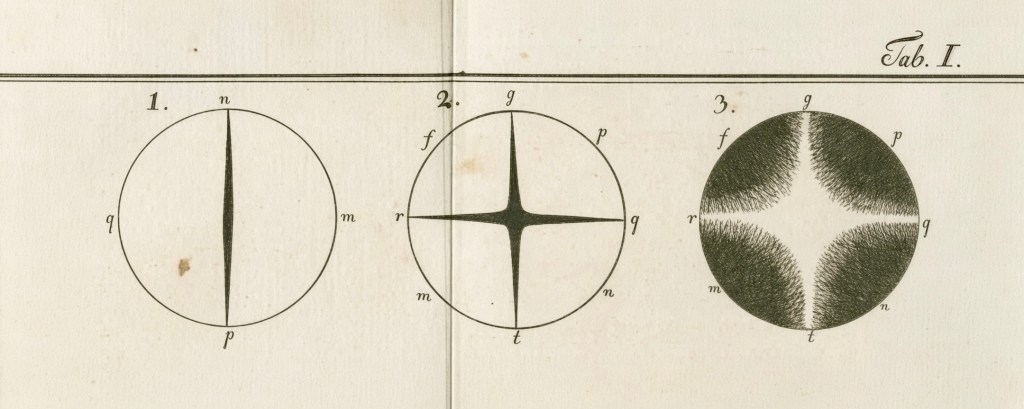
The standing half-wave is the first harmonic. It is also the figure of the fundamental being-becoming polarity fractalizing throughout existence.
On a string fixed at both ends it is the simplest form that can persist: one antinode between two nodes, the interval occupied and returned. Higher harmonics are additional half-waves sharing those same outer ends. When they lock as integer multiples, their envelopes superpose and return on a shared beat. The compound tone is a stack of football shapes — antinodes flaring up and down between the nodes.
The same geometry appears on a Chladni plate. A driving frequency excites a standing wave fixed by the plate’s stiffness and its square boundary. Nodal lines form where the metal does not move; sand collects there and is thrown clear of the antinodes. Each empty region between the lines is a half-wave interval whose envelope is a prolate spheroid.
Master violin makers have sprinkled fine sand or glitter across the top or back of an instrument under construction and bowed or tapped it, watching which patterns emerged. Clean, symmetrical nodal figures indicated that the wood’s thickness, arching and stiffness would support strong, stable half-wave modes across the playing range. Irregular or weak patterns showed that energy would scatter instead of standing, and the plate was thinned or graduated until the desired Chladni figures locked in.
The cochlea sorts this geometry into place. Each frequency finds a segment of the basilar membrane where its envelope reaches a maximum and falls. A complex tone therefore excites a set of peaks — the physiological counterparts of the half-wave intervals. Hair-cell activation marks the antinodes; quieter stretches lie between them. A nodal pattern reaches the auditory pathway; the relative strengths of the standing half-waves color the tone. Consonance is the stability of that figure. The ends hold, the interior intervals reinforce, and scattering at the peaks stays low.
Pleasure is the signal of the lock. Positive vedanā registers the chamber having taken a high-fidelity standing geometry — recurrence without interior interference, a clearer gather at the nodes. It is the felt amplitude of a half-wave stack that has phase-locked. Dissonance drives half-waves whose periods do not share nodes cleanly; their envelopes interfere and the same system reports the decoherence as roughness.
Memes are the same saṅkhārā. Each is a standing half-wave at its core: carrier and pattern held apart and in contact, attention or rite as the antinode that must cycle through the circuit. A memeplex forms when several of these half-waves share a node — a common carrier, a complementary rite, a nested period — and are driven together. The shared end becomes a stronger reflector for every interval that terminates on it. Complementary poles keep the antinode from collapsing; additional jointed memes multiply the resistant termini the register can push against. Because the half-waves are phase related and reoccupied as one formation, energy that would have leaked at open ends is returned into the intervals, as with a torus. The compound figure therefore stands at higher amplitude: more earth to reflect from, a wider set of joints holding the register and a stronger pattern delivered to any mind that phase-locks with it.
A self-torus phase-locking to an intense memeplex receives the stronger pattern the way the cochlea receives a consonant stack. The nodal cross at the center gathers a pattern whose ends hold across a wider set of intervals and whose interior returns in phase. Coherence rises.
What arrives is a standing complex rather than a scatter of separate saṅkhārā. The geometry that makes a musical tone feel gathered is the geometry that lets a memeplex amplify the register it feeds.
Check out “Dynamic Zones of the Self-Torus.” Or read the Existential Firestorm essay series “The 12 Turns” on Kindle.

