Part 7 — Rekindling the metaphysical fire
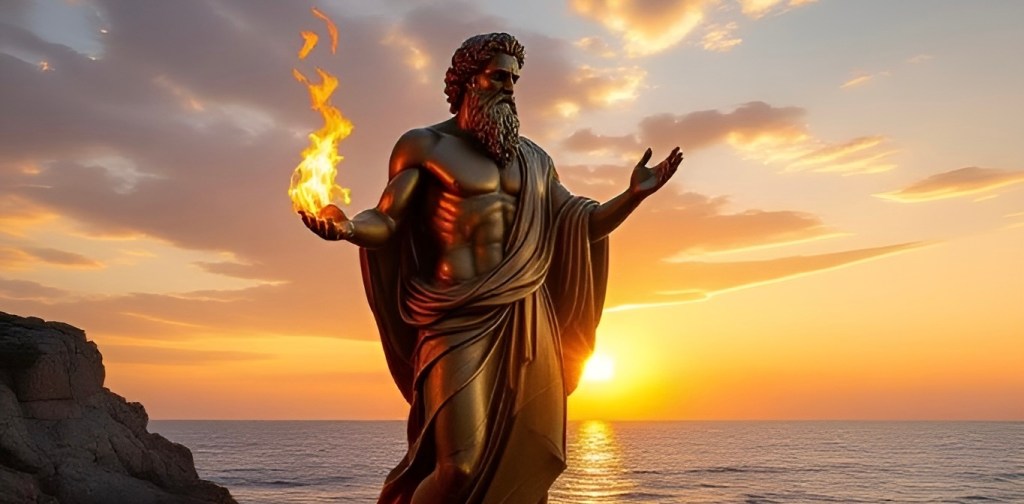
Metaphysics seems to have smoldered out after we realized Plato’s Forms were a catastrophe. Yet I propose rekindling it — not as an ideal realm, but a dynamic process fueled by the interplay of Heraclitean flux, Nietzschean will, Heideggerian releasement, Sartrean freedom and Ñāṇavīrean insights.
This revival asserts that everything in existence shares fire’s nature: flickering, hungry for fuel, illuminating, etc. I also draw from Heraclitus’ insights on strife (polemos) driving us forward and justice (dikē) regulating harmony between the ontological poles of being and becoming.
But it’s his metaphorical description of the elements in motion that underpins this renewal of metaphysics, where earth embodies rigidity and water and flames signify dissolution and transformation. Earth is fire, but as illusory form. Water, less apt as a metaphor than a blaze, is more suitable to life as a flowing, rejuvenating force — it’s what we mostly are. Air (sky) is fire too, symbolizing generative nothingness like the other non-earth elements. So fire is our essential being, but realizing it, say, as an explosion across the Zero Meridian of absolute nihilism, hasn’t been historically pretty. A more watery transition is in order.
Existence cycles between earth and fire, embodying the tension between stability and chaos — being and becoming. Our minds harden, for instance, when we’re objectified by others’ gazes or cult idols’ standing reserve, reduced to a mere resource. The more these idols mind-jack our choices, the more our awareness of cetanā (power of choice) dims. But liquidness counters this in my novel The Flame of Heraclitus — like when a character finds releasement by a stream, forgetting former distractions and flowing into nature’s mystery.
This movement gets blocked by mental forms triggered by perceptions of external and internal phenomena. Memories, both personal and collective, stoke papañca (feelings of significance). This empowers cults, which are memetic self-replicators in the scientific materialist realm and forms of will to power gone too far to the being pole in the metaphysical. The word “meme” is related to Mneme, the muse of memory (see the fairy’s digression in Ch. 2), and its counter is lethe, the Greek underworld river where the dead drink to forget their earthly concerns. Abandoning obsessive mind loops cuts through papañca (cannabis also breaks the chains of memory for releasement).
Another problem with papañca is that it blinds us to everything except the brilliance of aletheia. It is nature’s (physis’) visible side — the opposite pole from lethe’s concealment (the fountainhead feeding its existence). This problem flares up especially with scientific materialism, which can only deal with aletheia while devaluing or ignoring lethe. Also, while Buddhist meditation can help expose our experience of solidity as illusion — by focusing attention on what arises in the mind intently enough to glimpse reality’s evanescent, flickering nature — this overemphasizes the particulars arising in our senses, blinding us to the larger context including the concealed aspect of mind and physis).
Yet this spell cast by aletheia is a necessary lie for life to exist, as Nietzsche pointed out — its illusory being holds becoming in a polar unity, where stability in strife with active creation pushes existence forward.
This is his will to power metaphysic, a self-overcoming drive that restores our agency after idols steal it. Sartre’s “Hell is other people” offers an example of how this could work in action. The “look” (le regard) in No Exit imposes the solid earth forms damming up the flow of free choice — a blockage that’s our objectification we perceive in the minds of others. Here we must realize cetanā’s power in the existential vein of the monk Ñāṇavīra — that it secretes nothingness, severing the causal chain of the past for free choice, so that we may become more than a thing (e.g., the role as a waiter in Sartre’s famous example of bad faith).
Cults and other idols enforce power through these rigid mental forms — we’re arranged so that, when a command passes through a chain of action, we feel drawn toward a particular behavior to play our part.
A lack of becoming in the stagnation of dogma also leads to existential decay, like how the Mouse Utopia experiments revealed that when mice were given everything they wanted they fell into social and individual decline. Rigidity stifles fire. Strife fuels existence as flux.
This metaphysics reignites ontology as a living flame — we embrace anxiety over ease, resisting the gaze of idols in a blaze of freedom. When Heidegger deprecated Nietzsche’s will to power as the end of metaphysics, he was too rash. Will to power, refined by lethe’s mystery, complements Heidegger’s releasement with its dynamic core: being as becoming — reality’s in-itself-as-not-itself nature.
When we realize the interplay of the elements, we can embrace chaos to break earth’s bonds. We grow even more entrenched as long as we don’t.
Being burns in the abyss of becoming.
Read Part 8 — Fractal metaphysics: Mind as reflection of physis. (Originally shared on X)

 Rob Robill