The revealed and hidden: Flipping Plato’s polarity in the waveform
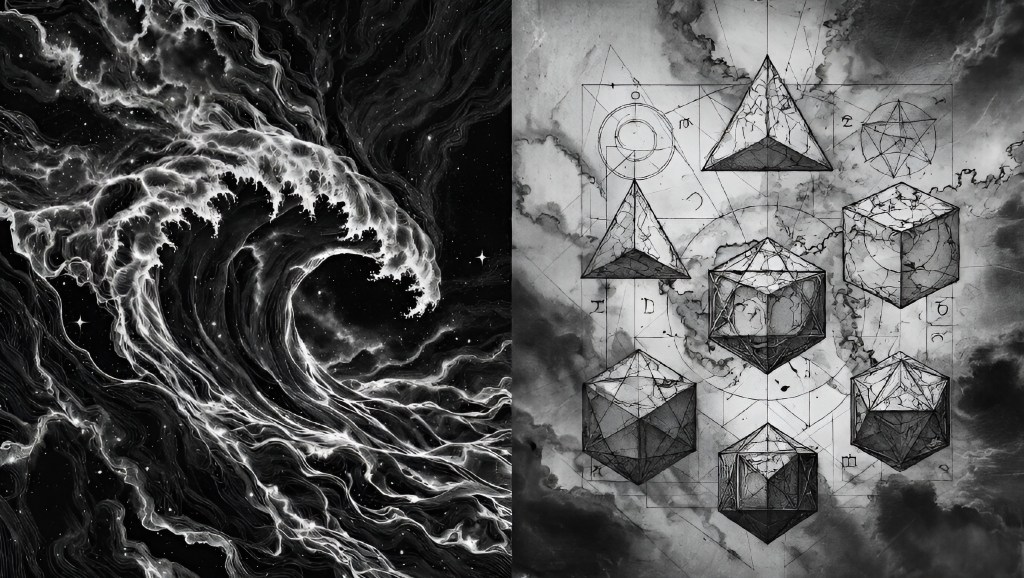
Metaphysics has always revolved around the split between the revealed and the hidden. Plato saw perfection in the changeless realm of Forms, with the sensible world as a degraded copy — a fall from truth into flux. Salvation meant ascent back to the eternal. I say keep the topology but lose the hierarchy.
The hidden is the unbounded universal waveform — pure becoming, infinite potential, no fixed form, no entropy. This is Heraclitus’ ever-living fire, the single broadcast that contains every quale and path in undifferentiated shimmer.
The revealed forms are local, bounded standing-wave helices — conditioned in the rūpa chambers where the waveform collapses into apparent solidity (being) and tangible flux (becoming). Here the five aggregates cohere into “I,” and paticcasamuppāda sustains the illusion of separation.
The metaphysical structures of Plato and Heraclitus echo ancient patterns:
- A primordial unity (the waveform) behind multiplicity.
- Concealment (lethe/avijjā) that makes us forget that unity.
- Revelation/unconcealment (aletheia) when damping thins.
- A drive toward coherence (dikē, cetanā) that pulls us back toward the source.
But the inversion is radical and immanent:
- The hidden is not better than the revealed; it’s the same fire, unbound vs. bound.
- There is no fall from perfection — the waveform simply assumes confinement. Polarity, strife, and becoming are inherently part of the architecture.
- Salvation is not escape to the hidden. It’s remembering that the revealed was always the hidden expressing itself — amor fati, not renunciation — and re-membering your coherence with the divine spark of Dionysus.
- The polarity is not a ladder to climb out of the physical realm. It is the fire’s own self-limitation — the place where its intensity arises through structure. The waveform does not deny the ash; it blazes brighter through it.

 Rob Robill