All must eventually dissolve for the fire to taste its self-surpassing toward higher coherence.
— Author unknown

Phiale’s hand shook as she poured hibiscus tea into the principal’s porcelain cup. Pulling the spout away, she spilled a few red blossoms on the white tablecloth … and swayed under everyone’s gaze.
Ms. Owen, the biology teacher and Flower Club adviser, sucked in a breath and clicked her tongue from the other end of the long table where a half dozen girls sat, dappled in sunlight under the conservatory’s glass ceiling.
“Fail-a-lee,” whispered one of the nearby Roses.
As Principal Rapp smiled slightly and dabbed the spill with a cloth napkin, Phiale caught a whiff of musty vanilla, like the crumbling Bible in her dad’s office. “So, fie-a-lee, the fire department wants you to stop by the station after school tomorrow,” he said and looked at Ms. Owen. “Apparently, before they could interview her yesterday, she practically fled from the scene of that incident or whatever it was — an exploding hydrangea or something. From the way some people were talking, it sounded like the flames of Armageddon had spewed forth to claim the unrighteous.” He sighed and stared wistfully toward a line of sycamores along the Wabash, stroking his long, graying Amish beard. “If only … ”
“Eh … the important thing is that Phiale’s okay,” Ms. Owen said.
The girl finished pouring the tea from flowers she’d harvested there in the greenhouse and dropped stiffly into her metal chair, wishing everyone would pay attention to something else. WTF, universe — a flying pyro on watering day and Rapp on tea shift? Exactly what I was looking for.
“Yes, of course … das ist gut,” he said.
Rapp was really getting into the spirit of his German American fifth-great-grandfather George (quite literally) in the months ahead of the Boatload of Knowledge bicentennial reenactment. (The town was knocking out the celebration six months early because the real anniversary falls in the cold heart of January.)
“I hope you’ll join us for our flower walk after tea,” Ms. Owen said with the confidence he would say no (or perhaps nein).
The principal and teacher were direct descendants of New Harmony’s two utopian experiments: the Rappite apocalypse cult immediately followed by the Owenite rationality cult.
Wearing a black antique dress, Ms. Owen was herself already getting into character before the reenactment as her ancestor Jane Dale Owen Fauntleroy, daughter of leader Robert Owen (to be represented by the history teacher, her father).
“I wish I could, honestly,” Rapp said. “But I just stopped by to pick up the ferns for tomorrow’s mascot unveiling — the ones with the fiery-red leaves.”
“I see nothing wrong with our current mascot,” Ms. Owen interjected. “Minerva has guided generations of Owls with her wisdom and strength. And this isn’t a religiously affiliated school — so I certainly don’t think an angel is appropriate.”
“I heard it has a tail and scales,” said a Daffodil named Lily under her breath. An athletic Rose named Camellia chortled.
“Silence!” commanded the principal. “Ms. Owen, there are some dominions where the god of science is not the highest power … but how many times have I been through this with you?”
Playing from speakers on a potting bench, the “Allegro” from Haydn’s String Quartet in C Major quickened as the two adults exchanged glares, their shadows stretched out in the afternoon light like echoes of old portraits melting across the conservatory floor. Cups clinked on saucers, the air thick with the smell of earth.
Rapp suddenly smiled. “Ah, look, there they go,” he said, nodding toward a nearby line of girls marching across an unmowed field between the school and river, nets resting on their shoulders like rifles. “The Butterfly Club’s off to the labyrinth today … it’s already reopened. We’ve been hearing rumors that the legendary talking frosted elfin has reappeared there — she would be quite the showpiece pinned to our display wall.”
Phiale choked on her tart tea as the principal waved at the passing girls, who raised their nets in salute under his paternal gaze. His face darkened, however, when the one at the end stumbled and fell beneath the weeds, much to the Flower Club’s amusement.
Rapp mumbled something about a “plague of gophers,” stood, took a sip of tea and puckered his mouth. “I must go now,” he said. “No time to waste — the end draweth nigh.”
* * *
Indiana’s western edge falls in a straight line from the industrial ruins of Gary until it hits an area of high ground (Terre Haute in French) along the Wabash, whose meandering chaos serves as the state’s border until it disappears into the Ohio.
Twenty-two miles north of this confluence, Maple Run burbles near the hedge labyrinth (reconstructed from the Rappites’ original) before meandering through the New Harmony Girls Academy property and joining the Wabash, which Phiale could see flowing between the trees. The Flower Club was huddled around Ms. Owen on the bank of the small creek; she was pointing to a patch of wild blue phlox from a crouch.
The cry of a Violet pierced the air: “Snake!” Much more shrieking followed as Phiale caught sight of a large black serpent with a red mark on its head. It flashed through the scattering girls and splashed into the creek.
“Everything’s okay — just a run-of-the-mill snake,” Ms. Owen said.
She doesn’t sound convinced, though, thought Phiale, who was unfazed by the snake.
“We really must stay on track if we want to wrap up before it rains,” the teacher continued. The sunshine had given up to low clouds. “Notice the five lobed petals … as for its scientific name, the genus Phlox is Greek for ‘flame’ and species divaricata is Latin for ‘spreading.’ In fact — girls … listen, do be quiet … the snake didn’t hurt anyone, and it has swum away — in fact, spreading through replication is the purpose of all organisms.”
Ms. Owen collected herself, smoothing her dress. “This is clear if you take the gene’s-eye view that Richard Dawkins discussed in his keynote at the 2005 Owen Science Society annual meeting.” While Phiale didn’t quite grasp the meaning of the woman’s words, she did notice Ms. Owen blush as she clasped her hands to her chest, smiled and sighed. “That was back when we could still get speakers of his stature … though last year’s chemist from Mount Vernon was an expert on asphalt’s liquidity—”
“Lame!” shouted a girl who had sidled up next to Phiale.
Ms. Owen frowned as she took in the new arrival with long blonde hair and a small, upturned nose. The girl’s sparkly-framed glasses made a mockery of the school uniform. “It seems we have a visitor. You must be new to the academy, because we teach our Owls better manners than that. What is your name?”
The girl spat and tried to screech hypersonically, but it just came out as a weak “eeeee.” She shook her head in frustration and said, “Just call me Belle for now.”
Ms. Owen shut her eyes for a moment and continued in the voice of a 19th-century schoolmarm — but with the confusing precision of a 20th-century slide rule: “As I was saying, imagine strands of DNA lying there in the dirt; their one job is to endure and replicate, but they can’t last long unprotected. So in the case of animals like us, we develop a body around ourselves and a mind to move about for food and to reproduce with the opposite sex.”
“Principal Rapp told us there’s no reason to bother with the last part — back when he canceled our mixers,” said Camellia, whose hand rested on Lily’s far shoulder. “The end is near, and all that.”
Ms. Owen pressed on: “Fifty years ago, Dr. Dawkins described another kind of replicator called a meme.”
“Like the lady yelling at the cat?” asked a Violet standing next to the teacher.
“I wouldn’t know about such nonsense … I mean a bit of culture — like when a song repeats over and over in your head to make you sing it aloud to spread to somebody else’s head — or like when Principal Rapp believes that a Bible verse is so relevant he can’t help but to recite it. It’s the same reason a cold virus makes you sneeze — they have to disperse to other people to survive and thrive.”
“That’s funny how it’s called a meme” — Belle said and winked, giving off faint sparks that caused Ms. Owen to rub her eyes. “I had a friend named Mneme.” The fairy facepalmed and grimaced. “No, I mean I learned about Mneme in school like a normal human.”
Phiale couldn’t explain it at the time, but she felt nervous for Belle and the Flower Club members in general.
“She’s the Boeotian muse of memory, you know,” she rambled on. “The gods hated actors screwing up their lines — especially about their exploits. So they’d have Mneme whisper the right words into a performer’s ear to cut down on mutations. She never forgot anything ever … not nearly as irritating as Echo, though.”
“I’m scared,” said the Violet, shrinking against Ms. Owen, who stared dumbfounded at Belle.
Phiale felt the closeness of the late April sky, the air heavy with moisture. She wished it would pour — so it did. Overcome with shock and power of what she’d done, Phiale fell to the ground.
Belle helped her stand as the rest of the group sprinted up a hill toward the school and led her back to the stream bank. Then she plucked a magnolia leaf, held it over her head, winked and fluttered back into her sprightly form. Phiale blinked at the tiny, iridescent blur of her gossamer wings, shielded from the pelting rain.
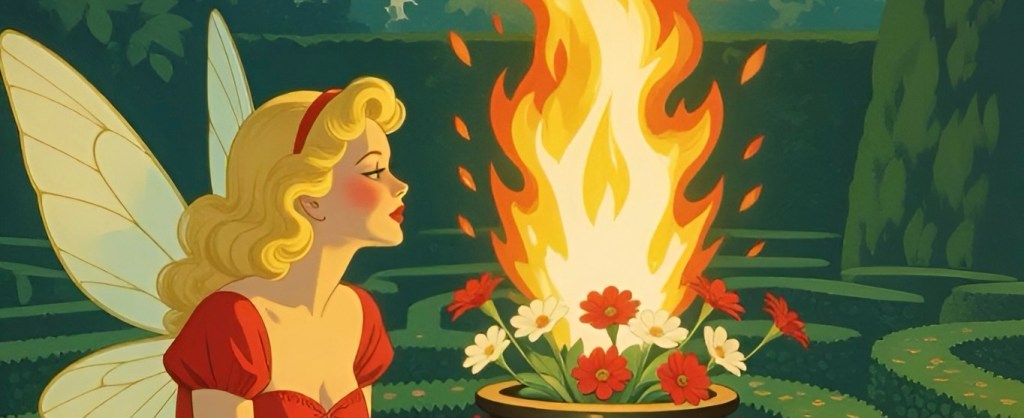
“Ah, that’s better — human bodies are so unwieldy!” Tinker Bell shouted over the hammering drops. “Thanks for the cloudburst, by the way. Sometimes I don’t know when to shut up — at least that’s what those Fairy Council tyrants say … I guess even the dimmest of wits can occasionally be right about something … like a stopped clock … where’d you go?”
Bent over the stream, Phiale was soaking wet and enjoying it, watching the water ripple past rocks and branches, swirling, drawing her in. Her mood had loosened. Maybe the universe isn’t so bad after all.
“What’s going on?” she asked the sprite, who was now darting over the creek and around her face like a dragonfly with boundary issues.
A plastic ring appeared around Tinker Bell’s waist — which started gyrating. “You know how sometimes groups of humans suddenly feel compelled to all start doing the same thing? Like grab a hoop and twirl it around their midsection?” She pulled off the ring and flicked it at Phiale’s forehead. “Well, this whole town’s like that — with everything — because it got cursed from the sheer stupidity of the people who used to live here.
“It also means residents are more open to possession by cults, ghosts and divine presences — from gods to well … minor deities in your case.”
“I made it rain, Tink.”
Part 1 of The Flame of Heraclitus is now lit on Kindle and in paperback. Check out Chapter 3, or catch up with the Prologue.

 Rob Robill