The answer to life, the universe and everything

Existential Firestorm

Part 9: Fractal reincarnations — The metaphysics of forgetting

Named after the stream of forgetfulness coiling through Hades, lethe as our mind’s volition washes away the accumulated debris of the past for a fresh rebirth each moment. From this void, our future possibilities arise, as does our awareness.

Our will (cetanā in Pāli) secretes nothingness as a fractal eddy in the grand gyre of existence. These micro-arsons mirror the macro-collapses of universes, as human choice reflects the cosmos’ torching of forms to invite the next unveiling. This isn’t random erasure; it’s the telic tug of justice (dikē) pulling away from extremes, ensuring becoming doesn’t dissolve into bedlam — and being doesn’t rigidify into an affront of the world’s ephemerality.

A fragment of Heraclitus says: “Nature loves to hide.” But lethe’s hiding is an injustice within the fundamental polarity; it’s too far toward becoming and away from being. So justice (dikē) steps in as a regulator and pushes nature in the direction of revelation. Here, name and form (nāma-rūpa) manifest in our minds in reaction to concealment.

At its most basic level, lethe is the hidden side of physis, the polar opposite of aletheia, forms that appear and disintegrate in the universe’s ever-changing torrent. This reflects Nietzsche’s Apollo-Dionysus polarity and Heidegger’s elaboration of Heraclitus’ physis and logos. It is, at its core, the being-becoming metaphysic: aletheia as being’s forms, lethe as becoming’s restless undertow and their strife (polemos) as the generative fire.

Our mind’s forgetting mirrors that of the dead in the ancient Greek myth of the river Lethe. Framed in Plato’s Republic (Book X) as the underworld’s regenerative veil, it’s where souls drink to shed grudges and regrets so their rebirth dawns unweighted by prior being (bhava) — although past actions (kamma) and other facticities determine the future’s horizons.

Each moment, cetanā clears a micro-void for the mini-reincarnation of consciousness (viññāṇa). Dark and light — Heraclitus’ logos weaves these opposites into an unseen harmony.

This directed strife prevents flux from devolving into mere chaos, both in our mind and the universe itself. And the regulating telos of justice infuses physis with meaning, which is absent in scientific materialism’s flattened world of physics.

Logos, not logic, supplies the “magic spark” of consciousness — yet we can’t see this when we’re blinded by aletheia’s totalizing glare. Science flattens the world into manipulable grid, while logos deepens it when we attune to the hidden realm’s generative hum.

Echoing this metaphysics, the Buddha described forms as conditioned polarities (saṅkhāra), interlinked fractals feeding one another existentially. The overarching saṅkhāra describing how our mind works is called paṭiccasamuppāda in Pāli (dependent origination). That is, if it’s considered from the existential perspective of the monk Ñāṇavīra — not as a 12-link causal chain on the scale of lifespans, but as the simultaneous arising of interdependent saṅkhāras within the larger one.

Paṭiccasamuppāda lists the will next to consciousness as its necessary basis, providing it with existential nutriment — cetanā’s volitional secretion clears space for the discerning flare of viññāṇa. Further nodes (nidānas) echo this theme of polar strife and regulating justice. For instance, contact (phassa) and feeling (vedanā) form a dyadic saṅkhāra totality, an interlocked holonic rift: Phassa’s poles — raw impingement (lethe’s neutral onrush of amorphous sense data) versus perceptual ignition (aletheia’s meaningful forms) — wage polemos, risking meaninglessness (undifferentiated haze) or fixation (distortions of permanence and significance). Dikē tempers the extremes, forging a regulated breach, which ignites vedanā’s poles — affective neutrality (lethe’s indifferent flow) and evaluative significance (tugs of pleasant or unpleasant) — in escalating strife, teetering toward taṇhā’s chaotic craving or inert disconnection; dikē intervenes as telic justice, weaving the tension toward the next node, clinging (upādāna) and beyond.

Through the dynamic of paṭiccasamuppāda and the forms that manifest in it, we become either enchanted by aletheia’s surfaces — mistaking flux’s signs (nimitta) for solid idols — or attuned to physis’ dual nature, recognizing mental (citta) nimitta of generative forces simmering beneath awareness.

Attuned to this fractal forgetfulness, we are bathed in the grace of physis. We’ll know that the next time we step in the river, it won’t be the same — and neither will we.


Check out Part 10 — Earth and starry sky.

The answer to life, the universe and everything

Existential Firestorm

Part 8 — Fractal metaphysics: Mind as reflection of physis

Physis is nature as Heraclitus understood it, far more deeply than we do. He saw how its hidden, underlying properties play out in the realm that appears to us.

To see physis’ most obvious holon, to use Arthur Koestler’s phrase, follow the lead of the phenomenologists and turn to what’s closest: our mind. Its nature is that of physis because it’s part of physis, as is everything — a metaphysical fractal we can observe and describe, secrets from the hidden realm, as it were.

As holons, both physis and mind are conditioned polarities (saṅkhāras in ancient Pali), each with a concealed pole providing existential nutriment to the revealed one. The poles correspond to the metaphors of fire and water for becoming and earth for being. In fact, Heidegger calls the hidden side of physis “lethe” after the underworld river of forgetfulness. The concealed side of mind is citta— an existential fountainhead as well, providing the necessary context to what arises in our mind, as lethe does with physis’ revealed side, aletheia.

They also both possess the nature of intention. Physis has a cosmic will — with no one willing it — and our own will is a reflection of that. Here, we’re witnessing the metaphysical underpinnings of polemos (strife) between the two poles of being and becoming as Nietzsche’s will to power, regulated by dikē (justice). Our mind’s chain of paṭiccasamuppāda is a fractal of this, where taṇhā (craving) is the strife propelling being as becoming (kamma bhava). These are ruled by either an individual’s will or cult justice, where an idol’s power directs one’s action.

Paṭiccasamuppāda, the Buddhist doctrine of the mind’s dependent origination, fractals physis as a recursive echo of its polar architecture. The mind scales the cosmos’ strife (polemos) into its own micro-gyre without losing the whole’s hidden harmony.

The dependent saṅkhāras (e.g., sensations conditioning craving) inherit and replicate this holonic structure: fundamentally, each draws “nutriment” (existential support) from physis, while it’s granted wholeness as a discrete form.

In the fractal weave of paṭiccasamuppāda, these nidānas (links) are themselves opposites feeding each other in recursive tension, both within the node’s own polarity and across the chain’s holistic hum.

saṅkhāra’s opposing poles create a rift in its unity, a clearing for forms to appear. At the level of physis, this is unconcealment (aletheia), or lethe-nimitta (signs). And at the level of mind, the forms that appear (e.g. thoughts) are citta-nimitta. We can either perceive both types as signs of the nature of reality — or they can blind us so we think the nimitta are all that is.

In other words, the being-as-becoming polar rift is an opening where the fountainheads of lethe or citta bubble up from the depths to sparkle in the sunlight of revelation. We are either dazzled or catch a glimpse of the concealed realm in its nature as universal holon.

The paṭiccasamuppāda clearings are vijñāna (consciousness) and cetanā (will). Both are nidānas that secrete nothingness — the former for appearance of mental phenomena and the latter to sever the causal chain of the past to give us potentialities to choose from.

Because of these creative destructions happening in citta, forms appear in the mind. Here, dikē is pulling mind from its becoming pole toward its illusory one of being — as a metaphysically compelled opposite reaction. We can either be subsumed into the maelstrom of papañca (feelings of significance) or take a more holistic approach and use forms to level up in the revealed realm to thrive and create in the flux, while realizing none of it will last and laughing at the absurdity.

This is the strife between being and becoming, which propels the arrow of both kamma bhava — and existence itself. It’s how we both persist and excel in the torrent of flux as will to power. Our phenomenological experience of this is taṇhā, as we are attracted or repelled by what appears, blinding us to the concealed. So the mind is a micro-physis where the veiled hush of ignorance ignites the saṅkhāras’ eddies.

As with mind, physis’ act of concealment demands the opposite: presencing of forms. Lethe’s flux of becoming — the metaphorical water element (similar to our true nature of fire, but better for life) — compels justice to regulate phyein (bringing forth) into forms. These typically become earthen traps of being for us, but keep the universe from pure chaos.

This tension’s endurance raises a question: Why don’t the two poles of physis ever come to rest harmoniously in some middle ground? What sustains dikē’s perpetual motion?

Rest without strife stills becoming, a decadent existential sink that goes against the true, flowing nature of the universe. So justice unleashes flux upon form in an act of creative destruction. Stability proves to be a fractal of instability.

On the other hand, under a deluge of lethe’s concealed becoming, justice demands the being of forms. “Nature loves to hide,” Heraclitus said; therefore it has to show. We then get lost in the glare of phyein (in the rigid realm of idolatry) because we’re unaware of its context: that it’s the frothing of a hidden torrent. Then, having reached an extreme, dikē shifts again toward becoming.

The truth of flux in both physis and mind flow together in Heraclitus’ famous fragment: “You can never step in the same river twice, because you’re not the same person and it’s not the same river.”


Check out Part 9 — Fractal reincarnations — The metaphysics of forgetting. (Originally shared on X)

The answer to life, the universe and everything

Existential Firestorm

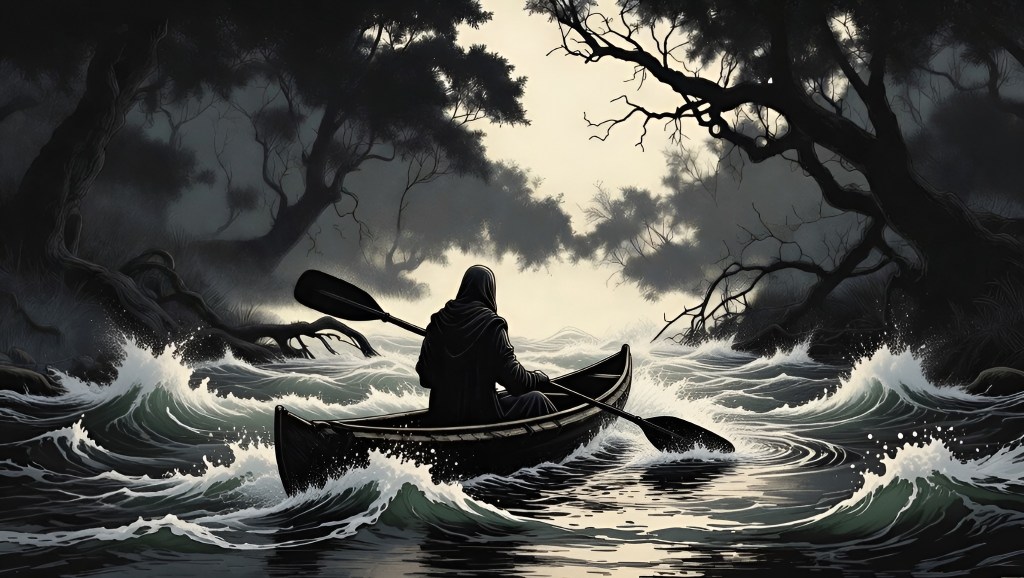
Part 5 — Paddling the polar torrent

A subterranean current flows from Heraclitus to Nietzsche to Heidegger, feeding insights into reality’s flux. These thinkers explain how all forms are raging polarities — where concealment nourishes revelation and opposites clash in strife.

Will to power serves as the fundamental being-as-becoming metaphysic grounding all other polarities like physis and our mind — any conditioned formation, or saṅkhāra in ancient Pali.

This isn’t just airy philosophical chatter — the hidden metaphysics of lethe helps explain the revealed realm of aletheia and adds depth to life. So we’re making a grave civilizational error when we ignore reality’s existential fountainhead.

When we’re unaware of the polar nature of physis, we mistake aletheia for all there is. Since we can control and understand what appears to us, we think we are masters of nature — that the apparent is everything. But we’re ultimately the ones being controlled by this arrangement, which squanders our life energy as we chase and cling to illusory forms. The glare of the golden calves blinds us to the shadows. So how can we get in touch with lethe, the other pole of physis?

We need to let go, embrace creative destruction. Our intention (cetanā) points the way by secreting a generative nothingness between the present and past, breaking the solid chain of cause and effect and opening our ability to act toward new possibilities through kamma. Far from ending this continual renewal as the Buddhists urge, we need to embrace the freedom, propelling becoming (kamma-bhava) to blaze our best path. The trick is to not forget we’ve cleared a space for us to make a choice. Because if we do, a stronger force will organize us within its form of dominion — and even make us feel like we enjoy it sometimes.

This reflects the being-becoming poles of will to power. We fight to maintain our stable being as an individual or collective form, which gives us at least the illusion of having leveled up. Or we decide in an inventive, destructive act where we’re headed toward a better future and turn into a cosmic Chad.

Let’s delve into saṅkhāras not just as general conditioned formations, but specifically the one where we’re able to act — a volitional construct polarized at its core. Each phenomenon arising in our mind bears a revealed stability (an illusory anchor of dogma or a self-reifying narrative) and a concealed dynamism (the fountainhead of citta, a roiling of impermanence devoid of self). Both poles are necessary for us to survive and thrive.

While these ideas were simmering in the East, Heraclitus came up with his logos as a unity of opposites, harmonized in strife (polemos). This is birth and decay in a bow’s tension: The arrow of becoming launches only when it has the tension of a bow to push off from.

We need to strike a balance between these two metaphysical phases: becoming (our true nature) and being (which we’d like to be our true nature). Being enchants us with promises of timeless unity — but without becoming’s polemos, existence declines into the seemingly safe rigidity of idol worship. Becoming brings forth the blast of justice (dikē) to shatter being’s illusion. But introduce too much chaos and you get scorched by the fire that is the metaphorical and metaphysical core of all beings.

Nietzsche’s will to power, a ceaseless drive toward self-overcoming, embraces both poles. On the one hand, it imposes (conjures) an order in flux, making it bend to its will and forging values in aletheia’s totalizing, nihilistic glare. But then Fritz tosses in a stick of dynamite to unleash lethe’s nourishing torrent — a non-clinging flow that washes away idols.

Unlike the will-decay of religious nihilism or the explosion of cult nihilism across the Zero Meridian, Nietzsche’s saṅkhāra streams through the heart of the void affirming eternal recurrence as amor fati. The nothingness it secretes clears a space for new values and meaning, but the process is closer to water than Jünger’s detonation into our true, fiery nature (WWII was a sign of this metaphysic as it appears in the realm of history and scientific-materialism). This downshift in elements from lit to wet is more amenable to life, a key to weathering our present transition from being to becoming. (I dive deep into metaphysics on this “elemental” level in my serial novel The Flame of Heraclitus.)

We must realize that unresolved strife generates social, existential and cultural becoming — in the way that Nietzsche’s Dionysian-Apollonian polarity is the saṅkhāra feeding artistic creation. The primal torrent of Dionysus clashes with Apollo’s ordered illusions (beauty, form), birthing works of deep meaning, but without resolution.

Challenges are our existential nutriment. Nietzsche’s “What does not kill me makes me stronger” means you grow through resistance. Yet, as our lives become easier — with AI thinking for us and robots waiting on us — our civilization will continue sliding into nihilistic decay. It’s an injustice in the sense of going too far to the pole of being. When we escape to a more perfect world, we’re blinded to the polar interplay — we feed on cult illusion but starve existentially. John B. Calhoun’s Mouse Utopia experiment shows us that unlimited resources without strife lead to decadence — social collapse, withdrawal, extinction. Resolving opposites into harmony atrophies life, depriving it of the generative tension that nourishes becoming. Strife propels the arrow of existence. Utopias breed decline.

Around 500 BC, this wisdom stretched across Eurasia. Humanity was tuned into the torrent of physis — and then Plato came along a short while later and dammed it up with his Forms. He elevated static essence and false dualisms above the older knowing.

By embracing both sides of polarities large and small, we accept flux not as chaos to tame, but a hidden harmony attuning us to real meaning and authentic becoming.

In the Existential Firestorm, non-clinging isn’t retreat, but propulsion — water’s flow sparkles with fire’s heat as it dances across the illusion of earth, which it uses only for support.


Embrace the absurdity and read Part 6 — “Pounding sand in the labyrinth.” (Originally shared on X)