§ 11. Standing waves: Stillness and motion that build a self
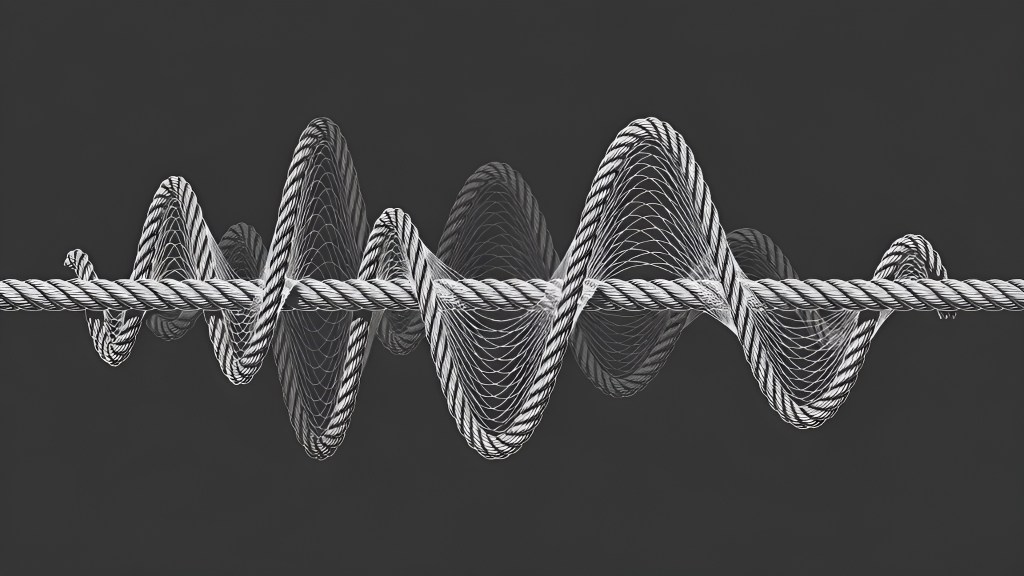
A standing wave is a magical sight. When two identical waves traveling from opposite directions overlap and perfectly cancel or reinforce each other, the nodes stand still as quiet anchors of calm while the antinodes whip up and down.
Instead of the wave traveling along like on a pond, a stable pattern takes shape — a coherent interplay of stillness (being) and dynamic surging (becoming). They form in a resonant structure like a guitar string or DNA spiral.
Then there are the Chladni plates.
In the late 1700s, German scientist and musician Ernst Chladni discovered the order inherent in standing waves. He sprinkled fine sand evenly over thin metal plates and then drew a violin bow along an edge while touching certain points with his finger. The vibration rippled waves across the plate in both directions. Wherever they canceled each other (the nodes), the sand remained still and piled up in neat lines. Wherever they added together and increased the most (the antinodes), the sand was shaken away. As a result, the scattered sand re-membered itself into striking geometric designs — multi-pointed stars, crosses, nested circles, flower-like mandalas and intricate lattices. Chladni called them “sound figures,” demonstrating how invisible vibrations create visible order and beauty. People in his time were amazed — some even felt they were glimpsing hidden universal harmonies written directly by nature. They were right.

Standing wave nodes give the illusion of solid, unchanging being — the fixed, reliable shape or “self” that seems permanent (like the outline of a mandala or the feeling of “this is me”). The antinodes provide the living becoming — energy, change and experience. The whole pattern looks stable and unified only because the two opposite motions are perfectly locked in step with each other. They don’t fight; they complete one another. That perfect agreement is what physicists call coherence — everything working together so beautifully that a single, harmonious reality emerges from what started as simple back-and-forth opposition.
We can feel when this happens. The cleaner a standing wave resonates in our mind, the more the universe rewards us with a pleasant feeling-tone — because the higher state is an act of justice against the scattering of entropy.
Now instead of a rope, picture a Slinky helix with the same push-and-pull happening inside a spiral shape. The stillness and surging no longer just bounce straight back and forth in a line. They wind around each other in a rising spiral.
Standing waves manifest as a spring’s rhythmic architecture of compressed density and spacious stillness. The coils gather into tight, pressurized zones (nodes) holding concentrated energy, then release into open, stretching expanses (rarefactions). These waves don’t just move; they spiral through the spring’s geometry as counter-propagating forces — intertwining in a fixed embrace. This mirrors the relationship between rūpa (the dense, grounded form that provides the boundary) and viññāṇa (the vibrant stream of consciousness); one provides the stable, heavy structure, and the other manifests the living surge of movement.
As with the value memes (vMEMEs) of human development, a helix turns simple back-and-forth vibration into an upward climb. Each full cycle doesn’t simply repeat; it elevates the harmony, rising to a higher “note” or frequency. The physical grounding lifts the localized instance of universal consciousness, volition and feeling-tone, clearing away confusion and resistance (layers of signal damping or “soot”).
Flux is baked into the process. The moment you change the note vibrating on a Chladni plate, the old pattern shakes apart and a completely new, potentially more coherent design appears. Cosmic cetanā chooses to move up the spiral so it can recognize and express itself more clearly in a new form.
Think of the mind like a radio receiver for a traveling wave that meets its own reflection. The coil and capacitor set the rhythm, so when the incoming frequency finds its match, forward and returning currents embrace. Now locked into a standing wave, and the faint signal grows strong enough to sing.
We’re picking up the ever-living fire’s broadcast in one infinite waveform that broadcasts cetanā, viññāṇa and vedanā (the living tone of every possible feeling) across all existence. Our body is the tuned circuit. Our sense organs reach out as antennas. Our localized cetanā turns the dial. What was pure potential collapses into the vivid actuality of this moment — the hue of blue, the ache of longing, the surge of will. The receiver creates nothing. It only gives the eternal fire a resonant chamber to stand in. We feel it as our own lived experience.
The quiet nodes give us the comforting but illusory sense of solid identity and permanence — and the surging antinodes give us the thrill of rebirth.
And when the masks and illusions of a separate self burn away, the wave strengthens until nothing is left but a pure, radiant fire that knows itself completely.
Read § 12: Aletheia fans from Zero Meridian as paṭiccasamuppāda.
 Rob Robill