“Wagner is bad for young men; he is fatal for women.”
— Friedrich Nietzsche
The sound of flatulence and tittering from the balcony blended with a low B and E flat rising from the orchestra pit. Thus began the New Harmony Opera Society’s special daytime presentation of Das Rheingold for local schools: with an ill wind — a bad omen.
In contrast to the riffraff overhead, Thalia held a golden masquerade mask to her face (hiding in fear of the cast). It reminded Phiale of a butterfly glowing faintly in the darkened hall.
Phiale never especially cared for opera, but she was paying close attention to the supertitles because it featured water nymphs — two “swimming” through the air on ropes and one sitting on a rock. They were supposed to be protecting a trove of gold under the Rhine, but they screw up and lose it: After the hunchback Alberich starts flirting, they taunt him, saying he could have the hoard only if he swears off love entirely — which the nymphs think he’ll never do. But he does, so he can forge the gold into a ring of power.
While the dwarf, bathed in golden light, acted like he was scooping up the riches, Windi said quite loudly as the music swelled, “That’s it! Now I remember. The treasure map — it’s in the grease pit.”
Alberich made off with the gold as nymphs sang “Hülfe! Hülfe!” (“help! help!”). But then Flosshilde suddenly fell silent and slumped, aglitter in aquamarine, dangling like a piano four feet over the floor. Bubbles rose from a nearby machine.
“Flosshilde!” shouted Woglinde. “What’s wrong?”
A balding man in a suit and woman in blue coveralls (a custodian who’d been cranking the bubbler) rushed from the wings and shook the singer. The man checked her pulse and gasped. He turned toward the audience and said, “Eh … it’s over.” The curtain fell.
For a few moments, the opera house was silent except for onstage sobbing and frantic exertions of stagehands unharnessing Flosshilde — along with a smattering of applause from students who thought that might somehow be appropriate. Someone called 911 and begged them to hurry.
In the ensuing commotion after the lights came on, Windi grabbed her friends and led them through a door beside the stage.
“I k-killed her,” Thalia said as they rushed through a narrow passageway into a room with props like battle axes, female breastplates and helmets with horns. (The company planned to eventually present the entire Ring Cycle, a project the local Grapevine newspaper had deemed “overly ambitious for such a backwater operation.”)
“Killed who?” Windi asked.
“The singer,” she whispered. “That was the one I slammed into the beam. Maybe she had a delayed reaction from hitting her head.”
“Nonsense.” Windi seized a spear and, with the handle end, rapped on a large oriental rug in the center of the room until it made a hollow sound. Then she pulled the carpet back, exposing a trap door. “Ha! I knew it. Don’t ask me how, but I knew it.”
“Daddy’s always down there under a tin lizzie … ,” murmured Thalia with a faraway voice.
“Freedom for the woman who owns a Ford,” Windi responded.
Struggling to make sense of either of them, Phiale stayed above as a lookout while their phone lights danced around below, illuminating things long forgotten. “Creepy … it looks like War of the Worlds down here,” Windi said.
“Those things on tripods are old theater lights — from back when they used incandescents,” Thalia informed her.
Phiale heard an ambulance pull up outside and people run down the hall.
“Look!” Windi shouted, and the other girls shushed her. “That wall, it’s stone … older than the others.” She grunted from exertion. “Help me shove in this smooth part. Not there, find my hand and push right below it.”
Giggling … silence …
“Oh, yeah, push,” Thalia said. “It moved! Look, a secret compartment!”
They came back up grimy and flushed, Windi gripping a folded, yellowed sheet of paper. She carefully spread it out on the rug.
“That’s just a Peter Pan map … a prop,” Phiale scoffed after noticing locations like “Skull Rock.”
Thalia ran her finger along a squiggly line. “No, look, the Wabash. That ain’t Neverland.” The map also featured a crude drawing of a goose where a smaller stream came out. Beneath it, written in neat script, someone had copied two fragments attributed to Heraclitus: “Asses prefer chaff over gold” and “Water is born from earth and your soul from water.” At the bottom of the map, someone had scrawled “C+V.” (The paper itself was in good condition for being 200 years old, thanks to a century-old fairy spell.)
“It says ‘Treasure Map’ but there’s no X,” Windi noted.
“Hope it’s not supposed to be there.” Phiale tapped the words “Cannibal Cove.”
“You know it has to be,” Windi said.
* * *
Sam took one look at the map later that afternoon, dipped a quill into an inkwell, and drew an “X” through the heart of Cannibal Cove. “There’s your spot.”
“I told you he’d know,” Belle said. (She’d met the shopkeeper back when she was hunting for an antique Ouija board — made from wood and not cardboard, so it actually worked.)
“Follow me.” Sam led them into a back room with a large bookcase and removed a leather-bound volume in a series on medical botany; the case slid sideways along rails exposing an entrance to the shop’s real back room.
In the dim light, Phiale discerned oddities like a stuffed, two-headed calf and an enormous footprint impressed into a chunk of limestone (Tinker Bell wasn’t just making that one up, she thought).
Sam pulled a book from another shelf (this one stayed put) and leafed through it. “Yes, here it is … from the journal of professor Constantine Samuel Rafinesque: ‘There exists a little bay in the Wabash, a short distance below Harmonie, in the new state of Indiana, that was the scene of a brutal ritual. Lore has it, when Chief Waynunak died, his tribe interred his head along the bank and devoured the body in a grim feast. Then they cast an offering of pure gold from New Spain into the middle of the cove as payment for some sort of aquatic panther to carry the leader’s soul into the spirit realm. But something else took it first.”
“Let me guess,” Phiale said. “A black snake with a red mark on its head.”
Thalia was instantly on her phone. “Oh, mighty Artemis, we beseech you to join us in our quest for sunken treasure.” Then, turning away from the others, she whispered, “for your votive offerings.”
Thalia hung up and said, “We’ve got a diver and gear, but the search and rescue boat is up in the yard for repairs.”
“Hmm … no … that would just be silly … ” Sam said mysteriously. “Oh yes, I almost forgot … follow me, I’ve got hungry mouths to feed.”
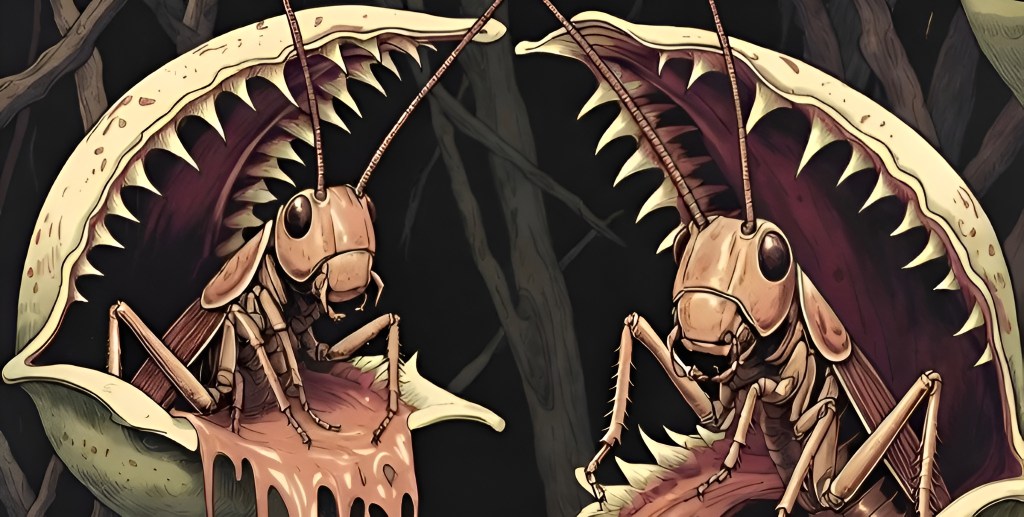
They walked down a narrow hallway into the brightness of an herbary, passing under a tangled arbor of hallucinogenic devil’s trumpet into a secluded space against an exterior glass wall. A card table was covered with dozens of tubular plants up to three feet tall, sporting frilly white hoods with red veins that fanned out like flames in the sunlight.
Sam picked up a small “Wabash Wigglers” cylinder with a cartoon worm struggling on a hook but smiling nonetheless. With a slight grin himself, he removed a live cricket and dropped it into one of the plant’s maws.
“Some call them crimson pitchers,” he said. “I named them Sarracenia leucophylla after the white, translucent tops. They produce a volatile organic compound that attracts insects into the brilliant atrium at the top, only for them to slip down the tube into a dark pit of digestive fluids.”
“Cool!” Windi said. “You’re the one who named these things? I thought somebody would have done that a long time ago.”
“Well, yes.”
“What’s your experiment about?” Phiale asked, touching the side of one of the recently fed plants. She felt the tube vibrate as the cricket struggled in the water at the bottom, dank with bacteria, flecks of exoskeleton, fermented nectar, crumpled antennae — she jerked her hand back in revulsion.
“I’m breeding them to mimic the pheromones of blue ghost fireflies — to trap them and prove we have a local population. That halfwit Thomas Say named the insects Lampyris reticulata shortly before he slithered off the Philanthropist … maybe we could take her out for a quick spin … no, of course not … what was I saying … oh, that Say fellow, the father of American entomology, indeed — I’m the one who described the entire family as Lampyridae.”
“You’re wasting your time,” Belle said. “Those bugs don’t live around here — what do you want with them, anyway.” She glared at him with a raised eyebrow.
“You’ll see … you’ll all see … ” He dug into the cylinder again, shook it and sighed. “That settles it, they need more Wigglers and I’ve got a tiller that needs testing. Call your diver back. We set sail soon.”
***
Their feet crunched on the gravel drive as they approached the bait shack. Phiale felt the onrush of the Wabash before she saw it flowing past the city dock, which secured an unfinished replica of the Philanthropist (the name on the stern lacked the second “h”). At 40 feet, the keel boat was half the length of the original and still lacked a cabin, but Sam had recently installed a real tiller from the era.
Looming ahead of them was the shop’s mascot, now faint pink instead of the original vermillion, writhing above a line in the warped boards marking the great flood of 1913. Phiale almost felt sorry for the shop hunkering along the bank, resigned to decades of abuse.
Inside, past a creaking screen door, she was enveloped by the smell of mildew, fish and cigarette smoke, and from somewhere in the depths, a disembodied voice sang in German, “Mild und leise wie er lächelt” — hacking coughs — “wie das Auge er öffnet.”
“Tristan’s ‘Liebestod,’ Western civilization’s swan song,” Belle said as they weaved their way around racks of lures and bobbers, watched over by mounted catfish and the milky eyes of a deer head with patchy fur, one ear rotted off by decades of river mist.
“I’ve had enough opera for a lifetime — it’s all just screaming gibberish,” Windi said, and the woman sitting behind stacks of styrofoam worm cups stopped singing. Phiale immediately recognized her as the janitor who’d rushed onto the opera stage earlier that day — moonlighting at the bait shop.
Wearing a T-shirt that proclaimed, “I’m Not Lazy, I Just Really Enjoy Doing Nothing,” her face as weathered as the shack’s pine boards, she stood, ashed into a Busch Light can and glared at the new arrivals. “Philistines,” she hissed.
“Finally, somebody I can agree with,” Belle said. “How could they ever appreciate how the metaphorical water element in Tristan und Isolde washes away old orders — as opposed to the earth element blasting them over Jünger’s zero meridian?”
“Exactly,” the clerk croaked. “They could never feel the full weight of the metaphysical contraction that births renewal in the radiant B major triad.”
The bait shop employee had more than just opera on her mind, though — she had her eye on Thalia. Both the fairy and Phiale scooted in front of the girl to hide her.
Sam shook the cricket cylinder. “We just need a refill.”
***
Di met them at the dock wearing a wetsuit, and Thalia helped her unload a fire department scuba tank and other gear from the back of her pickup onto the boat.
“What could go wrong?” Sam said. “Simply oar downstream and then hoist the sail for the return trip.” He held his finger out. “We’ll take advantage of the southerly breeze.”
“I doubt that’s how you spell it,” Windi said as she boarded, pointing at the name on the stern.
The original Philanthropist launched from Pittsburgh back in December 1825 with 40 boatloaders including scientists, educators and artists on an arduous journey down the Ohio to New Harmony. They arrived a month later — in the dead of winter (an imperfect anniversary date for a reenactment, so it was moved up to the summer).
As Belle was walking over a plank onto the craft, Di grabbed the back of her shirt and pulled her to solid ground. “Where on this river does your magic end?”
The fairy looked downstream. “Well … just past the Maple Run confluence, I’d say.”
Di looked at the map. “Cannibal Cove is past that. You’re staying here.”
“Raf! I mean Sam! You’re the captain — let me board.”
“Not if the lady says you can’t,” he replied. Then in a brisk voice, he told Di and Phiale to each grab an oar on either side of the boat while he untethered it from the dock. Thus, the Philanthropist once again glided along the Wabash on an improbable mission.
Belle glared from the shore with clenched fists as they drifted away. Both oar blades flared with fairy fire on the upstroke and hissed out in the water. “Quit being a baby!” Di shouted.
Although a steady wind blew against the bow, Phiale’s oar pushed easily, almost magically, against the water as the boat sliced its way downstream. A bald eagle soared above them, seemingly keeping up with the boat.
Cannibal Cove was easy to find once they spotted Skull Rock, a jutting piece of limestone that lived up to its name (if you squinted). Sam swung the Philanthropist into the backwater and had Windi release the anchor rope attached to an old-timey winch. The firefighter, who was holding an underwater metal detector and wearing a headlamp strapped above her goggles, tipped backward over the rim of the boat and disappeared into the murk.
“Sam, do you think the gold’s still there?” Windi asked.
He scrutinized the Wabash. Then he scanned the shoreline until his gaze fixed on the branches of a beech, where a large black snake hung over the water. “Can’t be sure, but this land does hide unspeakable riches … for those strong enough to claim them.”
Sitting on one of the benches, Thalia was hunched over in a prayer that seemed to match the rhythm of the crickets. Phiale noticed a hole in her skirt and thought of the moths from the other night.
But Thalia’s supplications went unfulfilled. When the firefighter resurfaced, she shook her head; apparently, the only gold down there was a Goldschläger bottle, and the only gleaming was from a lure still hooked in the jaw of a bluegill skeleton.
So they hoisted the sail and started back. Windi was mopey and Thalia, sobbing, proclaimed, “I’ve lost a fortune and my freedom in the same day.”
Di put an arm around the girl. “Your freedom?”
“T-that fat lady … the one who profaned you … ”
“Oh, the singer,” Di said and laughed. “They took her to Evansville for an autopsy. She looked unhealthy to begin with — and angry … could’ve been anything.”
“Really?” She rested her head on Di’s shoulder, and the woman spat tobacco juice overboard.
Spinning the heavy, detached winch handle in her hand, Windi glowered at Di with dull green eyes. “Spitting is disgusting. Even when men do it.”
The firefighter made as if to spit on Windi but stopped herself in an act of divine intervention.
“Beefy, goddamn Amazon!” Windi screamed and threw down the winch crank — it smashed clear through the craft’s wooden planks, weakened by fungal infections.
Water gushed through the hole — shouts — crickets chirping madly — silence.
The Philantropist descended.
Part 1 of The Flame of Heraclitus is now lit on Kindle and in paperback. Check out Chapter 9, or catch up with the Prologue.

 Rob Robill