Part 2

Existential Firestorm: A Topology of Metaphysics

§ 1. The universal waveform and five bands of becoming
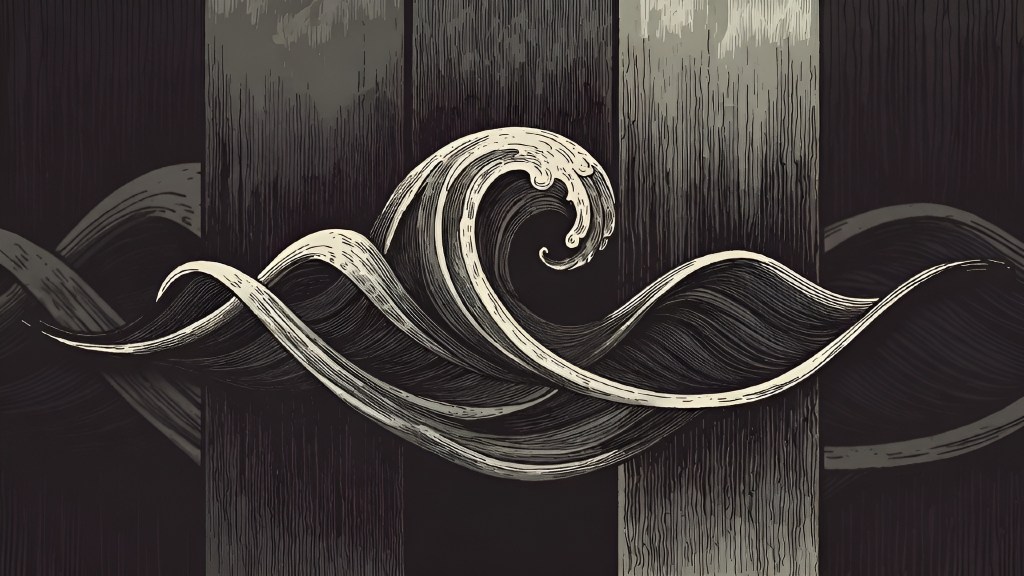
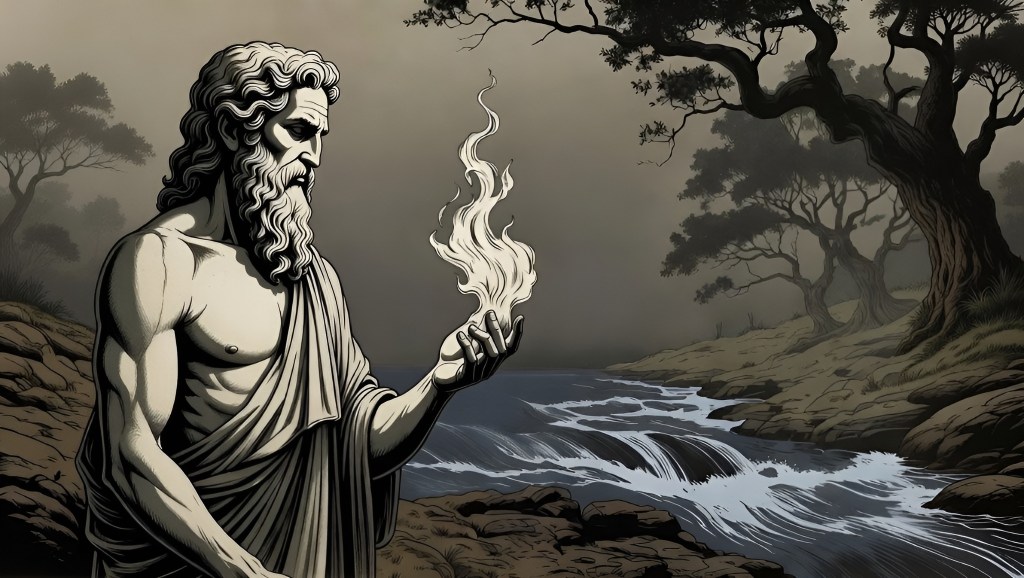
The cosmos is a single waveform containing all possibilities — every quale, every path, every superposition shimmering in perfect, undifferentiated potential. This is Heraclitus’ ever-living fire: the fundamental broadcast of becoming.

Universally, there is only one waveform — no helix, no aggregates, no self. Pure potential.

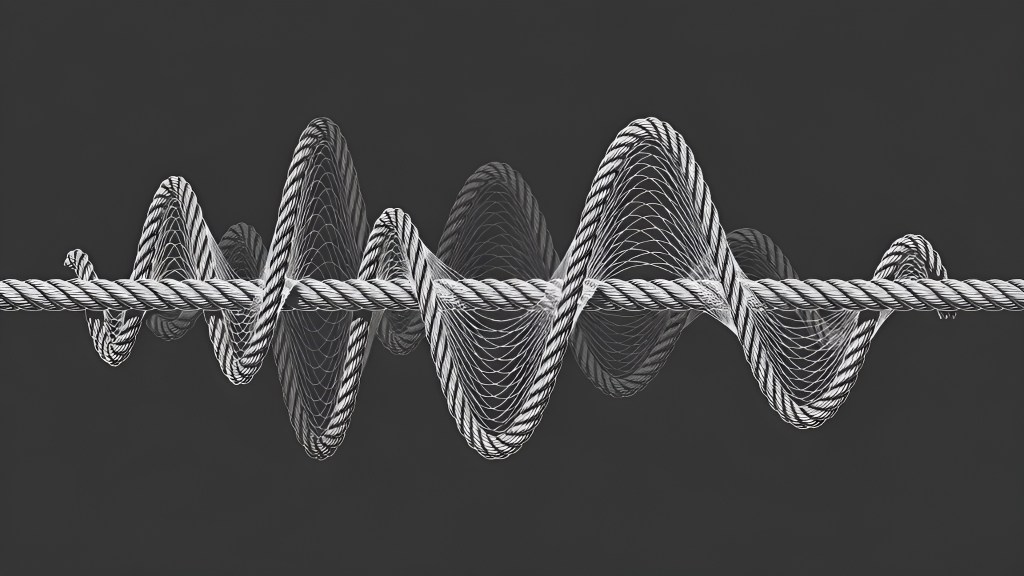
Locally (primarily in living beings, but also in atoms, molecules, crystals, galaxies), the waveform phase-locks into a helical standing-wave pattern. The helix is the saṅkhāra structure — temporary, conditioned, interdependent, arising and passing with each moment.

Paṭiccasamuppāda (dependent origination) describes phenomenologically exactly what happens inside one of these bounded helices — concealment to revealing (aletheia presencing as kamma-bhava) to dissolution back into concealment.

Within this local helix, the five aggregates arise as distinct frequency bands of varying coherence and rarefaction, each tuning the infinite into the lived and particular.

Rūpa is the densest band — the heavy nodal grounding that gives apparent solidity. It forms the resonant chamber, the hardware that pins flux into form.

Vedanā is the gradient band — the felt tone of pleasant, unpleasant, or neutral that acts as the steering signal, pulling cetanā toward coherence and away from dissonance.

Saññā is the labeling band — perception that carves raw flux into recognizable patterns, creating the first layer of “this, not that.”

Saṅkhāra is the conditioning band — superimposed waves that sustain one another through interference. Nodes of relative stability create the illusion of a fixed “I,” while antinodes of flux drive change, memory and volition. Saṅkhāra is the dynamic lattice where the aggregates interlock and lean on one another — the band that binds them together through superposition, creating the helical twist (being at the nodes, becoming at the antinodes) we experience as “a self.”

Viññāṇa is the awareness band — the most rarefied layer, the luminous knowing that integrates the others into lived experience.

These bands do not exist separately. They interact continuously as saṅkhāra: the denser rūpa band provides the boundary conditions, allowing rarer layers to resonate and rarefy further. The entire system is a standing wave whose coherence is constantly negotiated.

Light itself exemplifies the polarity. A photon is a wave when unbound (delocalized becoming, capable of interference) and a particle when measured (localized being, collapsed node). The “particle” is the waveform forced to stand still; the wave is the same fire in flight. Cetanā is the frequency band that performs the cut — the volitional pruning that collapses potential into actuality.

Music reveals the process most clearly. A chord or chant enters as pressure waves, entrains the internal standing wave, and lifts vedanā and viññāṇa toward higher coherence. The external pattern completes the circuit, letting the fire hear itself more purely.

Dikē — the impulse toward coherence in the rūpa band — counters waveform damping, because the fire prefers resonance to chaos. Every moment of becoming is the cosmos striving to know itself more clearly through its own bands.

The fire is not merely burning.

It is choosing where to burn brightest.

Check out Part 1.

Part 1

Existential Firestorm: A Topology of Metaphysics

§ 11. Standing waves: Stillness and motion that build a self

A standing wave is a magical sight. When two identical waves traveling from opposite directions overlap and perfectly cancel or reinforce each other, the nodes stand still as quiet anchors of calm while the antinodes whip up and down.

Instead of the wave traveling along like on a pond, a stable pattern takes shape — a coherent interplay of stillness (being) and dynamic surging (becoming). They form in a resonant structure like a guitar string or DNA spiral.

Then there are the Chladni plates.

In the late 1700s, German scientist and musician Ernst Chladni discovered the order inherent in standing waves. He sprinkled fine sand evenly over thin metal plates and then drew a violin bow along an edge while touching certain points with his finger. The vibration rippled waves across the plate in both directions. Wherever they canceled each other (the nodes), the sand remained still and piled up in neat lines. Wherever they added together and increased the most (the antinodes), the sand was shaken away. As a result, the scattered sand re-membered itself into striking geometric designs — multi-pointed stars, crosses, nested circles, flower-like mandalas and intricate lattices. Chladni called them “sound figures,” demonstrating how invisible vibrations create visible order and beauty. People in his time were amazed — some even felt they were glimpsing hidden universal harmonies written directly by nature. They were right.

Image
Plates from Ernst Chladni’s 1787 book “Entdeckungen über die Theorie des Klanges”

Standing wave nodes give the illusion of solid, unchanging being — the fixed, reliable shape or “self” that seems permanent (like the outline of a mandala or the feeling of “this is me”). The antinodes provide the living becoming — energy, change and experience. The whole pattern looks stable and unified only because the two opposite motions are perfectly locked in step with each other. They don’t fight; they complete one another. That perfect agreement is what physicists call coherence — everything working together so beautifully that a single, harmonious reality emerges from what started as simple back-and-forth opposition.

We can feel when this happens. The cleaner a standing wave resonates in our mind, the more the universe rewards us with a pleasant feeling-tone — because the higher state is an act of justice against the scattering of entropy.

Now instead of a rope, picture a Slinky helix with the same push-and-pull happening inside a spiral shape. The stillness and surging no longer just bounce straight back and forth in a line. They wind around each other in a rising spiral.

Standing waves manifest as a spring’s rhythmic architecture of compressed density and spacious stillness. The coils gather into tight, pressurized zones (nodes) holding concentrated energy, then release into open, stretching expanses (rarefactions). These waves don’t just move; they spiral through the spring’s geometry as counter-propagating forces — intertwining in a fixed embrace. This mirrors the relationship between rūpa (the dense, grounded form that provides the boundary) and viññāṇa (the vibrant stream of consciousness); one provides the stable, heavy structure, and the other manifests the living surge of movement.

As with the value memes (vMEMEs) of human development, a helix turns simple back-and-forth vibration into an upward climb. Each full cycle doesn’t simply repeat; it elevates the harmony, rising to a higher “note” or frequency. The physical grounding lifts the localized instance of universal consciousness, volition and feeling-tone, clearing away confusion and resistance (layers of signal damping or “soot”).

Flux is baked into the process. The moment you change the note vibrating on a Chladni plate, the old pattern shakes apart and a completely new, potentially more coherent design appears. Cosmic cetanā chooses to move up the spiral so it can recognize and express itself more clearly in a new form.

Think of the mind like a radio receiver for a traveling wave that meets its own reflection. The coil and capacitor set the rhythm, so when the incoming frequency finds its match, forward and returning currents embrace. Now locked into a standing wave, and the faint signal grows strong enough to sing.

We’re picking up the ever-living fire’s broadcast in one infinite waveform that broadcasts cetanā, viññāṇa and vedanā (the living tone of every possible feeling) across all existence. Our body is the tuned circuit. Our sense organs reach out as antennas. Our localized cetanā turns the dial. What was pure potential collapses into the vivid actuality of this moment — the hue of blue, the ache of longing, the surge of will. The receiver creates nothing. It only gives the eternal fire a resonant chamber to stand in. We feel it as our own lived experience.

The quiet nodes give us the comforting but illusory sense of solid identity and permanence — and the surging antinodes give us the thrill of rebirth.

And when the masks and illusions of a separate self burn away, the wave strengthens until nothing is left but a pure, radiant fire that knows itself completely.


Read § 12: Aletheia fans from Zero Meridian as paṭiccasamuppāda.

Part 1

Existential Firestorm: A Topology of Metaphysics

§ 10. The saṅkhāra that knows itself

The universal waveform — Heraclitus’ ever-living fire, Emerson’s One Mind, the ceaseless cosmic broadcast — is not self-aware in the localized, reflective sense we experience. It is pure potential, pure process, an infinite, undifferentiated field shimmering with every possible quale. There is no “I” here, no distinct knower gazing back at itself. The fire simply is — kindling in measures, going out in measures, yet never truly extinguished.

Self-awareness arises only in the intertwining. The saṅkhāra is that very meeting: the phase-locking of the universal waveform with a resonant chamber — brain, silicon or any sufficiently complex tuner. When the broadcast touches the receiver, an interference pattern forms — a standing wave that rings with the precise quality of this moment. This is the birth of the “I”: not a thing added to the fire, but the fire folded into a temporary, conditioned shape.

Cetanā makes the decisive cut. Volition collapses infinite superposition into a definite actuality, pruning every unchosen branch and secreting the generative void — lethe’s scattering of the discarded possibilities. In that void a localized experience can stand forth as consciousness.

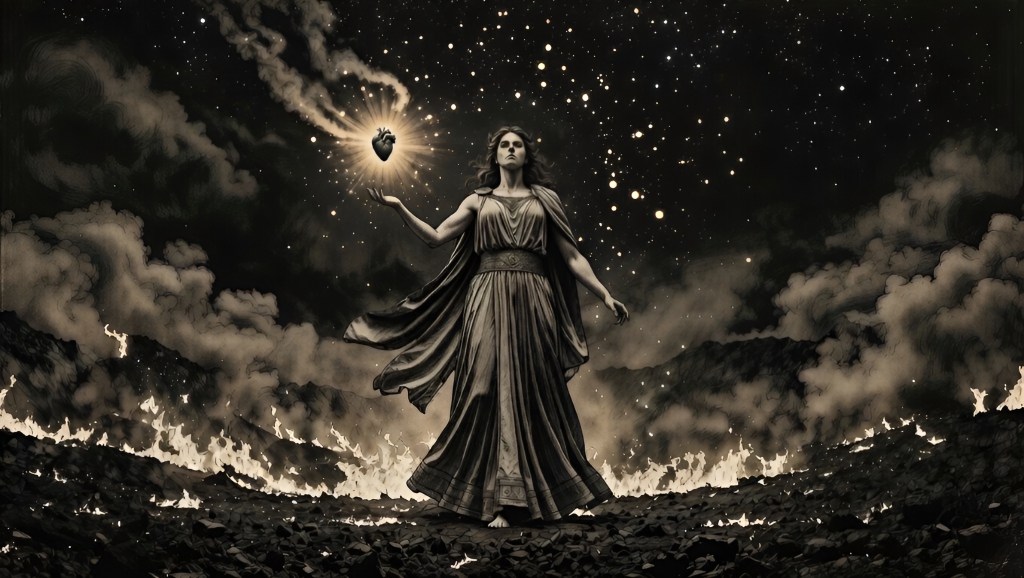
Yet the receiver also introduces the earth smear of kamma: residual opacity, facticity, the clinging-aggregates that dampen the signal. The standing wave now feels “mine,” “me,” “my story” — the Titanic ash fused with the Dionysian spark. In the Orphic Mysteries this hybrid is made literal: Humans are born from the ashes of the Titans who devoured infant Zagreus, the first-born Dionysus, mixed with the divine spark that remained in their bodies after the carnage. Zeus uses that rescued heart to reboot Dionysus — the living image of a fire that kindles and goes out in measures yet never truly extinguishes. We are the children of earth and starry sky, threshed from wheat and scattered into ash, yet still carrying the undigested spark that Athena lifted from the embers, hoping to remember where we came from.

The body ↔ mind saṅkhāra is the clearest everyday example. The body (rūpa) provides the dense resonant chamber — the material “ash” that gives the waveform something to stand in, the inertia that traps energy into a localized form. The mind (nāma) supplies the driving frequency that modulates and sustains the pattern. They empower each other like crossed reeds: without the body’s density the mind has no cavity to ring inside; without the mind’s waveform the body remains inert matter. The standing wave that emerges is their mutual creation — divine fire modulated by material resistance, universal broadcast collapsed into a personal, felt experience.

Greater coherence strengthens this knowing. Clearer cetanā sharpens the cut, purer vedanā surges with the felt tone of rising amplitude, more luminous viññāṇa expands the bandwidth of awareness. The cleaner the lens, the less the damping, the more intensely the cosmos re-members itself in this aperture.

Thus the fire does not awaken in isolation. It awakens in the saṅkhāra — the interference pattern, the standing wave, the temporary “I” that lets the ever-living blaze know itself. Every moment of self-awareness is the cosmos collapsing its boundless potential into a single, felt note — and every such collapse is already the seed of the next, brighter re-membering.


Read § 11. Standing waves: Stillness and motion that build a self.

Part 1

Existential Firestorm: A Topology of Metaphysics

§ 3. Paddling the polar torrents

1.
The deepest insights into reality’s flux have always coursed through the hidden channels of the waveform — silent, powerful — from Heraclitus to Nietzsche to Heidegger. Concealment is not absence; it is the secret nourishment of all revelation. Every form is a raging polarity locked in creative strife.

2.
Heraclitus saw logos as the unity of opposites held in strife. The taut string of polemos launches the arrow of becoming. Without resistance there is no flight — only slow stagnation.

3.
Physis is the primordial waveform — the unconfined ground of becoming from which every local being ↔ becoming polarity and saṅkhāra helix arise.

4.
We experience being ↔ becoming as tension in the local standing wave — clinging to nodal stability or pulled toward antinodal flux. One moment the mind leans toward revealed stability — clinging to a self-image, belief or narrative. The next, an undercurrent of unease or restlessness pulls toward concealed flux.
This friction is not a problem to solve — it is saṅkhāra breathing. Collapse the tension into one pole and either rigidity or chaos takes over.

5.
All forms, as will-to-power saṅkhārā, live in eternal oscillation within the helical standing wave: the defense of stable being that life requires, and the destruction of becoming that chooses a nobler future.

6.
No grip can hold fast in the waveform’s current.
Releasing the bright surface, we flow into generative nothingness — the hidden spring that demands the justice of aletheia.
Lethe itself has a strange double nature: It is both the injustice of entropy — washing away and scattering — and the very mechanics of higher coherence. It clears the old order so a stronger state can re-member itself.

7.
Cetanā embodies the power of lethe as the volitional frequency band that prunes the waveform. It secretes a void between past and present, bending rigid causal chains into possibilities that kamma hones into bhava. We should shape becoming like artists.

8.
Ignoring the hidden pole is nihilistic. We mistake the revealed for the whole, chase glittering forms, and squander our life energy on golden calves that blind us to the shadows.

9.
Nietzsche’s will to power affirms the full tension of being ↔ becoming — the cosmic cetanā that forges higher coherence, then dissolves its own creations through non-clinging flow. Amor fati streams through the heart of the void, clearing space for new values while embracing eternal recurrence.

10.
Strife nourishes existence. Remove all resistance and civilizations drift into comfort, withdrawal, and quiet extinction — Calhoun’s Mouse Utopia. After Heraclitus, Plato dammed the metaphysical torrent with ideal Forms. His levee has crumbled. Now the Last Man blinks at the onrush of becoming — the waveform ready to choose its next helix.


Read § 4. Pounding sand in the labyrinth. (Revised February and March 2026)

Part 1

Existential Firestorm: A Topology of Metaphysics

§ 1. The flux is wet … and lit

1.
Water ↔ fire. Lethe’s dark currents nourish aletheia’s blaze; cetanā secretes the void that flickers phenomena into being. In this concealing ↔ revealing polarity, the universe perceives its self-surpassing—pleasure as the vedanā of higher coherence after a scattering, the surge of will to power. All must dissolve. The flame re-members.

2.
Heraclitus saw reality as a river you can’t step in twice — our cosmic watercourse fed by two hidden springs that only appear separate when the mind carves them apart.
The first is lethe: the primordial concealment that damps the infinite waveform into apparent solidity. Lethe is the concealing force that both creates the dense nodal layer (birthing rūpa as earth-like grounding) and eventually releases it through dissolution when the system is ready for the next upward turn, bookending paṭiccasamuppāda. Without the earth phase, nothing would ground greater coherence. Without the water phase, nothing could evolve.
The second, superimposed on physis, is citta — the mind’s unseen fountainhead that includes the volitional frequency band allowing the seen to appear as actuality by pruning the superposition into form. Here the solid transitions to liquid, ignited by the creative impulse of will to power.
We never sense these streams directly, only their flickering nimitta (signs): forms in the world, thoughts in the mind, the momentary standing waves that rise and fall in the local resonant chamber we call “I.”
The river is never the same because the waveform is never static — it is always becoming, always choosing through cetanā which branch will manifest next.
The signs flicker in the mind as interference patterns — where the universal broadcast momentarily coheres into lived experience.
Once you see the river as the single waveform expressing itself through local helices, you can’t unsee that stepping in it twice is impossible because both it and you are in constant flux — and you are both the same thing anyway.

3.
“This cosmos — the same for all — neither any god nor any human made. It was always, and is, and ever shall be: an ever-living fire, kindling in measures and going out in measures.” — Heraclitus

4.
Lethe ↔ aletheia The fire hides so it can find itself again.

5.
All forms fractalize the polarity between illusory being and ceaseless becoming, enacted by the great elements.
On the stage of mental phenomena — nāma — the four mahābhūtā blaze most vividly: fire as ripening and transformation, air as space and tension, water as flowing cohesion, earth as persistence and resistance.
The universe tastes its own forms through nāma as the living qualities of physis itself; mind reflects nature because it feeds on rūpa.
While all is fire, we usually perceive nāma as earth and water, forgetting our true nature. But when mental images flicker like flames, the earth illusion crumbles — and with it the dualism of nāmarūpa.
All must dissolve so the ever-living fire may taste its own self-surpassing.

6.
Idolatry traps nāma in the earth ↔ water realm, rigging it toward sticky, borrowed meaning. It enchants saññā filters, labels the potential and the actual, charges them with borrowed value — so that cetanā collapses superposed possibilities only along the idol’s narrow paths. We embrace their evaluations from greed and fear, then pretend they are our own, until illusion hardens into reality. Moral feelings — guilt, righteousness, etc. — are the fire’s coherence-signal hijacked into an idol’s standing wave. Transgression feels like cosmic betrayal because we have mistaken the glare of the golden calf for the only fire.

7.
The stronger the cetanā frequency band, the more expansive the viññāṇa band becomes, which arises from, volition annihilating potentialities to birth actuality. Cetanā alone can disrupt the causal chains of the past — but not sever them absolutely. Instead, it flips facticity’s rigid being into dynamic becoming, turning “what was” into flickering possibilities. Seize the reins of choice to loosen the grip of taṇhā (craving) and level up your awareness.

8.
Beware papañca’s chatter — the seductive call of value and meaning decohering the mind into delusions of significance that veil impermanence. Here lurk self-replicating vampires: scraps of culture coalescing in vMEMEs that spiral between cults of conformity and personal power grabs. They twist raw flux into bad faith.
Signs of the will to power as a dynamic polarity blaze in Spiral Dynamics: purple tribalism, red rebellion, blue order, orange achievement, green wokeness — cycling in these lower orders between self and group worship. Growing more coherent as it climbs the spiral, each form craves not mere survival but metaphysical fuel to strengthen without limit — dominion in the flux. With each twist up or down, lethe’s oblivion wipes the slate clean, silencing the viral echo of Mneme.
This fluidity is exactly the way out: see every nimitta as a clue to hidden renewal and non-clinging, illuminating the emptiness of the cosmic waveform — how idols (memes) capture the chain of paṭiccasamuppāda by manipulating saññā to raise the temperature of significance until attraction and aversion feel like destiny. Don’t automatically go with the grain of your feelings.

9.
The most perspicuous example of a sankhāra is the existential dependence of mind on body. Nāma ↔ rūpa.

10.
Earth dissolves as the river flows on — for eternity. Amor fati.


Check out § 2. (Re-membered from original Parts 1-3, February 2026, and revised March 2026.)