An Existential Fairy Tale

The Flame of Heraclitus: Chapter 6

“The state is the coldest of all cold monsters.”
— Friedrich Nietzsche

illustration of singers on an underwater set

“Nasty, privileged bitches like you make it hard for me to control my temper,” agent LaTonya Booker said. Almost as large as a linebacker, she leaned toward Phiale, the threads of her pantsuit straining. “We know the exact time the photo of the girls with the sword was taken — right after you were recorded leaving your dorm headed toward the mound … a sacred site I’m under oath to protect. And you’re saying you don’t know anything about any desecration?

“T-that’s right.”

A laptop beeped shrilly. “She’s lying again,” said agent Doug Fafner, tall and skinny with acne and round glasses reflecting the glow of multiple computer screens.

Parked in the school lot, the Smithsonian’s mobile interrogation unit looked like a vanload of amazing discoveries from the outside, featuring images of a boy enthralled with an arrowhead and a space shuttle flying over a triceratops skeleton — certainly not a rolling star chamber to enforce the Native American Graves Protection and Repatriation Act.

“You should talk to Sienna instead of me. She’s in the photo — and in the Seance Club. I don’t have anything to do with raising the dead … almost never.” Phiale’s gaze focused on a small devil’s ivy next to a digital EKG reader; its leaves were mostly brown and shriveled, although droplets reflecting faint sparks around the base of its pot pointed to recent watering.

Booker snapped her fingers. “Girl, over here!” The agent sighed and laughed. “What’s all this about raising the dead? We’re just trying to solve a simple grave robbery you dipshits obviously committed. Why’s your pal Skipper Windi googling about Middle Mississippian emerald jewelry? And whether it can give people second sight? Andhow much it’s worth?”

* * *

Phiale struggled to open a tartar sauce packet because her hands were still shaking from that morning’s third degree. She always ate lunch with Windi but hadn’t seen her all morning. On the lam, no doubt. Now I’ve got to sit here eating by myself like a loser.

She was taking a bite of a fish sandwich when she noticed Rapp staring at her over a bin of stewed apples from the other side of the buffet line. By the time she’d finished chewing, he was sitting across from her.

“I asked for food of my Fatherland, but the lunch frau prepared this.” He picked through strands of sauerkraut served with breakfast sausages, then glared at the girl. “Your only friend hasn’t bothered to show up for classes today. Where is she?

“I have no idea, sir.” It was the truth, although she wouldn’t have told him anyway. Belle had made them promise not to run their mouth to anyone in authority — not even about what Mr. Owen was up to, because of all the attention it would draw.

“Was she acting strange on the field trip yesterday? Did she say she needed to get something?”

“An emerald?”

“Yes! You saw her take it!”

“No, the Smithsonian lady said Windi was googling how much she could get for it.” Idiot! Why’d I bring up the emerald? Keep it together.“She thinks we’re the grave robbers.”

“Oh, neinnein. They need to be looking into Mr. Owen and his coven.”

An out-of-breath woman in a hairnet rushed up to the table. “Just caught a student in the cooler … shoving a whole chicken up her … toga … slipped past me … ran out the back door with it … shouted ‘charge the Theater Club!’”

Rapp frowned. “From what I’ve gathered, they’re conspiring with the Fire Safety Goddess on some sort of presentation … or ceremony, as she called it. Heathens, the lot of them.”

* * *

Belle saw a great opportunity to regale the children of a degraded culture with the treasures of ancient Greece when the goddess of Heraclitus (in part) said she was planning a burn trailer demonstration at the school. So the fairy retrieved a box of costumes she’d stowed away in a forgotten tunnel under the auditorium following a spring 1925 production of “The Flame of Heraclitus” (the play where the labyrinth planter came from). Belle beamed at their pristine condition thanks to her protection spell against mold and moths. While she could’ve just wagged her wand to materialize passable replicas, she felt the actual link to that era was the bee’s knees.

One of the chiton tunics was worn by Thalia, along with a bay laurel crown and leather sandals, as she walked at a stately pace toward the burn trailer with a sliver tray holding the chicken carcass. This was her first “role” — she secretly wanted to act but was too shy (although, being African-American, she was often encouraged so the cast would appear diverse).

The fire department had pulled the trailer and a pumper truck into the back lot near the Butterfly Garden, and the academy’s students formed a wide circle around it. Inside the trailer was a typical dorm room: bed, desk, chair, strewn clothing, overstuffed trash can and Hunger Games: Catching Fire poster of a young archer surrounded by flames. Not so typical was an altar with stag antlers attached to the front and a large offering bowl along with a saucer of red amaranth leaves on top. Fire hoses snaked through the grass.

Two other Theater Club members, also clad in ancient Greek attire, flanked the trailer, facing it with their palms to the sky. “Oh, mighty Artemis, accept this burnt offering to the delight of your everlasting soul,” they chanted in unison from a script Belle had written.

Thalia placed the chicken in the altar bowl, and all three girls stepped back. As Di emerged from the truck wearing a tunic and crown of flowers, they prostrated themselves before the trailer. The firefighter seemed even taller than usual, almost floating across the ground, her metallic eyes glinting in the sunshine. (Phiale, a face in the crowd, fought an urge to fall to the pavement herself in supplication.)

Di climbed into the trailer and turned to the girls with a serious expression. “Hanging out in your room on a festival day? Feeling too lazy to take that burnt offering outside? Think twice before you char it in your dorm room.” After a moment of awkward silence, she cleared her throat.

“Sorry,” Thalia said. She stood and ascended into the trailer, pulling out a long-stemmed lighter from her belt. Di handed her a can of accelerant, which the girl lightly sprinkled on the chicken.

“A generous application of holy fluid is necessary,” said the firefighter, squeezing her hand over Thalia’s, squirting it all over the altar and the mess around it.

“I am now prepared to receive my nourishment,” Di said. Thalia pointed the lighter at the chicken and clicked the trigger. Nothing. She tried again and again, stabbing at it with each attempt. Prepared for such a mishap from living in cursed places so long, Belle wiggled her foot back and forth on a stick to create a spark at a distance.

The fire roared, and Di and Thalia quickly stepped out of the trailer. “Behold the speed at which the pyre consumes everything you hold dear — and likely you as well,” said the goddess, glowing in the conflagration. A column of black smoke rose into the empyrean.

Phiale watched forms wink in and out of the roiling flames: a volley of arrows, a snarling bear, a man’s face twisted in agony. Then her gaze wandered across the lawn to the garden and its shed, which made her wonder whether she’d wound the hose back up the other day like she was supposed to. As she stared at reflections in the outbuilding’s dirty window, her mind again conjured recognizable shapes, like a girl’s face … specifically Windi’s face.

After the demonstration, Larry doused the blaze and Di changed back into her fire gear to help clean up. The girls had trickled away to after-school clubs (or for a nip of nectar in Belle’s case); but Phiale headed to the shed, where she peeked in the window to ensure the hose was coiled around its reel (it was) and the image of Windi had been illusory (it hadn’t).

The Skipper was looking up at her like a cornered animal wedged between a lawnmower and stack of terra cotta pots — until she recognized her friend and grinned with relief. The door was padlocked from the outside, but Phiale could open it because she had the combination saved to her phone.

“You must have climbed through the window — or somebody locked you in,” she said as Windi hugged her in the dim, dusty light.

“No.”

“Eh … how’d you get in here?”

“My life’s in danger,” she said. “I had to go underground … literally.”

“You stole an emerald, didn’t you? Off that mannequin.” Phiale held up her phone with the picture she’d taken and zoomed in on the pendant.

“Not too sly was I?” she admitted, pointing to her purse on a potting bench. Phiale started for it but Windi grabbed her. “No, don’t touch it. It shows you things you don’t want to see … like me lying on a stone slab … a Monarch hovering over, ready to plunge a knife in my heart.”

“Why don’t you just give it to Rapp like he wants?”

“I’m not going near that creep anymore … I’m sorry, that’s bad, I shouldn’t call him that … no — I’m done with butterfly cults … I’m the one who took the risk — it’s more mine than his.”

“He’s our principal. You can’t keep hiding from him. Anyway, do you remember the dragon saying he’s after a gem? Do you want that nasty thing coming for you?”

“It’s more mine than his, too.”

A sudden whiff of smoke filled the shed as Di appeared in the doorway, hulking and dirty. “I don’t know who they are, but you’re being watched,” she said.

Phiale looked out the window and saw agents Booker and Fafner peeking from opposite sides of a large oak 50 yards away. “It’s the Feds.”

Windi leapt up and grabbed her purse. “I’ve got to go.” She twisted a rusty bucket sitting next to the door until it clicked and then lifted it, along with several floorboards stuck to the bottom. Phiale peered into the hole and saw a ladder, which Windi descended into the darkness until just her head was visible. She looked at the other two and pointed to a small flashlight clipped to the side of Di’s helmet. “My phone’s battery ran out this morning. Can I borrow that?”

“No need,” Di said. She radioed the chief that she had a few other things to take care of and to go ahead back without her. “We’re coming too. You two go down first — I’ll bear the light.”

Phiale glanced once more out the window and saw the agents now walking toward the shed. So down she went, past dirt, roots and rock. At the bottom, she looked up in time to see Di struggling to shut the trap door. Then the light from her helmet danced as her boots loudly scraped the rungs in the otherwise hushed space. Was there still supposed to be a crack of light at the top?

A system of underground pathways had existed in New Harmony since the Rappite days, when Father Rapp had them dug as a way for him to keep an eye on his flock. (He could also appear seemingly out of nowhere — for a touch of the supernatural.) The most recent beam restoration and passage clearing happened in the 1980s as part of an “Under Utopia” tourism scheme using federal fallout shelter funds. But having drawn more attention from Department of Justice auditors than paying visitors, the project was abandoned.

The network as a whole was largely forgotten over the next four decades, but the Butterfly Club knew about it. (A map of the tunnels drawn by Father Rapp himself more than 200 years earlier was a cherished Butterfly Club secret.) Windi and other members occasionally used the passages as shortcuts and to avoid bad weather on outings.

As Phiale filled Di in on the gem heist and interrogation by the museum heavies, they passed several offshoot tunnels — along with several doors.

“Where are we supposed to come out, Windi?” Di asked.

“The labyrinth.”

“I don’t think we’re headed the right way,” Phiale said.

“How would you know?”

“I can sense the river getting closer.”

They reversed course with little protest from Windi, who wasn’t confident navigating the tunnels to begin with. (Di tried to check their location on her phone but couldn’t get a signal.)

After nearly 10 minutes of Windi supposedly getting her bearings and then losing them again, Di stopped in a patch of light from a slanted air vent.

“This is getting ridiculous,” she said, stuffing tobacco under her bottom lip. “We just need to try a door and apologize later if we wind up in somebody’s cellar. Then we should figure out what to do about that emerald — and get those agents off your tail.”

“I heard Sienna told the Feds she just happened to come across the girls with the giant’s sword — and ran off before she could see who it was,” Phiale said. “Surely the government already has some kind of file on the Seance Club.”

“I bet so. After y’all came back from the field trip, I heard on the scanner that one of your classmates got transported back to Evansville — to a psych ward.”

“The ones who weren’t in the Seance Club chalked it up to some kind of laser light show — a hologram. Guess not all of them could believe that.”

“Also …,” Di said glaring at Phiale, “Belle is not supposed to leave New Harmony.”

“I doubt I could stop her from doing anything.”

“Just call me next time. She’s in too much danger when she’s away.”

Hey,” Windi interrupted. “Is somebody singing?” They stopped to listen.

“I can hear something now, like an orchestra,” Phiale said.

Then, from somewhere close in the tunnels, agent Booker shouted: “This way! I think I heard one of those motherfu—”

“Shhh!” the other hissed. “We’ll scare them off again.”

The three of them set off around a corner — and nearly knocked over a dwarf in a leather trench coat.

“Hello, ladies,” he said, smoothing his receding hairline. “Alberich’s my name … getting ready for my cue to go up.” He pointed to a nearby ladder and hatch to where the opera music was coming from. “Have to flirt with some Rhinemaidens, get paid.”

“Whatever, creep,” Di said as she climbed the ladder and pushed open the hatch with the girls in tow.

“Wait! You can’t — we’re rehearsing!”

When Phiale surfaced onto the stage, Flosshilde was on a downward swing — headed straight toward the girl in a shimmery, sequined aqua blue dress, her face twisted in a scream: “Woglinde!

Just in time, Thalia (with the help of a much stronger stagehand) pulled a rope to raise the high-momentum singer and prevent a collision of water nymphs. “Humans are emerging from Nibelheim!”

“They are trespassers,” proclaimed her sister, also out for a swim while suspended from the rafters. “Thieves after our gold!”

“Are they willing to renounce love for it?”

“Sorry people, just a routine fire inspection,” Di said. “Everything looks fine. Congratulations.”

“I tried to stop them,” Alberich said, poking up his head. “And two more just showed up.”

“Oh, shut up you troll,” Woglinde said from above.

“Get your ass out our way!” agent Booker shouted from below.

Tracking mud across the stage toward the exit, Phiale and Windi smiled and waved as they followed Di past a backdrop decorated with bubbles, fish and seaweed. Clamshell footlights glowed along the edge of the stage.

“Who are they, then?” asked the third sister, Wellgunde, perched on a river rock, pointing to the students.

“Eh … my interns,” Di responded.

“I’d like to see one of them carry me out of a burning building,” Flosshilde said with a deep, hearty laugh. “You need to schedule these things in advance next time, loser!”

How dare you insult mighty Artemis,” Thalia said and jerked as hard as she could on the rope during an upswing, causing the singer to strike her head on a wooden beam.

* * *

Di grilled venison for Phiale, Windi and the fire crew that evening, having dispatched the agents with a deadly glare at the front door of the station when they dropped by to see why she’d gone with the students into the tunnel. Phiale stuck to corn on the cob and baked beans, though, having read about Artemis changing some perv hunter into a stag after she caught him watching her and her nymphs bathe — his own dogs devoured him. The girl also showed off her newfound archery skills in front of Windi and the firefighters.

As the two students walked back to the academy after nightfall, their plan to get Windi out of her Butterfly Club mess started shaping up sooner than expected — when they noticed four pale green lights dancing toward them along the sidewalk. Windi grabbed her friend’s arm and pulled her into a stand of trees at the edge of Tillich Park.

“Monarchs,” she said. “They’re collecting luna moth eggs for a ceremony. The glowy paint under their eyes is supposed to help them find the clutches. They shimmer in the dark somehow.” She pulled a canvas sack with a cartoon Dalmatian in a fire helmet from her purse and handed it to Phiale. “Give the stone to them; I’ll stay here in the bushes. Good luck.”

As Phiale approached the Monarchs in gray cloaks with their hoods up, one of them shouted: “Look! A Violet at night — her blooms are closed for sure.”

“Is she scared?” asked the other, swaying as if drunk.

“Where’d your friend skip off to, Fail-a-lee? She has something that doesn’t belong to her.”

“Tell Rapp she’s done with your cult,” Phiale said, handing over the sack. “Here’s the gem. Make sure to touch it — you won’t believe how smooth it feels.”

Looking inside, one of them proclaimed, “Father will be pleased!” Then they turned with a flutter of capes and headed toward the school. They hadn’t gotten far when Phiale heard a shriek. She smiled, wondering what the cursed emerald had revealed.

***

The night was breezy and warm as moviegoers filed into a small downtown theater for that week’s Terror Tuesday Throwback feature: The Hunchback of Notre Dame (the 1920s poster featured a gypsy dancing with a goat standing on its hind legs). Passing the brightly lit ticket booth, Phiale pointed out a long narrow bruise on the back of Windi’s leg.

“That’s probably from sleeping with a hoe last night.”

What? Oh, yeah, the garden shed.” Phiale laughed. “You’re probably looking forward to your own bed. Prop your chair against the doorknob so nobody with a key can get in.”

From the glow of the main strip, they turned onto a residential street where only one of the overhead lamps worked, and the trees rustled like leathery wings in the wind. “What do you think the dragon would do with Belle if he got ahold of her?” Phiale asked.

“No idea. Rapp doesn’t talk about Gabriel … at least to Skippers. Those weirdos you gave the emerald to probably know.”

Phiale shuddered when she remembered how it felt to be within striking range of those footlong fangs. “Ms. Owen might know something about the snake at least. She saw it too.”

“Don’t tell her about it turning into a dragon, or she’ll have you committed — speaking of, wonder who it was that slipped her lid after the Indian seance.”

“Don’t have a clue. Mr. Owen shouldn’t make club outsiders do things like that. They were more concerned about student well-being at my last school.”

Regardless, Phiale was glad she finally had somebody to discuss things with … even if those things were monstrous — along the lines of how she felt like she might finally be settling in somewhere … even if that somewhere was deeply unsettling.

Back at the residence hall, she said goodnight to Windi in the stairwell as they went to their separate floors. Phiale opened the door to her room and gasped.

Her mattress had been stripped and tossed onto the floor, along with the contents of her dresser and closet. The top of her desk had been swiped clean except for two things. One was a framed photo — its glass smashed — of her and her parents in front of a Mayan temple sculpture depicting a priest holding a severed head (her mom was researching the site). The other was something she’d never seen before — and it felt like a backhand to the face. Phiale stood frozen, staring at a plastic mastodon skeleton with a plaque attached to the base. It read, “Smithsonian Institution: Our past, our shared future.”


Part 1 of The Flame of Heraclitus is now lit on Kindle and in paperback. Check out Chapter 7, or catch up with the Prologue.

An Existential Fairy Tale

The Flame of Heraclitus: Chapter 5

“The eyes of that species of extinct giants, whose bones fill the mounds of America, have gazed on Niagara, as ours do now.”
— Abraham Lincoln, on a visit to the famous falls

“Guten Morgen, Angels!” began the morning announcements — so loudly Phiale jumped in her seat. Ms. Owen set down the chalk she was using to explain meiosis, sighed and waited for his ranting to cease.

Rapp’s pronouncements included a reminder for his Butterfly Club members to get permission slips signed to remain at school through the Festival of Knowledge. “Remember to tell your parents that your room and board will be paid for through the generosity of the Hoosier Friends of Lepidopterology.” (No such group existed.) “Additionally, students going on this morning’s field trip with Mr. Owen’s so-called History class are to board the bus in front of school at the end of first period. I pray for your souls. And finally, Skipper Windi and Violet Phiale are to report to my office — und mach schnell.

Windi was already sitting in one of two uncomfortable, wooden chairs facing Rapp’s mission-style desk by the time Phiale got there. Other than a large wooden cross hanging behind the principal, the walls were bare and white. A stack of herpetology and angelology books sat on his desk next to a framed embroidery quote: “I am a prophet, and I am called to be one.”

He noticed Phiale reading it as she sat down (there wasn’t anything else to look at). “Back in Deutschland, I — no, mein ancestor — was jailed for uttering that obvious truth in 1791. We had to flee the Fatherland, you see.”

“Eh …” said Phiale. Windi trembled beside her, the Skipper’s face paler than usual.

A grandfather clock ticked.

“Yes, well … while you girls were tending that butterfly trap last night, did either of you see anything unusual … maybe wander off into the woods?”

Chimes marked another quarter hour closer to the end.

“The only weird thing was the sky lighting up — huge flames down by the river,” Phiale said as she’d rehearsed.

“That seems to be a theme with you. Anyhow, Windi, did you happen to go off by yourself and see something you weren’t supposed to see yet? I can’t imagine you’d want to jeopardize your place in the initiation rite … or worse: participate in a way you wouldn’t enjoy.”

“N-no. We were both at the garden the whole time. Just hanging out and talking after it got dark.” Belle had (somewhat) filled her in on what was happening (while for some reason calling her Clara). The explanation did nothing to ease Windi’s feeling that reality was spinning away from her — beginning with the moment she fell into the abyss of the goat man’s gaze. She’d told Phiale how it left her feeling detached, like everything was happening on a movie screen.

Rapp stared coldly at Windi, twisting his beard hairs. “You will remain a Skipper until you’ve proven yourself worthy. I trust you’re clear on Operation Tiger Lily.” He side-eyed Phiale. “Of course that’s no business of outsiders.”

Windi nodded obediently. Then, as the girls were getting up to leave, the school secretary rushed in. “Sorry to interrupt, but a Smithsonian Institution agent is on the phone demanding to speak with the principal. I told her you’re in a meeting, but she doesn’t care … she used the F-word.”

* * *

The Angel Mounds State Historic Site has two main buildings connected by a glass walkway, both resembling earthen platform pyramids — one a gift shop (the only way in and out) and the other an interpretive center.

“What’s the deal with all the Abe Lincoln stuff?” Phiale asked, squeezing a stress ball of his bust she’d picked up from a display as they made their way through the shop.

“He used to live 30 miles from here when he was a teenager,” Windi said.

“And they call me a know-it-all,” Belle chimed in. The fact she was there at all was a testament to her FOMO over seeing what the Seance Club had planned. The barrier supposedly keeping her in New Harmony was that she lost her magic when she was away. This leads to a range of troubles — from spell casting withdrawals (always grabbing at twigs) to an increased threat of mortality. Mr. Owen had seen Belle previously but didn’t know who she was, so he’d pulled her aside as she was getting on the bus. She begged to come along because she was so excited to explore possible influences of Atlantean giants on Middle Mississippian culture. The teacher’s face brightened, and he waved her aboard, also happy that an additional soul could stand in for Sienna, quarantined over the viral photo.

By the time they got to Angel Mounds, Mr. Owen had grown jittery. “Keep walking,” he said after the girls stopped to browse. “We’ll have time to shop on the way out.”

Windi asked Phiale if she thought she could get away with slipping the squishy Abe into her purse instead of putting it back on the shelf like she was doing — if she’d noticed what the security cameras looked like and where they were.

“Why would I want that stupid thing?”

“Eh … no reason. Just like to play these things out in my head.”

A middle-aged woman bedecked in turquoise jewelry stood at the entrance to the interpretive center. “Hi, Mr. Owen … glad to see you back,” she said like she wasn’t at all. “Nice top hat. You got a rabbit in there?”

“Magic is for later, Tallulah. We were promised a tour.”

* * *

Dragons are avid gemstone collectors. In fact, they can sense when one with strong magic is within a hundred miles or so — and they feel unsettled until it’s added to their treasure hoard. Stones that trigger clairvoyance, like the emerald pendant dangling over a Mississippian girl’s bare chest in an Angel Mounds mannequin display of village life, also tend to provide the beasts with detailed visions of their location.

Originally dug up by a Cherokee in the Blue Ridge Mountains and then engraved with a thunderbird, the gem should have been in a museum or at least behind glass. But back in the ’70s, an archaeology student (guided by the Fates) had “accidentally” tossed it into a box of glass costume jewelry for the reenactment displays instead of the one for real artifacts.

The mannequin that ended up wearing it was watching an older woman sitting in the dirt pounding corn into flour with a mortar and pestle. “Girls your age learned vital skills like food preparation along with child-rearing, and were soon married,” the guide informed the class.

“That’s if they weren’t sacrificed in a ritual first,” noted Bellatrix, a Dabbler-level Seance Club member with jet-black lipstick and matching eyeshadow, fingernail polish and hair. “They probably kept quiet about being virgins, is all I’m getting at.”

Tallulah gasped. “Why would you even say that? These were a gentle people living in harmony with nature … just look.” She waved her arm over the smiling figures, also frozen in acts of fish net mending, drumming, hut thatching, etc. — bird calls and tribal chanting emanated from unseen speakers.

“Utopian, I’m sure,” Belle said, followed by “ancestor-cult” while coughing.

The guide cleared her own throat: “Moving along, the next diorama depicts the entire site, which was occupied from 1000-1450 CE and had a peak population of more than 1,400. They built at least 11 earthen structures for burials, escaping floods, elevating the chieftain’s home and ceremonies — when astronomical events closed the distance between the natural and spirit worlds. Central Mound is the tallest at 44 feet … ”

Windi stopped Phiale and Belle from following the group and stepped over the display rope. “I want to get a photo: Windi, Tinker Bell and Tiger Lily together again at last. Stay there, Phiale — take it with your phone.”

Belle joined Windi, and they each put an arm around the diorama girl for the picture. Afterward, as the fairy was climbing back over the rope, Phiale saw Windi pull out of her purse what looked like a pair of scissors glinting under the spotlights. Then she hugged the mannequin and said, “Thank you, Tiger L—” Windi shrieked and stumbled backward, shoving things into her purse and tripping over the rope. Phiale caught her, shocked at her pallor and trembling. Did Operation Tiger Lily — whatever that was — just go FUBAR?

“What’s going on over there?!” shouted an elderly man wearing a name tag, wagging a finger at them from across the hallway. Looking back at the mannequin as they raced to catch up with the group, Phiale felt something was missing but couldn’t quite say what.

The rest of the tour was a blur of broken pottery, barely covered natives and archaeological photos (several Seance Club members laughed at how meticulous their digs were).

When it was wrapping up, Bellatrix expressed disappointment in not getting to see at least pictures of the skeletal remains found at the site. And Mr. Owen heartily seconded her concern.

“Back when I visited Angel Mounds as a girl,” Tallulah said, wiping away a tear, “I was exposed to those horrific images of desecration. We are more respectful these days.”

“Is it that?” Mr. Owen shot back. “Or are you hiding something?

“Like Atlantean skeletons? Sir, I’ll remind you for the umpteenth time that the tallest ancestor disturbed from rest at this particular site measured 6 feet, 4 inches.

“My mission,” she continued, “is to tell the true tale of my people, not a tall tale.”

“Your people were Middle Mississippian?” Bellatrix asked.

“Fort Ancient, actually.”

“Mr. Owen, didn’t you tell us those two cultures fought with each other?”

“Like savages, I’m sure.”

* * *

“More than 2,000 known mounds dot the Indiana landscape, but a lot more have gone undetected because they can look like normal hills,” Mr. Owen said as he led the girls over a bridge toward the main field on that warm spring day. They’d broken off the tour with Tallulah after she pointed at the threatening sky, saying it meant her predecessors were angry at them. He promised he’d tell them she said hi.

Distant thunder rumbled as they reached a reconstructed wattle-and-daub palisade wall section. “This outer barrier once stood as tall as 15 feet, but that’s surely a conservative estimate,” Mr. Owen continued.

“Maybe it’s because the Indians didn’t pay them,” said Thalia, a mousy Theater Club stagehand who secretly wanted to act but was too shy.

“Didn’t pay whom?” Mr. Owen asked.

“Th-the giants … maybe the Indians didn’t pay them for building the mounds, and then the giants got mad … eh … like in the opera, so they had to make the fence so tall.”

“Oh, now I remember. In her essay, Thalia references the upcoming New Harmony Opera Society production of Wagner’s Das Rheingoldthat her club is helping stage.” (Rehearsals were held up when Climate Club members stole the ropes and pulleys meant to suspend ample water nymphs swimming through the air.) “The god Wotan commissions two giants to build Valhalla in exchange for his sister-in-law. His wife nixes that deal, so there’s the problem with their compensation.”

Belle nudged Phiale and said, “You’ll never believe this, but those giants were actually my idea … Wagner and I used to hang out by the lake, you know. I had to step in — he actually had dwarfs building Valhalla when he first told me about RheingoldDwarfs!

“That’s right, Belle. Dwarfs were certainly involved, and it didn’t end well … Valhalla went up in flames. Anyway, because giants also constructed these earthen mounds — and the tall fences are an obvious defense against Atalan attacks — Thalia’s theory does have some grounding.”

“I’m confused,” Windi said, trying to seize hold of anything in her fog. “Did normal-size Native Americans build a wall to protect themselves from giants? I thought the giants were their rulers … and buried here.”

“May I explain?” Belle offered.

“Please do,” Mr. Owen said with a tip of his hat.

“Based on writings of professor Rafinesque, the Atalans were post-Atlantis diaspora who ruled as gods over the much shorter natives. But they eventually lost power and were cast out of the villages.”

“Very good,” Mr. Owen said. He looked up at the leaden clouds and waved for the group to follow him.

Belle continued as they walked briskly toward Central Mound. “Remnant Atalan populations retreated to Mesoamerica and into the American wilderness, mainly the caves. They’re now known by such names as Bigfoot and the Hovey Lake Swamp Ape, who I’ve actually met.” (She held her nose and waved her hand in front of her face.)

As they made their way up the structure’s ramp, marked by a trail of freshly mowed grass, Mr. Owen’s voice boomed: “When the Atalans still held sway in this region, their mighty king Aranuk sat on the Cahokia throne while his giant chiefs ruled satellite villages like Angel Mounds. We’ll be speaking with one of them shortly.”

The teacher gathered his class into a circle on the mound, although Phiale lingered at the highest point, transfixed by the murky brown Ohio River rolling past. She felt small near its silent power and wondered what unknown horrors its depths concealed. Catfish as big as school buses? Sunken barges? Death itself?

“Girls, over here … now,” Mr. Owen said, snapping Phiale out of her trance. With the wind picking up, and rain looking imminent (although not of her doing this time), the last of the site’s other visitors were headed back across the field to the interpretive center. So the teacher and his charges were left alone to connect with history as he saw fit.

This involved having them form a ring and hold hands. “Clear your minds and think of corn … what’s that? No, Windi, not creamed corn — more like you’d see in a field.” Then he recited an incantation in an American Atlantean dialect (no spitting or screeching).

Rain began to patter. “You should have left your purse in the bus — it’s going to get soaked,” Phiale said to Windi.

“My purse is no business for outsiders.”

Holding Phiale’s other hand, Belle tried to interpret for her what the teacher was reading from a sheet of paper: “Chief Waynunak, we already hear your voice rumbling through the clouds … now manifest in all the grotesqueness of your Atalan form … no, that’s not what he said (I hope!) — ‘greatness’? … let’s just watch and see what happens. Oh, corn is happening.”

Stalks of iridescent ghost maize sprouted up around them, and a ring of translucent mastodon tusks appeared in the middle of the seance circle. From within this ring arose the spectral image of red-haired, nine-foot-tall Chief Waynunak. He looks upset, Phiale thought, hoping against all evidence that Belle at least might have things under control.

Mr. Owen fumbled his paper, dropped it and tried to dry it on his topcoat. “I can’t read it; the ink has run too badly.” He shoved it into his pocket and grabbed the hands of the two nearest girls. “Don’t break the circle — hold tight!”

Glaring at them, Chief Waynunak opened his mouth and pearls tumbled out, down his bare chest and past a loincloth featuring a beaded eagle’s head with an open beak and extended tongue.

The ghost giant roared forth epithets Phiale couldn’t understand. Belle knew what he was saying, though.

“May I interpret?” she asked Mr. Owen, who just smiled meekly. “He thinks you disturbed his celestial slumber to ask him to become one of your … er, harem girls.”

“No-no, tell him I am his humble servant and I just want to ask a question — one that may help restore his chiefdom to its former glory.”

Belle told him (trying not to spit). Chief Waynunak laughed and responded via the fairy: “There are some answers humans can’t handle knowing, so be careful what you ask. As for reviving the Dominion of the Eagle, a wounded chicken would be more likely to achieve that than you and your band of girl warriors.”

“Ask him what the proper time is for the Rite of Resurrection,” Mr. Owen shouted as the rain started coming down in sheets and lightning flashed around the mound. The seance circle was scattering in a panic at this point, and the otherworldly maize was disappearing.

“When the firewheel flickers in the Flower Moon,” Belle translated. “The big guy also said that the recompense isn’t due until the Buck Moon rises.”

“What kind of recompense?”

But Chief Waynunak was gone.

Belle didn’t have to ask, though. “From what I know about the lore, he’s after two things. One, a cache of river gold originally meant as an offering to the Underwater Panther but wrongly claimed by the Fire Snake. And … ” She just shook her head.

“What’s two?”

“A river of blood.”


Part 1 of The Flame of Heraclitus is now lit on Kindle and in paperback. Check out Chapter 6, or catch up with the Prologue.

An Existential Fairy Tale

The Flame of Heraclitus: Chapter 3

“Fanaticism is the only kind of willpower the weak and insecure can actually muster.”
— Friedrich Nietzsche

Rapp’s voice crackled from the hallway speakers late in the school day as the girls filed out of their classrooms: “Remember, you have no sixth period. Report directly to the gymnasium for the assembly. Those who miss it or show up late will face severe punishment. Additionally, if you have any information about the Theater Club’s missing pulleys und ropes … ”

“I hope he catches those thieves,” said Windi, the lowly Skipper who’d been bringing up the end of yesterday’s Butterfly Club procession. Gangly, a bit bug-eyed and limping, the girl had fallen in beside Phiale as the students made their way toward the academic building’s back doors. “Maybe Principal Rapp can use the rope they stole to han—”

Windi sprawled face down on the floor, tripped from behind by the girl with sparkly glasses — whose knee was now pressing hard against her back. “That was for yesterday, scum!” the fairy shrieked, and then just as suddenly helped her up. “Hi, my name is—,” she said and spat on Windi’s shoes.

“Eh … meet Belle,” Phiale said.

“Keep that freak away from me — I’ve never done anything to her!” she yelled, now limping even harder as she tried to keep up with the other two, who’d moved on. Windi had no other friends (even her fellow club members shunned her) and was tolerated in this instance only because Phiale herself didn’t have close companions, having transferred just a few months earlier.

“I’ve got my eye on you and your nasty cult,” Belle informed Windi. “And if you think you stand a chance against me with those nets … they’re the kind you give to little children,” she said, laughing.

“Oh, look, another nasty cult,” the fairy added as they emerged into the glare of the sun. Just outside the doors, members of the Climate Club were confronting their fellow students along the short path to the high school’s wooden gym. The girls held signs with messages like “Natural gas is silent but deadly” and, accompanied by a crude drawing of the Earth engulfed in flames: “THE END IS NEAR!!” Racing past them toward the gym, Rapp glanced at the latter image and gave it a thumbs up.

As Phiale passed them, she overheard a senior with a nose ring say into her phone: “I don’t care if you’re afraid of heights — this is more important than your own miserable existence, you weakling.”

Inside the gym, bathed in the heat and red glow of 10-foot flames blasting up from a pair of cardboard-facade sword hilts, the girls took their places in the bleachers. Black curtains hung from the rafters to the hardwood floor behind the methane-fed props. At a podium stood Rapp wearing a scarlet skullcap — grinning like a maniac and flanked by fiery ferns.

“Behold, our Avenging Angel!” the principal said with a wave of his arm. The curtains jerked back to reveal a large metal tank filled with water. From its two-foot depths, someone in a black Godzilla costume with a wire halo emerged brandishing a plastic flaming sword (its LED lights not flickering from the moisture). Prostrate before their new mascot, pompoms extended, the NHGA cheer squad encircled the pool. The gym fell silent, except for the torches whooshing fire … and a faint squeaking. Despite everything else going on, Phiale’s attention focused on the squeak … squeak. Where was it coming from? Was it getting louder? Her heart now racing, she felt disoriented by the whole hellish scene … and the squeaking … it now sounded like it was coming from two different places … somewhere overhead?

Then slowly, led by Rapp, a chant grew: “vengeance … vengeance … vengeance  ”

“Is that wet lizard the mascot?” Belle asked. “And it’s supposed to be an angel?” Windi glared at her, chanting louder. “My favorite part about cultists like Rapp is how distorted their perceptions get — like falling under an enchantment spell without magic. Hilarious.”

… vengeance … vengeance … ”

“And what’s this?” the fairy said. Using a stick she’d just pulled from her pocket, Belle pointed out a girl descending on a rope from the darkness above. She was sobbing, gripping a bucket while bracing herself — an arm around the line and a foot through a loop — like a frightened acrobat.

“Stop swinging me! I’m going to miss!” she yelled.

Miss what? Phiale wondered. Whatever was going on, it didn’t seem like it was part of the program.

Then, from above: “How can I be swinging you — it’s on a pulley, you idiot! You better not miss!”

Phiale now saw there were actually two girls on ropes swaying in front of the flames. “I’m too low! And quit swinging us!” screamed the other. The pulley squeaking intensified as an unseen accomplice struggled to bring her more in line.

“This is too much fun,” said Belle, moving the stick in sync with their oscillations.

One of the protesters decided to go ahead and complete her act of resistance anyway: “As guardians of Gaia, we extinguish—” She slammed into the other girl.

Not only did they manage to splash only each other as opposed to the carbon-spewing torches, but one of them kicked out at a sword hilt to avoid being incinerated, and the prop fell over, setting the curtains ablaze.

Despite everybody’s shrieking and jostling, Phiale concentrated on the water tank as the mascot hopped over the rim and slithered around on the floor trying to stand but slipping on abandoned pompoms. The heat in the gym was now fierce as sweat beaded on Phiale’s forehead. She grasped the situation in a flash: The flames were spreading quickly, and they might not make it out alive. Watching the fire reflections dance chaotically and ephemerally in the rippling water, Phiale felt a bizarre mental tug that somehow pulled her underneath the cool weight of the tank’s 700 gallons. With explosive force, she sprayed it up onto the curtains, dousing the flames.

* * *

After everyone was accounted for, Phiale set off toward Main Street feeling a strange mix of elation and unease — The water in the tank just obeyed my will, like when I made it rain by the creek. It felt like I was doing it, but …

Phiale glanced over her shoulder while crossing the school lot and saw the fairy was following her. “Go find someone else to get in trouble,” she said. “I’ve got to go talk to people about one of the fires you started … our school has counselors, you know. Seek help.

“That was impressive back there, you putting out the fire,” Belle replied. “You,” she repeated, making scare quotes around the word and grinning darkly.

“Hey, I did it as much as any nymph did,” Phiale snapped back, and she even tried to tell herself that all that talk of possession was total bunk anyway. Was it, though? How much control do I really have anymore? And was that awful fairy reading my mind just now? “Anyway, leave me alone. I’m going to have to start carrying a fire extinguisher if you keep following me around. You need to take things more seriously. You’re going to kill people.”

“Whatever, I’d just watch out when that firefighter lady starts taking things seriously.” Then, under her breath she added, “Talk about killing people.” Looking around to make sure nobody was watching, she turned back into Tinker Bell and fluttered into a flowerbed in front of the academy’s sign.

Phiale already knew a shortcut to the fire station, having seen the back of it while picnicking with classmates by a pond. She’d never been to New Harmony before her parents deposited her at the boarding school 130 miles from their Bloomington home. They were going on sabbaticals that spring to opposite ends of the globe — her mom, an art historian, to Nicaragua and her father to Naxos.

She walked up Main Street, past golf carts parked in front of quaint shops and eateries like Pie in the Sky, which smelled like something was burning. Right before the road ended, a large, brick-walled enclosure came up on her left. This was the Roofless Church that Mr. Owen had talked about in history class, how its “gilded gate was designed by … no one is to laugh or you’ll get detention  by the brilliant sculptor Jacques Lipchitz … silence!

Then Phiale crossed the road into Paul Tillich Park, named after a German-American existentialist greatly influenced by the fundamental ontology of Martin Heidegger, a colleague of his at the University of Marburg in the 1920s. Tinker Bell had also been deeply affected by Heidegger; she’d sneak into the Working Men’s Institute library in the wee hours to ponder Being and Time by the light of pixie dust — which was why when a visiting scholar from Indiana University later said the section “Reality as an Ontological Problem” had “sparkled on the page,” he meant it literally.

After the commotion of the assembly, Phiale felt the park’s silence viscerally; all the dead needles on the ground seemed to muffle the sounds around her. The quiet amplified her sense of being alone, which she often valued over hanging around girls she didn’t know very well. But how long will I be able to feel any solitude with that … thing in my mind?

Phiale’s uncanny feelings intensified when she came upon a bronze of Tillich’s oversized head stuck PEZ-like on a pedestal, framed by the park’s glittering pond behind it. A little farther along the trail, she passed a granite marker for his ashes, which were buried in New Harmony because he’d been so taken with the town’s Christian and socialist roots. “Why stop at being a slave to just one victimization cult when you can have two?” Belle actually said to his face when he visited town in 1963.

Now on a short path to the station’s back lawn, Phiale saw the firefighter from the other day in a T-shirt and camo pants shooting arrows at a hay target shaped like a deer, her movements graceful and flowing. When the girl got closer, she noticed all the arrows were clustered in the center of the bullseye (a rare sign of perfection in New Harmony).

“Come over here,” the woman said, holding out a three-fingered glove. After Phiale put it on, she positioned the girl’s left hand on the bow’s grip, nocked the arrow on the string and stepped away. Phiale drew it back without thinking and sent the shaft flying into the bullseye 30 yards away.

“You’ve done this before,” the firefighter said.

“Never.”

“That right? You know, I used to shoot at a scarecrow out here, but Chief made me change it after some crybaby complained about seeing arrows sticking out of its heart.” She drew the string back … “A crybaby who might just turn into a deer himself and learn the sweet release of my bow.” Thump.

Another firefighter, in uniform, emerged from the back of the station and shouted, “Die!”

Di grinned and turned to Larry. “Hi, chief. This is … what’s your name?”

Phiale told them, side-eyeing him.

“Seems like I knew a Phiale a long time ago,” she said and spit out tobacco. “I’m Di.”

“Oh, that’s what he meant,” the girl said, relieved.

The chief, middle-aged, short of breath and coughing, looked at Phiale and slowly shook his head. “It didn’t sound like much on the scanner … I only expected to set up some fans to air out the gym and be done with it. All of you girls were saying how the water leapt up by itself and put out the fire. What kind of hogwash is that?”

Phiale looked away and twisted the sole of a white tennis shoe back and forth in the grass. “It was chaos … I can’t remember anything really … had something to do with global warming, I think.”

“Hey, ain’t you the one who was at the labyrinth the other day? Why are you here? What do you know about all this?” An arrow whizzed by his ear and stuck into the station behind him.

You’re the one who called Rapp yesterday about the labyrinth incident and made Phiale come here,” Di said. “And sorry … I missed,” she added, pointing to the target in the opposite direction.

“Ah! Now I remember. Weird fellow, that Rapp.”

“I’d say!” said a man who’d just wandered through the back door wearing a frock coat and ascot. “Hi, Phiale.”

“Hi, Mr. Owen.”

He glowered at the chief. “I demand a full investigation into that madman. When my family ran the academy, our girls lived and learned under optimal conditions … well, somewhat — but not the ninth circle of Hell it is now.”

“The fire was an accident, the way I understand,” the chief said. “He feels bad about it … promised to keep indoor flames to under eight feet and get the sprinkler system fixed. I scheduled a Fire Safety Goddess demonstration for the students.”

Mr. Owen sniffed. “We need more than gimmicks at this point, but what would one expect from a town in such utter decline — you just wait, though, things will change around here one way or another,” he said and stormed off.

“Come to think of it,” the chief said, walking closer to the other two. “I didn’t tell anybody because it’s not my business how people choose to worship the Lord, but I was fishing on the Wabash the other night just before dark and saw Rapp standing in the river with both his hands in the air, palms up. He had his head bent down … I couldn’t make out what he was chanting, but he was pretty intense.”

“Where’d you see him?” Di asked.

“Downstream from the academy, near where the creek comes out.”

“That’s funny. I was tracking wild turkeys around there and saw a swath of trees knocked down. I couldn’t think of what could’ve done it. There were these indentations, too … I figured I was just being stupid, but when I stood back, it looked like a big lizard print.”

“How big?” asked the chief.

“Well … if you parked your pickup over it, you’d still see toes sticking out.”

Phiale’s face turned ghostly pale. There’s no way she said “lizard print.”


Part 1 of The Flame of Heraclitus is now lit on Kindle and in paperback. Check out Chapter 4, or catch up with the Prologue.

An Existential Fairy Tale

The Flame of Heraclitus: Chapter 2

All must eventually dissolve for the fire to taste its self-surpassing toward higher coherence.
— Author unknown

Phiale’s hand shook as she poured hibiscus tea into the principal’s porcelain cup. Pulling the spout away, she spilled a few red blossoms on the white tablecloth … and swayed under everyone’s gaze.

Ms. Owen, the biology teacher and Flower Club adviser, sucked in a breath and clicked her tongue from the other end of the long table where a half dozen girls sat, dappled in sunlight under the conservatory’s glass ceiling.

Fail-a-lee,” whispered one of the nearby Roses.

As Principal Rapp smiled slightly and dabbed the spill with a cloth napkin, Phiale caught a whiff of musty vanilla, like the crumbling Bible in her dad’s office. “So, fie-a-lee, the fire department wants you to stop by the station after school tomorrow,” he said and looked at Ms. Owen. “Apparently, before they could interview her yesterday, she practically fled from the scene of that incident or whatever it was — an exploding hydrangea or something. From the way some people were talking, it sounded like the flames of Armageddon had spewed forth to claim the unrighteous.” He sighed and stared wistfully toward a line of sycamores along the Wabash, stroking his long, graying Amish beard. “If only … ”

“Eh … the important thing is that Phiale’s okay,” Ms. Owen said.

The girl finished pouring the tea from flowers she’d harvested there in the greenhouse and dropped stiffly into her metal chair, wishing everyone would pay attention to something else. WTF, universe — a flying pyro on watering day and Rapp on tea shift? Exactly what I was looking for.

“Yes, of course … das ist gut,” he said.

Rapp was really getting into the spirit of his German American fifth-great-grandfather George (quite literally) in the months ahead of the Boatload of Knowledge bicentennial reenactment. (The town was knocking out the celebration six months early because the real anniversary falls in the cold heart of January.)

“I hope you’ll join us for our flower walk after tea,” Ms. Owen said with the confidence he would say no (or perhaps nein).

The principal and teacher were direct descendants of New Harmony’s two utopian experiments: the Rappite apocalypse cult immediately followed by the Owenite rationality cult.

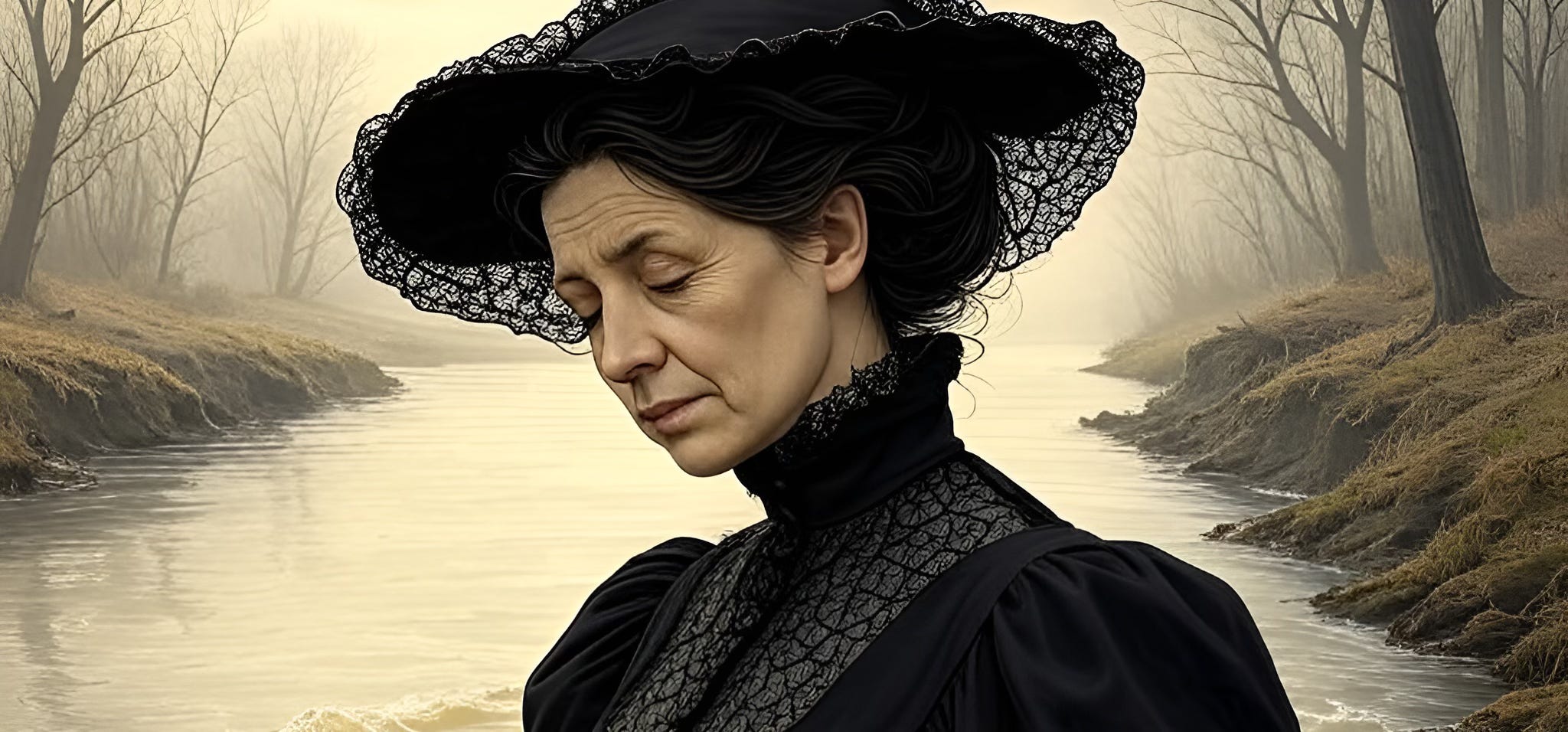
Wearing a black antique dress, Ms. Owen was herself already getting into character before the reenactment as her ancestor Jane Dale Owen Fauntleroy, daughter of leader Robert Owen (to be represented by the history teacher, her father).

“I wish I could, honestly,” Rapp said. “But I just stopped by to pick up the ferns for tomorrow’s mascot unveiling — the ones with the fiery-red leaves.”

“I see nothing wrong with our current mascot,” Ms. Owen interjected. “Minerva has guided generations of Owls with her wisdom and strength. And this isn’t a religiously affiliated school — so I certainly don’t think an angel is appropriate.”

“I heard it has a tail and scales,” said a Daffodil named Lily under her breath. An athletic Rose named Camellia chortled.

“Silence!” commanded the principal. “Ms. Owen, there are some dominions where the god of science is not the highest power … but how many times have I been through this with you?”

Playing from speakers on a potting bench, the “Allegro” from Haydn’s String Quartet in C Major quickened as the two adults exchanged glares, their shadows stretched out in the afternoon light like echoes of old portraits melting across the conservatory floor. Cups clinked on saucers, the air thick with the smell of earth.

Rapp suddenly smiled. “Ah, look, there they go,” he said, nodding toward a nearby line of girls marching across an unmowed field between the school and river, nets resting on their shoulders like rifles. “The Butterfly Club’s off to the labyrinth today … it’s already reopened. We’ve been hearing rumors that the legendary talking frosted elfin has reappeared there — she would be quite the showpiece pinned to our display wall.”

Phiale choked on her tart tea as the principal waved at the passing girls, who raised their nets in salute under his paternal gaze. His face darkened, however, when the one at the end stumbled and fell beneath the weeds, much to the Flower Club’s amusement.

Rapp mumbled something about a “plague of gophers,” stood, took a sip of tea and puckered his mouth. “I must go now,” he said. “No time to waste — the end draweth nigh.”

* * *

Indiana’s western edge falls in a straight line from the industrial ruins of Gary until it hits an area of high ground (Terre Haute in French) along the Wabash, whose meandering chaos serves as the state’s border until it disappears into the Ohio.

Twenty-two miles north of this confluence, Maple Run burbles near the hedge labyrinth (reconstructed from the Rappites’ original) before meandering through the New Harmony Girls Academy property and joining the Wabash, which Phiale could see flowing between the trees. The Flower Club was huddled around Ms. Owen on the bank of the small creek; she was pointing to a patch of wild blue phlox from a crouch.

The cry of a Violet pierced the air: “Snake!” Much more shrieking followed as Phiale caught sight of a large black serpent with a red mark on its head. It flashed through the scattering girls and splashed into the creek.

“Everything’s okay — just a run-of-the-mill snake,” Ms. Owen said.

She doesn’t sound convinced, though, thought Phiale, who was unfazed by the snake.

“We really must stay on track if we want to wrap up before it rains,” the teacher continued. The sunshine had given up to low clouds. “Notice the five lobed petals … as for its scientific name, the genus Phlox is Greek for ‘flame’ and species divaricata is Latin for ‘spreading.’ In fact — girls … listen, do be quiet … the snake didn’t hurt anyone, and it has swum away — in fact, spreading through replication is the purpose of all organisms.”

Ms. Owen collected herself, smoothing her dress. “This is clear if you take the gene’s-eye view that Richard Dawkins discussed in his keynote at the 2005 Owen Science Society annual meeting.” While Phiale didn’t quite grasp the meaning of the woman’s words, she did notice Ms. Owen blush as she clasped her hands to her chest, smiled and sighed. “That was back when we could still get speakers of his stature … though last year’s chemist from Mount Vernon was an expert on asphalt’s liquidity—”

“Lame!” shouted a girl who had sidled up next to Phiale.

Ms. Owen frowned as she took in the new arrival with long blonde hair and a small, upturned nose. The girl’s sparkly-framed glasses made a mockery of the school uniform. “It seems we have a visitor. You must be new to the academy, because we teach our Owls better manners than that. What is your name?”

The girl spat and tried to screech hypersonically, but it just came out as a weak “eeeee.” She shook her head in frustration and said, “Just call me Belle for now.”

Ms. Owen shut her eyes for a moment and continued in the voice of a 19th-century schoolmarm — but with the confusing precision of a 20th-century slide rule: “As I was saying, imagine strands of DNA lying there in the dirt; their one job is to endure and replicate, but they can’t last long unprotected. So in the case of animals like us, we develop a body around ourselves and a mind to move about for food and to reproduce with the opposite sex.”

“Principal Rapp told us there’s no reason to bother with the last part — back when he canceled our mixers,” said Camellia, whose hand rested on Lily’s far shoulder. “The end is near, and all that.”

Ms. Owen pressed on: “Fifty years ago, Dr. Dawkins described another kind of replicator called a meme.”

“Like the lady yelling at the cat?” asked a Violet standing next to the teacher.

“I wouldn’t know about such nonsense … I mean a bit of culture — like when a song repeats over and over in your head to make you sing it aloud to spread to somebody else’s head — or like when Principal Rapp believes that a Bible verse is so relevant he can’t help but to recite it. It’s the same reason a cold virus makes you sneeze — they have to disperse to other people to survive and thrive.”

“That’s funny how it’s called a meme” — Belle said and winked, giving off faint sparks that caused Ms. Owen to rub her eyes. “I had a friend named Mneme.” The fairy facepalmed and grimaced. “No, I mean I learned about Mneme in school like a normal human.”

Phiale couldn’t explain it at the time, but she felt nervous for Belle and the Flower Club members in general.

“She’s the Boeotian muse of memory, you know,” she rambled on. “The gods hated actors screwing up their lines — especially about their exploits. So they’d have Mneme whisper the right words into a performer’s ear to cut down on mutations. She never forgot anything ever … not nearly as irritating as Echo, though.”

“I’m scared,” said the Violet, shrinking against Ms. Owen, who stared dumbfounded at Belle.

Phiale felt the closeness of the late April sky, the air heavy with moisture. She wished it would pour — so it did. Overcome with shock and power of what she’d done, Phiale fell to the ground.

Belle helped her stand as the rest of the group sprinted up a hill toward the school and led her back to the stream bank. Then she plucked a magnolia leaf, held it over her head, winked and fluttered back into her sprightly form. Phiale blinked at the tiny, iridescent blur of her gossamer wings, shielded from the pelting rain.

“Ah, that’s better — human bodies are so unwieldy!” Tinker Bell shouted over the hammering drops. “Thanks for the cloudburst, by the way. Sometimes I don’t know when to shut up — at least that’s what those Fairy Council tyrants say … I guess even the dimmest of wits can occasionally be right about something … like a stopped clock … where’d you go?”

Bent over the stream, Phiale was soaking wet and enjoying it, watching the water ripple past rocks and branches, swirling, drawing her in. Her mood had loosened. Maybe the universe isn’t so bad after all.

“What’s going on?” she asked the sprite, who was now darting over the creek and around her face like a dragonfly with boundary issues.

A plastic ring appeared around Tinker Bell’s waist — which started gyrating. “You know how sometimes groups of humans suddenly feel compelled to all start doing the same thing? Like grab a hoop and twirl it around their midsection?” She pulled off the ring and flicked it at Phiale’s forehead. “Well, this whole town’s like that — with everything — because it got cursed from the sheer stupidity of the people who used to live here.

“It also means residents are more open to possession by cults, ghosts and divine presences — from gods to well … minor deities in your case.”

“I made it rain, Tink.”


Part 1 of The Flame of Heraclitus is now lit on Kindle and in paperback. Check out Chapter 3, or catch up with the Prologue.

An Existential Fairy Tale

The Flame of Heraclitus: Chapter 1

“Heraclitus’ words blaze with truth — but only if seized intuitively, not logically.”
Friedrich Nietzsche

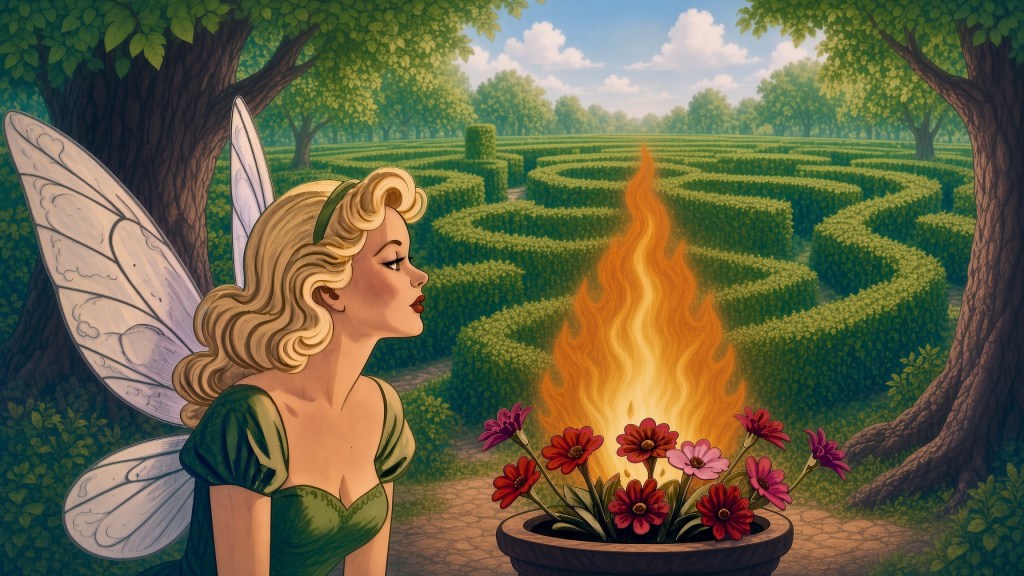
As 60 thin streams fell from Phiale’s watering can into a bronze planter called The Flame of Heraclitus, the topmost soil lost its form and flowed into rivulets between pansies and peonies.

A glint of light flashed near a patch of swamp buttercups she’d just watered — and a large bug zig-zagged in front of her face, dripping wet and asking what the hell her problem was. Phiale dropped the can with a splash and stumbled back into eight-foot-tall hedges encircling the center of the labyrinth.

“Don’t worry, Phiale. I’m not evil,” said the insect. No … more like a fairy … laughing evilly.

“How do you know my n-n-name?”

“You’re an attendant nymph of Artemis. Anybody who’s anybody knows your name.”

“You’ve got me mixed up with somebody else,” blurted Phiale, a first-year student at the New Harmony Girls Academy. Dressed in a gray skirt and green V-neck sweater emblazoned with the school logo, she took a deep breath, picked up the can and started for a gap in the hedges. “Anyway, er … Tinker Bell, my name just happens to be Phiale. My dad is a professor of classics.”

“No, it was the Fates who named you — they get cute before big events … to amuse the gods … especially when they’ve been hanging around Bacchus. Wait! Don’t leave yet — I’ve got something to show you.” Then, more to herself than to the girl: “Maybe this time I’ll get exiled someplace less cornpone.”

Wondering what corn had to do with anything, Phiale suddenly stopped and turned around. (Something turned her around.)

“That’s better,” Tinker Bell said. She wrung out her blonde hair and spiraled up above the planter to take a look around. The wide bowl, which sat atop a pedestal, was originally an academy play prop before the Class of 1925 installed it as a senior project — all under the fairy’s influence (although Phiale didn’t know its story that far back yet). The fairy noticed her looking at it. “That thing used to have an ‘eternal’ flame instead of flowers … until the 1975 natural gas shortage. They tried a fountain with a water line after that but gave up because of a drought … settled for dirt. That’s usually the narrative arc around here: big ideas to … well … ” She grimaced at the muck-streaked pavers below.

“Now let’s begin our lesson. Listen up, and redeem yourself for dousing my nap.” The fairy flew to the hedge tops over Phiale’s head, snapped off a twig and took aim at the planter, ringed by stone benches and Ionic columns, already crumbling, no longer able to support a small roof.

Tinker Bell cleared her throat and … a car door shut.

Crouched in the hedges, Phiale heard voices approaching the labyrinth entrance. “I hope you brought some red thread,” a man said.

“No, but I can leave crumbs — I’ve got half a scone left over from the ‘Finding Utopia in Victimhood’ session,” a woman replied.

I hear cult scum,” the fairy hissed as her dress changed from mossy green to fiery red.

The man’s voice grew louder and fainter as the pair progressed through the hedge convolutions: “We’re now on a journey to the center, a peaceful, inner space to contemplate our identities before we follow the path back into the world as stronger, more focused allies.”

“That’s so beautiful, the way you put that,” the woman cooed.

Tinker Bell vomited a sparkly stream of half-digested nemesis bloom nectar, wiped her mouth and said, “Class is in session …

“ALL IS FIRE!”

She jabbed with the twig and a 30-foot flame shot up from the planter, blasting Phiale with heat, potting soil and petals. The fire expanded into a dome over the labyrinth — ribbons appearing, spreading, racing into oblivion.

“Oh, my God!” the woman screamed. “The sky’s on fire!”

“Get down!” yelled her companion. “Crawl! Crawl! No, that’s the wrong way!”

“Up and down are one and the same!” Tinker Bell proclaimed. She raised the wand over her head, and as she slowly brought it down, the fire itself dropped a little and was replaced by a mist that shimmered in different colors, shifting with Phiale’s gaze like some kind of psychic Instagram filter. Then the cloud coalesced into water as it continued falling, retracing back to the center in a column above the planter. The girl shivered and felt a wave of relief with the transition in elements. And she had a wild thought: Did I somehow make the mist twinkle?

“Water is descending fire,” Tinker Bell said, “an illusion of form that makes it seem denser, less rarefied than it really is.” She dropped her arm and the water fell as earth back into the planter (mostly).

Phiale let out a long breath. Maybe I’m not going to die … I need to get out of here, though. But she felt like she couldn’t move, trapped in the center of a maze.

“Dirt is fire, but even less its true nature,” the fairy continued. “It has fallen, you see, into stability, rigidity, dogma — into cult … and then …

“EVERYTHING BURNS!”

She cackled and poked with the stick — another column of flame exploded upward and, dropping, turned to mist, water and then dirt.

Peeking between her fingers, Phiale heard distant sirens.

* * *

When the girl emerged from the labyrinth accompanied by an EMT who’d found her still in the shrubbery, she tried to hurry past a firefighter with a boot on the front bumper of a ladder truck and a clipboard on her thigh. She was questioning the man and woman, both openly weeping.

“Hey, Larry!” the firefighter called out to the chief eating a sandwich in the front seat. “This fellow says somebody screamed ‘fire’ before each of the explos—”

“Fellow?” interrupted the eyewitness.

The firefighter’s silver eyes met Phiale’s glance as the girl tried to sneak past. The tall, young woman pulled down her helmet’s chinstrap and spit a string of tobacco juice onto the pavement. “Howdy, miss,” she said.

Phiale gasped and looked away. As she picked up her pace, goosebumps spread over her body. Did I just see a goddess?


Part 1 of The Flame of Heraclitus is now lit on Kindle and in paperback. Check out Chapter 2, or catch up with the Prologue.

An Existential Fairy Tale

The Flame of Heraclitus: Prologue

You can never step in the same river twice, because you’re not the same person and it’s not the same river.
— Heraclitus

The fairy darted between alpine lilies like a bumblebee who’d gotten into a bottle of coca wine from the local pharmacy.

She was feeling especially angry and reckless back in summer 1869, muttering a steady hum of antediluvian swear words, high above Switzerland’s sparkling Lake Lucerne. The sprite had been kicked out of more cursed spots than she’d care to mention — malign meadows, godforsaken gullies — because she kept blabbing about things humans couldn’t handle hearing anymore.

So when she spied a resting hiker with a mustache like a drooping bratwurst, she couldn’t help but land on his knee with a chipper, “Hi there!” Out spilled her original Atlantean name, which included spitting and a hypersonic screech. The man blinked, unperturbed, but the shriek sent a nearby goat leaping to higher ground … dodging a boulder hiding the grave of Pontius Pilate. As with the fairy (another agent of chaos), the body of the Roman who crucified Christ had been exiled to Mount Pilatus.

She filled the hiker in on the legend, waving her little hands around in a whirl. “The body’s been cursing this place since ancient times. First they dumped Pilate in a river but had to fish out the corpse after a bunch of boats started sinking there. Guess they thought this would be out of the way enough to handle a curse like that. Some people are trouble wherever you send them.”

The fairy buzzed on a bit about the universe — dragging out chestnuts like the river of flux and unity of opposites, along with a few even more dangerous descents (the kind that cut the tether keeping you from the void).

“How interesting,” said the man — Friedrich Nietzsche, a visitor to the nearby home of his friend Richard Wagner. He sat on a log, squinting philosophically at her with bloodshot eyes. Then he smiled and adjusted his lederhosen while balancing a satchel that reeked of cannabis tincture.

Nietzsche’s pleasant curiosity made her even more ill-tempered. “Fine, you asked for it, freak. I was there with Artemis in her temple when Heraclitus was dropping off his scrolls for safekeeping. A lot of good that did, by the way — all his writings burned up a while later along with everything else in the Artemisium.

“You’ll never guess what they were talking about, though. It’ll shatter your senses more than that weed of yours grown in a ditch. To Hades with those Fairy Council hags.”

Tell me more,” Nietzsche said with a crazy grin.

Thus, years later, after he went on to deteriorate mentally while ranting metaphysically, the Fairy Council connected the dots and felt a certain Swiss miss deserved banishment to an even more remote, accursed place.

They sent her to Indiana.


Part 1 of The Flame of Heraclitus is now lit on Kindle and in paperback. Check out Chapter 1.