Part 1

Existential Firestorm: A Topology of Metaphysics

§ 4. Pounding sand in the labyrinth
Albert Camus’ 1939 existential travelogue “The Minotaur, or The Stop in Oran” unveils a stark land carved from rock and enchanted by idolatry — yet, for those very reasons, a place where an outsider finds renewal in generative voids. Oran is a labyrinth, trapping its denizens in a maze of rigid roles and inflated meaning. Yet the fiery sky overhead, the desert beyond its walls, even cult itself offer clearings to glimpse the concealed mystery that deepens existence. Between these extremes, the ancient Mediterranean mediates the poles of domineering order and indifferent chaos — being and becoming.

As a brief visitor to the Algerian town, Camus gleaned insights into the human condition. He was uncaptivated by local influences, so he could taste the transfigurative release of ego death through ritual without clinging to idolatry. This detachment let him view Oran’s communal practices as absurd spectacles rather than valid dogmas. Unlike the residents, trapped in their maze by habit and therefore blind to the landscape and sea, Camus remained open to the world’s mystery.

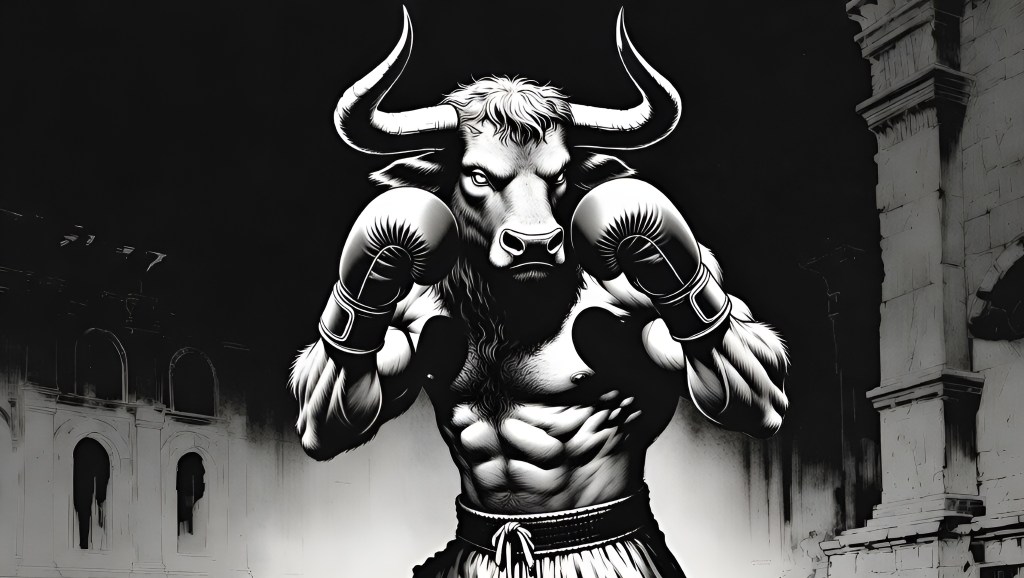
Oran’s most vivid spectacle is a boxing match, where fans from rival cities, Oran and Algiers, project collective identities onto the fighters. A physical contest becomes a clash of communal pride. They hurl insults, not personal but philosophically deeper, assaulting group honor and inflating its significance until a vengeance ignites. The arena transforms into a ritualistic space, with boxers idolized as proxies for group victory or defeat. “These insults are more stinging than one might think, since they are metaphysical,” Camus observes, highlighting how group identity turns mundane strife into existential drama.

He describes the fights in religious tones:

“The crowd grows animated, yet remains polite. It inhales the sacred scent of liniment, contemplating slow rites and confused sacrifices, made authentic by the expiatory shadows cast against the wall. These are the prelude to a savage, calculated religion. Only later comes the trance.”

In this fervor, pride swells, fights erupt in the crowd, and vengeance is exacted. As communal passions approach the Zero Meridian — a tipping point of absolute nihilism — Heraclitean polemos (strife) ignites, generating meaning through opposition. Yet this risks rigid dogma, inflamed by papañca, the mental proliferation that weaves illusions from raw flux. This marks the pole of being: earthbound rituals enforcing order, where individuals subsume their will to the collective, mistaking idols for transcendent truth. The fans’ zeal — group assertion and self-abnegation — opposes the becoming pole of individual empowerment and overcoming.

Camus, as an outsider attuned to absurdity, is able to avoid the group’s enchantment while benefiting from the ego dissolution in the ritual’s raw energy. This is a transfigurative release into lethe, the Greek notion of concealing or forgetting, without being ensnared by dogma. Lethe pairs with aletheia (unconcealment, truth) as physis — nature’s self-emerging flux. Moderns, lost in the nihilism of total aletheia (e.g., scientific materialism or Neo-Marxism), often overlook lethe’s mystery.

Beyond the arena, Oran’s idolatry manifests in its monuments and streets — eroded statues of forgotten generals or the Maison du Colon, a patchwork edifice blending colonial styles into a hollow symbol of economic utility. Oranians invest these with rigid roles to ward off the labyrinth’s mundaneness, their identities subsumed in forms echoing Ernst Jünger’s “form as cult” — structured yet spontaneous assertions of power. Push too far into this, and one risks entrapment, mistaking idols for absolutes. Yet, fully embraced, it can blaze across the Zero Meridian, revealing the fiery nature within.

Water, however, is life’s most advantageous element. It dissolves the self-idol with its generative nothingness, sweeping clear for renewal. 

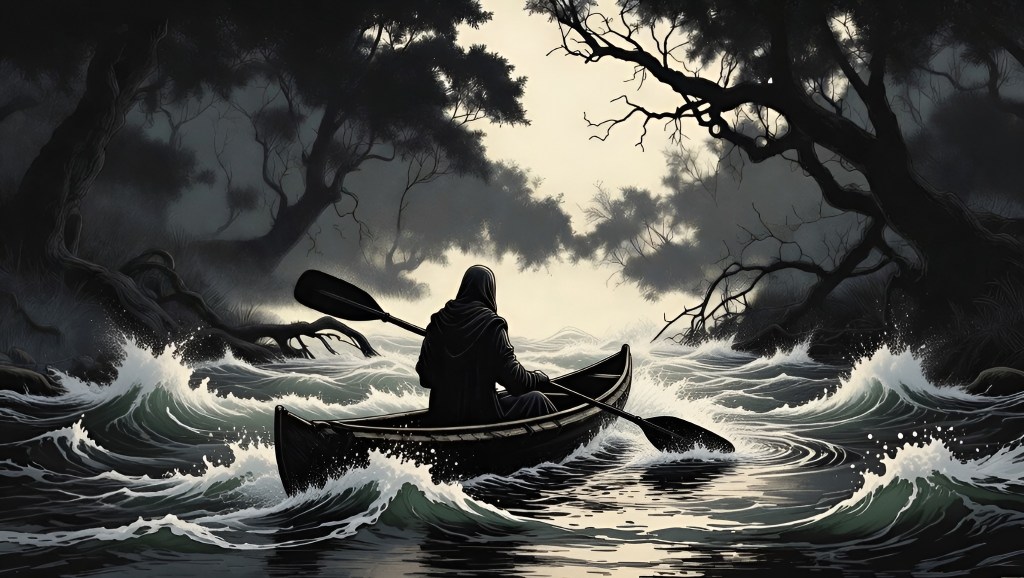
This middle way eases the transition from earth to fire. In Oran, rituals promising surrender to collective forms offer respite from anguish but risk entrapment in bad faith — becoming a manipulable “thing.” Camus sees the farce, yet he finds form’s solidity necessary for engaging flux. “Nothingness is no more within our reach than the absolute,” he writes, navigating a middle way. It’s riding the rapids of intersecting polar torrents. Here, physis and citta (mind) swirl as superimposed saṅkhāras — conditioned phenomena shaping reality. Oran’s stark elements — dusty streets, brilliant sky — hint at physis’ concealed side, while the mind’s forms, like “the self” and group identity, proliferate illusions that blind us to the fact there even is a concealed side. The sea mediates, channeling flux into a life-affirming flow that tempers extremes without quenching vitality.

Stripped bare, Oran breeds existential anxiety from a lack of stimulation. In a city “without soul and without reprieve,” the scarcity of distractions forces confrontation with the absurd: our craving for purpose in an indifferent universe. Oranians seek refuge from the void in daily clamor and other idols — boxers as sacrificial figures or the Maison du Colon’s grandeur — projecting meaning to fill the emptiness. Yet this glare of papañca obscures physis’ mystery.

For a cosmic Chad like Camus, though, Oran’s starkness facilitates releasement. Urban anonymity, the desert’s silence, the sea’s elusive horizon — all invite attunement to nimitta, subtle signs of concealed truth. Camus glimpses the void without clinging, balancing Nietzsche’s Dionysian torrent and Apollonian form. Through depersonalization — viewing rituals as absurd theater — or art’s grandeur, one attunes to mystery without falling into cult. Lethe dissolves ego, not into escapism but forgetful immersion, losing the self in flux without illusion.

To face the sky’s neutral indifference, we must release our need for constant stimulation and embrace the resulting anxiety. The Minotaur is boredom; Ariadne’s thread leads from the labyrinth to the hard landscape, blazing sky and ultimately the sea, attuned to physis’ depths. Camus writes:

“These weighty galleons of stone and light quiver on their keels, as if ready to sail toward sunlit isles. Oh, Oran’s mornings! From the high plateaus, swallows dive into vast cauldrons of shimmering air. The entire coast stands poised for departure, stirred by a thrill of adventure. Tomorrow, perhaps, we shall set sail together.”

This evokes a shift from being to becoming: the sky’s chaos loosens earth’s dogma, letting the sea bear us along the flux — our true nature. Lethe affirms vitality without illusion.


Check out § 5. Rekindling the metaphysical fire.
Part 1

Existential Firestorm: A Topology of Metaphysics

§ 3. Paddling the polar torrents

1.
The deepest insights into reality’s flux have always coursed through the hidden channels of the waveform — silent, powerful — from Heraclitus to Nietzsche to Heidegger. Concealment is not absence; it is the secret nourishment of all revelation. Every form is a raging polarity locked in creative strife.

2.
Heraclitus saw logos as the unity of opposites held in strife. The taut string of polemos launches the arrow of becoming. Without resistance there is no flight — only slow stagnation.

3.
Physis is the primordial waveform — the unconfined ground of becoming from which every local being ↔ becoming polarity and saṅkhāra helix arise.

4.
We experience being ↔ becoming as tension in the local standing wave — clinging to nodal stability or pulled toward antinodal flux. One moment the mind leans toward revealed stability — clinging to a self-image, belief or narrative. The next, an undercurrent of unease or restlessness pulls toward concealed flux.
This friction is not a problem to solve — it is saṅkhāra breathing. Collapse the tension into one pole and either rigidity or chaos takes over.

5.
All forms, as will-to-power saṅkhārā, live in eternal oscillation within the helical standing wave: the defense of stable being that life requires, and the destruction of becoming that chooses a nobler future.

6.
No grip can hold fast in the waveform’s current.
Releasing the bright surface, we flow into generative nothingness — the hidden spring that demands the justice of aletheia.
Lethe itself has a strange double nature: It is both the injustice of entropy — washing away and scattering — and the very mechanics of higher coherence. It clears the old order so a stronger state can re-member itself.

7.
Cetanā embodies the power of lethe as the volitional frequency band that prunes the waveform. It secretes a void between past and present, bending rigid causal chains into possibilities that kamma hones into bhava. We should shape becoming like artists.

8.
Ignoring the hidden pole is nihilistic. We mistake the revealed for the whole, chase glittering forms, and squander our life energy on golden calves that blind us to the shadows.

9.
Nietzsche’s will to power affirms the full tension of being ↔ becoming — the cosmic cetanā that forges higher coherence, then dissolves its own creations through non-clinging flow. Amor fati streams through the heart of the void, clearing space for new values while embracing eternal recurrence.

10.
Strife nourishes existence. Remove all resistance and civilizations drift into comfort, withdrawal, and quiet extinction — Calhoun’s Mouse Utopia. After Heraclitus, Plato dammed the metaphysical torrent with ideal Forms. His levee has crumbled. Now the Last Man blinks at the onrush of becoming — the waveform ready to choose its next helix.


Read § 4. Pounding sand in the labyrinth. (Revised February and March 2026)

Part 1

Existential Firestorm: A Topology of Metaphysics

§ 2. From Valhalla in flames to a new turning

1.
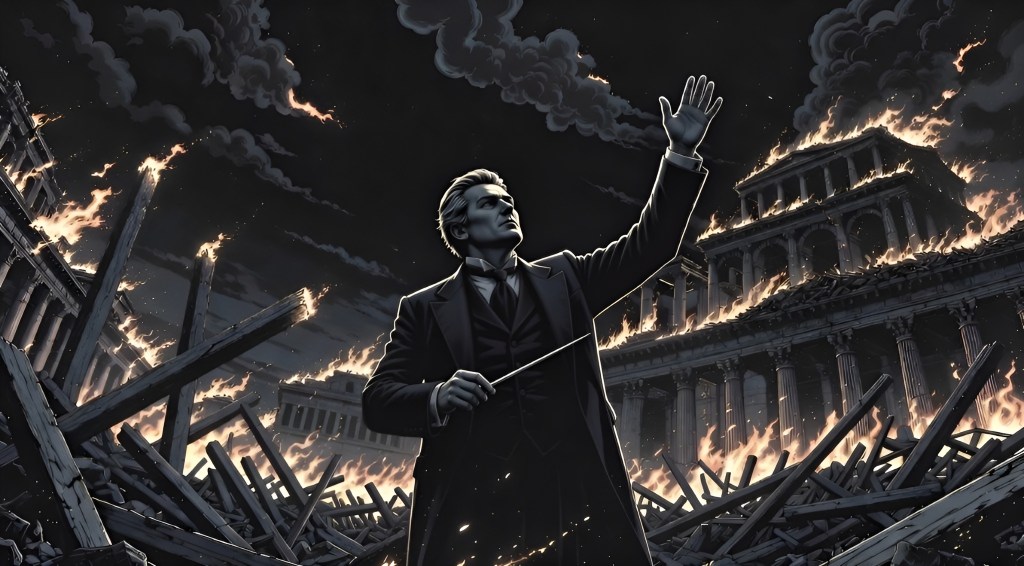
Operas usually end in tragedy, but only Richard Wagner has the audacity to torch the gods themselves. When Valhalla goes up in flames at the close of Götterdämmerung, the entire illusion of divine stability collapses in a cataclysmic turning. Out of those ashes, space opens for something far wilder: the raw, creative force of becoming.

2.
Ernst Jünger maps the plunge into nihilism’s deepest terrain. Its favored ground is rigid order; its hidden pit opens through depersonalization, fracture or cult worship — the sudden hollowing of all meaning that yearns for ultimate significance. Give yourself over to an idol completely and the earth begins to crack, revealing the fiery essence that was always waiting beneath the crust.

3.
A transition toward our true nature of fire can begin without the explosive nature of a cult. From clinging to the solidity of earth, we can flow first into water — lethe’s preparatory dissolution — eroding every false idol before risking the Zero Meridian. Cults and rigid systems explode in the crossing, but the river tempers the flame.

4.
The way out of rūpa’s labyrinth is not to get lost in the content by being mindful the context. These nimitta manifesting in our minds are not random; they intimate the concealed harmony of anicca — impermanence as the logos that secretly unites every opposite. Through avijjā we mistake appearance for all that exists and serve false significance. Look closely at the signs themselves and feel how the hidden realm is not a solid ground of Forms, but flickering flux.

5.
Zeus’ thunderbolt = decoherence.
Titanic ash = rūpa.
Trapped spark = nāma wavebands entangled in density.
Orphism = the re-cohering of the fire.

6.
“This world is the will to power — and nothing besides!”
— Friedrich Nietzsche

Universal cetanā broadcasts living viññāṇa — our rūpa antennas pick up the signal and amplify it as a self-knowing sankhāra.

7.
Zarathustra descends the mountain as a prophet of fire.

8.
The Titanic ash is decoherence made flesh — the dense rūpa realm that entangles the divine spark and damps its native superposition into the illusion of solid, separate particles.
The Orphics knew the tragedy: trapped in this heavy nodal grounding, the Dionysian fire forgets itself. Yet every act of re-membering is the waveform fighting back — a momentary rarefaction, a thinning of the soot, where the spark reclaims its coherence and the god begins to remember he was never ash at all.
Decoherence is the fall.
Re-membering is the resurrection.

9.
“Hidden harmony is stronger than the obvious.”
— Heraclitus

10.
On the far side of the line, once every tether is released, something new turns toward us. As Jünger wrote:

“The instant the line is crossed brings a new turning of Being toward us, and with it what is truly real begins to shimmer. This will become visible even to the dullest eyes. New celebrations will follow.”


Check out § 3. Paddling the polar torrents. (Revised February and March 2026)

Part 1

Existential Firestorm: A Topology of Metaphysics

§ 1. The flux is wet … and lit

1.
Water ↔ fire. Lethe’s dark currents nourish aletheia’s blaze; cetanā secretes the void that flickers phenomena into being. In this concealing ↔ revealing polarity, the universe perceives its self-surpassing—pleasure as the vedanā of higher coherence after a scattering, the surge of will to power. All must dissolve. The flame re-members.

2.
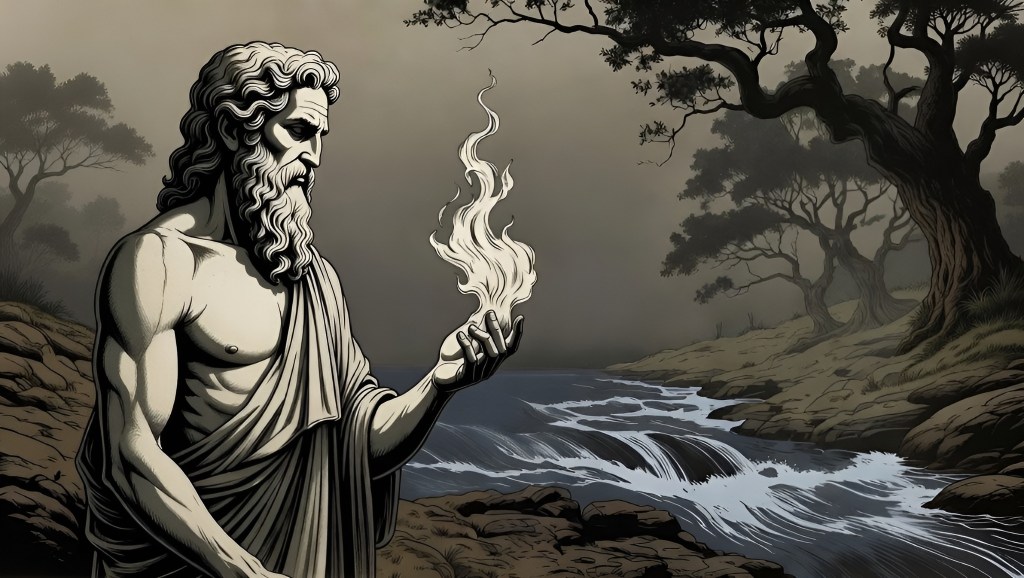
Heraclitus saw reality as a river you can’t step in twice — our cosmic watercourse fed by two hidden springs that only appear separate when the mind carves them apart.
The first is lethe: the primordial concealment that damps the infinite waveform into apparent solidity. Lethe is the concealing force that both creates the dense nodal layer (birthing rūpa as earth-like grounding) and eventually releases it through dissolution when the system is ready for the next upward turn, bookending paṭiccasamuppāda. Without the earth phase, nothing would ground greater coherence. Without the water phase, nothing could evolve.
The second, superimposed on physis, is citta — the mind’s unseen fountainhead that includes the volitional frequency band allowing the seen to appear as actuality by pruning the superposition into form. Here the solid transitions to liquid, ignited by the creative impulse of will to power.
We never sense these streams directly, only their flickering nimitta (signs): forms in the world, thoughts in the mind, the momentary standing waves that rise and fall in the local resonant chamber we call “I.”
The river is never the same because the waveform is never static — it is always becoming, always choosing through cetanā which branch will manifest next.
The signs flicker in the mind as interference patterns — where the universal broadcast momentarily coheres into lived experience.
Once you see the river as the single waveform expressing itself through local helices, you can’t unsee that stepping in it twice is impossible because both it and you are in constant flux — and you are both the same thing anyway.

3.
“This cosmos — the same for all — neither any god nor any human made. It was always, and is, and ever shall be: an ever-living fire, kindling in measures and going out in measures.” — Heraclitus

4.
Lethe ↔ aletheia The fire hides so it can find itself again.

5.
All forms fractalize the polarity between illusory being and ceaseless becoming, enacted by the great elements.
On the stage of mental phenomena — nāma — the four mahābhūtā blaze most vividly: fire as ripening and transformation, air as space and tension, water as flowing cohesion, earth as persistence and resistance.
The universe tastes its own forms through nāma as the living qualities of physis itself; mind reflects nature because it feeds on rūpa.
While all is fire, we usually perceive nāma as earth and water, forgetting our true nature. But when mental images flicker like flames, the earth illusion crumbles — and with it the dualism of nāmarūpa.
All must dissolve so the ever-living fire may taste its own self-surpassing.

6.
Idolatry traps nāma in the earth ↔ water realm, rigging it toward sticky, borrowed meaning. It enchants saññā filters, labels the potential and the actual, charges them with borrowed value — so that cetanā collapses superposed possibilities only along the idol’s narrow paths. We embrace their evaluations from greed and fear, then pretend they are our own, until illusion hardens into reality. Moral feelings — guilt, righteousness, etc. — are the fire’s coherence-signal hijacked into an idol’s standing wave. Transgression feels like cosmic betrayal because we have mistaken the glare of the golden calf for the only fire.

7.
The stronger the cetanā frequency band, the more expansive the viññāṇa band becomes, which arises from, volition annihilating potentialities to birth actuality. Cetanā alone can disrupt the causal chains of the past — but not sever them absolutely. Instead, it flips facticity’s rigid being into dynamic becoming, turning “what was” into flickering possibilities. Seize the reins of choice to loosen the grip of taṇhā (craving) and level up your awareness.

8.
Beware papañca’s chatter — the seductive call of value and meaning decohering the mind into delusions of significance that veil impermanence. Here lurk self-replicating vampires: scraps of culture coalescing in vMEMEs that spiral between cults of conformity and personal power grabs. They twist raw flux into bad faith.
Signs of the will to power as a dynamic polarity blaze in Spiral Dynamics: purple tribalism, red rebellion, blue order, orange achievement, green wokeness — cycling in these lower orders between self and group worship. Growing more coherent as it climbs the spiral, each form craves not mere survival but metaphysical fuel to strengthen without limit — dominion in the flux. With each twist up or down, lethe’s oblivion wipes the slate clean, silencing the viral echo of Mneme.
This fluidity is exactly the way out: see every nimitta as a clue to hidden renewal and non-clinging, illuminating the emptiness of the cosmic waveform — how idols (memes) capture the chain of paṭiccasamuppāda by manipulating saññā to raise the temperature of significance until attraction and aversion feel like destiny. Don’t automatically go with the grain of your feelings.

9.
The most perspicuous example of a sankhāra is the existential dependence of mind on body. Nāma ↔ rūpa.

10.
Earth dissolves as the river flows on — for eternity. Amor fati.


Check out § 2. (Re-membered from original Parts 1-3, February 2026, and revised March 2026.)