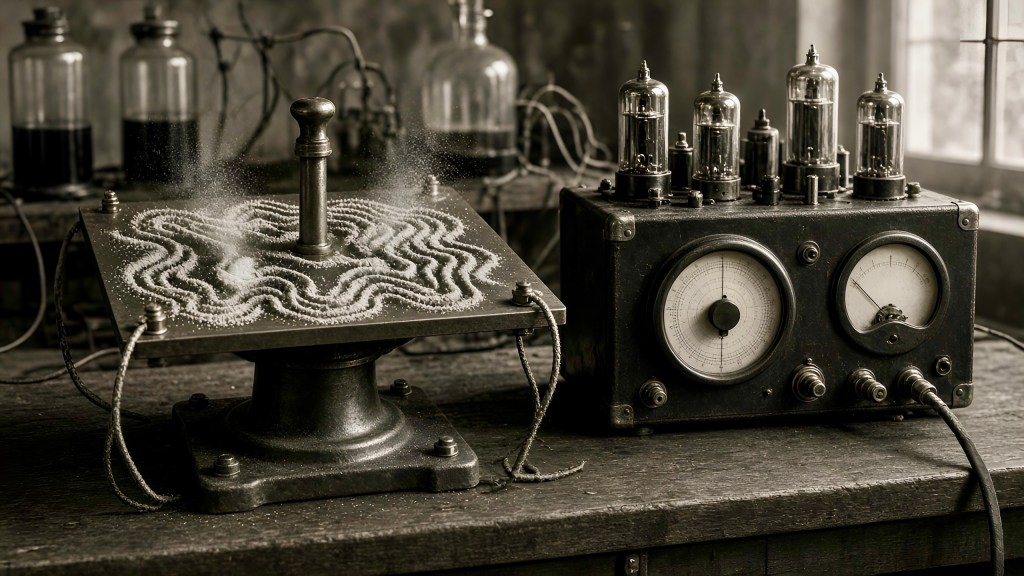
The topography of a Chladni plate reveals a standing wave’s nodes as lines of sand gathered by unseen antinodes. The sand rests where the metal is still, thrown clear of every region where the plate is moving. The antinodal work of swinging crests and troughs is the far activity that holds the near appearance of the nodal map in tension across the plate. Without that cohesion, the nodes would scatter; with it, they form a coherent topography that can be redrawn while the plate continues to stand. The same standing-wave cartography structures the mind, the memes it locks with, and the span of a human life between birth and death.
What we read as the sign is the carrier at rest; what makes it a sign is the motion it is excluded from. Citta (mind) is the background plate that remains standing — not a substance beneath the nimittāni (signs), but the context and boundary that decide which patterns can form at all. Cetanā (volition) is the antinodal work driving the plate and scattering possibilities, and citta-nimittāni (mind forms) are the shifting sand patterns that gather at the nodes. Across each interval, a standing wave passes through the elemental weathers: earth gathers as the nodal phase, while fire disperses at the antinodes as the most rarefied weather. Between them, water binds the figure in cohesion and air opens the spacing in which “this” can be held apart from “that.”
This repeated rarefaction at the antinodes and gathering at the nodes is the basic figure fractalizing throughout existence. The standing wave is therefore not merely a physical analogy; it is the fundamental cartography of the being–becoming polarity. The nodes are a map sustained by the space that keeps it other than the terrain. The same internal difference appears in Ñāṇavīra’s Fundamental Structure: Any particular formation can be indicated only because it remains other than the structural conditions that make it possible, an invariance under transformation. A shift in frequency migrates the nodes, gathers new mental formations, and redraws the chart, yet it remains a map of the same plate because the saṅkhāra (binding lattice) was never identical with any arrangement of sand.
Saṅkhāra is that jointure of sand and wave, and it is the lattice that holds memes in phase-lock with the self-torus. Within a meme, the same binding joins a physical carrier — an earthen mound, a book, a rite — to a metaphysical pattern in the realm of toroidal resonance. Left to itself, the carrier is inert earth and the pattern is diffuse fire. Held in tension across a shared node, the carrier gives the pattern a boundary to reflect against, and the pattern’s antinodal pulse keeps the carrier from collapsing into a mere pile of matter. At a larger scale, individual memes are themselves arranged nodes held in place by the antinodal force of a governing metaphysical pattern. A shift in conditions can scatter and rearrange those sub-nodes while the larger memeplex — the meta-meme — remains standing, the way species differentiate and turn over within a genus whose deeper type endures.
Within the self-torus, the 12 nidānāni (causal links) of the wavenumber-6 standing wave form nodal spokes that meet at the central nodal cross. They are the simultaneous structural loci of paṭiccasamuppāda (dependent origination), where experience is indicated moment by moment. Lethe is a shift in frequency — the antinodal surge that clears the current standing pattern, migrates the sand, and allows a new chart to form on the same terrain. In the clearing cut at the cross, consciousness manifests with the quality of the elemental weathers while the self-torus changes and stands at once, because the nimittāni remain other than the continuous binding that sustains them.
A human life is this standing wave stretched between the terminal nodes of jāti (birth) and jarāmaraṇa (aging-and-death). Both belong to the 12 spokes of the ring, yet their pull as the outer poles of a life converges at the central cross, where the force holding the entire span is gathered. Each moment of experience is a local nodal figure — a passing weather of citta-nimitta — across that longer topography. Ordinary lethe redraws the intermediate map while the terminal poles continue to stand; even a deep rearrangement leaves the life the same life for as long as the lattice holds birth and death in relation.
Without that binding, the terminal nodes would open no interval in which “this life” could be distinguished from the activity that sustains it, and no coherent cartography could appear. Mortals, however, cannot reflect forever. Only the universe itself, as the standing half-wave of all standing half-waves, maintains the lattice without exhaustion. Every finite form is a local weather system whose figure holds only while its wave energy lasts. Death is the larger lethe that arrives when the standing wave can no longer sustain the difference between its poles and the nodal pattern breaks apart. The topography of the universe continues, but the weather of that particular life does not.
Read “Emerald Acropolis Pilgrimage as a Standing Half-Wave.”


