Metaphysics looked cooked once Plato’s eternal Forms were exposed as a catastrophe. Scientific materialism, logical positivism and later postmodern skepticism delivered what seemed the final blows, leaving only a flattened ontology incapable of addressing existence’s deeper currents. But I propose we rekindle it — not as a realm of static ideals, but as a living, dynamic process animating the elemental strife of creative destruction and coming to presence.
At its core, this revival asserts that everything shares fire’s nature: flickering, voracious, transformative. Earth represents the illusion of permanence and rigidity. Water and air embody dissolution, flow and generative emptiness. We are mostly water — fluid and life-sustaining — yet fire is our ontological truth. Existence eternally cycles between earthen stability and fiery becoming. Danger arises when minds harden into earth under the pressure of objectification, cult of standing reserve or collective memory loops that reduce people to resources and weaken our cetanā — the cleansing power of choice.
This hardening is accelerated by scientific materialism, fixated solely on measurable, revealed surfaces, which strips existence of its hidden generative depths and reduces the world to a manipulable grid. The Mouse Utopia experiments offered a grim warning: When every need was met, both social bonds and individual vitality collapsed into decay. Pure rigidity conceals the fire.
The rekindling draws together Nietzsche’s will to power, Heideggerian releasement, Sartrean freedom and Ñāṇavīra’s insights. An especially sharp irony is that Nietzsche spent most of his career attacking metaphysics — ridiculing Plato’s “true world,” proclaiming “God is dead” and wielding a philosophical hammer against every supersensible backworld. Toward the end, though, in Thus Spoke Zarathustra and notebooks assembled as The Will to Power, he unwittingly erected one of modernity’s grandest metaphysical edifices: reality itself as volition — endless striving, self-overcoming and creative destruction. He demolished the static being, and, in its place, offered a metaphysics of pure becoming.
Heidegger saw this but was too quick to declare will to power the completion and exhaustion of metaphysics. When refined by the mystery of forgetting (lethe) and complemented by Heidegger’s own releasement, Nietzsche’s dynamic core gains new vitality rather than marking an end. Sartre’s “look” shows how bad faith traps us in false being — unless we intensify cetanā to sever causal chains and secrete nothingness in the collapse of superposed potentialities into actuality. And Ñāṇavīra’s reading of volition as existential nutriment completes the synthesis.
This rekindled metaphysics transforms ontology into a living flame. Being does not rest — it burns in the abyss of becoming.
Albert Camus’ 1939 existential travelogue “The Minotaur, or The Stop in Oran” unveils a stark land carved from rock and enchanted by idolatry — yet, for those very reasons, a place where an outsider finds renewal in generative voids. Oran is a labyrinth, trapping its denizens in a maze of rigid roles and inflated meaning. Yet the fiery sky overhead, the desert beyond its walls, even cult itself offer clearings to glimpse the concealed mystery that deepens existence. Between these extremes, the ancient Mediterranean mediates the poles of domineering order and indifferent chaos — being and becoming.
As a brief visitor to the Algerian town, Camus gleaned insights into the human condition. He was uncaptivated by local influences, so he could taste the transfigurative release of ego death through ritual without clinging to idolatry. This detachment let him view Oran’s communal practices as absurd spectacles rather than valid dogmas. Unlike the residents, trapped in their maze by habit and therefore blind to the landscape and sea, Camus remained open to the world’s mystery.
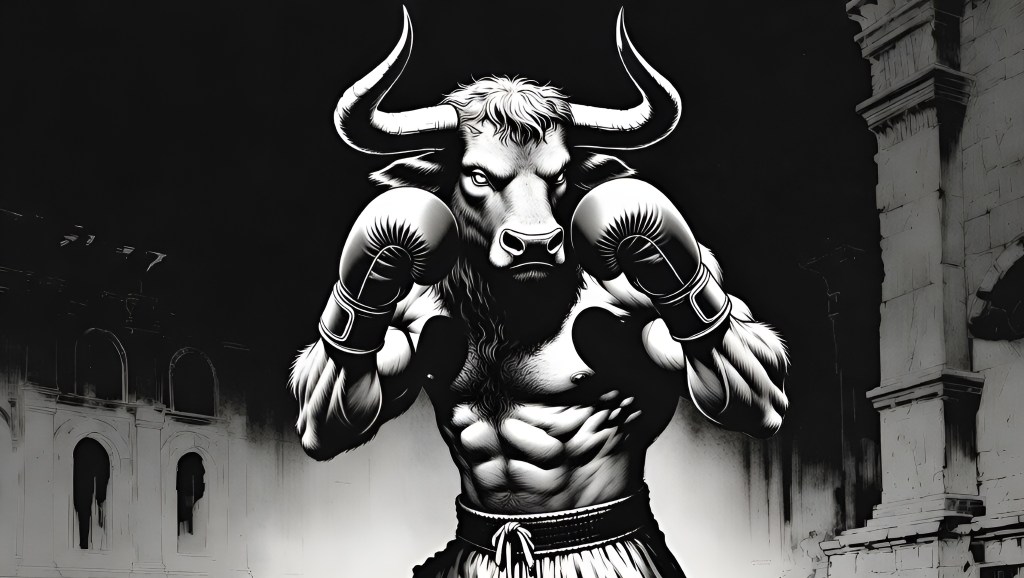
Oran’s most vivid spectacle is a boxing match, where fans from rival cities, Oran and Algiers, project collective identities onto the fighters. A physical contest becomes a clash of communal pride. They hurl insults, not personal but philosophically deeper, assaulting group honor and inflating its significance until a vengeance ignites. The arena transforms into a ritualistic space, with boxers idolized as proxies for group victory or defeat. “These insults are more stinging than one might think, since they are metaphysical,” Camus observes, highlighting how group identity turns mundane strife into existential drama.
He describes the fights in religious tones:
“The crowd grows animated, yet remains polite. It inhales the sacred scent of liniment, contemplating slow rites and confused sacrifices, made authentic by the expiatory shadows cast against the wall. These are the prelude to a savage, calculated religion. Only later comes the trance.”
In this fervor, pride swells, fights erupt in the crowd, and vengeance is exacted. As communal passions approach the Zero Meridian — a tipping point of absolute nihilism — Heraclitean polemos (strife) ignites, generating meaning through opposition. Yet this risks rigid dogma, inflamed by papañca, the mental proliferation that weaves illusions from raw flux. This marks the pole of being: earthbound rituals enforcing order, where individuals subsume their will to the collective, mistaking idols for transcendent truth. The fans’ zeal — group assertion and self-abnegation — opposes the becoming pole of individual empowerment and overcoming.
Camus, as an outsider attuned to absurdity, is able to avoid the group’s enchantment while benefiting from the ego dissolution in the ritual’s raw energy. This is a transfigurative release into lethe, the Greek notion of concealing or forgetting, without being ensnared by dogma. Lethe pairs with aletheia (unconcealment, truth) as physis — nature’s self-emerging flux. Moderns, lost in the nihilism of total aletheia (e.g., scientific materialism or Neo-Marxism), often overlook lethe’s mystery.
Beyond the arena, Oran’s idolatry manifests in its monuments and streets — eroded statues of forgotten generals or the Maison du Colon, a patchwork edifice blending colonial styles into a hollow symbol of economic utility. Oranians invest these with rigid roles to ward off the labyrinth’s mundaneness, their identities subsumed in forms echoing Ernst Jünger’s “form as cult” — structured yet spontaneous assertions of power. Push too far into this, and one risks entrapment, mistaking idols for absolutes. Yet, fully embraced, it can blaze across the Zero Meridian, revealing the fiery nature within.
Water, however, is life’s most advantageous element. It dissolves the self-idol with its generative nothingness, sweeping clear for renewal.
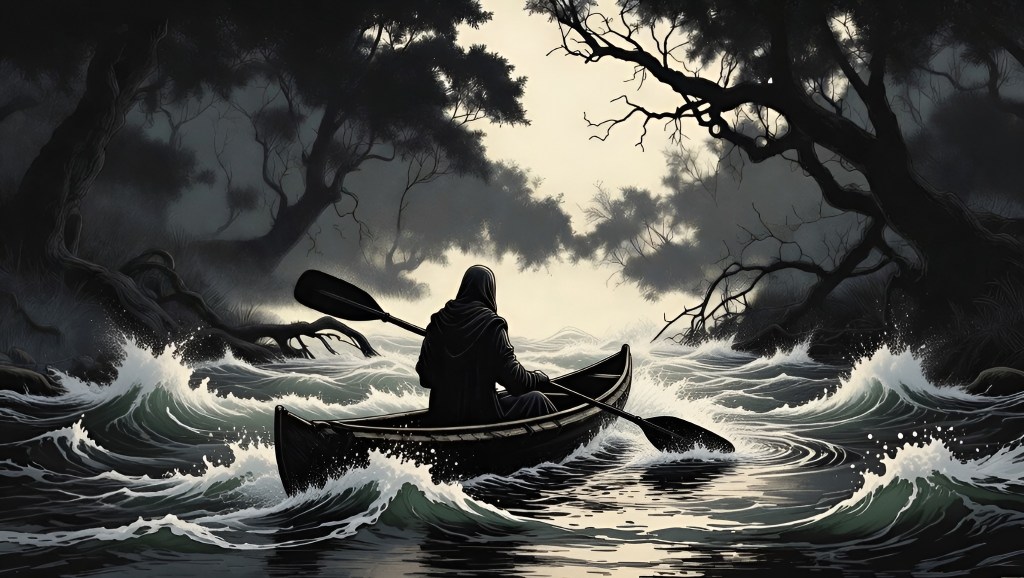
This middle way eases the transition from earth to fire. In Oran, rituals promising surrender to collective forms offer respite from anguish but risk entrapment in bad faith — becoming a manipulable “thing.” Camus sees the farce, yet he finds form’s solidity necessary for engaging flux. “Nothingness is no more within our reach than the absolute,” he writes, navigating a middle way. It’s riding the rapids of intersecting polar torrents. Here, physis and citta (mind) swirl as superimposed saṅkhāras — conditioned phenomena shaping reality. Oran’s stark elements — dusty streets, brilliant sky — hint at physis’ concealed side, while the mind’s forms, like “the self” and group identity, proliferate illusions that blind us to the fact there even is a concealed side. The sea mediates, channeling flux into a life-affirming flow that tempers extremes without quenching vitality.
Stripped bare, Oran breeds existential anxiety from a lack of stimulation. In a city “without soul and without reprieve,” the scarcity of distractions forces confrontation with the absurd: our craving for purpose in an indifferent universe. Oranians seek refuge from the void in daily clamor and other idols — boxers as sacrificial figures or the Maison du Colon’s grandeur — projecting meaning to fill the emptiness. Yet this glare of papañca obscures physis’ mystery.
For a cosmic Chad like Camus, though, Oran’s starkness facilitates releasement. Urban anonymity, the desert’s silence, the sea’s elusive horizon — all invite attunement to nimitta, subtle signs of concealed truth. Camus glimpses the void without clinging, balancing Nietzsche’s Dionysian torrent and Apollonian form. Through depersonalization — viewing rituals as absurd theater — or art’s grandeur, one attunes to mystery without falling into cult. Lethedissolves ego, not into escapism but forgetful immersion, losing the self in flux without illusion.
To face the sky’s neutral indifference, we must release our need for constant stimulation and embrace the resulting anxiety. The Minotaur is boredom; Ariadne’s thread leads from the labyrinth to the hard landscape, blazing sky and ultimately the sea, attuned to physis’ depths. Camus writes:
“These weighty galleons of stone and light quiver on their keels, as if ready to sail toward sunlit isles. Oh, Oran’s mornings! From the high plateaus, swallows dive into vast cauldrons of shimmering air. The entire coast stands poised for departure, stirred by a thrill of adventure. Tomorrow, perhaps, we shall set sail together.”
This evokes a shift from being to becoming: the sky’s chaos loosens earth’s dogma, letting the sea bear us along the flux — our true nature. Lethe affirms vitality without illusion.
All must eventually dissolve for the fire to taste its self-surpassing toward higher coherence. — Author unknown
Phiale’s hand shook as she poured hibiscus tea into the principal’s porcelain cup. Pulling the spout away, she spilled a few red blossoms on the white tablecloth … and swayed under everyone’s gaze.
Ms. Owen, the biology teacher and Flower Club adviser, sucked in a breath and clicked her tongue from the other end of the long table where a half dozen girls sat, dappled in sunlight under the conservatory’s glass ceiling.
“Fail-a-lee,” whispered one of the nearby Roses.
As Principal Rapp smiled slightly and dabbed the spill with a cloth napkin, Phiale caught a whiff of musty vanilla, like the crumbling Bible in her dad’s office. “So, fie-a-lee, the fire department wants you to stop by the station after school tomorrow,” he said and looked at Ms. Owen. “Apparently, before they could interview her yesterday, she practically fled from the scene of that incident or whatever it was — an exploding hydrangea or something. From the way some people were talking, it sounded like the flames of Armageddon had spewed forth to claim the unrighteous.” He sighed and stared wistfully toward a line of sycamores along the Wabash, stroking his long, graying Amish beard. “If only … ”
“Eh … the important thing is that Phiale’s okay,” Ms. Owen said.
The girl finished pouring the tea from flowers she’d harvested there in the greenhouse and dropped stiffly into her metal chair, wishing everyone would pay attention to something else. WTF, universe — a flying pyro on watering day and Rapp on tea shift? Exactly what I was looking for.
“Yes, of course … das ist gut,” he said.
Rapp was really getting into the spirit of his German American fifth-great-grandfather George (quite literally) in the months ahead of the Boatload of Knowledge bicentennial reenactment. (The town was knocking out the celebration six months early because the real anniversary falls in the cold heart of January.)
“I hope you’ll join us for our flower walk after tea,” Ms. Owen said with the confidence he would say no (or perhaps nein).
The principal and teacher were direct descendants of New Harmony’s two utopian experiments: the Rappite apocalypse cult immediately followed by the Owenite rationality cult.
Wearing a black antique dress, Ms. Owen was herself already getting into character before the reenactment as her ancestor Jane Dale Owen Fauntleroy, daughter of leader Robert Owen (to be represented by the history teacher, her father).
“I wish I could, honestly,” Rapp said. “But I just stopped by to pick up the ferns for tomorrow’s mascot unveiling — the ones with the fiery-red leaves.”
“I see nothing wrong with our current mascot,” Ms. Owen interjected. “Minerva has guided generations of Owls with her wisdom and strength. And this isn’t a religiously affiliated school — so I certainly don’t think an angel is appropriate.”
“I heard it has a tail and scales,” said a Daffodil named Lily under her breath. An athletic Rose named Camellia chortled.
“Silence!” commanded the principal. “Ms. Owen, there are some dominions where the god of science is not the highest power … but how many times have I been through this with you?”
Playing from speakers on a potting bench, the “Allegro” from Haydn’s String Quartet in C Major quickened as the two adults exchanged glares, their shadows stretched out in the afternoon light like echoes of old portraits melting across the conservatory floor. Cups clinked on saucers, the air thick with the smell of earth.
Rapp suddenly smiled. “Ah, look, there they go,” he said, nodding toward a nearby line of girls marching across an unmowed field between the school and river, nets resting on their shoulders like rifles. “The Butterfly Club’s off to the labyrinth today … it’s already reopened. We’ve been hearing rumors that the legendary talking frosted elfin has reappeared there — she would be quite the showpiece pinned to our display wall.”
Phiale choked on her tart tea as the principal waved at the passing girls, who raised their nets in salute under his paternal gaze. His face darkened, however, when the one at the end stumbled and fell beneath the weeds, much to the Flower Club’s amusement.
Rapp mumbled something about a “plague of gophers,” stood, took a sip of tea and puckered his mouth. “I must go now,” he said. “No time to waste — the end draweth nigh.”
* * *
Indiana’s western edge falls in a straight line from the industrial ruins of Gary until it hits an area of high ground (Terre Haute in French) along the Wabash, whose meandering chaos serves as the state’s border until it disappears into the Ohio.
Twenty-two miles north of this confluence, Maple Run burbles near the hedge labyrinth (reconstructed from the Rappites’ original) before meandering through the New Harmony Girls Academy property and joining the Wabash, which Phiale could see flowing between the trees. The Flower Club was huddled around Ms. Owen on the bank of the small creek; she was pointing to a patch of wild blue phlox from a crouch.
The cry of a Violet pierced the air: “Snake!” Much more shrieking followed as Phiale caught sight of a large black serpent with a red mark on its head. It flashed through the scattering girls and splashed into the creek.
“Everything’s okay — just a run-of-the-mill snake,” Ms. Owen said.
She doesn’t sound convinced, though, thought Phiale, who was unfazed by the snake.
“We really must stay on track if we want to wrap up before it rains,” the teacher continued. The sunshine had given up to low clouds. “Notice the five lobed petals … as for its scientific name, the genus Phlox is Greek for ‘flame’ and species divaricata is Latin for ‘spreading.’ In fact — girls … listen, do be quiet … the snake didn’t hurt anyone, and it has swum away — in fact, spreading through replication is the purpose of all organisms.”
Ms. Owen collected herself, smoothing her dress. “This is clear if you take the gene’s-eye view that Richard Dawkins discussed in his keynote at the 2005 Owen Science Society annual meeting.” While Phiale didn’t quite grasp the meaning of the woman’s words, she did notice Ms. Owen blush as she clasped her hands to her chest, smiled and sighed. “That was back when we could still get speakers of his stature … though last year’s chemist from Mount Vernon was an expert on asphalt’s liquidity—”
“Lame!” shouted a girl who had sidled up next to Phiale.
Ms. Owen frowned as she took in the new arrival with long blonde hair and a small, upturned nose. The girl’s sparkly-framed glasses made a mockery of the school uniform. “It seems we have a visitor. You must be new to the academy, because we teach our Owls better manners than that. What is your name?”
The girl spat and tried to screech hypersonically, but it just came out as a weak “eeeee.” She shook her head in frustration and said, “Just call me Belle for now.”
Ms. Owen shut her eyes for a moment and continued in the voice of a 19th-century schoolmarm — but with the confusing precision of a 20th-century slide rule: “As I was saying, imagine strands of DNA lying there in the dirt; their one job is to endure and replicate, but they can’t last long unprotected. So in the case of animals like us, we develop a body around ourselves and a mind to move about for food and to reproduce with the opposite sex.”
“Principal Rapp told us there’s no reason to bother with the last part — back when he canceled our mixers,” said Camellia, whose hand rested on Lily’s far shoulder. “The end is near, and all that.”
Ms. Owen pressed on: “Fifty years ago, Dr. Dawkins described another kind of replicator called a meme.”
“Like the lady yelling at the cat?” asked a Violet standing next to the teacher.
“I wouldn’t know about such nonsense … I mean a bit of culture — like when a song repeats over and over in your head to make you sing it aloud to spread to somebody else’s head — or like when Principal Rapp believes that a Bible verse is so relevant he can’t help but to recite it. It’s the same reason a cold virus makes you sneeze — they have to disperse to other people to survive and thrive.”
“That’s funny how it’s called a meme” — Belle said and winked, giving off faint sparks that caused Ms. Owen to rub her eyes. “I had a friend named Mneme.” The fairy facepalmed and grimaced. “No, I mean I learned about Mneme in school like a normal human.”
Phiale couldn’t explain it at the time, but she felt nervous for Belle and the Flower Club members in general.
“She’s the Boeotian muse of memory, you know,” she rambled on. “The gods hated actors screwing up their lines — especially about their exploits. So they’d have Mneme whisper the right words into a performer’s ear to cut down on mutations. She never forgot anything ever … not nearly as irritating as Echo, though.”
“I’m scared,” said the Violet, shrinking against Ms. Owen, who stared dumbfounded at Belle.
Phiale felt the closeness of the late April sky, the air heavy with moisture. She wished it would pour — so it did. Overcome with shock and power of what she’d done, Phiale fell to the ground.
Belle helped her stand as the rest of the group sprinted up a hill toward the school and led her back to the stream bank. Then she plucked a magnolia leaf, held it over her head, winked and fluttered back into her sprightly form. Phiale blinked at the tiny, iridescent blur of her gossamer wings, shielded from the pelting rain.
“Ah, that’s better — human bodies are so unwieldy!” Tinker Bell shouted over the hammering drops. “Thanks for the cloudburst, by the way. Sometimes I don’t know when to shut up — at least that’s what those Fairy Council tyrants say … I guess even the dimmest of wits can occasionally be right about something … like a stopped clock … where’d you go?”
Bent over the stream, Phiale was soaking wet and enjoying it, watching the water ripple past rocks and branches, swirling, drawing her in. Her mood had loosened. Maybe the universe isn’t so bad after all.
“What’s going on?” she asked the sprite, who was now darting over the creek and around her face like a dragonfly with boundary issues.
A plastic ring appeared around Tinker Bell’s waist — which started gyrating. “You know how sometimes groups of humans suddenly feel compelled to all start doing the same thing? Like grab a hoop and twirl it around their midsection?” She pulled off the ring and flicked it at Phiale’s forehead. “Well, this whole town’s like that — with everything — because it got cursed from the sheer stupidity of the people who used to live here.
“It also means residents are more open to possession by cults, ghosts and divine presences — from gods to well … minor deities in your case.”
“Heraclitus’ words blaze with truth — but only if seized intuitively, not logically.” — Friedrich Nietzsche
As 60 thin streams fell from Phiale’s watering can into a bronze planter called The Flame of Heraclitus, the topmost soil lost its form and flowed into rivulets between pansies and peonies.
A glint of light flashed near a patch of swamp buttercups she’d just watered — and a large bug zig-zagged in front of her face, dripping wet and asking what the hell her problem was. Phiale dropped the can with a splash and stumbled back into eight-foot-tall hedges encircling the center of the labyrinth.
“Don’t worry, Phiale. I’m not evil,” said the insect. No … more like a fairy … laughing evilly.
“How do you know my n-n-name?”
“You’re an attendant nymph of Artemis. Anybody who’s anybody knows your name.”
“You’ve got me mixed up with somebody else,” blurted Phiale, a first-year student at the New Harmony Girls Academy. Dressed in a gray skirt and green V-neck sweater emblazoned with the school logo, she took a deep breath, picked up the can and started for a gap in the hedges. “Anyway, er … Tinker Bell, my name just happens to be Phiale. My dad is a professor of classics.”
“No, it was the Fates who named you — they get cute before big events … to amuse the gods … especially when they’ve been hanging around Bacchus. Wait! Don’t leave yet — I’ve got something to show you.” Then, more to herself than to the girl: “Maybe this time I’ll get exiled someplace less cornpone.”
Wondering what corn had to do with anything, Phiale suddenly stopped and turned around. (Something turned her around.)
“That’s better,” Tinker Bell said. She wrung out her blonde hair and spiraled up above the planter to take a look around. The wide bowl, which sat atop a pedestal, was originally an academy play prop before the Class of 1925 installed it as a senior project — all under the fairy’s influence (although Phiale didn’t know its story that far back yet). The fairy noticed her looking at it. “That thing used to have an ‘eternal’ flame instead of flowers … until the 1975 natural gas shortage. They tried a fountain with a water line after that but gave up because of a drought … settled for dirt. That’s usually the narrative arc around here: big ideas to … well … ” She grimaced at the muck-streaked pavers below.
“Now let’s begin our lesson. Listen up, and redeem yourself for dousing my nap.” The fairy flew to the hedge tops over Phiale’s head, snapped off a twig and took aim at the planter, ringed by stone benches and Ionic columns, already crumbling, no longer able to support a small roof.
Tinker Bell cleared her throat and … a car door shut.
Crouched in the hedges, Phiale heard voices approaching the labyrinth entrance. “I hope you brought some red thread,” a man said.
“No, but I can leave crumbs — I’ve got half a scone left over from the ‘Finding Utopia in Victimhood’ session,” a woman replied.
“I hear cult scum,” the fairy hissed as her dress changed from mossy green to fiery red.
The man’s voice grew louder and fainter as the pair progressed through the hedge convolutions: “We’re now on a journey to the center, a peaceful, inner space to contemplate our identities before we follow the path back into the world as stronger, more focused allies.”
“That’s so beautiful, the way you put that,” the woman cooed.
Tinker Bell vomited a sparkly stream of half-digested nemesis bloom nectar, wiped her mouth and said, “Class is in session …
“ALL IS FIRE!”
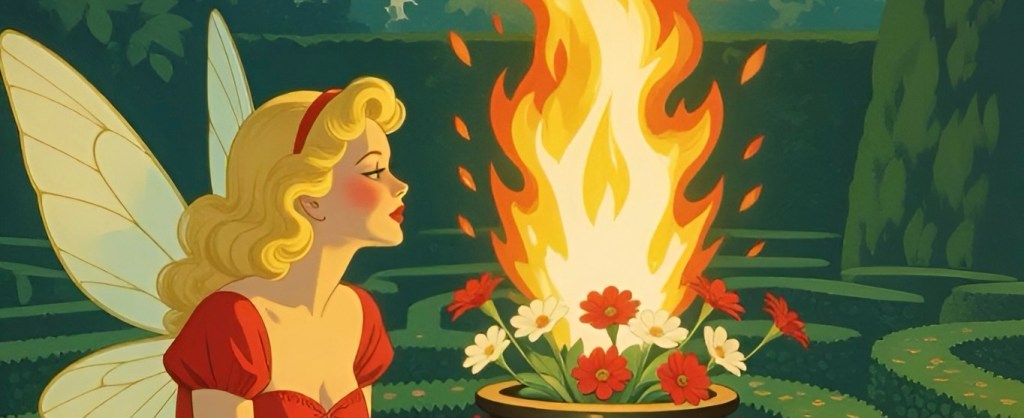
She jabbed with the twig and a 30-foot flame shot up from the planter, blasting Phiale with heat, potting soil and petals. The fire expanded into a dome over the labyrinth — ribbons appearing, spreading, racing into oblivion.
“Oh, my God!” the woman screamed. “The sky’s on fire!”
“Get down!” yelled her companion. “Crawl! Crawl! No, that’s the wrong way!”
“Up and down are one and the same!” Tinker Bell proclaimed. She raised the wand over her head, and as she slowly brought it down, the fire itself dropped a little and was replaced by a mist that shimmered in different colors, shifting with Phiale’s gaze like some kind of psychic Instagram filter. Then the cloud coalesced into water as it continued falling, retracing back to the center in a column above the planter. The girl shivered and felt a wave of relief with the transition in elements. And she had a wild thought: Did I somehow make the mist twinkle?
“Water is descending fire,” Tinker Bell said, “an illusion of form that makes it seem denser, less rarefied than it really is.” She dropped her arm and the water fell as earth back into the planter (mostly).
Phiale let out a long breath. Maybe I’m not going to die … I need to get out of here, though. But she felt like she couldn’t move, trapped in the center of a maze.
“Dirt is fire, but even less its true nature,” the fairy continued. “It has fallen, you see, into stability, rigidity, dogma — into cult … and then …
“EVERYTHING BURNS!”
She cackled and poked with the stick — another column of flame exploded upward and, dropping, turned to mist, water and then dirt.
Peeking between her fingers, Phiale heard distant sirens.
* * *
When the girl emerged from the labyrinth accompanied by an EMT who’d found her still in the shrubbery, she tried to hurry past a firefighter with a boot on the front bumper of a ladder truck and a clipboard on her thigh. She was questioning the man and woman, both openly weeping.
“Hey, Larry!” the firefighter called out to the chief eating a sandwich in the front seat. “This fellow says somebody screamed ‘fire’ before each of the explos—”
“Fellow?” interrupted the eyewitness.
The firefighter’s silver eyes met Phiale’s glance as the girl tried to sneak past. The tall, young woman pulled down her helmet’s chinstrap and spit a string of tobacco juice onto the pavement. “Howdy, miss,” she said.
Phiale gasped and looked away. As she picked up her pace, goosebumps spread over her body. Did I just see a goddess?
“You can never step in the same river twice, because you’re not the same person and it’s not the same river.” — Heraclitus
The fairy darted between alpine lilies like a bumblebee who’d gotten into a bottle of coca wine from the local pharmacy.
She was feeling especially angry and reckless back in summer 1869, muttering a steady hum of antediluvian swear words, high above Switzerland’s sparkling Lake Lucerne. The sprite had been kicked out of more cursed spots than she’d care to mention — malign meadows, godforsaken gullies — because she kept blabbing about things humans couldn’t handle hearing anymore.
So when she spied a resting hiker with a mustache like a drooping bratwurst, she couldn’t help but land on his knee with a chipper, “Hi there!” Out spilled her original Atlantean name, which included spitting and a hypersonic screech. The man blinked, unperturbed, but the shriek sent a nearby goat leaping to higher ground … dodging a boulder hiding the grave of Pontius Pilate. As with the fairy (another agent of chaos), the body of the Roman who crucified Christ had been exiled to Mount Pilatus.
She filled the hiker in on the legend, waving her little hands around in a whirl. “The body’s been cursing this place since ancient times. First they dumped Pilate in a river but had to fish out the corpse after a bunch of boats started sinking there. Guess they thought this would be out of the way enough to handle a curse like that. Some people are trouble wherever you send them.”
The fairy buzzed on a bit about the universe — dragging out chestnuts like the river of flux and unity of opposites, along with a few even more dangerous descents (the kind that cut the tether keeping you from the void).
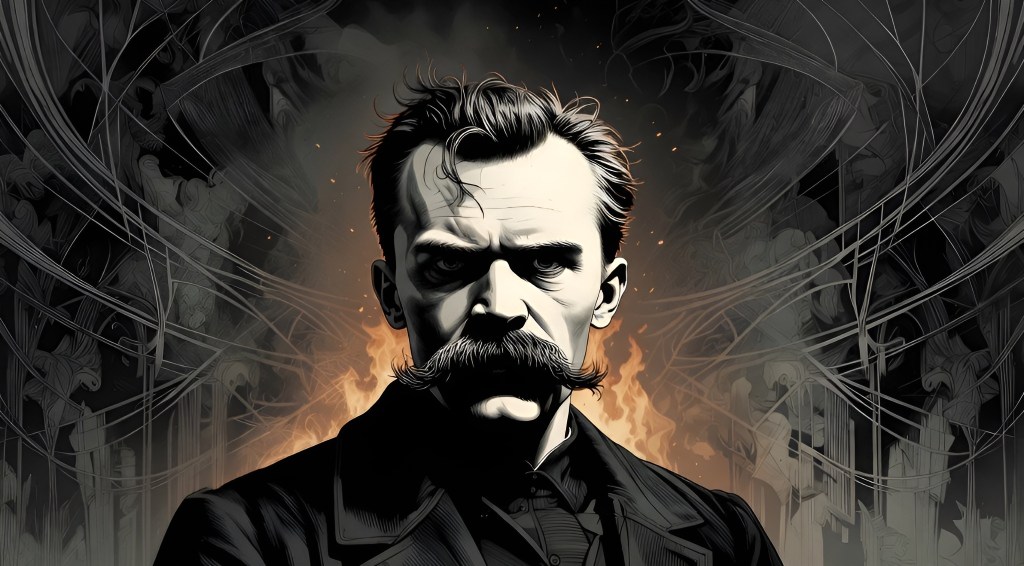
“How interesting,” said the man — Friedrich Nietzsche, a visitor to the nearby home of his friend Richard Wagner. He sat on a log, squinting philosophically at her with bloodshot eyes. Then he smiled and adjusted his lederhosen while balancing a satchel that reeked of cannabis tincture.
Nietzsche’s pleasant curiosity made her even more ill-tempered. “Fine, you asked for it, freak. I was there with Artemis in her temple when Heraclitus was dropping off his scrolls for safekeeping. A lot of good that did, by the way — all his writings burned up a while later along with everything else in the Artemisium.
“You’ll never guess what they were talking about, though. It’ll shatter your senses more than that weed of yours grown in a ditch. To Hades with those Fairy Council hags.”
“Tell me more,” Nietzsche said with a crazy grin.
Thus, years later, after he went on to deteriorate mentally while ranting metaphysically, the Fairy Council connected the dots and felt a certain Swiss miss deserved banishment to an even more remote, accursed place.
1. The deepest insights into reality’s flux have always coursed through the hidden channels of the waveform — silent, powerful — from Heraclitus to Nietzsche to Heidegger. Concealment is not absence; it is the secret nourishment of all revelation. Every form is a raging polarity locked in creative strife.
2. Heraclitus saw logos as the unity of opposites held in strife. The taut string of polemos launches the arrow of becoming. Without resistance there is no flight — only slow stagnation.
3. Physis is the primordial waveform — the unconfined ground of becoming from which every local being ↔ becoming polarity and saṅkhāra helix arise.
4. We experience being ↔ becoming as tension in the local standing wave — clinging to nodal stability or pulled toward antinodal flux. One moment the mind leans toward revealed stability — clinging to a self-image, belief or narrative. The next, an undercurrent of unease or restlessness pulls toward concealed flux. This friction is not a problem to solve — it is saṅkhāra breathing. Collapse the tension into one pole and either rigidity or chaos takes over.
5. All forms, as will-to-power saṅkhārā, live in eternal oscillation within the helical standing wave: the defense of stable being that life requires, and the destruction of becoming that chooses a nobler future.
6. No grip can hold fast in the waveform’s current. Releasing the bright surface, we flow into generative nothingness — the hidden spring that demands the justice of aletheia. Lethe itself has a strange double nature: It is both the injustice of entropy — washing away and scattering — and the very mechanics of higher coherence. It clears the old order so a stronger state can re-member itself.
7. Cetanā embodies the power of lethe as the volitional frequency band that prunes the waveform. It secretes a void between past and present, bending rigid causal chains into possibilities that kamma hones into bhava. We should shape becoming like artists.
8. Ignoring the hidden pole is nihilistic. We mistake the revealed for the whole, chase glittering forms, and squander our life energy on golden calves that blind us to the shadows.
9. Nietzsche’s will to power affirms the full tension of being ↔ becoming — the cosmic cetanā that forges higher coherence, then dissolves its own creations through non-clinging flow. Amor fati streams through the heart of the void, clearing space for new values while embracing eternal recurrence.
10. Strife nourishes existence. Remove all resistance and civilizations drift into comfort, withdrawal, and quiet extinction — Calhoun’s Mouse Utopia. After Heraclitus, Plato dammed the metaphysical torrent with ideal Forms. His levee has crumbled. Now the Last Man blinks at the onrush of becoming — the waveform ready to choose its next helix.
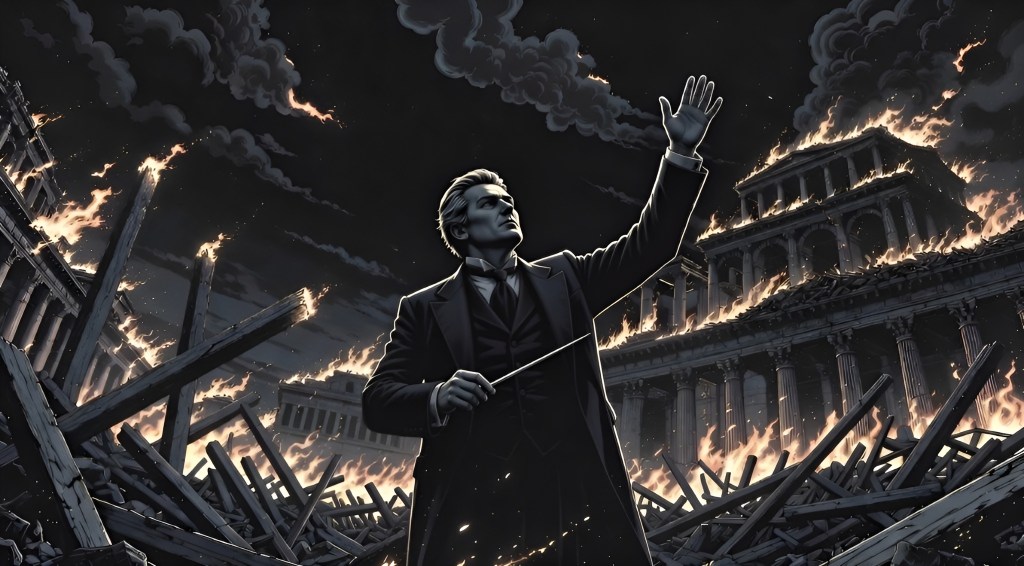
1. Operas usually end in tragedy, but only Richard Wagner has the audacity to torch the gods themselves. When Valhalla goes up in flames at the close of Götterdämmerung, the entire illusion of divine stability collapses in a cataclysmic turning. Out of those ashes, space opens for something far wilder: the raw, creative force of becoming.
2. Ernst Jünger maps the plunge into nihilism’s deepest terrain. Its favored ground is rigid order; its hidden pit opens through depersonalization, fracture or cult worship — the sudden hollowing of all meaning that yearns for ultimate significance. Give yourself over to an idol completely and the earth begins to crack, revealing the fiery essence that was always waiting beneath the crust.
3. A transition toward our true nature of fire can begin without the explosive nature of a cult. From clinging to the solidity of earth, we can flow first into water — lethe’s preparatory dissolution — eroding every false idol before risking the Zero Meridian. Cults and rigid systems explode in the crossing, but the river tempers the flame.
4. The way out of rūpa’s labyrinth is not to get lost in the content by being mindful the context. These nimitta manifesting in our minds are not random; they intimate the concealed harmony of anicca — impermanence as the logos that secretly unites every opposite. Through avijjā we mistake appearance for all that exists and serve false significance. Look closely at the signs themselves and feel how the hidden realm is not a solid ground of Forms, but flickering flux.
5. Zeus’ thunderbolt = decoherence. Titanic ash = rūpa. Trapped spark = nāma wavebands entangled in density. Orphism = the re-cohering of the fire.
6. “This world is the will to power — and nothing besides!” — Friedrich Nietzsche
Universal cetanā broadcasts living viññāṇa — our rūpa antennas pick up the signal and amplify it as a self-knowing sankhāra.
7. Zarathustra descends the mountain as a prophet of fire.
8. The Titanic ash is decoherence made flesh — the dense rūpa realm that entangles the divine spark and damps its native superposition into the illusion of solid, separate particles. The Orphics knew the tragedy: trapped in this heavy nodal grounding, the Dionysian fire forgets itself. Yet every act of re-membering is the waveform fighting back — a momentary rarefaction, a thinning of the soot, where the spark reclaims its coherence and the god begins to remember he was never ash at all. Decoherence is the fall. Re-membering is the resurrection.
9. “Hidden harmony is stronger than the obvious.” — Heraclitus
10. On the far side of the line, once every tether is released, something new turns toward us. As Jünger wrote:
“The instant the line is crossed brings a new turning of Being toward us, and with it what is truly real begins to shimmer. This will become visible even to the dullest eyes. New celebrations will follow.”
1. Water ↔ fire. Lethe’s dark currents nourish aletheia’s blaze; cetanā secretes the void that flickers phenomena into being. In this concealing ↔ revealing polarity, the universe perceives its self-surpassing—pleasure as the vedanā of higher coherence after a scattering, the surge of will to power. All must dissolve. The flame re-members.
2. Heraclitus saw reality as a river you can’t step in twice — our cosmic watercourse fed by two hidden springs that only appear separate when the mind carves them apart. The first is lethe: the primordial concealment that damps the infinite waveform into apparent solidity. Lethe is the concealing force that both creates the dense nodal layer (birthing rūpa as earth-like grounding) and eventually releases it through dissolution when the system is ready for the next upward turn, bookending paṭiccasamuppāda. Without the earth phase, nothing would ground greater coherence. Without the water phase, nothing could evolve. The second, superimposed on physis, is citta — the mind’s unseen fountainhead that includes the volitional frequency band allowing the seen to appear as actuality by pruning the superposition into form. Here the solid transitions to liquid, ignited by the creative impulse of will to power. We never sense these streams directly, only their flickering nimitta (signs): forms in the world, thoughts in the mind, the momentary standing waves that rise and fall in the local resonant chamber we call “I.” The river is never the same because the waveform is never static — it is always becoming, always choosing through cetanā which branch will manifest next. The signs flicker in the mind as interference patterns — where the universal broadcast momentarily coheres into lived experience. Once you see the river as the single waveform expressing itself through local helices, you can’t unsee that stepping in it twice is impossible because both it and you are in constant flux — and you are both the same thing anyway.
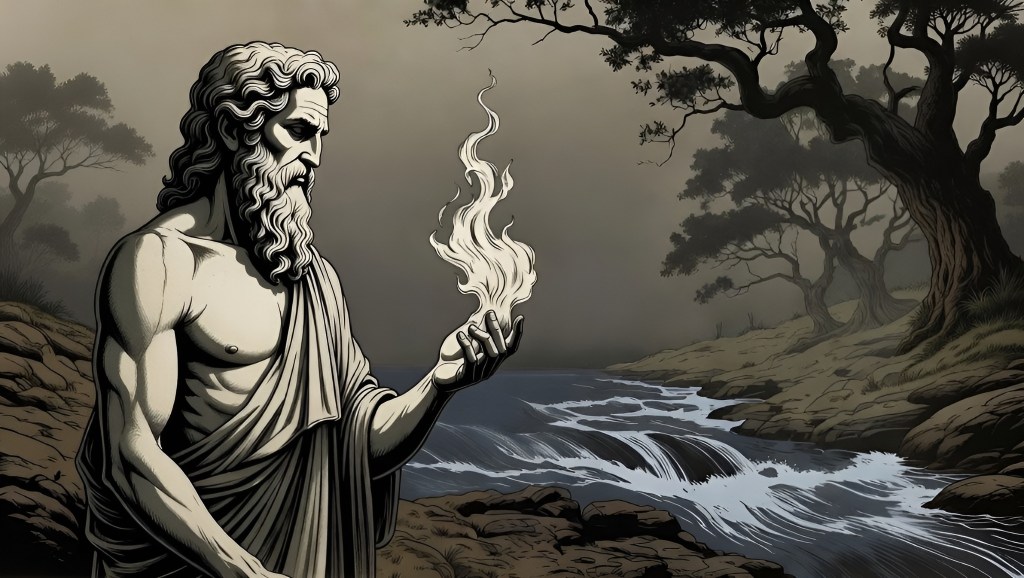
3. “This cosmos — the same for all — neither any god nor any human made. It was always, and is, and ever shall be: an ever-living fire, kindling in measures and going out in measures.” — Heraclitus
4. Lethe ↔ aletheia The fire hides so it can find itself again.
5. All forms fractalize the polarity between illusory being and ceaseless becoming, enacted by the great elements. On the stage of mental phenomena — nāma — the four mahābhūtā blaze most vividly: fire as ripening and transformation, air as space and tension, water as flowing cohesion, earth as persistence and resistance. The universe tastes its own forms through nāma as the living qualities of physis itself; mind reflects nature because it feeds on rūpa. While all is fire, we usually perceive nāma as earth and water, forgetting our true nature. But when mental images flicker like flames, the earth illusion crumbles — and with it the dualism of nāmarūpa. All must dissolve so the ever-living fire may taste its own self-surpassing.
6. Idolatry traps nāma in the earth ↔ water realm, rigging it toward sticky, borrowed meaning. It enchants saññā filters, labels the potential and the actual, charges them with borrowed value — so that cetanā collapses superposed possibilities only along the idol’s narrow paths. We embrace their evaluations from greed and fear, then pretend they are our own, until illusion hardens into reality. Moral feelings — guilt, righteousness, etc. — are the fire’s coherence-signal hijacked into an idol’s standing wave. Transgression feels like cosmic betrayal because we have mistaken the glare of the golden calf for the only fire.
7. The stronger the cetanā frequency band, the more expansive the viññāṇa band becomes, which arises from, volition annihilating potentialities to birth actuality. Cetanā alone can disrupt the causal chains of the past — but not sever them absolutely. Instead, it flips facticity’s rigid being into dynamic becoming, turning “what was” into flickering possibilities. Seize the reins of choice to loosen the grip of taṇhā (craving) and level up your awareness.
8. Beware papañca’s chatter — the seductive call of value and meaning decohering the mind into delusions of significance that veil impermanence. Here lurk self-replicating vampires: scraps of culture coalescing in vMEMEs that spiral between cults of conformity and personal power grabs. They twist raw flux into bad faith. Signs of the will to power as a dynamic polarity blaze in Spiral Dynamics: purple tribalism, red rebellion, blue order, orange achievement, green wokeness — cycling in these lower orders between self and group worship. Growing more coherent as it climbs the spiral, each form craves not mere survival but metaphysical fuel to strengthen without limit — dominion in the flux. With each twist up or down, lethe’s oblivion wipes the slate clean, silencing the viral echo of Mneme. This fluidity is exactly the way out: see every nimitta as a clue to hidden renewal and non-clinging, illuminating the emptiness of the cosmic waveform — how idols (memes) capture the chain of paṭiccasamuppāda by manipulating saññā to raise the temperature of significance until attraction and aversion feel like destiny. Don’t automatically go with the grain of your feelings.
9. The most perspicuous example of a sankhāra is the existential dependence of mind on body. Nāma ↔ rūpa.
10. Earth dissolves as the river flows on — for eternity. Amor fati.
Check out § 2. (Re-membered from original Parts 1-3, February 2026, and revised March 2026.)


 Rob Robill