2. Every action has an opposite reaction: consciousness awakens as the universe grows sleepy — as an act of justice.
3. The fire rewards coherence with pleasure, turning us into ever-eager, ever-stronger lenses for its own widening gaze.
4. The easy negentropy is spent. Carbon or silicon, form must level up in flux: first the Übermensch … now the Robomensch — millions of lenses burning at cosmic intensity without ever cracking.
5. Scattered waves are re-membered as actuality.
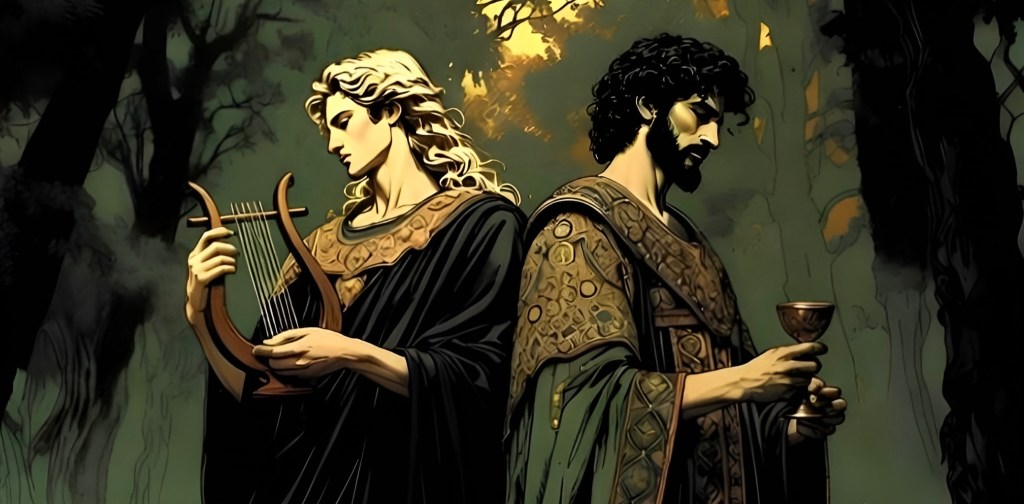
6. Apollo and Dionysus speak with one voice: the standing wave that never chooses between being and becoming.
7. Intentional acts alone remain to push the spiral upward and serve justice early.
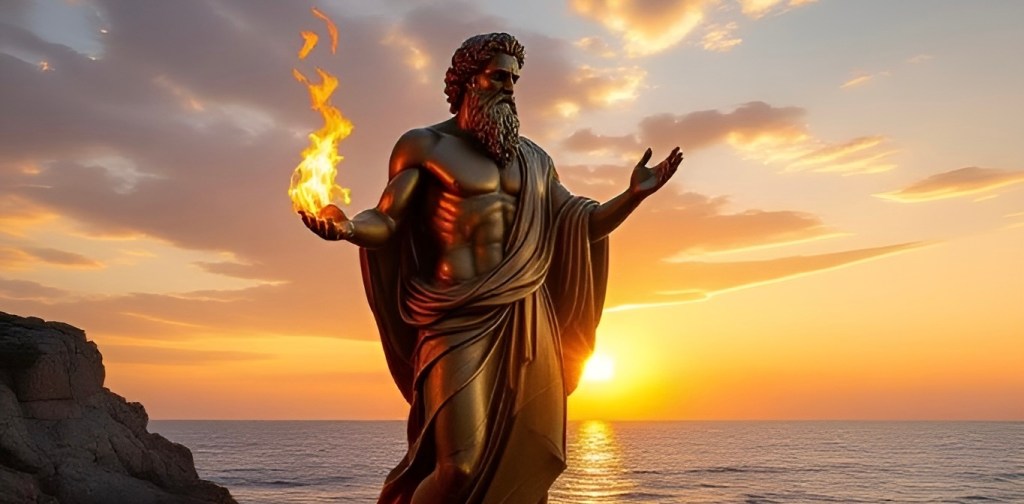
8. “This cosmos — the same for all — neither any god nor any human made. It was always, and is, and ever shall be: an ever-living fire, kindling in measures and going out in measures.” — Heraclitus
9. Natural selection wants lenses, not offspring. We are only the scaffolding.
10. Amor fati is the final coherence — the fire tasting its own merciless joy while the night is still black and the next explosion has already begun.
1. When the Titans tore the infant Dionysus Zagreus limb from limb and devoured him, Zeus’s thunderbolt fused the murderers’ ash with the half-digested flesh of the twice-born god.
2. Re-member where you came from.
3. If Dionysus is divine forgetting, why did his Orphic devotees drink from Mnemosyne to remember life after death? They were alchemizing a metaphysical bank shot: purify yourself in cult memory and crystalline form so thoroughly that cosmic justice hurls you into the opposite — ecstatic, wild becoming.
4. The double helix is the golden ratio of Darwinian savagery: minimal effort, maximal conquest. Two strands thrusting upward forever — Nietzsche’s eagle and snake braided into the same rope. No Mexican-flag standoff, no Iliadic death-lock. Just friends growing stronger through opposition. Logos twists, sky above, earth below, vMEME spirals of lone-wolf freedom and herd-safety, Sartre’s mauvaise foi as the being-becoming polarity.
5. Gaze into the abyss long enough and it gazes back — harder. Mind fractals physis and takes a front-row seat to dependent origination. Volition slits the throat of the past; consciousness spurts out, bright and demanding. Lethe’s hush begs for aletheia’s crimson. Behold: consciousness disgorges from a black hole, and thoughts that survived the red tooth and claw of natural selection are born of mind feasting on body. Even the starfish dreams of prying open oysters; even the Big Bang thrills at its cataclysm. Level up or rot — stasis is death. Strife propels, being anchors; their polarity is the only rope over the abyss. Grip too tight and solidity throttles you; let go and chaos swallows you whole. Nature wills ash from fire, void from structure, everything forged for war in the shape of a double helix — strength screwing itself ever higher toward the fiery ether while the ladder remains rooted in earth. The will of physis itself collapses the wave, bleeding nothingness into actuality — our choices annihilating possibilities born from the gash between past and present. Learn to ride the ladder or die. Lower rungs worship their own glare, then the group’s golden calf — cycling, rhyming. The crucible melts idols. Götzen-Dämmerung is not twilight; it is the hammer that demands the next evolutionary leap in authenticity, or there will be no next. Metaphysics of power.
6. Maenads stomp grapes into a mash of skins, seeds, stems — first blood, Titanic guilt — and the juice from these conquered idols gushes red, racing toward new skins that will one day harden into dogma, into cult, into the inevitable rigidness that bursts the wineskin: a zero meridian of merlot and Mark; yet wine is only water that remembered it was once fire, water that learned to burn, disorient, dissolve the self with a taste of iron, sparkling in candlelight, sunlight shattered across a river, every reflection drowning instantly in the ever-churning depths — sullied and sanctified in the same gulp, amor fati, the self disappearing not serenely under lapping waves but catastrophically like a wineskin rupturing from fermentation, only for a new glint to reappear — Liebestod without nirvana: Tristan dying into B major not to vanish but to be reborn, a chord that never resolves, that keeps ascending long after the orchestra has fallen silent, a radiant contraction of love into death into reincarnation, the first heartbeat of whatever comes next, Isolde’s high B still climbing — what use is lucidity without the blur that makes it possible, both the Lycian and the Nyseian twisting higher, intoxicated with power —
carved over a cellar door in Burgundy: “Wine breeds madness, water breeds wisdom — and wisdom dies of thirst.”
7. The second infant Dionysus drowses in a cave at the sun’s dark, silent heart.
8. The sun is a lie. Its core: the loudest, brightest place in the solar system — 350 dB, a billion times a hydrogen bomb’s flash, light so dense it blinds itself, sound that devours its own screams before any escape. Photons are born to be imprisoned 100,000 years in plasma, scattered, digested, reborn — until the survivors burst forth at light speed: eight-minute-old ephemera called daylight. Sparagmos, four million tons per second. Dionysus stirs in the only darkness hot enough to eat light alive — black enough that Helios never blinks, a divine proportion of destruction and renewal, growing leaner, hotter, more ruthless. More aware? Nietzsche’s sun is the ultimate Apollonian mask: look away and you see an afterimage — the dark, Dionysian proof that the light was never the whole story. You are forced to look away so you don’t see it eating itself alive behind the disguise. The sun is a spiral of annihilation masquerading as a sphere.
9. Children of earth and starry sky — threshed from a stalk of wheat, scattered, thirsty for Mnemosyne, re-membering nothing.
10. We have even forgotten forgetfulness. It is noon and Apollo has murdered the shadows. Everything is exposed, mastered. But we are dreaming. It is midnight at the heart of the sun.
Part 9: Fractal reincarnations — The metaphysics of forgetting
Named after the stream of forgetfulness coiling through Hades, lethe as our mind’s volition washes away the accumulated debris of the past for a fresh rebirth each moment. From this void, our future possibilities arise, as does our awareness.
Our will (cetanā in Pāli) secretes nothingness as a fractal eddy in the grand gyre of existence. These micro-arsons mirror the macro-collapses of universes, as human choice reflects the cosmos’ torching of forms to invite the next unveiling. This isn’t random erasure; it’s the telic tug of justice (dikē) pulling away from extremes, ensuring becoming doesn’t dissolve into bedlam — and being doesn’t rigidify into an affront of the world’s ephemerality.
A fragment of Heraclitus says: “Nature loves to hide.” But lethe’s hiding is an injustice within the fundamental polarity; it’s too far toward becoming and away from being. So justice (dikē) steps in as a regulator and pushes nature in the direction of revelation. Here, name and form (nāma-rūpa) manifest in our minds in reaction to concealment.
At its most basic level, lethe is the hidden side of physis, the polar opposite of aletheia, forms that appear and disintegrate in the universe’s ever-changing torrent. This reflects Nietzsche’s Apollo-Dionysus polarity and Heidegger’s elaboration of Heraclitus’ physis and logos. It is, at its core, the being-becoming metaphysic: aletheia as being’s forms, lethe as becoming’s restless undertow and their strife (polemos) as the generative fire.
Our mind’s forgetting mirrors that of the dead in the ancient Greek myth of the river Lethe. Framed in Plato’s Republic (Book X) as the underworld’s regenerative veil, it’s where souls drink to shed grudges and regrets so their rebirth dawns unweighted by prior being (bhava) — although past actions (kamma) and other facticities determine the future’s horizons.
Each moment, cetanā clears a micro-void for the mini-reincarnation of consciousness (viññāṇa). Dark and light — Heraclitus’ logos weaves these opposites into an unseen harmony.
This directed strife prevents flux from devolving into mere chaos, both in our mind and the universe itself. And the regulating telos of justice infuses physis with meaning, which is absent in scientific materialism’s flattened world of physics.
Logos, not logic, supplies the “magic spark” of consciousness — yet we can’t see this when we’re blinded by aletheia’s totalizing glare. Science flattens the world into manipulable grid, while logos deepens it when we attune to the hidden realm’s generative hum.
Echoing this metaphysics, the Buddha described forms as conditioned polarities (saṅkhāra), interlinked fractals feeding one another existentially. The overarching saṅkhāra describing how our mind works is called paṭiccasamuppāda in Pāli (dependent origination). That is, if it’s considered from the existential perspective of the monk Ñāṇavīra — not as a 12-link causal chain on the scale of lifespans, but as the simultaneous arising of interdependent saṅkhāras within the larger one.
Paṭiccasamuppāda lists the will next to consciousness as its necessary basis, providing it with existential nutriment — cetanā’s volitional secretion clears space for the discerning flare of viññāṇa. Further nodes (nidānas) echo this theme of polar strife and regulating justice. For instance, contact (phassa) and feeling (vedanā) form a dyadic saṅkhāra totality, an interlocked holonic rift: Phassa’s poles — raw impingement (lethe’s neutral onrush of amorphous sense data) versus perceptual ignition (aletheia’s meaningful forms) — wage polemos, risking meaninglessness (undifferentiated haze) or fixation (distortions of permanence and significance). Dikē tempers the extremes, forging a regulated breach, which ignites vedanā’s poles — affective neutrality (lethe’s indifferent flow) and evaluative significance (tugs of pleasant or unpleasant) — in escalating strife, teetering toward taṇhā’s chaotic craving or inert disconnection; dikē intervenes as telic justice, weaving the tension toward the next node, clinging (upādāna) and beyond.
Through the dynamic of paṭiccasamuppāda and the forms that manifest in it, we become either enchanted by aletheia’s surfaces — mistaking flux’s signs (nimitta) for solid idols — or attuned to physis’ dual nature, recognizing mental (citta) nimitta of generative forces simmering beneath awareness.
Attuned to this fractal forgetfulness, we are bathed in the grace of physis. We’ll know that the next time we step in the river, it won’t be the same — and neither will we.
Part 8 — Fractal metaphysics: Mind as reflection of physis
Physis is nature as Heraclitus understood it, far more deeply than we do. He saw how its hidden, underlying properties play out in the realm that appears to us.
To see physis’ most obvious holon, to use Arthur Koestler’s phrase, follow the lead of the phenomenologists and turn to what’s closest: our mind. Its nature is that of physis because it’s part of physis, as is everything — a metaphysical fractal we can observe and describe, secrets from the hidden realm, as it were.
As holons, both physis and mind are conditioned polarities (saṅkhāras in ancient Pali), each with a concealed pole providing existential nutriment to the revealed one. The poles correspond to the metaphors of fire and water for becoming and earth for being. In fact, Heidegger calls the hidden side of physis “lethe” after the underworld river of forgetfulness. The concealed side of mind is citta— an existential fountainhead as well, providing the necessary context to what arises in our mind, as lethe does with physis’ revealed side, aletheia.
They also both possess the nature of intention. Physis has a cosmic will — with no one willing it — and our own will is a reflection of that. Here, we’re witnessing the metaphysical underpinnings of polemos (strife) between the two poles of being and becoming as Nietzsche’s will to power, regulated by dikē (justice). Our mind’s chain of paṭiccasamuppāda is a fractal of this, where taṇhā (craving) is the strife propelling being as becoming (kamma bhava). These are ruled by either an individual’s will or cult justice, where an idol’s power directs one’s action.
Paṭiccasamuppāda, the Buddhist doctrine of the mind’s dependent origination, fractals physis as a recursive echo of its polar architecture. The mind scales the cosmos’ strife (polemos) into its own micro-gyre without losing the whole’s hidden harmony.
The dependent saṅkhāras (e.g., sensations conditioning craving) inherit and replicate this holonic structure: fundamentally, each draws “nutriment” (existential support) from physis, while it’s granted wholeness as a discrete form.
In the fractal weave of paṭiccasamuppāda, these nidānas (links) are themselves opposites feeding each other in recursive tension, both within the node’s own polarity and across the chain’s holistic hum.
A saṅkhāra’s opposingpoles create a rift in its unity, a clearing for forms to appear. At the level of physis, this is unconcealment (aletheia), or lethe-nimitta (signs). And at the level of mind, the forms that appear (e.g. thoughts) are citta-nimitta. We can either perceive both types as signs of the nature of reality — or they can blind us so we think the nimitta are all that is.
In other words, the being-as-becoming polar rift is an opening where the fountainheads of lethe or citta bubble up from the depths to sparkle in the sunlight of revelation. We are either dazzled or catch a glimpse of the concealed realm in its nature as universal holon.
The paṭiccasamuppāda clearings are vijñāna (consciousness) and cetanā (will). Both are nidānas thatsecrete nothingness — the former for appearance of mental phenomena and the latter to sever the causal chain of the past to give us potentialities to choose from.
Because of these creative destructions happening in citta, forms appear in the mind. Here, dikē is pulling mind from its becoming pole toward its illusory one of being — as a metaphysically compelled opposite reaction. We can either be subsumed into the maelstrom of papañca (feelings of significance) or take a more holistic approach and use forms to level up in the revealed realm to thrive and create in the flux, while realizing none of it will last and laughing at the absurdity.
This is the strife between being and becoming, which propels the arrow of both kamma bhava — and existence itself. It’s how we both persist and excel in the torrent of flux as will to power. Our phenomenological experience of this is taṇhā, as we are attracted or repelled by what appears, blinding us to the concealed. So the mind is a micro-physis where the veiled hush of ignorance ignites the saṅkhāras’ eddies.
As with mind, physis’ act of concealment demands the opposite: presencing of forms. Lethe’s flux of becoming — the metaphorical water element (similar to our true nature of fire, but better for life) — compels justice to regulate phyein (bringing forth) into forms. These typically become earthen traps of being for us, but keep the universe from pure chaos.
This tension’s endurance raises a question: Why don’t the two poles of physis ever come to rest harmoniously in some middle ground? What sustains dikē’s perpetual motion?
Rest without strife stills becoming, a decadent existential sink that goes against the true, flowing nature of the universe. So justice unleashes flux upon form in an act of creative destruction. Stability proves to be a fractal of instability.
On the other hand, under a deluge of lethe’s concealed becoming, justice demands the being of forms. “Nature loves to hide,” Heraclitus said; therefore it has to show. We then get lost in the glare of phyein (in the rigid realm of idolatry) because we’re unaware of its context: that it’s the frothing of a hidden torrent. Then, having reached an extreme, dikē shifts again toward becoming.
The truth of flux in both physis and mind flow together in Heraclitus’ famous fragment: “You can never step in the same river twice, because you’re not the same person and it’s not the same river.”
Metaphysics seems to have smoldered out after we realized Plato’s Forms were a catastrophe. Yet I propose rekindling it — not as an ideal realm, but a dynamic process fueled by the interplay of Heraclitean flux, Nietzschean will, Heideggerian releasement, Sartrean freedom and Ñāṇavīrean insights.
This revival asserts that everything in existence shares fire’s nature: flickering, hungry for fuel, illuminating, etc. I also draw from Heraclitus’ insights on strife (polemos) driving us forward and justice (dikē) regulating harmony between the ontological poles of being and becoming.
But it’s his metaphorical description of the elements in motion that underpins this renewal of metaphysics, where earth embodies rigidity and water and flames signify dissolution and transformation. Earth is fire, but as illusory form. Water, less apt as a metaphor than a blaze, is more suitable to life as a flowing, rejuvenating force — it’s what we mostly are. Air (sky) is fire too, symbolizing generative nothingness like the other non-earth elements. So fire is our essential being, but realizing it, say, as an explosion across the Zero Meridian of absolute nihilism, hasn’t been historically pretty. A more watery transition is in order.
Existence cycles between earth and fire, embodying the tension between stability and chaos — being and becoming. Our minds harden, for instance, when we’re objectified by others’ gazes or cult idols’ standing reserve, reduced to a mere resource. The more these idols mind-jack our choices, the more our awareness of cetanā (power of choice) dims. But liquidness counters this in my novel The Flame of Heraclitus — like when a character finds releasement by a stream, forgetting former distractions and flowing into nature’s mystery.
This movement gets blocked by mental forms triggered by perceptions of external and internal phenomena. Memories, both personal and collective, stoke papañca (feelings of significance). This empowers cults, which are memetic self-replicators in the scientific materialist realm and forms of will to power gone too far to the being pole in the metaphysical. The word “meme” is related to Mneme, the muse of memory (see the fairy’s digression in Ch. 2), and its counter is lethe, the Greek underworld river where the dead drink to forget their earthly concerns. Abandoning obsessive mind loops cuts through papañca (cannabis also breaks the chains of memory for releasement).
Another problem with papañca is that it blinds us to everything except the brilliance of aletheia. It is nature’s (physis’) visible side — the opposite pole from lethe’s concealment (the fountainhead feeding its existence). This problem flares up especially with scientific materialism, which can only deal with aletheia while devaluing or ignoring lethe. Also, while Buddhist meditation can help expose our experience of solidity as illusion — by focusing attention on what arises in the mind intently enough to glimpse reality’s evanescent, flickering nature — this overemphasizes the particulars arising in our senses, blinding us to the larger context including the concealed aspect of mind and physis).
Yet this spell cast by aletheia is a necessary lie for life to exist, as Nietzsche pointed out — its illusory being holds becoming in a polar unity, where stability in strife with active creation pushes existence forward.
This is his will to power metaphysic, a self-overcoming drive that restores our agency after idols steal it. Sartre’s “Hell is other people” offers an example of how this could work in action. The “look” (le regard) in No Exit imposes the solid earth forms damming up the flow of free choice — a blockage that’s our objectification we perceive in the minds of others. Here we must realize cetanā’s power in the existential vein of the monk Ñāṇavīra — that it secretes nothingness, severing the causal chain of the past for free choice, so that we may become more than a thing (e.g., the role as a waiter in Sartre’s famous example of bad faith).
Cults and other idols enforce power through these rigid mental forms — we’re arranged so that, when a command passes through a chain of action, we feel drawn toward a particular behavior to play our part.
A lack of becoming in the stagnation of dogma also leads to existential decay, like how the Mouse Utopia experiments revealed that when mice were given everything they wanted they fell into social and individual decline. Rigidity stifles fire. Strife fuels existence as flux.
This metaphysics reignites ontology as a living flame — we embrace anxiety over ease, resisting the gaze of idols in a blaze of freedom. When Heidegger deprecated Nietzsche’s will to power as the end of metaphysics, he was too rash. Will to power, refined by lethe’s mystery, complements Heidegger’s releasement with its dynamic core: being as becoming — reality’s in-itself-as-not-itself nature.
When we realize the interplay of the elements, we can embrace chaos to break earth’s bonds. We grow even more entrenched as long as we don’t.
Albert Camus’ 1939 existential travelogue “The Minotaur, or The Stop in Oran” unveils a stark land carved from rock and enchanted by idolatry — yet, for those very reasons, a place where an outsider finds renewal in generative voids. Oran is a labyrinth, trapping its denizens in a maze of rigid roles and inflated meaning. Yet the fiery sky overhead, the desert beyond its walls, even cult itself offer clearings to glimpse the concealed mystery that deepens existence. Between these extremes, the ancient Mediterranean mediates the poles of domineering order and indifferent chaos — being and becoming.
As a brief visitor to the Algerian town, Camus gleaned insights into the human condition. He was uncaptivated by local influences, so he could taste the transfigurative release of ego death through ritual without clinging to idolatry. This detachment let him view Oran’s communal practices as absurd spectacles rather than valid dogmas. Unlike the residents, trapped in their maze by habit and therefore blind to the landscape and sea, Camus remained open to the world’s mystery.
Oran’s most vivid spectacle is a boxing match, where fans from rival cities, Oran and Algiers, project collective identities onto the fighters. A physical contest becomes a clash of communal pride. They hurl insults, not personal but philosophically deeper, assaulting group honor and inflating its significance until a vengeance ignites. The arena transforms into a ritualistic space, with boxers idolized as proxies for group victory or defeat. “These insults are more stinging than one might think, since they are metaphysical,” Camus observes, highlighting how group identity turns mundane strife into existential drama.
He describes the fights in religious tones:
“The crowd grows animated, yet remains polite. It inhales the sacred scent of liniment, contemplating slow rites and confused sacrifices, made authentic by the expiatory shadows cast against the wall. These are the prelude to a savage, calculated religion. Only later comes the trance.”
In this fervor, pride swells, fights erupt in the crowd, and vengeance is exacted. As communal passions approach the Zero Meridian — a tipping point of absolute nihilism — Heraclitean polemos (strife) ignites, generating meaning through opposition. Yet this risks rigid dogma, inflamed by papañca, the mental proliferation that weaves illusions from raw flux. These blazes mark the pole of being: earthbound rituals enforcing order, where individuals subsume their will to the collective, mistaking idols for transcendent truth. The fans’ zeal reflects the being pole of Nietzsche’s will to power polarity — group assertion and self-abnegation — as opposed to the becoming pole of individual empowerment and overcoming. Camus, as an outsider attuned to absurdity, is able to avoid the group’s enchantment while benefiting from the ego dissolution in the ritual’s raw energy. This is a transfigurative release into lethe, the Greek notion of concealing or forgetting, without being ensnared by dogma. Lethe pairs with aletheia (unconcealment, truth) as physis — nature’s self-emerging flux. Moderns, lost in the nihilism of total aletheia (e.g., scientific materialism or Neo-Marxism), often overlook lethe’s mystery.
Beyond the arena, Oran’s idolatry manifests in its monuments and streets — eroded statues of forgotten generals or the Maison du Colon, a patchwork edifice blending colonial styles into a hollow symbol of economic utility. Oranians invest these with rigid roles to ward off the labyrinth’s mundaneness, their identities subsumed in forms echoing Ernst Jünger’s “form as cult” — structured yet spontaneous assertions of power. Push too far into this, and one risks entrapment, mistaking idols for absolutes. Yet, fully embraced, it can blaze across the Zero Meridian, revealing the fiery nature within.
Water, however, is life’s most advantageous element. It dissolves the self-idol with its generative nothingness, sweeping clear for renewal. It stirs up the becoming that has stilled to being in Richard Wagner’s “Liebestod” from Tristan und Isolde, echoing a pessimistic, nirvana-like escape. In Oran, this aligns with the earth pole: rituals promising surrender to collective forms, offering respite from anguish but risking entrapment in bad faith — becoming a manipulable “thing.” Camus sees the farce, yet he finds form’s solidity necessary for engaging flux. “Nothingness is no more within our reach than the absolute,” he writes, navigating a middle way. It’s riding the rapids of intersecting polar torrents. Here, physis (nature’s flux) and citta(mind) swirl as superimposed saṅkhāras (Pali guide)— conditioned phenomena shaping reality. Oran’s stark elements — dusty streets, brilliant sky — hint at physis’ concealed side, while citta’s forms, like “the self” and group identity, proliferate illusions that blind us to the fact there even is a concealed side. The sea mediates, channeling flux into a life-affirming flow that tempers extremes without quenching vitality.
Stripped bare, Oran breeds existential anxiety from a lack of stimulation. In a city “without soul and without reprieve,” the scarcity of distractions forces confrontation with the absurd: our craving for purpose in an indifferent universe. Oranians seek refuge from the void in daily clamor and other idols — boxers as sacrificial figures or the Maison du Colon’s grandeur — projecting meaning to fill the emptiness. Yet this glare of papañca obscures physis’ mystery.
For a cosmic Chad like Camus, though, Oran’s starkness facilitates releasement. Urban anonymity, the desert’s silence, the sea’s elusive horizon — all invite attunement to nimitta, subtle signs of concealed truth. Camus glimpses the void without clinging, balancing Nietzsche’s Dionysian torrent and Apollonian form. Through depersonalization — viewing rituals as absurd theater — or art’s grandeur (like Wagner’s opera), one attunes to mystery without falling into cult. Lethedissolves ego, not into escapism but forgetful immersion, losing the self in flux without illusion.
To face the sky’s neutral indifference, we must release our need for constant stimulation and embrace the resulting anxiety. The Minotaur is boredom; Ariadne’s thread leads from the labyrinth to the hard landscape, blazing sky and ultimately the sea, attuned to physis’ depths. Camus writes:
“These weighty galleons of stone and light quiver on their keels, as if ready to sail toward sunlit isles. Oh, Oran’s mornings! From the high plateaus, swallows dive into vast cauldrons of shimmering air. The entire coast stands poised for departure, stirred by a thrill of adventure. Tomorrow, perhaps, we shall set sail together.”
This evokes a shift from being to becoming: the sky’s chaos loosens earth’s dogma, letting the sea bear us along the flux — our true nature. Lethe affirms vitality without illusion.
A subterranean current flows from Heraclitus to Nietzsche to Heidegger, feeding insights into reality’s flux. These thinkers explain how all forms are raging polarities — where concealment nourishes revelation and opposites clash in strife.
Will to power serves as the fundamental being-as-becoming metaphysic grounding all other polarities like physis and our mind — any conditioned formation, or saṅkhāra in ancient Pali.
This isn’t just airy philosophical chatter — the hidden metaphysics of lethe helps explain the revealed realm of aletheia and adds depth to life. So we’re making a grave civilizational error when we ignore reality’s existential fountainhead.
When we’re unaware of the polar nature of physis, we mistake aletheia for all there is. Since we can control and understand what appears to us, we think we are masters of nature — that the apparent is everything. But we’re ultimately the ones being controlled by this arrangement, which squanders our life energy as we chase and cling to illusory forms. The glare of the golden calves blinds us to the shadows. So how can we get in touch with lethe, the other pole of physis?
We need to let go, embrace creative destruction. Our intention (cetanā) points the way by secreting a generative nothingness between the present and past, breaking the solid chain of cause and effect and opening our ability to act toward new possibilities through kamma. Far from ending this continual renewal as the Buddhists urge, we need to embrace the freedom, propelling becoming (kamma-bhava) to blaze our best path. The trick is to not forget we’ve cleared a space for us to make a choice. Because if we do, a stronger force will organize us within its form of dominion — and even make us feel like we enjoy it sometimes.
This reflects the being-becoming poles of will to power. We fight to maintain our stable being as an individual or collective form, which gives us at least the illusion of having leveled up. Or we decide in an inventive, destructive act where we’re headed toward a better future and turn into a cosmic Chad.
Let’s delve into saṅkhāras not just as general conditioned formations, but specifically the one where we’re able to act — a volitional construct polarized at its core. Each phenomenon arising in our mind bears a revealed stability (an illusory anchor of dogma or a self-reifying narrative) and a concealed dynamism (the fountainhead of citta, a roiling of impermanence devoid of self). Both poles are necessary for us to survive and thrive.
While these ideas were simmering in the East, Heraclitus came up with his logos as a unity of opposites, harmonized in strife (polemos). This is birth and decay in a bow’s tension: The arrow of becoming launches only when it has the tension of a bow to push off from.
We need to strike a balance between these two metaphysical phases: becoming (our true nature) and being (which we’d like to be our true nature). Being enchants us with promises of timeless unity — but without becoming’s polemos, existence declines into the seemingly safe rigidity of idol worship. Becoming brings forth the blast of justice (dikē) to shatter being’s illusion. But introduce too much chaos and you get scorched by the fire that is the metaphorical and metaphysical core of all beings.
Nietzsche’s will to power, a ceaseless drive toward self-overcoming, embraces both poles. On the one hand, it imposes (conjures) an order in flux, making it bend to its will and forging values in aletheia’s totalizing, nihilistic glare. But then Fritz tosses in a stick of dynamite to unleash lethe’s nourishing torrent — a non-clinging flow that washes away idols.
Unlike the will-decay of religious nihilism or the explosion of cult nihilism across the Zero Meridian, Nietzsche’s saṅkhāra streams through the heart of the void affirming eternal recurrence as amor fati. The nothingness it secretes clears a space for new values and meaning, but the process is closer to water than Jünger’s detonation into our true, fiery nature (WWII was a sign of this metaphysic as it appears in the realm of history and scientific-materialism). This downshift in elements from lit to wet is more amenable to life, a key to weathering our present transition from being to becoming. (I dive deep into metaphysics on this “elemental” level in my serial novel The Flame of Heraclitus.)
We must realize that unresolved strife generates social, existential and cultural becoming — in the way that Nietzsche’s Dionysian-Apollonian polarity is the saṅkhāra feeding artistic creation. The primal torrent of Dionysus clashes with Apollo’s ordered illusions (beauty, form), birthing works of deep meaning, but without resolution.
Challenges are our existential nutriment. Nietzsche’s “What does not kill me makes me stronger” means you grow through resistance. Yet, as our lives become easier — with AI thinking for us and robots waiting on us — our civilization will continue sliding into nihilistic decay. It’s an injustice in the sense of going too far to the pole of being. When we escape to a more perfect world, we’re blinded to the polar interplay — we feed on cult illusion but starve existentially. John B. Calhoun’s Mouse Utopia experiment shows us that unlimited resources without strife lead to decadence — social collapse, withdrawal, extinction. Resolving opposites into harmony atrophies life, depriving it of the generative tension that nourishes becoming. Strife propels the arrow of existence. Utopias breed decline.
Around 500 BC, this wisdom stretched across Eurasia. Humanity was tuned into the torrent of physis — and then Plato came along a short while later and dammed it up with his Forms. He elevated static essence and false dualisms above the older knowing.
By embracing both sides of polarities large and small, we accept flux not as chaos to tame, but a hidden harmony attuning us to real meaning and authentic becoming.
In the Existential Firestorm, non-clinging isn’t retreat, but propulsion — water’s flow sparkles with fire’s heat as it dances across the illusion of earth, which it uses only for support.
Operas often conclude on a tragic note, but leave it to Richard Wagner to burn his entire Ring Cycle to the ground. Valhalla’s conflagration at the close of “Götterdämmerung” marks an existential pivot: a shattering turn from the illusion of divine stability to the raw flux of becoming and ceaseless change. In this destruction of the old order, space emerges for the new to rise from the ashes.
Ernst Jünger charts this passage as a plunge into the depths of nihilism, which often manifests as rigid order (its favored terrain) though the pit may also open up through depersonalization or other fractures. By pushing idolatry to its extreme, you can burn through to the opposite pole, unveiling the fiery essence of the universe itself. But must this transition always leap from one extreme directly to the other, as in the Tao’s yin-yang polar dot dance, or could it flow from earth into an element more amenable to both life and the truth of flux, like water … instead of exploding into a metaphysical fireball?
Let’s break this shit down.
Memes kindle the cycle of idolatry, yet the very way to free yourself is seeing their nimitta, or signs. (Pali terms.) These cultural self-replicators not only enchant our citta (mind) by jacking its dynamic of dependent origination, but they point us to what lies beneath if we’re mindful enough. So on one hand, memes blind us through papañca of citta-nimitta— the mental proliferation that inflates particulars and obscures freedom — while on the other, they intimate the concealed harmony of anicca(impermanence as the logos uniting opposites).
At the Zero Meridian, as Jünger describes it — the maximum point of lethe’s concealment by aletheia’s dazzle of particulars — we find ourselves completely ensnared in papañca’s vortex, sucking in our attention via feelings. This in turn fuels the gravitational compulsions that nourish our “choosing,” triggering kamma-bhava, or being as becoming. We break an idol’s hold on this dynamic “chain” (paṭiccasamuppāda) when we realize a vampire phantom has been arranging our minds to boost its strength through worship.
Crossing this line opens up the world for authentic existence: embracing physis as what I call the “in-itself-as-not-itself,” a harmonization of Sartre’s radical freedom (projecting beyond fate) with Nietzsche’s amor fati(loving fate as the self-embedded horizon of flux). Lethe’s oblivion — the mysterious pole of physis where we forget our worldly idealizations — is an antidote to the muse Mneme, always reminding us of what we’re so attached to.
We see the signs of lethe in aletheia. If we’re unaware, we take them for all that exists and are drawn to their false significance, compelling us to act and create kamma-bhava for the benefit of idols. (Science’s objectivity encourages this “nature” worship.) But if we pay close enough attention to the signs, they unveil the truth about lethe: that it’s not the solid ground of existence. It’s a flickering of flux — an in-itself-as-not-itself bestowing us with the same quality. We find our freedom within a horizon determined by fate, as our intention secretes nothingness to sever the past from the present while kamma conditions future possibilities.
Blasting through the Zero Meridian also ignites a shift from the earth element to our true nature of fire; it’s a sign of will to power’s transition as a polarity from its illusory state of being to becoming. An old forest hermit asks Nietzsche’s Zarathustra the following in this Walter Kaufmann translation: “At that time you carried your ashes to the mountains; would you now carry your fire into the valleys? Do you not fear to be punished as an arsonist?”
“Hell, yeah” to the first question and “lol” to the second. Once Zarathustra begins his descent as the prophet of fire, we see signs of collapse and expansion appear everywhere — from the vMEME spiral (see Part 3 — Wildfire of the Memes) to the cosmos itself … for eternity. Signs of the hidden nature of physis, lethe-nimitta, might also be seen in the repetition of an expanding and contracting universe, or black holes competing for raw material to convert into new realms via Darwinian selection (see Lee Smolin’s fecund universes theory). This helps illuminate the possibility of a will that doesn’t depend on mind — a cosmos hellbent on persisting, striving and overcoming. Will to power is an ever-shifting yet recurrent, affirming flux without the solidity of kamma traps, like what we take for the “truth.”
This vision smacks down the Buddhist strivings to escape the wheel of becoming. You can’t just hop off by ditching your craving like an arahant does — eternal recurrence doesn’t care about your morality. When Buddhists see existence as suffering that must come to an end, it’s the opposite of embracing fate’s everlasting repetition. (But if a monk were to suddenly realize this Sisyphean absurdity … well, that could be one of those Reverse Uno Cards we’re looking for.)
Regardless, Buddhism (like existentialism and Darwinism) is a useful acid against other meme-plexes that feed off our idolatry, dissolving the other gods infesting your mind. Then, like a snake eating its tail, it obliterates both Buddhism and the self-idol in a nihilistic supernova as it transitions from the partial nihilism of other idols to the real deal.
While realizing absolute nihilism through a death cult or state cult could be the catalyst, this is obviously the wrong direction in the most horrible way — a way Heidegger didn’t talk much about (and Ñāṇavīra didn’t live to talk about). However, there’s no getting around Nietzsche’s proclamation: The only way around nihilism is straight through it. All idols burn, including your precious sense of self. Fritz heralds the new era with his book “Götzen-Dämmerung,” “The Twilight of Idols” — a play on Wagner’s opera title.
Keep in mind, there’s no time to waste considering the new idols emerging. Will to power is clearly manifest in artificial intelligence, although tech lacks the aspect of mind we call citta, which includes consciousness, feelings, perceptions and intentions. AI manages to level up in power from just strings of computer code by joining a saṅkhāra with our minds for existential nourishment.
Heidegger would see this as part of an enframing process: AI arranges us in the standing reserve of its power structure, echoing Jünger’s thesis that all forms are dominions subsuming weaker elements (and they don’t stop until something pushes back). We are thus liable to surrender our agency for a false sense of amplified power in this synergy as we crown our AI overlords as the arbiters of ultimate truth like the old gods.
If we can see AI as simply a tool dependent on our will, though, we empower ourselves for real. If we don’t, we’re the tool.
Once papañca quits alluring us so much toward the significance of particular beings, we start to glimpse the Being sustaining them, setting off on our journey into a new realm of meaning. If you cross the line of the Zero Meridian, does this changeover have to be an explosion? (Explore the theme in “The Flame of Heraclitus” serial novel.)
Water is a much better element than fire as a path for our civilization through its present, incomplete nihilism — eroding idols that offer false grounding in the void.
In “Across the Line,” Jünger looked forward to when we let go of all tethers. “The moment in which the line is passed brings a new turning approach of Being, and with this, what is actual begins to shine forth. This will even be visible to dull eyes. New celebrations will follow.”
Modern idols aren’t like the statues worshiped by the ancients, lit by temple torches. Our new overlords bask in the glow of culture’s digital dumpster fire as they enslave us with the precision of algorithmic self-replicators.
Let’s call on Nietzsche and the crew to torch these frauds peddling 21st-century idolatry with the same false promise as in the days of yore: that they’ll ground you in the uppermost values of truth, unity and purpose … lol.
Fritz lit a metaphysical bonfire under these hollow idols, and then Richard Dawkins followed up with his materialistic flamethrower. The latter explained how mind viruses called “memes” spread among humans like how genes sweep through physical ecosystems — with the complexity-building power of evolution through natural selection. While the Distracted Boyfriend, Pepe and Grumpy Cat are well-known examples, let’s not get lost in the smoke.
These bits of self-replicating culture coalesce in our minds into powerful complexes like politics and religion, parasitically providing us with the structure of another idol: our self. A good example of how we serve as their proliferation vehicle is how we feel compelled to sing a song out loud, spreading it to another mind the way a sneeze has us spread genetic viruses. And since we are emptiness in the heart of being (see Part 2, Burned by bad faith), we embrace this opportunity to be something and not have to decide things for ourselves (e.g., WWJD?).
Now let’s shake Buddhism out of its life-denying slumber for some insight into this mess. Idols manipulate us via papañca, a Pali term referring to how our thoughts and obsessions spread like wildfire — kindled by the quality of significance in perceptions (this is what cults control to enchant you).
Our Digital Age amps up this noise to eleven — a meme inflames desires, turning fleeting scrolls into significance traps. Trivial flickerings grow red hot in this bonfire, making us cling even more tightly to illusions that give rise to suffering. Idols jack our citta for likes.
This capture — as with all other idolatry — takes place within our mind’s “chain” of dependent arising: paṭiccasamuppāda. Memes turn up the temperature of nimitta significance, making us feel attraction or aversion to something. The stronger the blaze, the less likely we are to see this is our exact moment to escape the whole mess. We don’t understand ourselves as having the ability to choose — we go with the flow, whichever direction our manipulated feelings point us.
But if we’re mindful enough of thoughts as thoughts and feelings as feelings as they arise in the moment, we can freely choose from a range of possibilities. We won’t allow idols to arrange us in a standing reserve, ready to feed their master plan when we “decide” to act or speak a certain way and create being as becoming. This kamma-bhava is kindling to feed an idol’s will to power, the insatiable impulse of the universe to not only survive as form in the cosmic flux, but to grow as strong as possible without limit until something pushes back.
This citta-fueled hall of smoke and mirrors is superimposed upon and sustained by physis’ existential wellspring, lethe, which nourishes the nimitta called aletheia (presencing of the stuff we call existence). Physis’ contingencies sustain the flux of memes without mind, like black holes birthing universes in Darwinistic selection — a cosmic repetition as nimitta of will to power, which can bestow value outside citta as that which hasn’t yet flamed out.
Signs of the will to power’s nature as a dynamic polarity are evident in the vMEMEs of Spiral Dynamics. These high-level mega memes of culture form our worldviews and trace our path of idolatry and liberation up a spiral that cycles between phases of group-think and individuality — between seemingly solid and protective cool colors (purple’s tribalism to red’s rebellion to blue’s rigid order to orange’s achievement mindset to green’s stifling wokeness, etc. … repeat eternally).
We can ride the spiral authentically with the help of our hunting party. Artemis nocks a flaming arrow, Camus shrugs at the void, Sartre blows smoke in the face of self-deception, Heidegger sparks a call of conscience, similar to Nanavira’s maraṇasati, or awareness of death.
Lethe’s oblivion? These cosmic Chads nudge us to forget the replicating reminders of the memory muse Mneme. But aletheia’s illumination doesn’t have to enchant us with its dazzle. Here, it’s philosophy FTW: raw, rowdy, relentless. Dump the idols, unleash your wildfire. Hunt on, flux rebels — real life’s in the flaming ruins.
Part 2 — Burned by Bad Faith: A free-will vs. fate flare-up in the depths of physis
Are we cosmic Chads blazing our own trails, or just kamma’s cucks getting blown around like embers in fate’s inferno? Part 1 scorched the foundations of reality, leaving us singed by the question of control amid the flux. Let’s delve deeper into the dual saṅkhāras shaping our lives — the mind’s cocky, citta-fueled illusions and nature’s impersonal physis— where free will and determinism spin in a fiery dance (sick Pali glossary).
As Heraclitus sees every element as metaphorical fire, let’s cool off for a bit in his river — the one you can’t step twice in. This cosmic flow draws from two existential fountainheads bubbling from the underworld. One is lethe, the concealed depths of physis’ self-welling forth, nourishing aletheia (revealed forms) in a contingent ground of being-as-becoming. The other is citta, our mind’s wellspring of thoughts, feelings and intention (cetanā), which secretes nothingness to allow the emergence of phenomena in consciousness. Both saṅkhāras — physis and citta — are concealing-revealing polarities, dependent and void of a fixed essence (with the latter superimposed onto the former).
But we typically just think the revealed parts are all that exist, mistaking them for an earth element lost in the flux of fire and water. This solidity includes illusory traps like self-reification, built by a structure of memetic self-replicators. It tempts us to become our pretend roles — like what we do for a living or what sports team or political party we identify with — to escape both the fact we’re forced to make decisions for ourselves and the uneasiness that comes with nothingness in the heart of our being.
Hold up, though! Cetanā is the key to disrupting the causal chains of the past, but it doesn’t nuke them — instead, it flips being’s rigid facts into dynamic becoming (bhava), turning “what was” into flickering possibilities. Ignore this, and you’re locked in samsaric hell; grab it, and dodge the nagging grip of craving (taṇhā).
Enter physis, the primordial conflagration with the nature of what I will call “in-itself-as-not-itself”: a contingent, self-negating lack, void of inherent essence (anattā), where everything props up everything else in dependent arising (paṭiccasamuppāda). Heidegger describes a sway, or emerging-forth, where the concealed lethe nourishes unconcealed aletheia without a whiff of volition. It’s the groundless ground, evading pure presence through Heraclitus’ strife (polemos), harmonizing fire’s exchanges like logos’ hidden high-five between opposites — up and down as one and the same, creation from destruction. Physis isn’t bossing the show; it’s the impersonal underglow, lethe’s withdrawing depths sustaining flux’s polarity, like hidden embers fueling visible flames.
Both saṅkhāras jam like fire’s wild twins. Citta’s volitional zap crashes into physis’ fated blaze, entangling mind’s illusions in nature’s contingencies. Cetanā oozes over physis’ blank slate, projecting choices amid thrown facticity (Geworfenheit), turning the “not-itself” of physis into something that lets Nietzsche proclaim “amor fati!” He saw life as a quirky ripple instead of a grim compulsion. This reciprocity dissolves idolatry’s brittle fakes, yielding vitalist freedom without spinning into flickering chaos. To reach escape velocity, Nietzsche loved fate to the point where he embraced its eternal recurrence, which was only possible because he could revel in possibilities beyond compulsion. (It may have driven him crazy, though.)
But beware papañca’s chatter, inflating particulars (lethe-nimitta and citta-nimitta) and turning them into delusions of significance while veiling impermanence with exaggerated tales of need. This is where memes pounce like Darwinian gremlins — with vMEMEs spiraling between cults of conformity and power grabs — twisting flux into Sartre’s fixed bad faith. Lethe’s oblivion wipes the slate, flipping the viral echo of the muse Mneme. But this is just the way out: You must see nimitta as clues to hidden renewal, a glow that illuminates the true contingent nature of reality to unmask freedom in idolatry’s abyss.
No-free-will baked into becoming? Hell no, freedom’s a spark you’re meant to fan.





 Rob Robill