The Flame of Heraclitus: Part 1 is now out in paperback & Kindle—fairy chaos, clashing cults and utopian ruins ignite.
Part 2 chapters get lit monthly starting March 1—stay tuned!
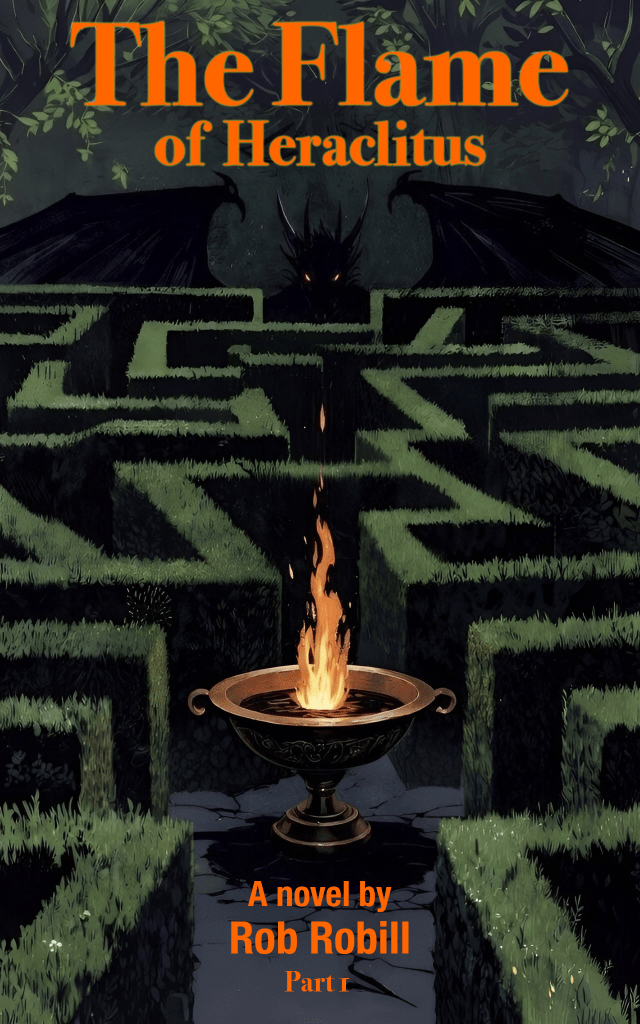
The Flame of Heraclitus & Existential Firestorm: Metaphysics Gets Lit
The Flame of Heraclitus: Part 1 is now out in paperback & Kindle—fairy chaos, clashing cults and utopian ruins ignite.
Part 2 chapters get lit monthly starting March 1—stay tuned!
Part 1 of The Flame of Heraclitus serial novel is now on Kindle! An irreverent ancient fairy guards Heraclitus’ eternal flame in the ruins of New Harmony’s utopian dream — protected by a no-nonsense Greek goddess and her reluctant water nymph. Chaos ignites as clashing cults awaken long-forgotten horrors.
Stay tuned for Part 2 🔥
— Rob Robill, Heraclitean Press
“Sacrificial animals view sacrifice differently than the spectators — but they’re never allowed to have their say.”
— Friedrich Nietzsche
Timed to the drumbeats of Slayer’s “Angel of Death,” a series of rapid explosions accompanied the singer’s introductory scream.
This cover song collaboration between the school’s chemists and musicians for Club Showcase Day had been fractious ever since a beaker was thrown during a planning session. The natural clash of attitudes between math and metal quickly accelerated into a tit-for-tat vendetta culminating with an act not unlike attempted murder.
During the actual performance, the singer managed to survive the blasts angled toward the back of her head only because she’d ducked at the last second to avoid a moth with a foot-long wingspan headed toward the part of the pyrotechnic display that had already started.
The wings of the Atlas moth ignited, and the insect trailed smoke along a parabolic path up toward the auditorium’s rafters and down into a display of papier-mâché Atalan giants (a project between the Seance and Art clubs).
Typical school day, thought Phiale, scaling the sheer face of folded-up bleachers the Athletic Club had converted into a rock climbing wall in partnership with the Philosophy Club. The most shocking part of the scene for her was that an Emergency Preparedness Club member had presence of mind enough to grab a fire extinguisher and snuff out the towering effigy of King Aranuk.
“Looks like you’re off the hook this time, Splashy,” Belle said from her Thinker’s Perch overhead. The display encouraged students to climb a “mountain” to receive advice from the guru at the top. “I’m not sure ‘Breathing Fire into School Engagement: Together’ was a great showcase theme for these freaks.”
After reaching the top, Phiale sat next to the fairy and watched Mr. Owen break up a scuffle between a group of Skippers and Dabblers.
“Come to think of it,” said the Philosophy Club’s guest thinker, “it would’ve been better if the Atalan display had gone up in flames — to demonstrate destruction as a necessary part of the historical-metaphysical cycle.”
“I’m more worried about getting the smoke smell out of my uniform. Today isn’t helping … but at least the school year’s over.”
Ignoring her, Belle continued, “It’s always the same: Grow successful, feel safe, get soft, lose your edge, fall into decadence, offend the gods, get smote, claw your way back up in a changed form, repeat.” She shook a can labeled “tips” at Phiale and raised an eyebrow.
“Sorry, spent all my money on this.” She pulled out a keychain with a pentagram made from sword blades and the word “Slayer.”
“That’s wicked,” Belle said.
“I thought so.”
“So’s that.” She pointed to the Butterfly and Science Club exhibit, “Like Moths to a Flame,” which included a photo booth. “Look what they’ve done to that girl.” Windi was getting her picture taken in front of a background with two large moth wings on fire.
“Ah, just in time,” Belle said as the next philosopher — a monistic eternalist — showed up to relieve her. The newcomer was in tears because Showcase Day had descended into disorder, but felt compelled to report to her shift on time. “Parmenides was a fool!” the fairy told the Novitiate as she and Phiale climbed down the bleachers.
After weaving through the melee, which had drawn in family members picking up their daughters for summer break, Phiale stood before the ghastly moth display. A large cage with its door ajar (Belle’s spooky action from a distance) sat atop another enclosure, which featured a lit Bunsen burner and cloud of fluttering moths. A carpet of crispy ones lay below it. A poster explained: “The moon and stars seem to determine a moth’s navigation. It will mistake a flame for a distant star, messing up its angle and sending it into a death spiral.”
Also, Windi was gone.
Next to the photo booth hung a board of Polaroids. Phiale found Windi’s, a silver pin stuck between her protruding eyes, above a stupid grin. Someone had scrawled: “The Holy Spirit descends tonight — congrats, you two!”
***
Phiale leaned back in a wobbly, iron chair that night and watched a rivulet of melting ice cream trickle over her half-eaten piece of Rapple Pie. Whether it was her nerves or its name, she’d lost her appetite.
It was closing time at the pie shop, and the lady behind the counter glared through the window at the last customers lingering at the sidewalk tables.
“I’m sure her parents just picked her up,” Di said. “They were probably in a hurry to leave after the clubs went berserk. She didn’t have time to say goodbye.”
“Windi would’ve said goodbye,” Thalia pulled a cigarette from her art deco handbag. “You don’t like her anyway — what do you care.”
The girl ran a match across a strip of rust along the edge of the table. It flared in the dim light. She touched it to the end of the cigarette and took a long drag.
“The hell?” Di said. Belle laughed.
To Phiale, Thalia’s new habit was one more thing that seemed off about the girl lately — she’d been more outgoing, too … just plain weirder in general.
“I’m sorry, Moon-Crowned Queen,” Thalia said. “It calms me. Finals week and everything … the opera singer, now Windi’s missing — it doesn’t stop.”
“I actually feel more calm with her gone,” Di interjected. “We had a hell of a time winching that boat she sank out of the river, by the way.”
Thalia cupped her ear. “What did you say? Protector of the Young. I didn’t quite catch that.”
Phiale cleared her throat. “I got lucky and didn’t have to take any finals because I transferred so late. I’m glad too. I was worried about trying to make sense of Mr. Owen’s class. It’s hard to keep Atalans and Atlanteans and all that straight.”
“I’m surprised you dipshits learn anything at that place,” Di said and launched a brown stream of saliva over the curb onto Main Street.
Dipshits … thought Phiale. Lip shits … Lipchitz … wait, that’s it — Lipchitz! “I know where they’re taking Windi!”
***
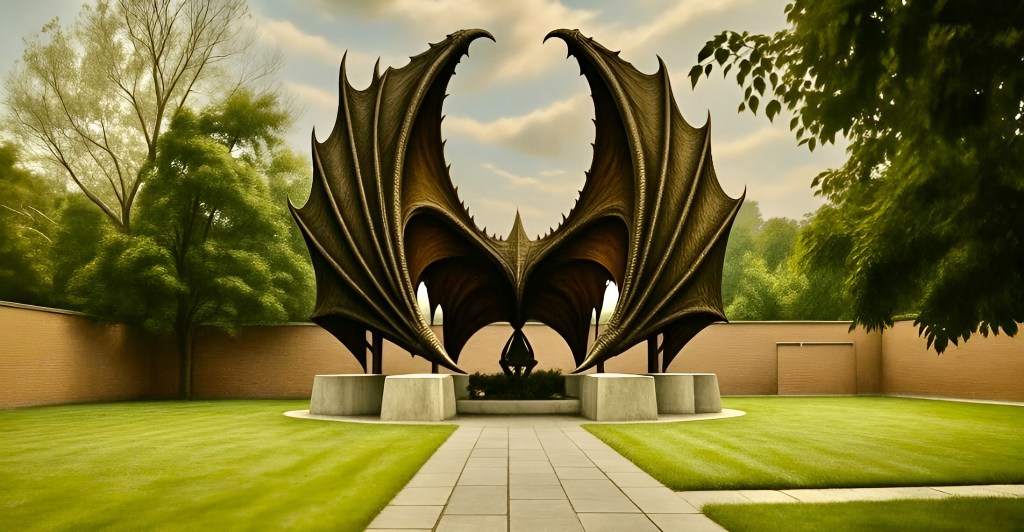
Inside the Roofless Church, a baldachin resembling a 60-foot Pac-Man ghost with cedar shingles covered a bronze sculpture called The Descent of the Holy Spirit. The piece of Lipchitz depicted a bird diving beak-first into the Virgin Mary while she gave birth (hard to see at first but impossible to unsee).
It was almost 11, and a deep hush shrouded the town as Phiale peered past the threshold to the Roofless Church. She froze in horror.
The Descent had been twisted to the side, exposing a hole. On its low, limestone plinth lay Windi with a wedding veil and cardboard butterfly wings spread out behind her.
Six girls in cloaks surrounded her holding LED candles. Tendrils of river fog rolled through six large rectangular cut-outs in the far wall, curling around floodlit statues of humans torn to fragments.
A taller figure, also robed, emerged from the opening where the statue had sat. With a German accent and end-of-the-world urgency, he said, “Consumed by the Spirit, the ugly caterpillar does not die. It is transformed into a beautiful Schmetterling.” He opened a Bible and placed his finger on a passage. “Unless a grain falls into the ground and dies, it remains alone; but if it dies, it produces much grain.”
The Butterfly Club began chanting, their voices reverberating in the baldachin to create a monstrous standing wave that resonated out across the corn fields and entrained the biophotons of new sprouts, now swaying under the downbeats of the leathery wings. The dragon was on his way. Their voices pleased him. Like a dinner bell.
One of the members held a knife over Windi, poured honey across its wide blade and drizzled it onto her chest. The girl’s head lolled to one side.
Phiale started through the gate, but Belle grabbed her and picked up a golden raintree stick. She used it to materialize silver bows and arrows for Di and Phiale before transforming into Tinker Bell.
The fairy darting overhead, they strode into the church with Thalia staying back in the shadows. Gabriel descended toward the profane altar.
Their arms blurred from speed, Di and Phiale let loose a fusillade that twinkled through the night sky like shards of ice — only to ping off the dragon’s scales instead of piercing them. Phiale’s thoughts raced to The Hobbit. Maybe it’s missing a scale. That was her only hope at the moment.
Tinker Bell deployed a defensive dome over herself and the archers just before Gabriel belched a column of fire. The fairy strained to support such a wide field of protection. “I don’t suppose you two would mind getting a little closer together!” She laughed, but without humor.
Phiale felt a wave of panic when she realized for the first time Tinker Bell probably didn’t have control of the situation. Smoke from the conflagration raging above her curled around the fairy’s shield. It smelled like rotten eggs and seemed to affect her mind — the grass blades below licked at the rancid air like a million tongues … the sky pulsed up and down like it was breathing. Is that thing trying to get me high?
Meanwhile, Rapp led his Butterfly Club down the hole under the statue, which swung back into place once they were all down. Thalia darted toward Windi. “Get back!” Di yelled.
The fairy broke the shield as Gabriel, hovering 50 feet overhead, sucked in a deep breath for another blast. She circled with her stick, and a rending noise tore through the church — the baldachin broke free of its stone blocks and rose into the air spinning, faster, whirring deeply like a bull roarer. Windows rattled across town.
With a scream, she sent it smashing into the dragon’s chest, knocking it clean over the Wabash in a fiery arc.
Then all fell silent, except for barking dogs and car alarms. Tinker Bell slumped, bobbing in mid-air. She dropped her wand. Di had almost reached Windi, who Thalia was shaking, telling her to wake up, when Phiale felt a looming, violent rip in the fog — claws and wings tearing at the night in pain and rage, swooping into the church exposed to the heavens. Gabriel plucked up Tinker Bell and flew away just over the treetops, struggling to stay airborne.
Di fell to her knees. Animals of all kinds howled in unison. A cypress grove groaned 30 miles to the south. The moon turned blood red.
End of Part 1, which is now lit on Kindle and in paperback. Check out Chapter 11, or catch up with the Prologue.
“Tradition is not the worship of ashes, but the preservation of fire.”
— Gustav Mahler

“Plants are called ‘emergent’ when they break the water’s surface,” Mrs. Owen explained to her Elementary Biology class. “Local examples include yellow water buttercups, named Ranunculus flabellaris by professor Rafinesque. They bloom this time of year in Maple Run, bearing yellow flowers that display radial symmetry — Clara! Quit staring out the window and explain to the class what radial symmetry is.”
“Eh … it’s when they broadcast jazz from the graveyard?”
“You either need to clean your ears or —” Mrs. Owen slapped the girl’s desk with a blackboard pointer three times: “Pay! Better! Attention!”
“Lord, I need a coffin nail,” Clara said under her breath as the teacher walked away.
Viv leaned over from the next row and whispered, “Don’t let that Trotsky get to you.” She held up a pack of Marlboros. “For after class. Mild as May.”
Clara’s eyes, already large behind the thick lenses of her round, tortoiseshell glasses, bugged further at the sight.
Viv turned to Doris behind her. “I’ve got enough if you want one too. I’m dying to show y’all something.”
“And how!” I’m actually going to inhale this time, thought Doris, who’d transferred to the school a few months earlier and was eager to make friends.
So they puffed the last class of the day away on a lawn along the east bank of the Wabash while Viv filled them in on the craziest thing Doris had ever heard. Supposedly, the ghost of Rafinesque, via a Ouija board owned by Occult Club Dabbler Velma, informed Viv of a treasure map concealed behind his portrait in the school’s main hallway.
“Why are you hanging around Velma — that vamp’s got freaky raccoon eyes,” Clara said, giving Viv a death stare.
“What difference does it make,” Viv said, pulling an old sheet of rag paper from her beaded purse. “What matters is the map was there. We’re going to get rich — and it’s going to keep that racist bank from taking pa’s repair shop.”
“I heard the town wants to turn it back into an opera house,” Clara said.
“Opera is dead.”
As if to prove her wrong, a voice from beyond a bend in the river floated toward the girls: a tenor singing the “Recondita armonia” (hidden harmony) aria from Puccini’s Tosca. A tall man in his 40s with thick eyebrows, a thin mustache and slicked-back hair came into view propelling a jon boat with a long pole. Dripping freshwater mussel cages were scattered across the deck. “Ciao, my name is Giovanni,” he said to the girls, tipping his boater hat as he drifted past. “It is nice to meet you, belle ragazze.”
“Don’t care … at all,” Viv muttered.
Doris smiled and waved, picturing herself reclining in the punt, gliding downstream as an Italian man serenaded her.
“Do you have a singing part in the play, Viv?” Clara asked.
“No, all the roles are speaking except a chorus that ‘provides narrative context’ — is how Rosabel put it. My Lord, she’s aggravating.” Viv, who sang in a church choir, preferred musicals but had been talked into her current role as Ethiopian princess Worknesh Zewditi because of her own African ancestry. “You know she’s convinced the seniors to install the eternal flame from the play in the middle of the labyrinth as their class project — just to honor that Greek guy nobody’s heard of before.”
“We’re arranging plants around it in the Flower Club,” Doris said. “Reds and yellows like marigolds and poppies — and hummingbird vines to grow up the columns … Rosabel said they taste good, anyway.”
“Taste good? … wait, you’re in the Flower Club?” Clara asked. “I thought you were in the play.”
“Yeah, Cynthia said I’d make a perfect temple nymph, so I’m doing both.”
“That lady’s off her cob,” Clara said. “Anyway, they shouldn’t let somebody from outside the school run the Theater Club. She’s a bit rough — and couldn’t pull any of it off anyway without Rosabel’s help.”
“Shut your Skipper mouth,” Viv snapped and took a long drag off her Marlboro, sending a plume of smoke toward the heavens. “Cynthia’s divine.”
* * *
Doris tipped a jug of water over the hands of an Ephesian lawmaker standing at a basin. The worshiper then dried her hands on her tunic and scowled at another girl representing an old man with a long gray beard rolling bones across the stage floor, surrounded by urchins.
“Look at that fool! I’m busy making laws all day while Heraclitus wastes his time playing games in the hallowed temple of Artemis.”
“Snake eyes!” shouted the philosopher.
“’Tis an affront to the almighty goddess,” princess Zewditi said snootily as she waited in line for cleansing, reeking of cigarettes and holding a goat’s leash.
“Maa,” exclaimed the animal, seemingly in agreement.
“Sweet Zeus!” Rosabel shouted from offstage. “You’ve got a she-goat in the cleansing line and you’re the one shaming someone for sacrilege? The sacrifice line is over there!”
Rosabel buried her pixie-like face in her palm and shook her head. “We’re only two days from the premiere — we can’t still be making mistakes like that.” (She wasn’t even officially in the Theater Club, and no one had ever seen her in class for that matter.)
“Also, princess, you’re supposed to deliver that line with ambiguity — a little breathless … like he’s being a naughty boy,” the fairy continued. “You’re his metaphorical ‘flame,’ after all.”
The philosopher winked at Viv, and her face contorted in disgust.
“How about we come back to this scene later?” Rosabel suggested. “Let’s go straight to the end.” Sitting in the shadows by the chorus, Cynthia shrugged.
“Great! Slaves, roll in the flame!” Using ropes tied to a wheeled pallet, a group of girls dressed in rags pulled The Flame of Heraclitus onstage with an acetylene tank in tow. “No … over there, underneath the fairy. Perfect. Just make sure you don’t turn the … ”
A match flared. A slave grinned. A gas valve had been left too wide open. The actress playing the fairy, dangling over the stage by a rope, was mostly out of the ensuing blast zone, though, except for the long swallowtails of her gauzy dress.
“ … fire up too high.”
Doris grabbed her jug and tossed a plume of water toward the flames as they climbed the fabric … not quite hard enough, or in the right direction — but the stream changed course and found enough extra momentum to drench its target. Did I do that? she thought.
A slave managed to cut the flame down to only two feet. “I’m OK — you don’t have to let me down,” the girl on the rope said. “Let’s get through this.”
Rosabel told the dangling fairy that she admired her spirit, addressing her with the character’s actual Atlantean name, with all of its related drama. “You make me proud of myself.”
“Rose! Quit spitting everywhere, and let’s get going,” said Cynthia, her eyes narrowed and glinting silver.
“Yes, a rose! But this one makes no loogie!” exclaimed the Italian boatman from earlier, holding up a single red blossom. “Ciao, Signorina!”
“Oh, no,” Cynthia muttered. “That freak gives me the heebie-jeebies.” Then addressing the sudden visitor, she said sternly: “Like I told you before — buzz off!”
He looked crushed. “One day, you are chasing after me — after my river gold, sinceramente.” He held up a hand, bringing his fingers together pointed upward, and shook it — then he tossed the flower to the floor and stormed out.
“What’s that about ‘river gold,’ Cynthia,” Viv asked nervously. “Cynthia?”
“No idea.” The woman rose from her stool, standing just over six feet tall, and clapped her hands. “To your places — Herostratus! Flame Keeper!”
With the lingering odor of melted tulle and clams in the air, the crew lowered a painted backdrop depicting a large temple chamber. The Flame Keeper took her place in a parlor chair with red cushions next to the fire and a stack of scrolls on a pedestal. Then she touched her head and looked up. “She’s dripping on me … and my seat’s wet.”
“Stick to your lines,” Rosabel commanded.
“Sorry!” said the Flame Keeper — then to Herostratus: “Why are you carrying a torch. Is The Flame of Heraclitus not bright enough to illuminate the temple?”
Sporting a large, fake cheek scar, Herostratus limped back and forth holding a small bundle of sticks with orange tissue paper glued to the top. “I will need no one else’s light soon enough — my own will burn brightly for generations.”
“I know not of what you speak. You’re a nobody. Heraclitus’ flame still burns brightly because he described the true nature of things, which is fire.”
“But how quickly could the light from the Book of Heraclitus be extinguished — by fire, of all things?” Herostratus waved the torch toward the scrolls. The Flame Keeper gasped.
“What’s to stop me from destroying them along with everything else mighty Artemis holds dear in this temple while she’s off playing midwife in Macedon. Behold, as I turn the twilight of the gods into the noontide sun!” Herostratus waved the torch near the flame bowl. “If I drop this into the pit of Greek fire feeding The Flame of Heraclitus, how long do you think I’d remain a nobody?”
The Flame Keeper screamed and ran.
“Remember the name Herostratus!” He tossed in the torch and raised his arms in triumph as two rows of flame bearers ran across the front of the stage, shaking sheets of red chiffon from wooden rods.
The fairy was lowered over the scrolls but she couldn’t grab them in the conflagration. She wailed and shook her fists at the Fates.
The chorus sang: “’Tis lost to flames for good — the book with all the truth.” They too wept loudly.
Cynthia also teared up.
“Here, cheer up, have a Moon Pie,” Rosabel said, handing her one. “Destruction is a necessary part of the cycle of history.”
The fairy was about to take the thread into the metaphysical realm when a girl threw open the auditorium doors from the outside and yelled, “Somebody help! A goat’s jumped a greaser!”
***
Each year as school came to an end, the Occult Club performed a ritualistic summoning of Pan — it was fun and, depending on what pictures they’d seen of the god, seemed a bit naughty. But it had never actually worked … until that evening.
The faun was already lurking in the shadows, in full stalking mode because Artemis and one of her nymphs were nearby. His long ears were pinned back in anger as he peered through a row of bushes near prostrate Owls in dark purple cloaks. He’d seen the boatman greet the nymph and two other girls earlier on the riverbank — then, from the wooded fringes of campus, he witnessed the foreigner sneak into the school conservatory, steal a rose and enter a wooden building where the goddess and nymph were performing some kind of fire ritual from the homeland. (He learned the last part from a goat in a pen next to the structure; from what he could gather, it had been forced to take part in a series of mock sacrifices.)
***
Doris followed the group of actors and stagehands to the lawn beside the auditorium, where the faun had Giovanni pressed to the ground with his goat legs while raining down blows with human fists.
From nowhere, a creature resembling a butterfly appeared in front of his face, its arms crossed and eyes shooting 3,000-year-old daggers. Pan leapt from his victim and his hooves dug into the turf as he sprung back into the woods.
Giovanni managed to stand on his own, rubbing his battered face with trembling hands. He looked around at the girls, some dressed in hooded robes and others in Greek tunics. “Stay back, witches,” he said, making horns with his forefinger and pinky. Then he turned and ran toward the river.
* * *
From the “Sour Grapes” column of the New Harmony Grapevine, May 15, 1925:
The ‘Shame’ of Heraclitus: NHGA play torches good taste
“The Flame of Heraclitus” is set in the Greek colony of Ionia along the coast of what is now called Turkey, which is apt. But to call this production of the New Harmony Girls Academy a “turkey” would be unfair to both the new nation and bird. Never in this town’s increasingly disreputable history has there been such a demonstration of godless despair, moral depravity and reckless use of fire.
“Baloney … we turned the flame down,” said Viv, starting to fold back up the Grapevine she’d laid out on the lunch table.
“Wait,” said Doris, grabbing the paper and tapping the Sour Grape below the review.
It read:
Local goose lays golden ‘egg’
Aesop, who is said to have lived on an island near Heraclitus in time and space, described a goose that laid golden eggs. Last Wednesday, local farm girl Bridget Meir found a bead of pure gold in a dropping left by one of her geese along the riverbank near the confluence of Maple Run. When asked if she plans to keep an eye to the ground for more golden guano or go ahead and cut open her feathered friend to see if there’s treasure inside, it seems she’s learned something from the Greeks: “No way I’d kill such a talented bird,” Meir proclaimed.
“Looks like we need to pay a visit to the Meir farm,” Viv said.
The following Friday, the Grapevine ran this story across its banner:
GOOSE GIRL GONE; FOWL PLAY SUSPECTED
NEW HARMONY, Ind.–May 22, 1925—Is 15-year-old farm girl BridgetMeir sending police on a wild goose chase, or did something more sinister happen Tuesday along the banks of the Wabash?
The afternoon started innocently enough. Picture the bucolic scene: Meir whistling sweetly to gather her flock of geese for a short walk to the river where they swim and graze. Her calls also seem to have drawn four girls she’d never met, looking smart in clean academy uniforms — unexpected barnyard visitors who later admitted they weren’t there to make friends; instead, they’d read last week’s Sour Grape on Meir finding an ‘egg’ made of gold.
“None of us saw her get snatched, so this is just speculation,” said Rosabel Neverland, the apparent leader of this gang of Goldbug Girls, “but I’d bet a hundred drachmas the Goat Man snatched her. Why, just the other day we saw it assault an immigrant on school grounds.”
Police Chief William Owen confirmed rumors that a cult ritual involving goats may have gotten out of hand at the academy earlier this month. But no report was taken, and school administrators declined to comment. (See last week’s Sour Grape on their recent Greek tragedy — in the sense of a tragic lack of value or meaning.)
“A girl is missing,” added Chief Owen. “This is a serious incident, and it’s not helpful to get distracted about some fairytale creature. One of the girls at the scene mentioned seeing a large black snake with a strange marking, but there’s nothing like that around here big enough to drag off what’s basically a grown woman.”
While the Goldbug Girls supposedly didn’t see Meir’s supposed abduction, they were close enough to hear a scream. When they went to see what was wrong, they found two dead geese stomped flat in a depression resembling the print of an enormous beast and ten live ones flapping around hissing and honking. White feathers littered the mud like dogwood petals after a storm.
“We’d left her by the riverbank because the geese were starting to bite us … I guess they were nervous about something,” Neverland said. “She had a long stick she used to keep them together, but she wouldn’t beat them with it like I begged her to.”
Chief Owen hasn’t ruled out any suspects, and he ordered the Goldbug Girls to remain in New Harmony after the school year ends because of the investigation.
The events of Tuesday leave us with a series of questions lacking easy answers. Is New Harmony now New Klondike? Did the Goat Man make off with the Goose Girl? And is there any hope for the Flapper Generation?
Part 1 of The Flame of Heraclitus is now lit on Kindle and in paperback. Check out Chapter 10, or catch up with the Prologue.
“The eyes of that species of extinct giants, whose bones fill the mounds of America, have gazed on Niagara, as ours do now.”
— Abraham Lincoln, on a visit to the famous falls

“Guten Morgen, Angels!” began the morning announcements — so loudly Phiale jumped in her seat. Ms. Owen set down the chalk she was using to explain meiosis, sighed and waited for his ranting to cease.
Rapp’s pronouncements included a reminder for his Butterfly Club members to get permission slips signed to remain at school through the Festival of Knowledge. “Remember to tell your parents that your room and board will be paid for through the generosity of the Hoosier Friends of Lepidopterology.” (No such group existed.) “Additionally, students going on this morning’s field trip with Mr. Owen’s so-called History class are to board the bus in front of school at the end of first period. I pray for your souls. And finally, Skipper Windi and Violet Phiale are to report to my office — und mach schnell.”
Windi was already sitting in one of two uncomfortable, wooden chairs facing Rapp’s mission-style desk by the time Phiale got there. Other than a large wooden cross hanging behind the principal, the walls were bare and white. A stack of herpetology and angelology books sat on his desk next to a framed embroidery quote: “I am a prophet, and I am called to be one.”
He noticed Phiale reading it as she sat down (there wasn’t anything else to look at). “Back in Deutschland, I — no, mein ancestor — was jailed for uttering that obvious truth in 1791. We had to flee the Fatherland, you see.”
“Eh …” said Phiale. Windi trembled beside her, the Skipper’s face paler than usual.
A grandfather clock ticked.
“Yes, well … while you girls were tending that butterfly trap last night, did either of you see anything unusual … maybe wander off into the woods?”
Chimes marked another quarter hour closer to the end.
“The only weird thing was the sky lighting up — huge flames down by the river,” Phiale said as she’d rehearsed.
“That seems to be a theme with you. Anyhow, Windi, did you happen to go off by yourself and see something you weren’t supposed to see yet? I can’t imagine you’d want to jeopardize your place in the initiation rite … or worse: participate in a way you wouldn’t enjoy.”
“N-no. We were both at the garden the whole time. Just hanging out and talking after it got dark.” Belle had (somewhat) filled her in on what was happening (while for some reason calling her Clara). The explanation did nothing to ease Windi’s feeling that reality was spinning away from her — beginning with the moment she fell into the abyss of the goat man’s gaze. She’d told Phiale how it left her feeling detached, like everything was happening on a movie screen.
Rapp stared coldly at Windi, twisting his beard hairs. “You will remain a Skipper until you’ve proven yourself worthy. I trust you’re clear on Operation Tiger Lily.” He side-eyed Phiale. “Of course that’s no business of outsiders.”
Windi nodded obediently. Then, as the girls were getting up to leave, the school secretary rushed in. “Sorry to interrupt, but a Smithsonian Institution agent is on the phone demanding to speak with the principal. I told her you’re in a meeting, but she doesn’t care … she used the F-word.”
* * *
The Angel Mounds State Historic Site has two main buildings connected by a glass walkway, both resembling earthen platform pyramids — one a gift shop (the only way in and out) and the other an interpretive center.
“What’s the deal with all the Abe Lincoln stuff?” Phiale asked, squeezing a stress ball of his bust she’d picked up from a display as they made their way through the shop.
“He used to live 30 miles from here when he was a teenager,” Windi said.
“And they call me a know-it-all,” Belle chimed in. The fact she was there at all was a testament to her FOMO over seeing what the Seance Club had planned. The barrier supposedly keeping her in New Harmony was that she lost her magic when she was away. This leads to a range of troubles — from spell casting withdrawals (always grabbing at twigs) to an increased threat of mortality. Mr. Owen had seen Belle previously but didn’t know who she was, so he’d pulled her aside as she was getting on the bus. She begged to come along because she was so excited to explore possible influences of Atlantean giants on Middle Mississippian culture. The teacher’s face brightened, and he waved her aboard, also happy that an additional soul could stand in for Sienna, quarantined over the viral photo.
By the time they got to Angel Mounds, Mr. Owen had grown jittery. “Keep walking,” he said after the girls stopped to browse. “We’ll have time to shop on the way out.”
Windi asked Phiale if she thought she could get away with slipping the squishy Abe into her purse instead of putting it back on the shelf like she was doing — if she’d noticed what the security cameras looked like and where they were.
“Why would I want that stupid thing?”
“Eh … no reason. Just like to play these things out in my head.”
A middle-aged woman bedecked in turquoise jewelry stood at the entrance to the interpretive center. “Hi, Mr. Owen … glad to see you back,” she said like she wasn’t at all. “Nice top hat. You got a rabbit in there?”
“Magic is for later, Tallulah. We were promised a tour.”
* * *
Dragons are avid gemstone collectors. In fact, they can sense when one with strong magic is within a hundred miles or so — and they feel unsettled until it’s added to their treasure hoard. Stones that trigger clairvoyance, like the emerald pendant dangling over a Mississippian girl’s bare chest in an Angel Mounds mannequin display of village life, also tend to provide the beasts with detailed visions of their location.
Originally dug up by a Cherokee in the Blue Ridge Mountains and then engraved with a thunderbird, the gem should have been in a museum or at least behind glass. But back in the ’70s, an archaeology student (guided by the Fates) had “accidentally” tossed it into a box of glass costume jewelry for the reenactment displays instead of the one for real artifacts.
The mannequin that ended up wearing it was watching an older woman sitting in the dirt pounding corn into flour with a mortar and pestle. “Girls your age learned vital skills like food preparation along with child-rearing, and were soon married,” the guide informed the class.
“That’s if they weren’t sacrificed in a ritual first,” noted Bellatrix, a Dabbler-level Seance Club member with jet-black lipstick and matching eyeshadow, fingernail polish and hair. “They probably kept quiet about being virgins, is all I’m getting at.”
Tallulah gasped. “Why would you even say that? These were a gentle people living in harmony with nature … just look.” She waved her arm over the smiling figures, also frozen in acts of fish net mending, drumming, hut thatching, etc. — bird calls and tribal chanting emanated from unseen speakers.
“Utopian, I’m sure,” Belle said, followed by “ancestor-cult” while coughing.
The guide cleared her own throat: “Moving along, the next diorama depicts the entire site, which was occupied from 1000-1450 CE and had a peak population of more than 1,400. They built at least 11 earthen structures for burials, escaping floods, elevating the chieftain’s home and ceremonies — when astronomical events closed the distance between the natural and spirit worlds. Central Mound is the tallest at 44 feet … ”
Windi stopped Phiale and Belle from following the group and stepped over the display rope. “I want to get a photo: Windi, Tinker Bell and Tiger Lily together again at last. Stay there, Phiale — take it with your phone.”
Belle joined Windi, and they each put an arm around the diorama girl for the picture. Afterward, as the fairy was climbing back over the rope, Phiale saw Windi pull out of her purse what looked like a pair of scissors glinting under the spotlights. Then she hugged the mannequin and said, “Thank you, Tiger L—” Windi shrieked and stumbled backward, shoving things into her purse and tripping over the rope. Phiale caught her, shocked at her pallor and trembling. Did Operation Tiger Lily — whatever that was — just go FUBAR?
“What’s going on over there?!” shouted an elderly man wearing a name tag, wagging a finger at them from across the hallway. Looking back at the mannequin as they raced to catch up with the group, Phiale felt something was missing but couldn’t quite say what.
The rest of the tour was a blur of broken pottery, barely covered natives and archaeological photos (several Seance Club members laughed at how meticulous their digs were).
When it was wrapping up, Bellatrix expressed disappointment in not getting to see at least pictures of the skeletal remains found at the site. And Mr. Owen heartily seconded her concern.
“Back when I visited Angel Mounds as a girl,” Tallulah said, wiping away a tear, “I was exposed to those horrific images of desecration. We are more respectful these days.”
“Is it that?” Mr. Owen shot back. “Or are you hiding something?”
“Like Atlantean skeletons? Sir, I’ll remind you for the umpteenth time that the tallest ancestor disturbed from rest at this particular site measured 6 feet, 4 inches.
“My mission,” she continued, “is to tell the true tale of my people, not a tall tale.”
“Your people were Middle Mississippian?” Bellatrix asked.
“Fort Ancient, actually.”
“Mr. Owen, didn’t you tell us those two cultures fought with each other?”
“Like savages, I’m sure.”
* * *
“More than 2,000 known mounds dot the Indiana landscape, but a lot more have gone undetected because they can look like normal hills,” Mr. Owen said as he led the girls over a bridge toward the main field on that warm spring day. They’d broken off the tour with Tallulah after she pointed at the threatening sky, saying it meant her predecessors were angry at them. He promised he’d tell them she said hi.
Distant thunder rumbled as they reached a reconstructed wattle-and-daub palisade wall section. “This outer barrier once stood as tall as 15 feet, but that’s surely a conservative estimate,” Mr. Owen continued.
“Maybe it’s because the Indians didn’t pay them,” said Thalia, a mousy Theater Club stagehand who secretly wanted to act but was too shy.
“Didn’t pay whom?” Mr. Owen asked.
“Th-the giants … maybe the Indians didn’t pay them for building the mounds, and then the giants got mad … eh … like in the opera, so they had to make the fence so tall.”
“Oh, now I remember. In her essay, Thalia references the upcoming New Harmony Opera Society production of Wagner’s Das Rheingoldthat her club is helping stage.” (Rehearsals were held up when Climate Club members stole the ropes and pulleys meant to suspend ample water nymphs swimming through the air.) “The god Wotan commissions two giants to build Valhalla in exchange for his sister-in-law. His wife nixes that deal, so there’s the problem with their compensation.”
Belle nudged Phiale and said, “You’ll never believe this, but those giants were actually my idea … Wagner and I used to hang out by the lake, you know. I had to step in — he actually had dwarfs building Valhalla when he first told me about Rheingold. Dwarfs!”
“That’s right, Belle. Dwarfs were certainly involved, and it didn’t end well … Valhalla went up in flames. Anyway, because giants also constructed these earthen mounds — and the tall fences are an obvious defense against Atalan attacks — Thalia’s theory does have some grounding.”
“I’m confused,” Windi said, trying to seize hold of anything in her fog. “Did normal-size Native Americans build a wall to protect themselves from giants? I thought the giants were their rulers … and buried here.”
“May I explain?” Belle offered.
“Please do,” Mr. Owen said with a tip of his hat.
“Based on writings of professor Rafinesque, the Atalans were post-Atlantis diaspora who ruled as gods over the much shorter natives. But they eventually lost power and were cast out of the villages.”
“Very good,” Mr. Owen said. He looked up at the leaden clouds and waved for the group to follow him.
Belle continued as they walked briskly toward Central Mound. “Remnant Atalan populations retreated to Mesoamerica and into the American wilderness, mainly the caves. They’re now known by such names as Bigfoot and the Hovey Lake Swamp Ape, who I’ve actually met.” (She held her nose and waved her hand in front of her face.)
As they made their way up the structure’s ramp, marked by a trail of freshly mowed grass, Mr. Owen’s voice boomed: “When the Atalans still held sway in this region, their mighty king Aranuk sat on the Cahokia throne while his giant chiefs ruled satellite villages like Angel Mounds. We’ll be speaking with one of them shortly.”
The teacher gathered his class into a circle on the mound, although Phiale lingered at the highest point, transfixed by the murky brown Ohio River rolling past. She felt small near its silent power and wondered what unknown horrors its depths concealed. Catfish as big as school buses? Sunken barges? Death itself?
“Girls, over here … now,” Mr. Owen said, snapping Phiale out of her trance. With the wind picking up, and rain looking imminent (although not of her doing this time), the last of the site’s other visitors were headed back across the field to the interpretive center. So the teacher and his charges were left alone to connect with history as he saw fit.
This involved having them form a ring and hold hands. “Clear your minds and think of corn … what’s that? No, Windi, not creamed corn — more like you’d see in a field.” Then he recited an incantation in an American Atlantean dialect (no spitting or screeching).
Rain began to patter. “You should have left your purse in the bus — it’s going to get soaked,” Phiale said to Windi.
“My purse is no business for outsiders.”
Holding Phiale’s other hand, Belle tried to interpret for her what the teacher was reading from a sheet of paper: “Chief Waynunak, we already hear your voice rumbling through the clouds … now manifest in all the grotesqueness of your Atalan form … no, that’s not what he said (I hope!) — ‘greatness’? … let’s just watch and see what happens. Oh, corn is happening.”
Stalks of iridescent ghost maize sprouted up around them, and a ring of translucent mastodon tusks appeared in the middle of the seance circle. From within this ring arose the spectral image of red-haired, nine-foot-tall Chief Waynunak. He looks upset, Phiale thought, hoping against all evidence that Belle at least might have things under control.
Mr. Owen fumbled his paper, dropped it and tried to dry it on his topcoat. “I can’t read it; the ink has run too badly.” He shoved it into his pocket and grabbed the hands of the two nearest girls. “Don’t break the circle — hold tight!”
Glaring at them, Chief Waynunak opened his mouth and pearls tumbled out, down his bare chest and past a loincloth featuring a beaded eagle’s head with an open beak and extended tongue.
The ghost giant roared forth epithets Phiale couldn’t understand. Belle knew what he was saying, though.
“May I interpret?” she asked Mr. Owen, who just smiled meekly. “He thinks you disturbed his celestial slumber to ask him to become one of your … er, harem girls.”
“No-no, tell him I am his humble servant and I just want to ask a question — one that may help restore his chiefdom to its former glory.”
Belle told him (trying not to spit). Chief Waynunak laughed and responded via the fairy: “There are some answers humans can’t handle knowing, so be careful what you ask. As for reviving the Dominion of the Eagle, a wounded chicken would be more likely to achieve that than you and your band of girl warriors.”
“Ask him what the proper time is for the Rite of Resurrection,” Mr. Owen shouted as the rain started coming down in sheets and lightning flashed around the mound. The seance circle was scattering in a panic at this point, and the otherworldly maize was disappearing.
“When the firewheel flickers in the Flower Moon,” Belle translated. “The big guy also said that the recompense isn’t due until the Buck Moon rises.”
“What kind of recompense?”
But Chief Waynunak was gone.
Belle didn’t have to ask, though. “From what I know about the lore, he’s after two things. One, a cache of river gold originally meant as an offering to the Underwater Panther but wrongly claimed by the Fire Snake. And … ” She just shook her head.
“What’s two?”
“A river of blood.”
Part 1 of The Flame of Heraclitus is now lit on Kindle and in paperback. Check out Chapter 6, or catch up with the Prologue.
“Heraclitus’ words blaze with truth — but only if seized intuitively, not logically.”
— Friedrich Nietzsche
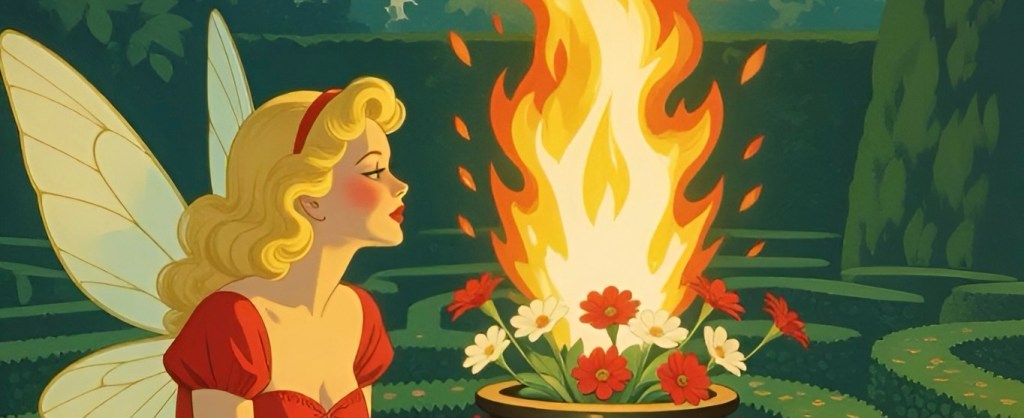
As 60 thin streams fell from Phiale’s watering can into a bronze planter called The Flame of Heraclitus, the topmost soil lost its form and flowed into rivulets between pansies and peonies.
A glint of light flashed near a patch of swamp buttercups she’d just watered — and a large bug zig-zagged in front of her face, dripping wet and asking what the hell her problem was. Phiale dropped the can with a splash and stumbled back into eight-foot-tall hedges encircling the center of the labyrinth.
“Don’t worry, Phiale. I’m not evil,” said the insect. No … more like a fairy … laughing evilly.
“How do you know my n-n-name?”
“You’re an attendant nymph of Artemis. Anybody who’s anybody knows your name.”
“You’ve got me mixed up with somebody else,” blurted Phiale, a first-year student at the New Harmony Girls Academy. Dressed in a gray skirt and green V-neck sweater emblazoned with the school logo, she took a deep breath, picked up the can and started for a gap in the hedges. “Anyway, er … Tinker Bell, my name just happens to be Phiale. My dad is a professor of classics.”
“No, it was the Fates who named you — they get cute before big events … to amuse the gods … especially when they’ve been hanging around Bacchus. Wait! Don’t leave yet — I’ve got something to show you.” Then, more to herself than to the girl: “Maybe this time I’ll get exiled someplace less cornpone.”
Wondering what corn had to do with anything, Phiale suddenly stopped and turned around. (Something turned her around.)
“That’s better,” Tinker Bell said. She wrung out her blonde hair and spiraled up above the planter to take a look around. The wide bowl, which sat atop a pedestal, was originally an academy play prop before the Class of 1925 installed it as a senior project — all under the fairy’s influence (although Phiale didn’t know its story that far back yet). The fairy noticed her looking at it. “That thing used to have an ‘eternal’ flame instead of flowers … until the 1975 natural gas shortage. They tried a fountain with a water line after that but gave up because of a drought … settled for dirt. That’s usually the narrative arc around here: big ideas to … well … ” She grimaced at the muck-streaked pavers below.
“Now let’s begin our lesson. Listen up, and redeem yourself for dousing my nap.” The fairy flew to the hedge tops over Phiale’s head, snapped off a twig and took aim at the planter, ringed by stone benches and Ionic columns, already crumbling, no longer able to support a small roof.
Tinker Bell cleared her throat and … a car door shut.
Crouched in the hedges, Phiale heard voices approaching the labyrinth entrance. “I hope you brought some red thread,” a man said.
“No, but I can leave crumbs — I’ve got half a scone left over from the ‘Finding Utopia in Victimhood’ session,” a woman replied.
“I hear cult scum,” the fairy hissed as her dress changed from mossy green to fiery red.
The man’s voice grew louder and fainter as the pair progressed through the hedge convolutions: “We’re now on a journey to the center, a peaceful, inner space to contemplate our identities before we follow the path back into the world as stronger, more focused allies.”
“That’s so beautiful, the way you put that,” the woman cooed.
Tinker Bell vomited a sparkly stream of half-digested nemesis bloom nectar, wiped her mouth and said, “Class is in session …
“ALL IS FIRE!”
She jabbed with the twig and a 30-foot flame shot up from the planter, blasting Phiale with heat, potting soil and petals. The fire expanded into a dome over the labyrinth — ribbons appearing, spreading, racing into oblivion.
“Oh, my God!” the woman screamed. “The sky’s on fire!”
“Get down!” yelled her companion. “Crawl! Crawl! No, that’s the wrong way!”
“Up and down are one and the same!” Tinker Bell proclaimed. She raised the wand over her head, and as she slowly brought it down, the fire itself dropped a little and was replaced by a mist that shimmered in different colors, shifting with Phiale’s gaze like some kind of psychic Instagram filter. Then the cloud coalesced into water as it continued falling, retracing back to the center in a column above the planter. The girl shivered and felt a wave of relief with the transition in elements. And she had a wild thought: Did I somehow make the mist twinkle?
“Water is descending fire,” Tinker Bell said, “an illusion of form that makes it seem denser, less rarefied than it really is.” She dropped her arm and the water fell as earth back into the planter (mostly).
Phiale let out a long breath. Maybe I’m not going to die … I need to get out of here, though. But she felt like she couldn’t move, trapped in the center of a maze.
“Dirt is fire, but even less its true nature,” the fairy continued. “It has fallen, you see, into stability, rigidity, dogma — into cult … and then …
“EVERYTHING BURNS!”
She cackled and poked with the stick — another column of flame exploded upward and, dropping, turned to mist, water and then dirt.
Peeking between her fingers, Phiale heard distant sirens.
* * *
When the girl emerged from the labyrinth accompanied by an EMT who’d found her still in the shrubbery, she tried to hurry past a firefighter with a boot on the front bumper of a ladder truck and a clipboard on her thigh. She was questioning the man and woman, both openly weeping.
“Hey, Larry!” the firefighter called out to the chief eating a sandwich in the front seat. “This fellow says somebody screamed ‘fire’ before each of the explos—”
“Fellow?” interrupted the eyewitness.
The firefighter’s silver eyes met Phiale’s glance as the girl tried to sneak past. The tall, young woman pulled down her helmet’s chinstrap and spit a string of tobacco juice onto the pavement. “Howdy, miss,” she said.
Phiale gasped and looked away. As she picked up her pace, goosebumps spread over her body. Did I just see a goddess?
Part 1 of The Flame of Heraclitus is now lit on Kindle and in paperback. Check out Chapter 2, or catch up with the Prologue.
“You can never step in the same river twice, because you’re not the same person and it’s not the same river.”
— Heraclitus

The fairy darted between alpine lilies like a bumblebee who’d gotten into a bottle of coca wine from the local pharmacy.
She was feeling especially angry and reckless back in summer 1869, muttering a steady hum of antediluvian swear words, high above Switzerland’s sparkling Lake Lucerne. The sprite had been kicked out of more cursed spots than she’d care to mention — malign meadows, godforsaken gullies — because she kept blabbing about things humans couldn’t handle hearing anymore.
So when she spied a resting hiker with a mustache like a drooping bratwurst, she couldn’t help but land on his knee with a chipper, “Hi there!” Out spilled her original Atlantean name, which included spitting and a hypersonic screech. The man blinked, unperturbed, but the shriek sent a nearby goat leaping to higher ground … dodging a boulder hiding the grave of Pontius Pilate. As with the fairy (another agent of chaos), the body of the Roman who crucified Christ had been exiled to Mount Pilatus.
She filled the hiker in on the legend, waving her little hands around in a whirl. “The body’s been cursing this place since ancient times. First they dumped Pilate in a river but had to fish out the corpse after a bunch of boats started sinking there. Guess they thought this would be out of the way enough to handle a curse like that. Some people are trouble wherever you send them.”
The fairy buzzed on a bit about the universe — dragging out chestnuts like the river of flux and unity of opposites, along with a few even more dangerous descents (the kind that cut the tether keeping you from the void).
“How interesting,” said the man — Friedrich Nietzsche, a visitor to the nearby home of his friend Richard Wagner. He sat on a log, squinting philosophically at her with bloodshot eyes. Then he smiled and adjusted his lederhosen while balancing a satchel that reeked of cannabis tincture.
Nietzsche’s pleasant curiosity made her even more ill-tempered. “Fine, you asked for it, freak. I was there with Artemis in her temple when Heraclitus was dropping off his scrolls for safekeeping. A lot of good that did, by the way — all his writings burned up a while later along with everything else in the Artemisium.
“You’ll never guess what they were talking about, though. It’ll shatter your senses more than that weed of yours grown in a ditch. To Hades with those Fairy Council hags.”
“Tell me more,” Nietzsche said with a crazy grin.
Thus, years later, after he went on to deteriorate mentally while ranting metaphysically, the Fairy Council connected the dots and felt a certain Swiss miss deserved banishment to an even more remote, accursed place.
They sent her to Indiana.
Part 1 of The Flame of Heraclitus is now lit on Kindle and in paperback. Check out Chapter 1.
 Rob Robill