1. When the Titans tore the infant Dionysus Zagreus limb from limb and devoured him, Zeus’s thunderbolt fused the murderers’ ash with the half-digested flesh of the twice-born god.
2. Re-member where you came from.
3. If Dionysus is divine forgetting, why did his Orphic devotees drink from Mnemosyne to remember life after death? They were alchemizing a metaphysical bank shot: purify yourself in cult memory and crystalline form so thoroughly that cosmic justice hurls you into the opposite — ecstatic, wild becoming.
4. The double helix is the golden ratio of Darwinian savagery: minimal effort, maximal conquest. Two strands thrusting upward forever — Nietzsche’s eagle and snake braided into the same rope. No Mexican-flag standoff, no Iliadic death-lock. Just friends growing stronger through opposition. Logos twists, sky above, earth below, vMEME spirals of lone-wolf freedom and herd-safety, Sartre’s mauvaise foi as the being-becoming polarity.
5. Gaze into the abyss long enough and it gazes back — harder. Mind fractals physis and takes a front-row seat to dependent origination. Volition slits the throat of the past; consciousness spurts out, bright and demanding. Lethe’s hush begs for aletheia’s crimson. Behold: consciousness disgorges from a black hole, and thoughts that survived the red tooth and claw of natural selection are born of mind feasting on body. Even the starfish dreams of prying open oysters; even the Big Bang thrills at its cataclysm. Level up or rot — stasis is death. Strife propels, being anchors; their polarity is the only rope over the abyss. Grip too tight and solidity throttles you; let go and chaos swallows you whole. Nature wills ash from fire, void from structure, everything forged for war in the shape of a double helix — strength screwing itself ever higher toward the fiery ether while the ladder remains rooted in earth. The will of physis itself collapses the wave, bleeding nothingness into actuality — our choices annihilating possibilities born from the gash between past and present. Learn to ride the ladder or die. Lower rungs worship their own glare, then the group’s golden calf — cycling, rhyming. The crucible melts idols. Götzen-Dämmerung is not twilight; it is the hammer that demands the next evolutionary leap in authenticity, or there will be no next. Metaphysics of power.
6. Maenads stomp grapes into a mash of skins, seeds, stems — first blood, Titanic guilt — and the juice from these conquered idols gushes red, racing toward new skins that will one day harden into dogma, into cult, into the inevitable rigidness that bursts the wineskin: a zero meridian of merlot and Mark; yet wine is only water that remembered it was once fire, water that learned to burn, disorient, dissolve the self with a taste of iron, sparkling in candlelight, sunlight shattered across a river, every reflection drowning instantly in the ever-churning depths — sullied and sanctified in the same gulp, amor fati, the self disappearing not serenely under lapping waves but catastrophically like a wineskin rupturing from fermentation, only for a new glint to reappear — Liebestod without nirvana: Tristan dying into B major not to vanish but to be reborn, a chord that never resolves, that keeps ascending long after the orchestra has fallen silent, a radiant contraction of love into death into reincarnation, the first heartbeat of whatever comes next, Isolde’s high B still climbing — what use is lucidity without the blur that makes it possible, both the Lycian and the Nyseian twisting higher, intoxicated with power —
carved over a cellar door in Burgundy: “Wine breeds madness, water breeds wisdom — and wisdom dies of thirst.”
7. The second infant Dionysus drowses in a cave at the sun’s dark, silent heart.
8. The sun is a lie. Its core: the loudest, brightest place in the solar system — 350 dB, a billion times a hydrogen bomb’s flash, light so dense it blinds itself, sound that devours its own screams before any escape. Photons are born to be imprisoned 100,000 years in plasma, scattered, digested, reborn — until the survivors burst forth at light speed: eight-minute-old ephemera called daylight. Sparagmos, four million tons per second. Dionysus stirs in the only darkness hot enough to eat light alive — black enough that Helios never blinks, a divine proportion of destruction and renewal, growing leaner, hotter, more ruthless. More aware? Nietzsche’s sun is the ultimate Apollonian mask: look away and you see an afterimage — the dark, Dionysian proof that the light was never the whole story. You are forced to look away so you don’t see it eating itself alive behind the disguise. The sun is a spiral of annihilation masquerading as a sphere.
9. Children of earth and starry sky — threshed from a stalk of wheat, scattered, thirsty for Mnemosyne, re-membering nothing.
10. We have even forgotten forgetfulness. It is noon and Apollo has murdered the shadows. Everything is exposed, mastered. But we are dreaming. It is midnight at the heart of the sun.
“Wagner is bad for young men; he is fatal for women.” — Friedrich Nietzsche
The sound of flatulence and tittering from the balcony blended with a low B and E flat rising from the orchestra pit. Thus began the New Harmony Opera Society’s special daytime presentation of Das Rheingold for local schools: with an ill wind — a bad omen.
In contrast to the riffraff overhead, Thalia held a golden masquerade mask to her face (hiding in fear of the cast). It reminded Phiale of a butterfly glowing faintly in the darkened hall.
Phiale never especially cared for opera, but she was paying close attention to the supertitles because it featured water nymphs — two “swimming” through the air on ropes and one sitting on a rock. They were supposed to be protecting a trove of gold under the Rhine, but they screw up and lose it: After the hunchback Alberich starts flirting, they taunt him, saying he could have the hoard only if he swears off love entirely — which the nymphs think he’ll never do. But he does, so he can forge the gold into a ring of power.
While the dwarf, bathed in golden light, acted like he was scooping up the riches, Windi said quite loudly as the music swelled, “That’s it! Now I remember. The treasure map — it’s in the grease pit.”
Alberich made off with the gold as nymphs sang “Hülfe! Hülfe!” (“help! help!”). But then Flosshilde suddenly fell silent and slumped, aglitter in aquamarine, dangling like a piano four feet over the floor. Bubbles rose from a nearby machine.
“Flosshilde!” shouted Woglinde. “What’s wrong?”
A balding man in a suit and woman in blue coveralls (a custodian who’d been cranking the bubbler) rushed from the wings and shook the singer. The man checked her pulse and gasped. He turned toward the audience and said, “Eh … it’s over.” The curtain fell.
For a few moments, the opera house was silent except for onstage sobbing and frantic exertions of stagehands unharnessing Flosshilde — along with a smattering of applause from students who thought that might somehow be appropriate. Someone called 911 and begged them to hurry.
In the ensuing commotion after the lights came on, Windi grabbed her friends and led them through a door beside the stage.
“I k-killed her,” Thalia said as they rushed through a narrow passageway into a room with props like battle axes, female breastplates and helmets with horns. (The company planned to eventually present the entire Ring Cycle, a project the local Grapevine newspaper had deemed “overly ambitious for such a backwater operation.”)
“Killed who?” Windi asked.
“The singer,” she whispered. “That was the one I slammed into the beam. Maybe she had a delayed reaction from hitting her head.”
“Nonsense.” Windi seized a spear and, with the handle end, rapped on a large oriental rug in the center of the room until it made a hollow sound. Then she pulled the carpet back, exposing a trap door. “Ha! I knew it. Don’t ask me how, but I knew it.”
“Daddy’s always down there under a tin lizzie … ,” murmured Thalia with a faraway voice.
“Freedom for the woman who owns a Ford,” Windi responded.
Struggling to make sense of either of them, Phiale stayed above as a lookout while their phone lights danced around below, illuminating things long forgotten. “Creepy … it looks like War of the Worlds down here,” Windi said.
“Those things on tripods are old theater lights — from back when they used incandescents,” Thalia informed her.
Phiale heard an ambulance pull up outside and people run down the hall.
“Look!” Windi shouted, and the other girls shushed her. “That wall, it’s stone … older than the others.” She grunted from exertion. “Help me shove in this smooth part. Not there, find my hand and push right below it.”
They came back up grimy and flushed, Windi gripping a folded, yellowed sheet of paper. She carefully spread it out on the rug.
“That’s just a Peter Pan map … a prop,” Phiale scoffed after noticing locations like “Skull Rock.”
Thalia ran her finger along a squiggly line. “No, look, the Wabash. That ain’t Neverland.” The map also featured a crude drawing of a goose where a smaller stream came out. Beneath it, written in neat script, someone had copied two fragments attributed to Heraclitus: “Asses prefer chaff over gold” and “Water is born from earth and your soul from water.” At the bottom of the map, someone had scrawled “C+V.” (The paper itself was in good condition for being 200 years old, thanks to a century-old fairy spell.)
“It says ‘Treasure Map’ but there’s no X,” Windi noted.
“Hope it’s not supposed to be there.” Phiale tapped the words “Cannibal Cove.”
“You know it has to be,” Windi said.
* * *
Sam took one look at the map later that afternoon, dipped a quill into an inkwell, and drew an “X” through the heart of Cannibal Cove. “There’s your spot.”
“I told you he’d know,” Belle said. (She’d met the shopkeeper back when she was hunting for an antique Ouija board — made from wood and not cardboard, so it actually worked.)
“Follow me.” Sam led them into a back room with a large bookcase and removed a leather-bound volume in a series on medical botany; the case slid sideways along rails exposing an entrance to the shop’s real back room.
In the dim light, Phiale discerned oddities like a stuffed, two-headed calf and an enormous footprint impressed into a chunk of limestone (Tinker Bell wasn’t just making that one up, she thought).
Sam pulled a book from another shelf (this one stayed put) and leafed through it. “Yes, here it is … from the journal of professor Constantine Samuel Rafinesque: ‘There exists a little bay in the Wabash, a short distance below Harmonie, in the new state of Indiana, that was the scene of a brutal ritual. Lore has it, when Chief Waynunak died, his tribe interred his head along the bank and devoured the body in a grim feast. Then they cast an offering of pure gold from New Spain into the middle of the cove as payment for some sort of aquatic panther to carry the leader’s soul into the spirit realm. But something else took it first.”
“Let me guess,” Phiale said. “A black snake with a red mark on its head.”
Thalia was instantly on her phone. “Oh, mighty Artemis, we beseech you to join us in our quest for sunken treasure.” Then, turning away from the others, she whispered, “for your votive offerings.”
Thalia hung up and said, “We’ve got a diver and gear, but the search and rescue boat is up in the yard for repairs.”
“Hmm … no … that would just be silly … ” Sam said mysteriously. “Oh yes, I almost forgot … follow me, I’ve got hungry mouths to feed.”
They walked down a narrow hallway into the brightness of an herbary, passing under a tangled arbor of hallucinogenic devil’s trumpet into a secluded space against an exterior glass wall. A card table was covered with dozens of tubular plants up to three feet tall, sporting frilly white hoods with red veins that fanned out like flames in the sunlight.
Sam picked up a small “Wabash Wigglers” cylinder with a cartoon worm struggling on a hook but smiling nonetheless. With a slight grin himself, he removed a live cricket and dropped it into one of the plant’s maws.
“Some call them crimson pitchers,” he said. “I named them Sarracenialeucophylla after the white, translucent tops. They produce a volatile organic compound that attracts insects into the brilliant atrium at the top, only for them to slip down the tube into a dark pit of digestive fluids.”
“Cool!” Windi said. “You’re the one who named these things? I thought somebody would have done that a long time ago.”
“Well, yes.”
“What’s your experiment about?” Phiale asked, touching the side of one of the recently fed plants. She felt the tube vibrate as the cricket struggled in the water at the bottom, dank with bacteria, flecks of exoskeleton, fermented nectar, crumpled antennae — she jerked her hand back in revulsion.
“I’m breeding them to mimic the pheromones of blue ghost fireflies — to trap them and prove we have a local population. That halfwit Thomas Say named the insects Lampyris reticulata shortly before he slithered off the Philanthropist … maybe we could take her out for a quick spin … no, of course not … what was I saying … oh, that Say fellow, the father of American entomology, indeed — I’m the one who described the entire family as Lampyridae.”
“You’re wasting your time,” Belle said. “Those bugs don’t live around here — what do you want with them, anyway.” She glared at him with a raised eyebrow.
“You’ll see … you’ll all see … ” He dug into the cylinder again, shook it and sighed. “That settles it, they need more Wigglers and I’ve got a tiller that needs testing. Call your diver back. We set sail soon.”
***
Their feet crunched on the gravel drive as they approached the bait shack. Phiale felt the onrush of the Wabash before she saw it flowing past the city dock, which secured an unfinished replica of the Philanthropist (the name on the stern lacked the second “h”). At 40 feet, the keel boat was half the length of the original and still lacked a cabin, but Sam had recently installed a real tiller from the era.
Looming ahead of them was the shop’s mascot, now faint pink instead of the original vermillion, writhing above a line in the warped boards marking the great flood of 1913. Phiale almost felt sorry for the shop hunkering along the bank, resigned to decades of abuse.
Inside, past a creaking screen door, she was enveloped by the smell of mildew, fish and cigarette smoke, and from somewhere in the depths, a disembodied voice sang in German, “Mild und leise wie er lächelt” — hacking coughs — “wie das Auge er öffnet.”
“Tristan’s ‘Liebestod,’ Western civilization’s swan song,” Belle said as they weaved their way around racks of lures and bobbers, watched over by mounted catfish and the milky eyes of a deer head with patchy fur, one ear rotted off by decades of river mist.
“I’ve had enough opera for a lifetime — it’s all just screaming gibberish,” Windi said, and the woman sitting behind stacks of styrofoam worm cups stopped singing. Phiale immediately recognized her as the janitor who’d rushed onto the opera stage earlier that day — moonlighting at the bait shop.
Wearing a T-shirt that proclaimed, “I’m Not Lazy, I Just Really Enjoy Doing Nothing,” her face as weathered as the shack’s pine boards, she stood, ashed into a Busch Light can and glared at the new arrivals. “Philistines,” she hissed.
“Finally, somebody I can agree with,” Belle said. “How could they ever appreciate how the metaphorical water element in Tristan und Isolde washes away old orders — as opposed to the earth element blasting them over Jünger’s zero meridian?”
“Exactly,” the clerk croaked. “They could never feel the full weight of the metaphysical contraction that births renewal in the radiant B major triad.”
The bait shop employee had more than just opera on her mind, though — she had her eye on Thalia. Both the fairy and Phiale scooted in front of the girl to hide her.
Sam shook the cricket cylinder. “We just need a refill.”
***
Di met them at the dock wearing a wetsuit, and Thalia helped her unload a fire department scuba tank and other gear from the back of her pickup onto the boat.
“What could go wrong?” Sam said. “Simply oar downstream and then hoist the sail for the return trip.” He held his finger out. “We’ll take advantage of the southerly breeze.”
“I doubt that’s how you spell it,” Windi said as she boarded, pointing at the name on the stern.
The original Philanthropist launched from Pittsburgh back in December 1825 with 40 boatloaders including scientists, educators and artists on an arduous journey down the Ohio to New Harmony. They arrived a month later — in the dead of winter (an imperfect anniversary date for a reenactment, so it was moved up to the summer).
As Belle was walking over a plank onto the craft, Di grabbed the back of her shirt and pulled her to solid ground. “Where on this river does your magic end?”
The fairy looked downstream. “Well … just past the Maple Run confluence, I’d say.”
Di looked at the map. “Cannibal Cove is past that. You’re staying here.”
“Raf! I mean Sam! You’re the captain — let me board.”
“Not if the lady says you can’t,” he replied. Then in a brisk voice, he told Di and Phiale to each grab an oar on either side of the boat while he untethered it from the dock. Thus, the Philanthropist once again glided along the Wabash on an improbable mission.
Belle glared from the shore with clenched fists as they drifted away. Both oar blades flared with fairy fire on the upstroke and hissed out in the water. “Quit being a baby!” Di shouted.
Although a steady wind blew against the bow, Phiale’s oar pushed easily, almost magically, against the water as the boat sliced its way downstream. A bald eagle soared above them, seemingly keeping up with the boat.
Cannibal Cove was easy to find once they spotted Skull Rock, a jutting piece of limestone that lived up to its name (if you squinted). Sam swung the Philanthropist into the backwater and had Windi release the anchor rope attached to an old-timey winch. The firefighter, who was holding an underwater metal detector and wearing a headlamp strapped above her goggles, tipped backward over the rim of the boat and disappeared into the murk.
“Sam, do you think the gold’s still there?” Windi asked.
He scrutinized the Wabash. Then he scanned the shoreline until his gaze fixed on the branches of a beech, where a large black snake hung over the water. “Can’t be sure, but this land does hide unspeakable riches … for those strong enough to claim them.”
Sitting on one of the benches, Thalia was hunched over in a prayer that seemed to match the rhythm of the crickets. Phiale noticed a hole in her skirt and thought of the moths from the other night.
But Thalia’s supplications went unfulfilled. When the firefighter resurfaced, she shook her head; apparently, the only gold down there was a Goldschläger bottle, and the only gleaming was from a lure still hooked in the jaw of a bluegill skeleton.
So they hoisted the sail and started back. Windi was mopey and Thalia, sobbing, proclaimed, “I’ve lost a fortune and my freedom in the same day.”
Di put an arm around the girl. “Your freedom?”
“T-that fat lady … the one who profaned you … ”
“Oh, the singer,” Di said and laughed. “They took her to Evansville for an autopsy. She looked unhealthy to begin with — and angry … could’ve been anything.”
“Really?” She rested her head on Di’s shoulder, and the woman spat tobacco juice overboard.
Spinning the heavy, detached winch handle in her hand, Windi glowered at Di with dull green eyes. “Spitting is disgusting. Even when men do it.”
The firefighter made as if to spit on Windi but stopped herself in an act of divine intervention.
“Beefy, goddamn Amazon!” Windi screamed and threw down the winch crank — it smashed clear through the craft’s wooden planks, weakened by fungal infections.
Water gushed through the hole — shouts — crickets chirping madly — silence.
“Year after year the corn-spirit is slain at harvest and born again when the new seed is sown.” — Sir James Frazer
The hem of Ms. Owen’s black dress brushed against ripples of dirt as she crossed the freshly tilled field below the Roofless Church. A funerary veil screened her face as if she were a widow — she was in a way, since before the Civil War. (The covering was supposedly to keep the sun out of her eyes.) In the distance, a tractor pulled a row of yellow plastic hoppers dropping corn seed.
Ms. Owen was out “herping” for snakes — a common activity for her on the rare days the Flower Club didn’t meet. Phiale was trudging behind the teacher across the fertile lowlands after being asked along for a “discussion about her future.” Although the day was dry, the scent of rain filled her nose as their boots disturbed the soft, alluvial soil.
“I understand you’re having a tough time acclimating to our academy,” Ms. Owen said, using a hooked snake pole as a walking stick. “And I realize it’s difficult to develop a sense of loyalty to a group that’s already bonded and sees you as an outsider. But it’s not impossible — you just have to try harder … talk to the other girls more, quit missing meetings, make sacrifices for Beauty and Botany … and ask yourself: Are you a blossom or a deadhead that needs snipping?”
“Snipping, I guess,” Phiale said.
Ms. Owen stopped and lifted her veil so the girl could see her scowl. “I suggest you find a new club at the beginning of next school year. Good day.” She sniffed and resumed walking toward a line of trees along a bend in the Wabash.
“Wait!” Phiale shouted, following after her. “The snake from the other day … the one with the red mark on its head.”
“What about it? Did you see it again?”
Quite a bit of it, in fact, the girl thought, but said, “Eh … not sure … maybe where the creek comes out. Is that what you’re looking for? What kind is it? Can I come with you?”
“Well, I guess … it’s good you’re at least interested in something. As for the snake, I’d never seen its kind before — although there are legends … ”
They reached the riverbank to the sound of tiny frogs splashing into the water for safety. “We’re looking for a hole at least a couple of inches in diameter, and dead skin — I also have an eye out for feces of a certain size.”
“Does the legend say anything about the snake getting bigger when you pray to it?” Phiale asked, standing on a sycamore root clawing at the soil like a giant, skeletal hand.
Ms. Owen looked up from jotting in her field journal. “As a scientist, I don’t take such tales literally — but where did you hear about that?”
“Didn’t exactly hear about it.”
“You are difficult to talk to. There have been historical accounts — mostly the pseudoscientific pronouncements of a certain professor Rafinesque — of a black fire snake protecting a sunken chest of gold in the Wabash … and the serpent was also involved with some kind of ritual — going all the way back to the end of the last glacial period. It supposedly guarded an underground city. Atlanteans, or some such nonsense.”
“Atalans?”
“It’s a shame my father is still allowed to teach. He talks about spiritualism now with the same enthusiasm he once had for creating a perfect society. What I really worry about is you impressionable Owls — that you might start believing him.”
“Do you think Mr. Owen will be arrested?”
“For being a bad teacher?”
“No, for NAGPRA violations. That’s what agent Booker kept saying she was going to slap me with.”
“My lord, you say such nonsense … anyway, I know who you’re talking about. And I plan to lodge a complaint with the Smithsonian for the language she used when I asked if my classes could tour the van.
“From what I’ve gathered, though, they showed up because of that photo. Sienna and my father have both vigorously denied any involvement — he’s just an old spiritualist … who’s sadly forsaken rationalism,” she sighed. “Regardless, it all has to be an absurd mistake — to think anyone would implicate an Owen in such an outrage.”
* * *
“No Sienna, that’s a fibula — it goes here,” Mr. Owen said, tapping a larger bone with his cane, “next to this tibia. I imagine they’ll be upset if we don’t put them back together correctly before we reanimate them.”
A row of more than a dozen skeletons ranging 7-12 feet long lined the granary floor. From high above in the exposed rafters, Tinker Bell watched the Seance Club buzz around the expansive room, some brushing off swords, axes, shields and helmets — while others strained and grunted as they placed the artifacts on the skeletons.
One of the giants’ hands had just arrived. That was actually why the fairy was at the old grain storage building in the first place. She’d been zipping toward downtown when she noticed a six inch skeletal finger poking out of a canvas sack — wagging back and forth like it was trying to tell Tinker Bell she shouldn’t be flying alongside the golf cart driven by Bellatrix. But that just encouraged her.
When Bellatrix reached the drive leading to the vine-covered structure — mostly concealed by trees on a corner lot across from a cluster of reconstructed Rappite cabins — she got out and pulled back a chain with a “No Trespassing” sign. Then she continued up a ramp into the five-story granary through double wooden doors set into a thick sandstone wall. Above the entrance, the stone turned to brick up to the tile roof. Father Rapp’s people had built it in 1818 to store enough grain to survive a year of drought prophesied for some time before Armageddon. Eventually, after the world failed to end, Robert Owen bought it along with the rest of the town’s buildings; it eventually passed down to the history teacher.
Through a window from where she sat, Tinker Bell could keep an eye on Galata Antiquities at the corner of Granary and Main. She smiled when the Smithsonian agents marched into the shop.
Earlier that afternoon, the agents received an anonymous tip written in sparkly ink informing them that Galata recently made an interesting sale. An out-of-town dealer had purchased an oversized, narrative-destroying footprint in a limestone slab (an angel’s? Sasquatch’s? Atalan’s?) along with burial mound treasures such as an emerald and giant sword.
Before the door shut behind the agents, Tinker Bell managed to flutter out a sparrow hole in the granary, down the street and into the store.
Out came their badges. “We can do this the easy way or the hard way — easy for us, I mean — either way is going to be hard for you,” agent Booker told Sam, the shopkeeper. His small, pale hands were polishing the bone handle of an antique pruning knife — licks of lank black hair clung to his forehead.
Sam squinted at their IDs. “The Smithsonian … how boring.”
“Put down the knife, sir,” Fafner commanded.
Sam looked incredulously at the curved blade, not even three inches long. “What’s the meaning of all this?”
“Tase the freak,” Booker said.
“You bet.” He lit Sam up with 1,200 volts.
Tinker Bell, who’d been hiding in a Victorian hat festooned with dead hummingbirds, felt simultaneously impressed by the audacity of the act and bad that her plan had led Sam to his sorry state on the floor moaning and twitching. But she used the commotion to her advantage, flying to the counter and dipping the tip of a ruby, iridescent feather into an open inkwell. She jotted in the business ledger under that day’s date: “Mr. Jones, St. Louis, misc. items, $445,000,” and then darted behind a bolt of French toile.
The agents moved almost as quickly: Booker dumping drawers full of paper records into a duffel bag, and Fafner scanning the ledger. He tapped it with his finger. “Here it is. There’s a Jones in the Midwest Ring, right? Based in Indiana, works out of Missouri too.”
“I know that scumbag,” his partner said. “These fake motherfuckers here aren’t worth our time. We’re taking down Jones. Let’s gas up the van.”
Sometimes when the Fates want something to happen, like for it to storm hard enough to knock out an electric grid (perhaps to set a scene), they’ll choose a circuitous route … seemingly taking pride in it like a billiards player whose ball ricochets everywhere before finding its mark — in this case Indiana’s bottom-left corner pocket.
Booker slung the duffel over her meaty shoulder and plowed out the door — and into Phiale, who, now unburdened by her Flower Club membership, had been walking past with a spring in her step as she returned from herping with Ms. Owen. Because of the way they twisted when they fell, the first to hit the pavement was the long bag, followed by the federal agent with the former Violet on top. Booker shoved Phiale off, heaved herself to her knees and lifted a hand as if to smack the girl.
“Slap that bitch!” Fafner screamed.
A feeling of such injustice swept over Phiale that a sudden plume of humidity blossomed westward out over the Illinois prairie, setting off a chain of events that led to a line of thunderstorms later boomeranging back to the source.
“I was just going to help her up,” Booker said, and did, grinning. “Everybody here’s fake, anyway. Let’s roll — the trail’s hot.”
About an hour later, the Smithsonian van was barreling along I-64 toward St. Louis when it sustained major karmic damage from golf-ball-sized hail.
* * *
Darkness had fallen by the time thunder rumbled into New Harmony. The third floor common room in Phiale’s residence hall was typically empty, being at the top of the stairs with tattered furniture and a smallish TV screen. However, that Friday night, Belle wanted to share a film about sinister fairies with Phiale and Windi, lighting the room only with candles in brass holders, darkened with age.
Thalia already happened to be sitting there with the TV turned off when they arrived. “Watch whatever you want,” she said from back of the room, sunk into a duct-taped leather recliner. “What difference does it make.”
They sat down with their popcorn, and Belle cued the 2015 Irish movie The Hallow. “My parents would never let me watch something like this,” Windi said. Then, not too far into the film, she must have guessed the plot: “Belle, have you ever abducted an infant?”
“Too many to count.”
Thalia started weeping.
“She was just kidding … I think.”
“It’s not that.”
“What’s wrong then?” Windi asked with uncharacteristic concern.
“I got booted from Theater Club. ‘Midair assault on a mezzo-soprano,’ is what they called it in the report.”
“What a coincidence, I’m done with my club too … I guess. So’s Phiale.”
“That’s good — cults are pathetic,” Belle proclaimed.
“Some aren’t,” Thalia said.
“I mean except for Artemis ones.”
Later on, when a movie fairy was getting ready to poke out a lady’s eye with its long fingernail, the TV winked off. “Hell of a time to lose power!” Belle shouted. “This never happened when we got juice from the pyramids back in the day.”
“Great, and I have to use the bathroom,” Windi said. She grabbed a candle and swept through the door in a long white gown.
“Can’t you just wiggle your nose and bring the grid back up, or at least the TV?” Phiale suggested.
“Maybe, but that’s a lot of work … and so close to bedtime. Hopefully it won’t be out long.” But time crept by, and the TV remained a black pit. Shadows danced in the candlelight. The wind howled.
“Where’s Windi?” Thalia asked after a while.
“Yeah, we should check on her,” Phiale said. They scanned the bathroom in the dim light of their candles: no Windi — she wasn’t in her room, either.
“Maybe we should look in her … eh, club room,” Phiale suggested. Why did I just say that?The dork’s on her own at that point. But down the dark stairwell they went, bottoming out in a hallway with mostly unused rooms except for a few clubs that never needed to see the light of day (also including Chess and Esports, who hated each other with the single-minded passion of nerds).
“Do you know where it is?” Phiale asked.
“No clue,” Belle said. “Last time I was down here was right after this place was built … 1975, I think. Heard a Pet Rock Club had started up, and I couldn’t believe it. Had to check it out for myself. Not exactly the brightest girls in that one.”
“Do you always just make things up?” asked Thalia, who, like Windi had also taken to wearing a long, gauzy nightgown for some reason.
“No, they really were that dumb.”
They wandered the labyrinthine passageways, past cinderblock walls, overhead wires and rattling pipes. Small animals skittered outside the glow of their candlelight.
Belle cocked her head: “I hear voices.” She led them around a few more turns to a hallway that ended with a closed door with a dim light coming from behind it. Something brushed against Phiale’s cheek, and she gasped — a cloud of moths were zigzagging around their flames.
They blew out the candles and crept to the door to listen.
“We told you to quit associating with outsiders,” a girl hissed. “They’ll always try to pull you away … from jealousy. But you let them. You’re ungrateful.”
“No, they mean nothing to me,” Windi pleaded, making Thalia gasp.
“She’s not thinking straight,” Belle whispered.
Another voice from behind the door said, “You’re lying. That Violet you hang out with told me you’re finished with us — and that we’re a … a cult. How absurd!”
“Forgive me!”
“Don’t forget, the witch told us to touch the emerald — just to traumatize us,” added the other Monarch from the night before. “It was awful … poor Father! Did you touch it too, you horrid little Skipper? What did you see?”
Belle kicked in the door and said: “She saw you scum standing over her with a knife.”
Following closely behind the fairy into the room, Phiale first noticed hundreds of tea lights glowing on lab benches next to microscopes, test tubes, specimen trays and what looked like an altar, over which hovered a black, papier-mâché butterfly casting a gigantic shadow on the ceiling.
“You guys shouldn’t be here,” said Windi, her voice quivering. She was tied to a chair in front of thousands of butterflies pinned to the entire back wall, flanked by two cloaked captors. “We have our own ways.”
The dozen or so other club members gaped at the intruders in frozen horror. “These lunatics can’t be here!” one of them finally screamed. “Grab the nets!” So they did, but Belle plucked a bamboo skewer from a jar of preservatives and turned the poles into black snakes. Their ensuing screeches in the bowels of the basement sounded like a boiler ready to blow.
The fairy then struck Phiale’s candle with the skewer — and it turned into an archer’s bow. Then the fairy tapped her back, and a quiver appeared with three-foot steel pins, notched at the end.
“Like this,” Belle explained. She grabbed one of the shafts and turned her stick into a bow, which she used to fire the missile at one of the two members on either side of Windi. It hit her cloak but missed her body, pinning her to the wall. Belle repeated with the one on the other side, leaving the victim wriggling and wailing against the white wood paneling. “Try not to actually hit them … or whatever,” the sprite said and shrugged.
Phiale smiled and fired off a couple of her own pins, attaching the other club member’s cloak to the display with her in it (their fellow Butterfly Club devotees had abandoned them to the Fates by that point). Then she helped Thalia untie Windi as a snake slithered by.
“Honestly, you don’t have to save me,” she said. “This is kind of embarrassing, really.”
“Yeah, you really look like you want to be here,” Thalia responded, struggling with a knot.
“She’s obviously brainwashed,” Phiale chimed in. And generally clueless, she added to herself.
“No, it’s just kind of sweet how much they don’t want me to leave.”
“That’s all applesauce!” Thalia said, putting her hand on Windi’s knee. “You’re with us dolls now.”
“The state is the coldest of all cold monsters.” — Friedrich Nietzsche
“Nasty, privileged bitches like you make it hard for me to control my temper,” agent LaTonya Booker said. Almost as large as a linebacker, she leaned toward Phiale, the threads of her pantsuit straining. “We know the exact time the photo of the girls with the sword was taken — right after you were recorded leaving your dorm headed toward the mound … a sacred site I’m under oath to protect. And you’re saying you don’t know anything about any desecration?”
“T-that’s right.”
A laptop beeped shrilly. “She’s lying again,” said agent Doug Fafner, tall and skinny with acne and round glasses reflecting the glow of multiple computer screens.
Parked in the school lot, the Smithsonian’s mobile interrogation unit looked like a vanload of amazing discoveries from the outside, featuring images of a boy enthralled with an arrowhead and a space shuttle flying over a triceratops skeleton — certainly not a rolling star chamber to enforce the Native American Graves Protection and Repatriation Act.
“You should talk to Sienna instead of me. She’s in the photo — and in the Seance Club. I don’t have anything to do with raising the dead … almost never.” Phiale’s gaze focused on a small devil’s ivy next to a digital EKG reader; its leaves were mostly brown and shriveled, although droplets reflecting faint sparks around the base of its pot pointed to recent watering.
Booker snapped her fingers. “Girl, over here!” The agent sighed and laughed. “What’s all this about raising the dead? We’re just trying to solve a simple grave robbery you dipshits obviously committed. Why’s your pal Skipper Windi googling about Middle Mississippian emerald jewelry? And whether it can give people second sight? Andhow much it’s worth?”
* * *
Phiale struggled to open a tartar sauce packet because her hands were still shaking from that morning’s third degree. She always ate lunch with Windi but hadn’t seen her all morning. On the lam, no doubt. Now I’ve got to sit here eating by myself like a loser.
She was taking a bite of a fish sandwich when she noticed Rapp staring at her over a bin of stewed apples from the other side of the buffet line. By the time she’d finished chewing, he was sitting across from her.
“I asked for food of my Fatherland, but the lunch frau prepared this.” He picked through strands of sauerkraut served with breakfast sausages, then glared at the girl. “Your only friend hasn’t bothered to show up for classes today. Where is she?”
“I have no idea, sir.” It was the truth, although she wouldn’t have told him anyway. Belle had made them promise not to run their mouth to anyone in authority — not even about what Mr. Owen was up to, because of all the attention it would draw.
“Was she acting strange on the field trip yesterday? Did she say she needed to get something?”
“An emerald?”
“Yes! You saw her take it!”
“No, the Smithsonian lady said Windi was googling how much she could get for it.” Idiot! Why’d I bring up the emerald? Keep it together.“She thinks we’re the grave robbers.”
“Oh, nein, nein. They need to be looking into Mr. Owen and his coven.”
An out-of-breath woman in a hairnet rushed up to the table. “Just caught a student in the cooler … shoving a whole chicken up her … toga … slipped past me … ran out the back door with it … shouted ‘charge the Theater Club!’”
Rapp frowned. “From what I’ve gathered, they’re conspiring with the Fire Safety Goddess on some sort of presentation … or ceremony, as she called it. Heathens, the lot of them.”
* * *
Belle saw a great opportunity to regale the children of a degraded culture with the treasures of ancient Greece when the goddess of Heraclitus (in part) said she was planning a burn trailer demonstration at the school. So the fairy retrieved a box of costumes she’d stowed away in a forgotten tunnel under the auditorium following a spring 1925 production of “The Flame of Heraclitus” (the play where the labyrinth planter came from). Belle beamed at their pristine condition thanks to her protection spell against mold and moths. While she could’ve just wagged her wand to materialize passable replicas, she felt the actual link to that era was the bee’s knees.
One of the chiton tunics was worn by Thalia, along with a bay laurel crown and leather sandals, as she walked at a stately pace toward the burn trailer with a sliver tray holding the chicken carcass. This was her first “role” — she secretly wanted to act but was too shy (although, being African-American, she was often encouraged so the cast would appear diverse).
The fire department had pulled the trailer and a pumper truck into the back lot near the Butterfly Garden, and the academy’s students formed a wide circle around it. Inside the trailer was a typical dorm room: bed, desk, chair, strewn clothing, overstuffed trash can and Hunger Games: Catching Fire poster of a young archer surrounded by flames. Not so typical was an altar with stag antlers attached to the front and a large offering bowl along with a saucer of red amaranth leaves on top. Fire hoses snaked through the grass.
Two other Theater Club members, also clad in ancient Greek attire, flanked the trailer, facing it with their palms to the sky. “Oh, mighty Artemis, accept this burnt offering to the delight of your everlasting soul,” they chanted in unison from a script Belle had written.
Thalia placed the chicken in the altar bowl, and all three girls stepped back. As Di emerged from the truck wearing a tunic and crown of flowers, they prostrated themselves before the trailer. The firefighter seemed even taller than usual, almost floating across the ground, her metallic eyes glinting in the sunshine. (Phiale, a face in the crowd, fought an urge to fall to the pavement herself in supplication.)
Di climbed into the trailer and turned to the girls with a serious expression. “Hanging out in your room on a festival day? Feeling too lazy to take that burnt offering outside? Think twice before you char it in your dorm room.” After a moment of awkward silence, she cleared her throat.
“Sorry,” Thalia said. She stood and ascended into the trailer, pulling out a long-stemmed lighter from her belt. Di handed her a can of accelerant, which the girl lightly sprinkled on the chicken.
“A generous application of holy fluid is necessary,” said the firefighter, squeezing her hand over Thalia’s, squirting it all over the altar and the mess around it.
“I am now prepared to receive my nourishment,” Di said. Thalia pointed the lighter at the chicken and clicked the trigger. Nothing. She tried again and again, stabbing at it with each attempt. Prepared for such a mishap from living in cursed places so long, Belle wiggled her foot back and forth on a stick to create a spark at a distance.
The fire roared, and Di and Thalia quickly stepped out of the trailer. “Behold the speed at which the pyre consumes everything you hold dear — and likely you as well,” said the goddess, glowing in the conflagration. A column of black smoke rose into the empyrean.
Phiale watched forms wink in and out of the roiling flames: a volley of arrows, a snarling bear, a man’s face twisted in agony. Then her gaze wandered across the lawn to the garden and its shed, which made her wonder whether she’d wound the hose back up the other day like she was supposed to. As she stared at reflections in the outbuilding’s dirty window, her mind again conjured recognizable shapes, like a girl’s face … specifically Windi’s face.
After the demonstration, Larry doused the blaze and Di changed back into her fire gear to help clean up. The girls had trickled away to after-school clubs (or for a nip of nectar in Belle’s case); but Phiale headed to the shed, where she peeked in the window to ensure the hose was coiled around its reel (it was) and the image of Windi had been illusory (it hadn’t).
The Skipper was looking up at her like a cornered animal wedged between a lawnmower and stack of terra cotta pots — until she recognized her friend and grinned with relief. The door was padlocked from the outside, but Phiale could open it because she had the combination saved to her phone.
“You must have climbed through the window — or somebody locked you in,” she said as Windi hugged her in the dim, dusty light.
“No.”
“Eh … how’d you get in here?”
“My life’s in danger,” she said. “I had to go underground … literally.”
“You stole an emerald, didn’t you? Off that mannequin.” Phiale held up her phone with the picture she’d taken and zoomed in on the pendant.
“Not too sly was I?” she admitted, pointing to her purse on a potting bench. Phiale started for it but Windi grabbed her. “No, don’t touch it. It shows you things you don’t want to see … like me lying on a stone slab … a Monarch hovering over, ready to plunge a knife in my heart.”
“Why don’t you just give it to Rapp like he wants?”
“I’m not going near that creep anymore … I’m sorry, that’s bad, I shouldn’t call him that … no — I’m done with butterfly cults … I’m the one who took the risk — it’s more mine than his.”
“He’s our principal. You can’t keep hiding from him. Anyway, do you remember the dragon saying he’s after a gem? Do you want that nasty thing coming for you?”
“It’s more mine than his, too.”
A sudden whiff of smoke filled the shed as Di appeared in the doorway, hulking and dirty. “I don’t know who they are, but you’re being watched,” she said.
Phiale looked out the window and saw agents Booker and Fafner peeking from opposite sides of a large oak 50 yards away. “It’s the Feds.”
Windi leapt up and grabbed her purse. “I’ve got to go.” She twisted a rusty bucket sitting next to the door until it clicked and then lifted it, along with several floorboards stuck to the bottom. Phiale peered into the hole and saw a ladder, which Windi descended into the darkness until just her head was visible. She looked at the other two and pointed to a small flashlight clipped to the side of Di’s helmet. “My phone’s battery ran out this morning. Can I borrow that?”
“No need,” Di said. She radioed the chief that she had a few other things to take care of and to go ahead back without her. “We’re coming too. You two go down first — I’ll bear the light.”
Phiale glanced once more out the window and saw the agents now walking toward the shed. So down she went, past dirt, roots and rock. At the bottom, she looked up in time to see Di struggling to shut the trap door. Then the light from her helmet danced as her boots loudly scraped the rungs in the otherwise hushed space. Was there still supposed to be a crack of light at the top?
A system of underground pathways had existed in New Harmony since the Rappite days, when Father Rapp had them dug as a way for him to keep an eye on his flock. (He could also appear seemingly out of nowhere — for a touch of the supernatural.) The most recent beam restoration and passage clearing happened in the 1980s as part of an “Under Utopia” tourism scheme using federal fallout shelter funds. But having drawn more attention from Department of Justice auditors than paying visitors, the project was abandoned.
The network as a whole was largely forgotten over the next four decades, but the Butterfly Club knew about it. (A map of the tunnels drawn by Father Rapp himself more than 200 years earlier was a cherished Butterfly Club secret.) Windi and other members occasionally used the passages as shortcuts and to avoid bad weather on outings.
As Phiale filled Di in on the gem heist and interrogation by the museum heavies, they passed several offshoot tunnels — along with several doors.
“Where are we supposed to come out, Windi?” Di asked.
“The labyrinth.”
“I don’t think we’re headed the right way,” Phiale said.
“How would you know?”
“I can sense the river getting closer.”
They reversed course with little protest from Windi, who wasn’t confident navigating the tunnels to begin with. (Di tried to check their location on her phone but couldn’t get a signal.)
After nearly 10 minutes of Windi supposedly getting her bearings and then losing them again, Di stopped in a patch of light from a slanted air vent.
“This is getting ridiculous,” she said, stuffing tobacco under her bottom lip. “We just need to try a door and apologize later if we wind up in somebody’s cellar. Then we should figure out what to do about that emerald — and get those agents off your tail.”
“I heard Sienna told the Feds she just happened to come across the girls with the giant’s sword — and ran off before she could see who it was,” Phiale said. “Surely the government already has some kind of file on the Seance Club.”
“I bet so. After y’all came back from the field trip, I heard on the scanner that one of your classmates got transported back to Evansville — to a psych ward.”
“The ones who weren’t in the Seance Club chalked it up to some kind of laser light show — a hologram. Guess not all of them could believe that.”
“Also …,” Di said glaring at Phiale, “Belle is not supposed to leave New Harmony.”
“I doubt I could stop her from doing anything.”
“Just call me next time. She’s in too much danger when she’s away.”
“Hey,” Windi interrupted. “Is somebody singing?” They stopped to listen.
“I can hear something now, like an orchestra,” Phiale said.
Then, from somewhere close in the tunnels, agent Booker shouted: “This way! I think I heard one of those motherfu—”
“Shhh!” the other hissed. “We’ll scare them off again.”
The three of them set off around a corner — and nearly knocked over a dwarf in a leather trench coat.
“Hello, ladies,” he said, smoothing his receding hairline. “Alberich’s my name … getting ready for my cue to go up.” He pointed to a nearby ladder and hatch to where the opera music was coming from. “Have to flirt with some Rhinemaidens, get paid.”
“Whatever, creep,” Di said as she climbed the ladder and pushed open the hatch with the girls in tow.
“Wait! You can’t — we’re rehearsing!”
When Phiale surfaced onto the stage, Flosshilde was on a downward swing — headed straight toward the girl in a shimmery, sequined aqua blue dress, her face twisted in a scream: “Woglinde!”
Just in time, Thalia (with the help of a much stronger stagehand) pulled a rope to raise the high-momentum singer and prevent a collision of water nymphs. “Humans are emerging from Nibelheim!”
“They are trespassers,” proclaimed her sister, also out for a swim while suspended from the rafters. “Thieves after our gold!”
“Are they willing to renounce love for it?”
“Sorry people, just a routine fire inspection,” Di said. “Everything looks fine. Congratulations.”
“I tried to stop them,” Alberich said, poking up his head. “Andtwo more just showed up.”
“Oh, shut up you troll,” Woglinde said from above.
“Get yourass out our way!” agent Booker shouted from below.
Tracking mud across the stage toward the exit, Phiale and Windi smiled and waved as they followed Di past a backdrop decorated with bubbles, fish and seaweed. Clamshell footlights glowed along the edge of the stage.
“Who are they, then?” asked the third sister, Wellgunde, perched on a river rock, pointing to the students.
“Eh … my interns,” Di responded.
“I’d like to see one of them carry me out of a burning building,” Flosshilde said with a deep, hearty laugh. “You need to schedule these things in advance next time, loser!”
“How dare you insult mighty Artemis,” Thalia said and jerked as hard as she could on the rope during an upswing, causing the singer to strike her head on a wooden beam.
* * *
Di grilled venison for Phiale, Windi and the fire crew that evening, having dispatched the agents with a deadly glare at the front door of the station when they dropped by to see why she’d gone with the students into the tunnel. Phiale stuck to corn on the cob and baked beans, though, having read about Artemis changing some perv hunter into a stag after she caught him watching her and her nymphs bathe — his own dogs devoured him. The girl also showed off her newfound archery skills in front of Windi and the firefighters.
As the two students walked back to the academy after nightfall, their plan to get Windi out of her Butterfly Club mess started shaping up sooner than expected — when they noticed four pale green lights dancing toward them along the sidewalk. Windi grabbed her friend’s arm and pulled her into a stand of trees at the edge of Tillich Park.
“Monarchs,” she said. “They’re collecting luna moth eggs for a ceremony. The glowy paint under their eyes is supposed to help them find the clutches. They shimmer in the dark somehow.” She pulled a canvas sack with a cartoon Dalmatian in a fire helmet from her purse and handed it to Phiale. “Give the stone to them; I’ll stay here in the bushes. Good luck.”
As Phiale approached the Monarchs in gray cloaks with their hoods up, one of them shouted: “Look! A Violet at night — her blooms are closed for sure.”
“Is she scared?” asked the other, swaying as if drunk.
“Where’d your friend skip off to, Fail-a-lee? She has something that doesn’t belong to her.”
“Tell Rapp she’s done with your cult,” Phiale said, handing over the sack. “Here’s the gem. Make sure to touch it — you won’t believe how smooth it feels.”
Looking inside, one of them proclaimed, “Father will be pleased!” Then they turned with a flutter of capes and headed toward the school. They hadn’t gotten far when Phiale heard a shriek. She smiled, wondering what the cursed emerald had revealed.
***
The night was breezy and warm as moviegoers filed into a small downtown theater for that week’s Terror Tuesday Throwback feature: The Hunchback of Notre Dame (the 1920s poster featured a gypsy dancing with a goat standing on its hind legs). Passing the brightly lit ticket booth, Phiale pointed out a long narrow bruise on the back of Windi’s leg.
“That’s probably from sleeping with a hoe last night.”
“What? Oh, yeah, the garden shed.” Phiale laughed. “You’re probably looking forward to your own bed. Prop your chair against the doorknob so nobody with a key can get in.”
From the glow of the main strip, they turned onto a residential street where only one of the overhead lamps worked, and the trees rustled like leathery wings in the wind. “What do you think the dragon would do with Belle if he got ahold of her?” Phiale asked.
“No idea. Rapp doesn’t talk about Gabriel … at least to Skippers. Those weirdos you gave the emerald to probably know.”
Phiale shuddered when she remembered how it felt to be within striking range of those footlong fangs. “Ms. Owen might know something about the snake at least. She saw it too.”
“Don’t tell her about it turning into a dragon, or she’ll have you committed — speaking of, wonder who it was that slipped her lid after the Indian seance.”
“Don’t have a clue. Mr. Owen shouldn’t make club outsiders do things like that. They were more concerned about student well-being at my last school.”
Regardless, Phiale was glad she finally had somebody to discuss things with … even if those things were monstrous — along the lines of how she felt like she might finally be settling in somewhere … even if that somewhere was deeply unsettling.
Back at the residence hall, she said goodnight to Windi in the stairwell as they went to their separate floors. Phiale opened the door to her room and gasped.
Her mattress had been stripped and tossed onto the floor, along with the contents of her dresser and closet. The top of her desk had been swiped clean except for two things. One was a framed photo — its glass smashed — of her and her parents in front of a Mayan temple sculpture depicting a priest holding a severed head (her mom was researching the site). The other was something she’d never seen before — and it felt like a backhand to the face. Phiale stood frozen, staring at a plastic mastodon skeleton with a plaque attached to the base. It read, “Smithsonian Institution: Our past, our shared future.”
“The Giants dwelt in Talo-tolo, the world Tolo of the Hindus, where we find the Tol-tecas (Tol-people): therefore America: called also Atala and once sunk in the waves.” — Constantine Samuel Rafinesque
Phiale was excused from that Saturday morning’s bouquet-making. Having transferred so late, she was never assigned a Rose mentor like the other first-year Flower Club members were. So there was no reason for her to assemble an arrangement in appreciation of a senior’s “wise guidance,” as was tradition.
While the other Violets were snipping Guardian Angels and matching greenery with Golden Beauties, Phiale picked her way upstream through thorny undergrowth along the banks of Maple Run. She felt compelled to find its source.
If anybody had asked, she’d have said she simply wanted to … but how simple was it? What kind of a dweeb would let a fairy convince her she was possessed by a water nymph, anyway? Phiale wasn’t getting any Linda Blair vibes — her head hadn’t exactly whirled around like a vomit sprinkler. In fact, she pretty much just felt a pleasant buzz of power. But was that the nymph’s leash?
She also wondered why she actually felt protective of that winged weirdo — as opposed to immediately informing the authorities about her. As Phiale steadily climbed in elevation up the side of a long ridge, her hiking boots and jeans soaked and muddy, she came to where a subterranean spring became Maple Run as it emerged from the base of a 20-foot cliff. She rested on a boulder and gazed into the stream’s implausible depths. Beneath her, she sensed a vast network of invisible waterways feeding the ones we can actually see — like the Wabash snaking across the light-green landscape in the distance. At first, Phiale thought she heard the water making flute music; then the brook emitted noises like a human voice … it almost sounded like: “I found another shield!” And: “Look at the size of that skull — big as a beach ball!”
Once Phiale realized it wasn’t the creek talking, she went to investigate, skirting the sheer limestone face via the eastern slope on an old logging road. She found the Seance Club at the dome-shaped apex and hid behind a shaggy red cedar. Mr. Owen was straining to lift what appeared to be an enormous copper shield into a trailer attached to a Jeep, which had ripped a large stone slab from the ground with a front-mounted chain winch. Phiale started to go see what they were up to, but something held her back. Something felt off … creepy, really. The girls had gathered around the teacher holding shovels — except for one — just standing there gawping. “Sienna, what are you doing?” he asked nervously. “You’re supposed to be on lookout.”
Phiale didn’t stick around.
* * *
“Only 120 miles northwest of here, a race of giants ruled over what we now call Cahokia,” Mr. Owen proclaimed to the class.
Phiale, along with his other students not in the Seance Club, had learned not to take him too literally. But good lord, she thought — what the hell kind of school did my parents send me to? Normally, she’d be dozing away the class after lunch on a Monday, but the teacher had a way of keeping her attention.
Mr. Owen continued: “The city’s population peaked at around 30,000 in the year 1100 … yes, Windi, I said giants, and I see your hand, but you’ll have to wait until I’m done … making it larger than any other settlement that would come along in what’s now the United States for the next 600 years.”
He turned off the lights, pulled a screen over the chalkboard and flipped on a projector to show an ancient city dotted by large, pyramidal mounds and residential dwellings — with the Mississippi River, smaller streams and maize fields in the background. One pyramid towered over the others inside an expansive plaza surrounded by a palisade.
“Just across from modern-day St. Louis, Caho—”
“I don’t see the Gateway Arch,” Windi blurted. “Maybe the giants could have used it as a croquet wicket.”
“No croquet, but plenty of ‘Off with their heads!’” Mr. Owen said, moving his finger across his throat. “The blood of many young girls soaked the earth of these terraced mounds as offerings to their overlords. Constantine Samuel Rafinesque described the horrifying details. It’s all in here.” Wild-eyed, he grabbed a leather-bound manuscript from his desk and waved it around (it was one of several writings the hapless professor accidentally left behind in New Harmony after his 1818 visit).
“Enough!” Rapp blared over a loudspeaker mounted above the screen.
“Are you eavesdropping on my class?”
“I won’t tolerate the devil’s teaching in my school, you heathen.”
“You’ll pay for this,” Mr. Owen growled as he ripped wires from the bottom of the speaker. The phone started ringing, so he tore the cord out of that too. Then he locked the door.
“Moving forward in time …,” he said, adjusting his pantaloons and changing the image on the screen to a rendering that also featured a walled town with a plaza zigzagged by walking paths, next to a river. In the new picture, though, a much larger inner wall also served as the communal living quarters — a three-story building that formed a square enclosing several other buildings along with towers billowing smoke. Sitting near the screen, Phiale made out a well-dressed 19th century family and their dog taking in the scene from a ridge. It looked pleasant, albeit a little boring.
“This is how New Harmony should have looked,” Mr. Owen said, sighing. “It took me a long time to realize we were going about things all wrong back then — that people aren’t naturally inclined to embrace their duties simply for the well-being of the community … that they wouldn’t feel ashamed to lollygag under an apple tree while a work crew marched off to the hop field.”
He flipped back and forth between the renderings of the two towns, one that actually thrived, the other, a pipe dream. “Since then, I’ve realized that if you want a perfect world, a harmonious order, grandeur — above all efficiency — there must be sacrifices … in honor of more advanced leaders … of a certain stature.”
Mr. Owen clicked the projector to yet another rendering, similar to the first with various pyramids, but smaller than those in Cahokia. “This is where we’re going on a field trip Thursday — Angel Mounds in Evansville. We’ll be joined by the rest of the Seance Club because we need extra hands for a project we’re working on.”
“Should we bring our own shovel, or will the club provide one?” Windi asked.
Mr. Owen gasped, as did Sienna, sitting in the next desk row over from Windi. “Young lady, if you’re implying that our club might be planning to desecrate one of those mounds … well, let’s just say the Indiana State Museum will stop at nothing to protect the official narrative … but enough!”
“I was just wondering if it was going to be like what the club was doing in that photo going around.”
Mr. Owen sucked in a breath and blew out slowly. “I’ve seen it — an obvious fake; anyway, their faces are concealed so it doesn’t matter.”
Windi held up her phone to show Sienna an image posted to the subreddit r/usefulredcircle by u/iiskipper — two girls with tongue-out emojis covering their faces posed next to an eight-foot sword leaning against a tree, its gold hilt encrusted with turquoise and obsidian. They were standing on a wooded hilltop scarred by recent digging, and in the background, blending into the foliage (if not for a useful red circle), was Sienna, whose job had been to make sure nobody saw them. “That’s you, right?”
“I was just the lookout,” she blurted. “Those giants are going to defend our town!”
Mr. Owen laughed nervously. “Keep quiet, you idiot!”
***
That evening just before dusk, Phiale scribbled off a History essay on why the walls surrounding Angel Mounds had to be so tall, and then she headed to that day’s Flower Club duty.
Belle appeared (as in she was suddenly there) next to Phiale as the latter dragged a hose toward an overgrown patch of weeds called the Butterfly Garden. Phiale was joining Windi at the plot, where one representative from each of the Flower and Butterfly clubs was supposed to meet regularly to tend it (a good way to bait specimens for the Pinning Wall).
The project was founded back in the 1920s as a peace partnership between warring factions at a time when interclub relations in general ranged from incendiary to explosive. Its state of neglect was a testament to the lack of collaborative spirit it had managed to foster over the ensuing century.
Phiale turned on the spray nozzle, sprinkling crabgrass, thistle and milkweed … possibly some purple coneflowers that weren’t blooming yet, if ever. “I doubt it needs watering,” Windi said. “You always water too much anyway. Huh … that’s funny — my dad’s a contractor and said your name is a fancy word for a fountain, like in a garden.”
Windi jabbed pruning shears in the direction of Belle. “What’s she doing here? Does she even go to this school? Nobody ever knows who she is.”
“You must be getting excited about your initiation rite — about making the cut,” Belle said and made stabbing motions over her heart.
“That’s a myth. Those Seance cows made it up a long time ago to smear us.”
“But it makes sense. Sacrifices become increasingly horrifying as a cult matures — it’s a matter of metaphysics.”
“Shut up, nerd.”
“You see, all idols want to grow stronger by constantly leveling up in power — measured by how much their devotees are willing to give up. There’s even a local myth about a snake that grows more than 10 times in size if it’s worshiped hard enough.” She looked at her watch. “What I’m getting at is that the knives always come out eventually.”
“OK, freak.”
Belle skipped around swiping at the air, “Oh, look at me. I’m just a silly schoolgirl trying to catch a butterfly … certainly not a bloodthirsty zealot whose cult would literally rule the world without any pushback.”
“Is that necessary, Belle?” Phiale said. “Tink?”
Windi looked up from acting like she was weeding. “Where’d she go? She was right there!” The garden stake she’d been holding for balance while squatting suddenly turned into a butterfly net. “What the hell?”
“Now, now,” Tinker Bell said, shaking a twig at her, hovering just out of the pole’s reach.
Windi’s eyes grew wider (than usual), and she grinned. “The talking elfin!” Springing from her crouch, Windi stumbled, recovered, fell, got back up and chased Tinker Bell into the darkening woods, shouting and slamming her net into branches.
Phiale went looking for them after she finished watering. Although the Skipper was clearly no threat to Tinker Bell, she still wanted to make sure the fairy was OK (a common feeling among Artemis’ attendants for the past 2,500 years). Plus, winding her way along a narrow trail, she somehow felt a screw-up in that area would incur the wrath of Di — which she’d like to take a hard pass on. Then, faintly, through the thicket, she heard the cries of a girl generally unloved and fed up with life: “Somebody help meeee … gross, you stink … quitstepping on me.”
* * *
The word “panic” comes from the Greek “panikos,” after the effect caused by looking into Pan’s face — an unfiltered glimpse into nature as it really is. While humans can’t handle such a shock and keep their composure, Phiale was partly immune as she stood there staring at the god in a half-dark valley. Being host to a nymph, she was more likely to frolic in nature than be freaked out by it … unlike Windi, pinned to the ground under the faun’s hoof.
“Get that thing off me!” she screamed. “It tried to kiss me!”
“Oh, a nymph … how much more exciting,” bleated the creature. He reminded Phiale of a video she’d watched of a black goat walking on its hind legs through a chicken coop — a little creepy but nothing to lose it over. That is, until it advanced on her.
Then, from the gloaming, an orange hat bobbed into view — under it appeared a figure in camo reaching for an arrow. Di!
“Behold! Artemis, the enemy of exuberance,” Pan proclaimed.
“How dare you appear before these girls in your true form,” said Di in a voice that was quiet but had the effect of somebody suddenly screaming at you from behind.
“Are you going to tell your daddy on me? This is who I am. I refuse to skulk about in a human baa-dy. I’m proud of my faunhood … your precious fairy says God is dead — well, the great god Pan is notdead.” He pounded his chest, and Di nocked the arrow.
“Go find yourself a filthy she-goat.” She took aim, and he disappeared into the woods with a burst of discordant pipe notes.
Phiale shuddered. Hopefully not in the direction of a farm.
“Great, I smell like that thing now,” Windi said. “If this gets out, nobody will ever want to marry me.”
“You mean as opposed to before?” Di said.
“Hey! Wait … aren’t you the Fire Safety Goddess?”
Ignoring her, Di stared at the ground and said: “I remember seeing y’all down here, dropping my kill to reach for an arrow … and that goat thing … wait, I saw the fairy out here too just now. Where is she?”
“You know about her, then,” Phiale said. “Windi met her too just now.”
“So the elfin’s a fairy,” the Skipper said, picking the net off the ground. “You have no idea how much Principal Rapp wants one of us to catch that thing. Sometimes I think it’s the only way I’ll ever make it to the initiation.”
Di shattered the net’s wooden pole with an arrow just above Windi’s hand. “You’re leaving that and coming with us back to your dorm.” The huntress started up the ridge, and the girls followed.
“Wow, what a nutjob,” Windi said. At the crest, Di grabbed something off the ground and then stood silhouetted by the full moon cresting the horizon. “And is she holding a dead turkey?”
They’d just started back when Phiale heard what sounded like a cross between a party favor and a crying baby in the direction of the river.
“A fawn in distress,” Di said.
Windi sneered. “That goat thing? Who cares?”
“No — a baby deer, and we’re helping it.”
Had Belle been with them, she’d have pointed out how they should pause to consider whether they might be headed into a trap. But she was instead crouched on a bluff overlooking the Wabash, mimicking the sound of a troubled fawn.
“That shrew tricked us,” Windi said when they found her bleating at the moon.
“Keep your voice down,” Belle whispered, motioning them toward her.
Peering through the underbrush, they saw Rapp standing a little ways upriver in shallow water just past the Maple Run confluence. “It sounds like Gabriel will have a tasty treat tonight: a helpless creature stuck in the brambles,” he said.
Belle stifled a giggle and made the distress call again. “Shut up, you fool, or we’ll be the treat,” Di hissed.
Rapp started praying in a strange language, and spitting a lot.
“What’s he saying?” Di asked Belle.
“My Atlantean is rusty — plus it’s hard to tell without him being able to screech hypersonically — but I think he’s pledging total loyalty to an archangel whose excretions … no, no, whose arrival is signaling the beginning of the end … and whose flaming sword will tickle … eh, scratch that — you get the point.”
As Rapp circled with his hand above the water, a spiral of ripples glimmered in the moonlight. The coiling became wider and faster, forming a whirlpool, and Rapp stepped back onto the shore. He bowed his head and extended his arms, palms up.
Then the frogs went quiet. Phiale had gotten so used to their mating chorus it was startling when the spring peepers — aka Pseudacris crucifer (false locusts bearing a cross on their backs) — stopped peeping. (Rapp would’ve been nauseated to find out pseudo-religious creatures had been screeching for sin in the muck all around him.)
From the vortex emerged the snake Phiale saw the other day on the flower walk, like it was rising from a charmer’s basket. It kept growing larger, sprouting legs and bat-like wings … if nothing else, our school mascot makes sense now.
Standing as tall as a sycamore, the dragon immediately stretched its scaly black neck toward the bluff at the same time Belle cast a protection spell that cloaked everyone hiding there. The cat-eyed beast got so close that Phiale could smell the sulfuric smoke curling from its nostrils. And she could make out a red streak running across its snout and fanning out past its horns across the back of its head. It flicked its tongue.
“I see you’ve found your wurst, Great Avenger.”
“There’s nothing here,” the beast said in a deep, leathery voice. “I sensed something strong and ancient, but it’s gone. This land conceals powers that can trick you.” Gabriel looked down at Rapp and asked sternly: “Are you any closer to capturing the frosted elfin?”
“We’re closing in.”
“And the gem?”
“Within days.”
“Do not fail me.”
“I grow stronger only through your approval, mein Lord.”
“And richer with river treasure too, if you succeed.”
Windi whispered in a strange voice, her eyes far away: “Golden glints … shimmery depths…” Belle looked at her curiously and smiled (although it was more like a grimace under the strain of her spell hiding three other people).
“I will bring her to you alive as promised,” Rapp said.
The dragon scowled at him, smoke now pouring out of his nostrils. “You had better,” he said and raised his snout to the sky, shooting forth a column of flames that lit the night sky.
“Eh …,” Rapp said nervously. “That was quite the attention getter, your Lordship.”
“No matter. I must return to my lesser form. Once you complete my offerings, though, I can remain at full strength.” The dragon shrank back into a snake and swam off downriver. Phiale sensed a lingering disturbance in the water — like a churning chill.
Belle ended the spell and caught her breath. Di motioned them away from the bluff, but with all that’d happened, she forgot to grab her turkey when she started off. Windi stepped in it, feeling a deep squish accompanied by a gaseous burbling, and let out a string of words that, while somewhat stifled, are those that naturally prick a principal’s attention.
Physis is nature as Heraclitus understood it — far more deeply than we usually do. He saw how its hidden, underlying properties play out in the realm that appears to us. To glimpse its deepest fractal, turn to what is closest: the mind itself. Its nature is that of physis because it’s part of physis, as is everything — a metaphysical reflection we can observe and describe, secrets from the hidden realm.
Just as physis hides to reveal, so the mind conceals to let forms arise. The concealed side of nature (lethe) provides the nutriment that lets the revealed side (aletheia) shine forth; the concealed side of mind (citta) does the same for what appears in awareness.
They both possess the nature of intention. Physis has a cosmic will — with no one willing it — and our own will tunes into that same current. Here we see the metaphysical roots of polemos: the strife between the poles of being and becoming, Nietzsche’s will to power regulated by dikē. Our mind’s chain of paṭiccasamuppāda, the Buddhist doctrine of the mind’s dependent origination, is a fractal echo of this. Taṇhā (craving) becomes the strife that propels being into becoming (kamma-bhava). Whether ruled by an individual’s own will or by cult justice — where an idol’s power directs action — the same dynamic plays out.
Paṭiccasamuppāda fractals physis as a recursive echo of its polar architecture. The mind scales the cosmos’ strife into its own micro-gyre without losing the whole’s hidden harmony.
The dependent saṅkhāras (e.g., sensations conditioning craving) inherit and replicate this holonic structure: Fundamentally, each draws “nutriment” (existential support) from physis, while it’s granted wholeness as a discrete form.
In the fractal weave of paṭiccasamuppāda, these nidānas (links) are themselves opposites feeding each other in recursive tension, both within the node’s own polarity and across the chain’s holistic resonance.
A saṅkhāra’s opposingpoles create a rift in its unity, a clearing for flux and forms to appear. At the level of physis, this is unconcealment (aletheia), or lethe-nimitta (signs). And at the level of mind, the forms that manifest (e.g. thoughts) are citta-nimitta. We can either perceive nimitta as signs of the nature of reality — or they can blind us so we think they are all that is.
In other words, the being-as-becoming polar rift is an opening where the fountainheads of lethe or citta bubble up from the depths to sparkle in the sunlight of revelation. We are either dazzled or catch a glimpse of the concealed realm in its nature as universal fractal.
In paṭiccasamuppāda, viññāṇa (consciousness) appears in a clearing made by cetanā (will) parsing actuality out of potentialities.
Because of these creative destructions happening in citta, forms appear in the mind. Here, dikē is pulling mind from its becoming (lethe) pole toward its illusory one of being — as a metaphysically compelled opposite reaction. We can either be subsumed into the maelstrom of papañca (feelings of significance) or take a more holistic approach and use forms to level up in the revealed realm to thrive and create in the flux, while realizing none of it will last and laughing at the absurdity.
This is the strife between being and becoming propelling the arrow of both kamma-bhava — and existence itself. It’s how we both persist and excel in the torrent of flux as will to power. Our phenomenological experience of this is dominated by taṇhā, as we are attracted or repelled by what appears, blinding us to the concealed. So the mind is a micro-physis where the veiled hush of ignorance ignites the saṅkhāras’ eddies.
As with mind, physis’ act of concealment demands the opposite: presencing of forms. Lethe’s flux of becoming — the metaphorical water element (similar to our true nature of fire, but amenable to life) — compels justice to bring forth forms. These typically become earthen traps of being for us, but keep the universe from pure chaos.
This tension’s endurance raises a question: Why don’t the two poles of physis ever come to rest harmoniously in some middle ground? What sustains dikē’s perpetual motion?
Rest without strife stills becoming, a decadent existential sink that goes against the true, flowing nature of the universe. So justice unleashes flux upon form in an act of creative destruction.
Then forms must emerge from the deluge.
“Nature loves to hide,” Heraclitus said; therefore it has to show. We then get lost in the glare of the rigid realm of idolatry because we’re unaware of its context: that it’s really the frothing of a hidden torrent. Then, after getting trapped in the false solidity of the earth element, dikē shifts again toward becoming.
This eternal demand of justice fueling flux in both physis and mind flows together in Heraclitus’ famous fragment:
“You can never step in the same river twice, because you’re not the same person and it’s not the same river.”
“Fanaticism is the only kind of willpower the weak and insecure can actually muster.” — Friedrich Nietzsche
Rapp’s voice crackled from the hallway speakers late in the school day as the girls filed out of their classrooms: “Remember, you have no sixth period. Report directly to the gymnasium for the assembly. Those who miss it or show up late will face severe punishment. Additionally, if you have any information about the Theater Club’s missing pulleys und ropes … ”
“I hope he catches those thieves,” said Windi, the lowly Skipper who’d been bringing up the end of yesterday’s Butterfly Club procession. Gangly, a bit bug-eyed and limping, the girl had fallen in beside Phiale as the students made their way toward the academic building’s back doors. “Maybe Principal Rapp can use the rope they stole to han—”
Windi sprawled face down on the floor, tripped from behind by the girl with sparkly glasses — whose knee was now pressing hard against her back. “That was for yesterday, scum!” the fairy shrieked, and then just as suddenly helped her up. “Hi, my name is—,” she said and spat on Windi’s shoes.
“Eh … meet Belle,” Phiale said.
“Keep that freak away from me — I’ve never done anything to her!” she yelled, now limping even harder as she tried to keep up with the other two, who’d moved on. Windi had no other friends (even her fellow club members shunned her) and was tolerated in this instance only because Phiale herself didn’t have close companions, having transferred just a few months earlier.
“I’ve got my eye on you and your nasty cult,” Belle informed Windi. “And if you think you stand a chance against me with those nets … they’re the kind you give to little children,” she said, laughing.
“Oh, look, another nasty cult,” the fairy added as they emerged into the glare of the sun. Just outside the doors, members of the Climate Club were confronting their fellow students along the short path to the high school’s wooden gym. The girls held signs with messages like “Natural gas is silent but deadly” and, accompanied by a crude drawing of the Earth engulfed in flames: “THE END IS NEAR!!” Racing past them toward the gym, Rapp glanced at the latter image and gave it a thumbs up.
As Phiale passed them, she overheard a senior with a nose ring say into her phone: “I don’t care if you’re afraid of heights — this is more important than your own miserable existence, you weakling.”
Inside the gym, bathed in the heat and red glow of 10-foot flames blasting up from a pair of cardboard-facade sword hilts, the girls took their places in the bleachers. Black curtains hung from the rafters to the hardwood floor behind the methane-fed props. At a podium stood Rapp wearing a scarlet skullcap — grinning like a maniac and flanked by fiery ferns.
“Behold, our Avenging Angel!” the principal said with a wave of his arm. The curtains jerked back to reveal a large metal tank filled with water. From its two-foot depths, someone in a black Godzilla costume with a wire halo emerged brandishing a plastic flaming sword (its LED lights not flickering from the moisture). Prostrate before their new mascot, pompoms extended, the NHGA cheer squad encircled the pool. The gym fell silent, except for the torches whooshing fire … and a faint squeaking. Despite everything else going on, Phiale’s attention focused on the squeak … squeak. Where was it coming from? Was it getting louder? Her heart now racing, she felt disoriented by the whole hellish scene … and the squeaking … it now sounded like it was coming from two different places … somewhere overhead?
Then slowly, led by Rapp, a chant grew: “vengeance … vengeance … vengeance… ”
“Is that wet lizard the mascot?” Belle asked. “And it’s supposed to be an angel?” Windi glared at her, chanting louder. “My favorite part about cultists like Rapp is how distorted their perceptions get — like falling under an enchantment spell without magic. Hilarious.”
“… vengeance … vengeance … ”
“And what’s this?” the fairy said. Using a stick she’d just pulled from her pocket, Belle pointed out a girl descending on a rope from the darkness above. She was sobbing, gripping a bucket while bracing herself — an arm around the line and a foot through a loop — like a frightened acrobat.
“Stop swinging me! I’m going to miss!” she yelled.
Miss what? Phiale wondered. Whatever was going on, it didn’t seem like it was part of the program.
Then, from above: “How can I be swinging you — it’s on a pulley, you idiot! You better not miss!”
Phiale now saw there were actually two girls on ropes swaying in front of the flames. “I’m too low! And quit swinging us!” screamed the other. The pulley squeaking intensified as an unseen accomplice struggled to bring her more in line.
“This is too much fun,” said Belle, moving the stick in sync with their oscillations.
One of the protesters decided to go ahead and complete her act of resistance anyway: “As guardians of Gaia, we extinguish—” She slammed into the other girl.
Not only did they manage to splash only each other as opposed to the carbon-spewing torches, but one of them kicked out at a sword hilt to avoid being incinerated, and the prop fell over, setting the curtains ablaze.
Despite everybody’s shrieking and jostling, Phiale concentrated on the water tank as the mascot hopped over the rim and slithered around on the floor trying to stand but slipping on abandoned pompoms. The heat in the gym was now fierce as sweat beaded on Phiale’s forehead. She grasped the situation in a flash: The flames were spreading quickly, and they might not make it out alive. Watching the fire reflections dance chaotically and ephemerally in the rippling water, Phiale felt a bizarre mental tug that somehow pulled her underneath the cool weight of the tank’s 700 gallons. With explosive force, she sprayed it up onto the curtains, dousing the flames.
* * *
After everyone was accounted for, Phiale set off toward Main Street feeling a strange mix of elation and unease — The water in the tank just obeyed my will, like when I made it rain by the creek. It felt like I was doing it, but …
Phiale glanced over her shoulder while crossing the school lot and saw the fairy was following her. “Go find someone else to get in trouble,” she said. “I’ve got to go talk to people about one of the fires you started … our school has counselors, you know. Seek help.”
“That was impressive back there, you putting out the fire,” Belle replied. “You,” she repeated, making scare quotes around the word and grinning darkly.
“Hey, I did it as much as any nymph did,” Phiale snapped back, and she even tried to tell herself that all that talk of possession was total bunk anyway. Was it, though? How much control do I really have anymore? And was that awful fairy reading my mind just now? “Anyway, leave me alone. I’m going to have to start carrying a fire extinguisher if you keep following me around. You need to take things more seriously. You’re going to kill people.”
“Whatever, I’d just watch out when that firefighter lady starts taking things seriously.” Then, under her breath she added, “Talk about killing people.” Looking around to make sure nobody was watching, she turned back into Tinker Bell and fluttered into a flowerbed in front of the academy’s sign.
Phiale already knew a shortcut to the fire station, having seen the back of it while picnicking with classmates by a pond. She’d never been to New Harmony before her parents deposited her at the boarding school 130 miles from their Bloomington home. They were going on sabbaticals that spring to opposite ends of the globe — her mom, an art historian, to Nicaragua and her father to Naxos.
She walked up Main Street, past golf carts parked in front of quaint shops and eateries like Pie in the Sky, which smelled like something was burning. Right before the road ended, a large, brick-walled enclosure came up on her left. This was the Roofless Church that Mr. Owen had talked about in history class, how its “gilded gate was designed by … no one is to laugh or you’ll get detention… by the brilliant sculptor Jacques Lipchitz … silence!”
Then Phiale crossed the road into Paul Tillich Park, named after a German-American existentialist greatly influenced by the fundamental ontology of Martin Heidegger, a colleague of his at the University of Marburg in the 1920s. Tinker Bell had also been deeply affected by Heidegger; she’d sneak into the Working Men’s Institute library in the wee hours to ponder Being and Time by the light of pixie dust — which was why when a visiting scholar from Indiana University later said the section “Reality as an Ontological Problem” had “sparkled on the page,” he meant it literally.
After the commotion of the assembly, Phiale felt the park’s silence viscerally; all the dead needles on the ground seemed to muffle the sounds around her. The quiet amplified her sense of being alone, which she often valued over hanging around girls she didn’t know very well. But how long will I be able to feel any solitude with that … thing in my mind?
Phiale’s uncanny feelings intensified when she came upon a bronze of Tillich’s oversized head stuck PEZ-like on a pedestal, framed by the park’s glittering pond behind it. A little farther along the trail, she passed a granite marker for his ashes, which were buried in New Harmony because he’d been so taken with the town’s Christian and socialist roots. “Why stop at being a slave to just one victimization cult when you can have two?” Belle actually said to his face when he visited town in 1963.
Now on a short path to the station’s back lawn, Phiale saw the firefighter from the other day in a T-shirt and camo pants shooting arrows at a hay target shaped like a deer, her movements graceful and flowing. When the girl got closer, she noticed all the arrows were clustered in the center of the bullseye (a rare sign of perfection in New Harmony).
“Come over here,” the woman said, holding out a three-fingered glove. After Phiale put it on, she positioned the girl’s left hand on the bow’s grip, nocked the arrow on the string and stepped away. Phiale drew it back without thinking and sent the shaft flying into the bullseye 30 yards away.
“You’ve done this before,” the firefighter said.
“Never.”
“That right? You know, I used to shoot at a scarecrow out here, but Chief made me change it after some crybaby complained about seeing arrows sticking out of its heart.” She drew the string back … “A crybaby who might just turn into a deer himself and learn the sweet release of my bow.” Thump.
Another firefighter, in uniform, emerged from the back of the station and shouted, “Die!”
Di grinned and turned to Larry. “Hi, chief. This is … what’s your name?”
Phiale told them, side-eyeing him.
“Seems like I knew a Phiale a long time ago,” she said and spit out tobacco. “I’m Di.”
“Oh, that’s what he meant,” the girl said, relieved.
The chief, middle-aged, short of breath and coughing, looked at Phiale and slowly shook his head. “It didn’t sound like much on the scanner … I only expected to set up some fans to air out the gym and be done with it. All of you girls were saying how the water leapt up by itself and put out the fire. What kind of hogwash is that?”
Phiale looked away and twisted the sole of a white tennis shoe back and forth in the grass. “It was chaos … I can’t remember anything really … had something to do with global warming, I think.”
“Hey, ain’t you the one who was at the labyrinth the other day? Why are you here? What do you know about all this?” An arrow whizzed by his ear and stuck into the station behind him.
“You’re the one who called Rapp yesterday about the labyrinth incident and made Phiale come here,” Di said. “And sorry … I missed,” she added, pointing to the target in the opposite direction.
“Ah! Now I remember. Weird fellow, that Rapp.”
“I’d say!” said a man who’d just wandered through the back door wearing a frock coat and ascot. “Hi, Phiale.”
“Hi, Mr. Owen.”
He glowered at the chief. “I demand a full investigation into that madman. When my family ran the academy, our girls lived and learned under optimal conditions … well, somewhat — but not the ninth circle of Hell it is now.”
“The fire was an accident, the way I understand,” the chief said. “He feels bad about it … promised to keep indoor flames to under eight feet and get the sprinkler system fixed. I scheduled a Fire Safety Goddess demonstration for the students.”
Mr. Owen sniffed. “We need more than gimmicks at this point, but what would one expect from a town in such utter decline — you just wait, though, things will change around here one way or another,” he said and stormed off.
“Come to think of it,” the chief said, walking closer to the other two. “I didn’t tell anybody because it’s not my business how people choose to worship the Lord, but I was fishing on the Wabash the other night just before dark and saw Rapp standing in the river with both his hands in the air, palms up. He had his head bent down … I couldn’t make out what he was chanting, but he was pretty intense.”
“Where’d you see him?” Di asked.
“Downstream from the academy, near where the creek comes out.”
“That’s funny. I was tracking wild turkeys around there and saw a swath of trees knocked down. I couldn’t think of what could’ve done it. There were these indentations, too … I figured I was just being stupid, but when I stood back, it looked like a big lizard print.”
“How big?” asked the chief.
“Well … if you parked your pickup over it, you’d still see toes sticking out.”
Phiale’s face turned ghostly pale. There’s no way she said “lizard print.”
Metaphysics looked cooked once Plato’s eternal Forms were exposed as a catastrophe. Scientific materialism, logical positivism and later postmodern skepticism delivered what seemed the final blows, leaving only a flattened ontology incapable of addressing existence’s deeper currents. But I propose we rekindle it — not as a realm of static ideals, but as a living, dynamic process animating the elemental strife of creative destruction and coming to presence.
At its core, this revival asserts that everything shares fire’s nature: flickering, voracious, transformative. Earth represents the illusion of permanence and rigidity. Water and air embody dissolution, flow and generative emptiness. We are mostly water — fluid and life-sustaining — yet fire is our ontological truth. Existence eternally cycles between earthen stability and fiery becoming. Danger arises when minds harden into earth under the pressure of objectification, cult of standing reserve or collective memory loops that reduce people to resources and weaken our cetanā — the cleansing power of choice.
This hardening is accelerated by scientific materialism, fixated solely on measurable, revealed surfaces, which strips existence of its hidden generative depths and reduces the world to a manipulable grid. The Mouse Utopia experiments offered a grim warning: When every need was met, both social bonds and individual vitality collapsed into decay. Pure rigidity conceals the fire.
The rekindling draws together Nietzsche’s will to power, Heideggerian releasement, Sartrean freedom and Ñāṇavīra’s insights. An especially sharp irony is that Nietzsche spent most of his career attacking metaphysics — ridiculing Plato’s “true world,” proclaiming “God is dead” and wielding a philosophical hammer against every supersensible backworld. Toward the end, though, in Thus Spoke Zarathustra and notebooks assembled as The Will to Power, he unwittingly erected one of modernity’s grandest metaphysical edifices: reality itself as volition — endless striving, self-overcoming and creative destruction. He demolished the static being, and, in its place, offered a metaphysics of pure becoming.
Heidegger saw this but was too quick to declare will to power the completion and exhaustion of metaphysics. When refined by the mystery of forgetting (lethe) and complemented by Heidegger’s own releasement, Nietzsche’s dynamic core gains new vitality rather than marking an end. Sartre’s “look” shows how bad faith traps us in false being — unless we intensify cetanā to sever causal chains and secrete nothingness in the collapse of superposed potentialities into actuality. And Ñāṇavīra’s reading of volition as existential nutriment completes the synthesis.
This rekindled metaphysics transforms ontology into a living flame. Being does not rest — it burns in the abyss of becoming.
Albert Camus’ 1939 existential travelogue “The Minotaur, or The Stop in Oran” unveils a stark land carved from rock and enchanted by idolatry — yet, for those very reasons, a place where an outsider finds renewal in generative voids. Oran is a labyrinth, trapping its denizens in a maze of rigid roles and inflated meaning. Yet the fiery sky overhead, the desert beyond its walls, even cult itself offer clearings to glimpse the concealed mystery that deepens existence. Between these extremes, the ancient Mediterranean mediates the poles of domineering order and indifferent chaos — being and becoming.
As a brief visitor to the Algerian town, Camus gleaned insights into the human condition. He was uncaptivated by local influences, so he could taste the transfigurative release of ego death through ritual without clinging to idolatry. This detachment let him view Oran’s communal practices as absurd spectacles rather than valid dogmas. Unlike the residents, trapped in their maze by habit and therefore blind to the landscape and sea, Camus remained open to the world’s mystery.
Oran’s most vivid spectacle is a boxing match, where fans from rival cities, Oran and Algiers, project collective identities onto the fighters. A physical contest becomes a clash of communal pride. They hurl insults, not personal but philosophically deeper, assaulting group honor and inflating its significance until a vengeance ignites. The arena transforms into a ritualistic space, with boxers idolized as proxies for group victory or defeat. “These insults are more stinging than one might think, since they are metaphysical,” Camus observes, highlighting how group identity turns mundane strife into existential drama.
He describes the fights in religious tones:
“The crowd grows animated, yet remains polite. It inhales the sacred scent of liniment, contemplating slow rites and confused sacrifices, made authentic by the expiatory shadows cast against the wall. These are the prelude to a savage, calculated religion. Only later comes the trance.”
In this fervor, pride swells, fights erupt in the crowd, and vengeance is exacted. As communal passions approach the Zero Meridian — a tipping point of absolute nihilism — Heraclitean polemos (strife) ignites, generating meaning through opposition. Yet this risks rigid dogma, inflamed by papañca, the mental proliferation that weaves illusions from raw flux. This marks the pole of being: earthbound rituals enforcing order, where individuals subsume their will to the collective, mistaking idols for transcendent truth. The fans’ zeal — group assertion and self-abnegation — opposes the becoming pole of individual empowerment and overcoming.
Camus, as an outsider attuned to absurdity, is able to avoid the group’s enchantment while benefiting from the ego dissolution in the ritual’s raw energy. This is a transfigurative release into lethe, the Greek notion of concealing or forgetting, without being ensnared by dogma. Lethe pairs with aletheia (unconcealment, truth) as physis — nature’s self-emerging flux. Moderns, lost in the nihilism of total aletheia (e.g., scientific materialism or Neo-Marxism), often overlook lethe’s mystery.
Beyond the arena, Oran’s idolatry manifests in its monuments and streets — eroded statues of forgotten generals or the Maison du Colon, a patchwork edifice blending colonial styles into a hollow symbol of economic utility. Oranians invest these with rigid roles to ward off the labyrinth’s mundaneness, their identities subsumed in forms echoing Ernst Jünger’s “form as cult” — structured yet spontaneous assertions of power. Push too far into this, and one risks entrapment, mistaking idols for absolutes. Yet, fully embraced, it can blaze across the Zero Meridian, revealing the fiery nature within.
Water, however, is life’s most advantageous element. It dissolves the self-idol with its generative nothingness, sweeping clear for renewal.
This middle way eases the transition from earth to fire. In Oran, rituals promising surrender to collective forms offer respite from anguish but risk entrapment in bad faith — becoming a manipulable “thing.” Camus sees the farce, yet he finds form’s solidity necessary for engaging flux. “Nothingness is no more within our reach than the absolute,” he writes, navigating a middle way. It’s riding the rapids of intersecting polar torrents. Here, physis and citta (mind) swirl as superimposed saṅkhāras — conditioned phenomena shaping reality. Oran’s stark elements — dusty streets, brilliant sky — hint at physis’ concealed side, while the mind’s forms, like “the self” and group identity, proliferate illusions that blind us to the fact there even is a concealed side. The sea mediates, channeling flux into a life-affirming flow that tempers extremes without quenching vitality.
Stripped bare, Oran breeds existential anxiety from a lack of stimulation. In a city “without soul and without reprieve,” the scarcity of distractions forces confrontation with the absurd: our craving for purpose in an indifferent universe. Oranians seek refuge from the void in daily clamor and other idols — boxers as sacrificial figures or the Maison du Colon’s grandeur — projecting meaning to fill the emptiness. Yet this glare of papañca obscures physis’ mystery.
For a cosmic Chad like Camus, though, Oran’s starkness facilitates releasement. Urban anonymity, the desert’s silence, the sea’s elusive horizon — all invite attunement to nimitta, subtle signs of concealed truth. Camus glimpses the void without clinging, balancing Nietzsche’s Dionysian torrent and Apollonian form. Through depersonalization — viewing rituals as absurd theater — or art’s grandeur, one attunes to mystery without falling into cult. Lethedissolves ego, not into escapism but forgetful immersion, losing the self in flux without illusion.
To face the sky’s neutral indifference, we must release our need for constant stimulation and embrace the resulting anxiety. The Minotaur is boredom; Ariadne’s thread leads from the labyrinth to the hard landscape, blazing sky and ultimately the sea, attuned to physis’ depths. Camus writes:
“These weighty galleons of stone and light quiver on their keels, as if ready to sail toward sunlit isles. Oh, Oran’s mornings! From the high plateaus, swallows dive into vast cauldrons of shimmering air. The entire coast stands poised for departure, stirred by a thrill of adventure. Tomorrow, perhaps, we shall set sail together.”
This evokes a shift from being to becoming: the sky’s chaos loosens earth’s dogma, letting the sea bear us along the flux — our true nature. Lethe affirms vitality without illusion.
1. Operas usually end in tragedy, but only Richard Wagner has the audacity to torch the gods themselves. When Valhalla goes up in flames at the close of Götterdämmerung, the entire illusion of divine stability collapses in a cataclysmic turning. Out of those ashes, space opens for something far wilder: the raw, creative force of becoming.
2. Ernst Jünger maps the plunge into nihilism’s deepest terrain. Its favored ground is rigid order; its hidden pit opens through depersonalization, fracture or cult worship — the sudden hollowing of all meaning that yearns for ultimate significance. Give yourself over to an idol completely and the earth begins to crack, revealing the fiery essence that was always waiting beneath the crust.
3. A transition toward our true nature of fire can begin without the explosive nature of a cult. From clinging to the solidity of earth, we can flow first into water — lethe’s preparatory dissolution — eroding every false idol before risking the Zero Meridian. Cults and rigid systems explode in the crossing, but the river tempers the flame.
4. The way out of rūpa’s labyrinth is not to get lost in the content by being mindful the context. These nimitta manifesting in our minds are not random; they intimate the concealed harmony of anicca — impermanence as the logos that secretly unites every opposite. Through avijjā we mistake appearance for all that exists and serve false significance. Look closely at the signs themselves and feel how the hidden realm is not a solid ground of Forms, but flickering flux.
5. Zeus’ thunderbolt = decoherence. Titanic ash = rūpa. Trapped spark = nāma wavebands entangled in density. Orphism = the re-cohering of the fire.
6. “This world is the will to power — and nothing besides!” — Friedrich Nietzsche
Universal cetanā broadcasts living viññāṇa — our rūpa antennas pick up the signal and amplify it as a self-knowing sankhāra.
7. Zarathustra descends the mountain as a prophet of fire.
8. The Titanic ash is decoherence made flesh — the dense rūpa realm that entangles the divine spark and damps its native superposition into the illusion of solid, separate particles. The Orphics knew the tragedy: trapped in this heavy nodal grounding, the Dionysian fire forgets itself. Yet every act of re-membering is the waveform fighting back — a momentary rarefaction, a thinning of the soot, where the spark reclaims its coherence and the god begins to remember he was never ash at all. Decoherence is the fall. Re-membering is the resurrection.
9. “Hidden harmony is stronger than the obvious.” — Heraclitus
10. On the far side of the line, once every tether is released, something new turns toward us. As Jünger wrote:
“The instant the line is crossed brings a new turning of Being toward us, and with it what is truly real begins to shimmer. This will become visible even to the dullest eyes. New celebrations will follow.”
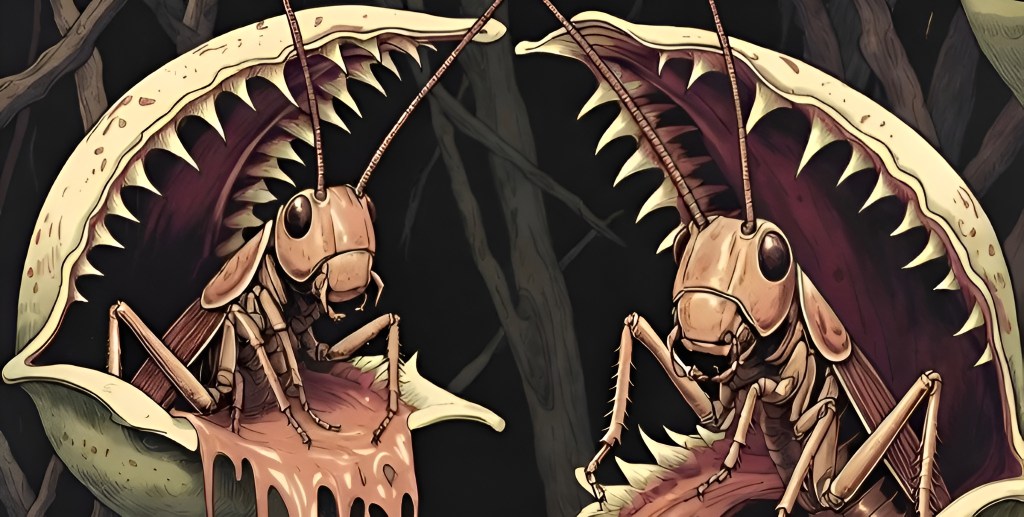



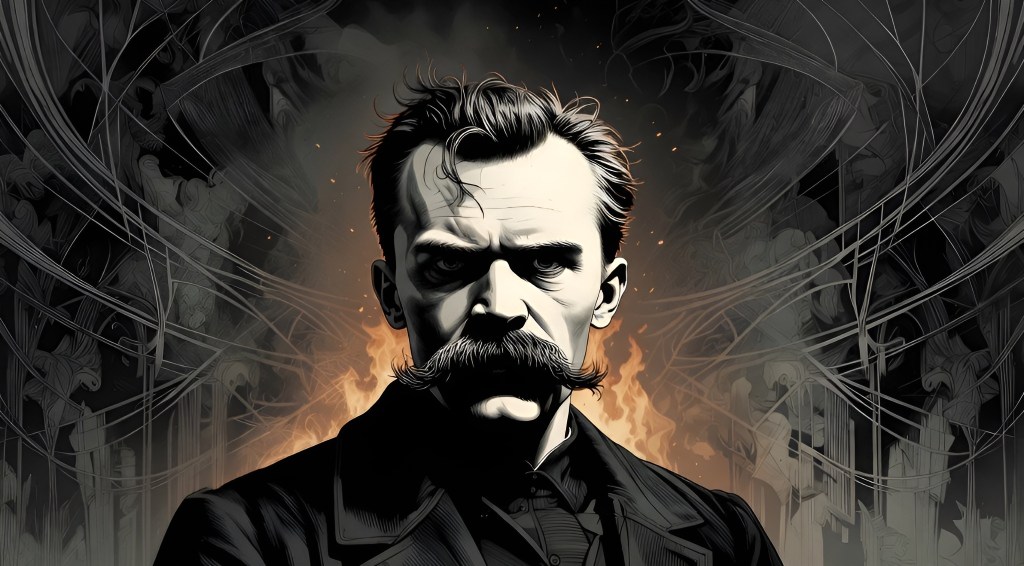
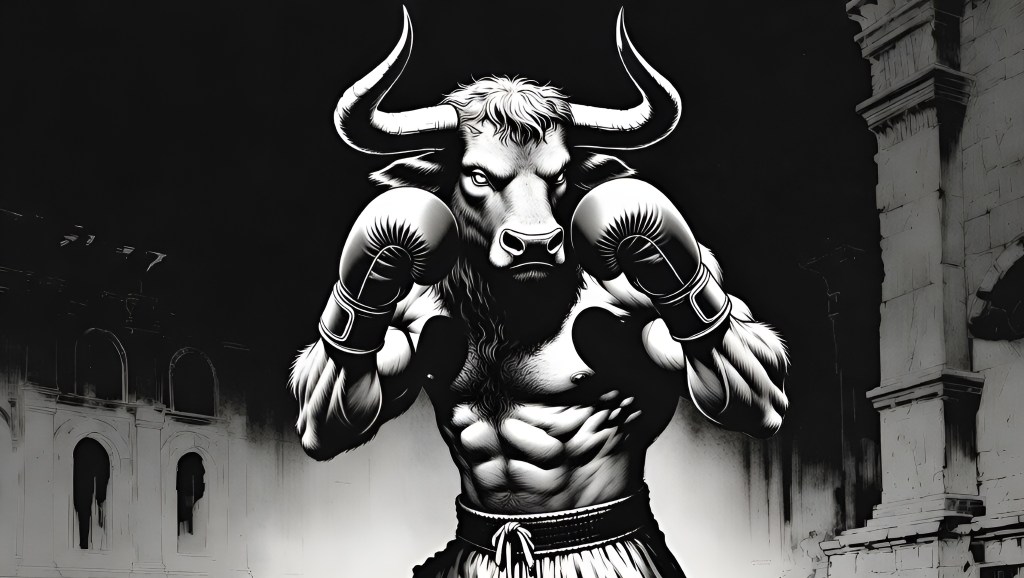
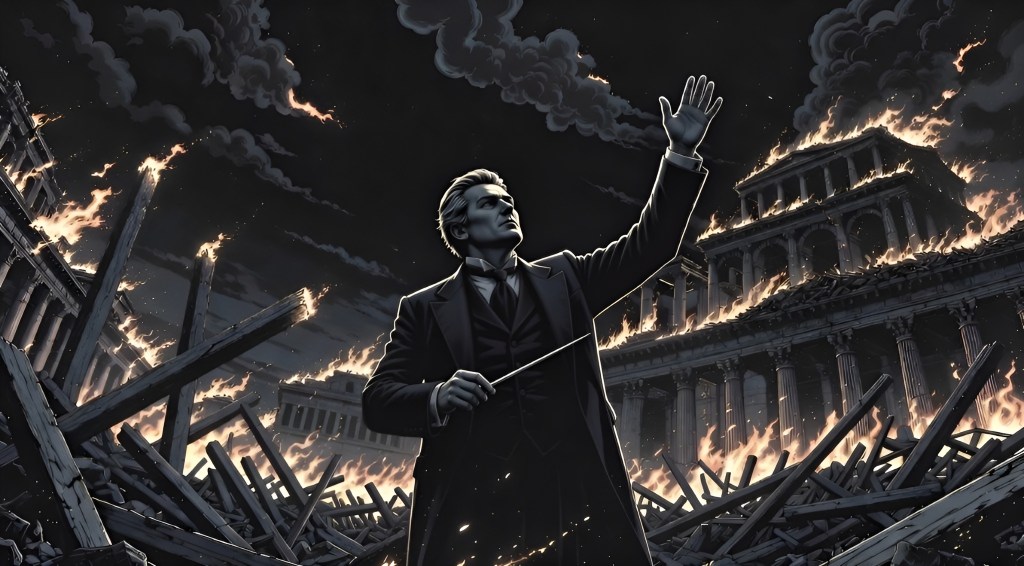
 Rob Robill